
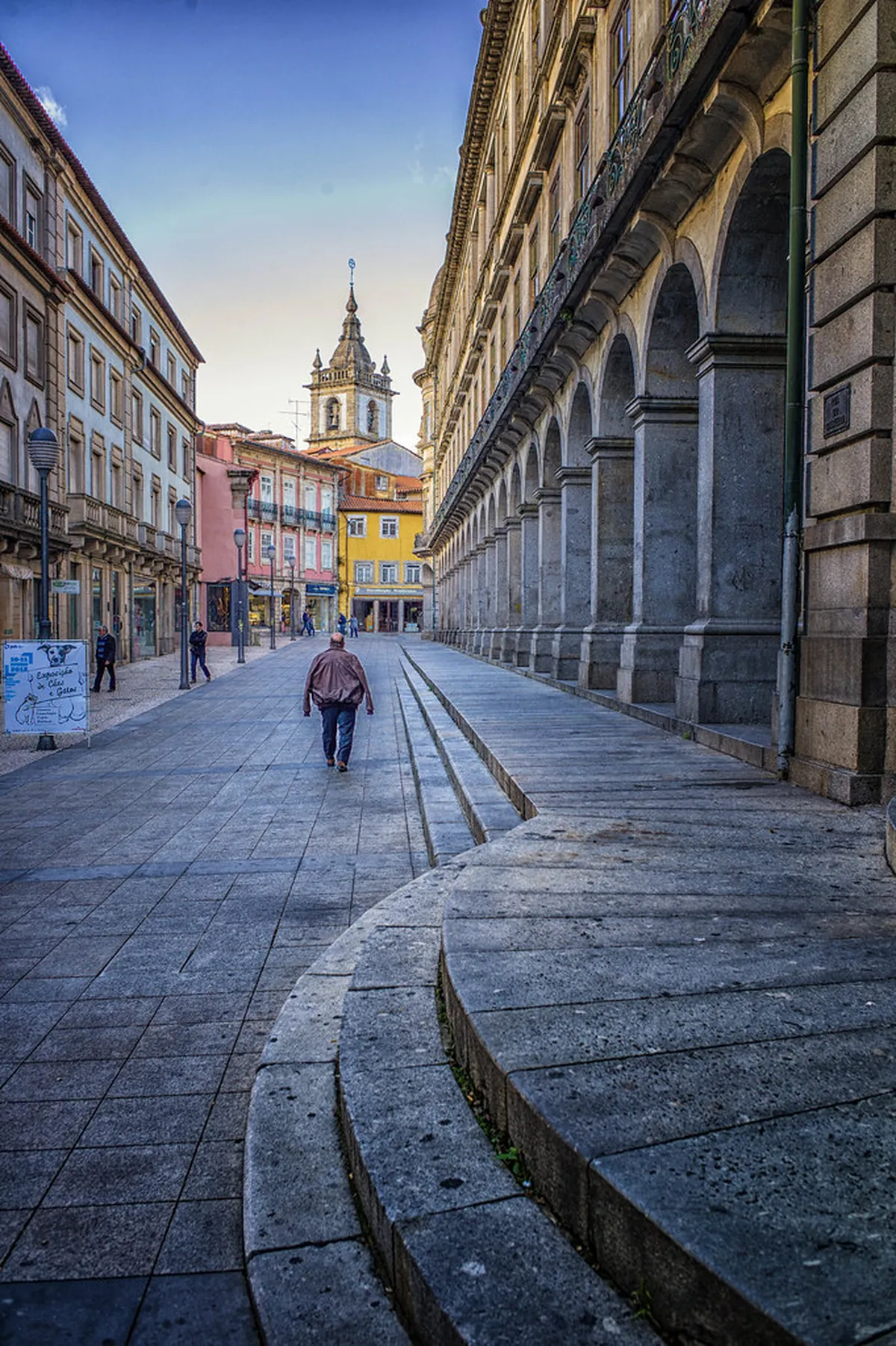
Braga Old Town Walking Guide: 10 Essential Stops and Tips
Explore the 'Portuguese Rome' with our self-guided Braga old town walking guide. Includes 10 essential stops, local coffee tips, and Bom Jesus logistics.
On this page
1-Day Braga Old Town Walking Guide: 10 Essential Stops
Braga is often called the 'Portuguese Rome' due to its extraordinary concentration of churches, archiepiscopal palaces, and Roman-era foundations. This guide covers ten essential stops on a self-guided loop through the historic centre, finishing with the hilltop sanctuary of Bom Jesus do Monte. It is built for first-time visitors who want a full day on foot without feeling rushed.
The old town is compact and almost entirely flat, which makes it one of the most walkable city centres in northern Portugal. Most of the route follows pedestrianised streets with no cars to dodge. We walked the full circuit in 2026 and updated the timings, entry fees, and transport details below.
Overview of the Braga Old Town Walking Route
The walking tour splits naturally into a morning loop through the historic centre and an afternoon trip out to Bom Jesus. The morning section covers roughly 5 kilometres starting at the Arco da Porta Nova, moving east to the Cathedral, north to the Archbishop's Palace gardens, then west past Praça da República to the Palácio do Raio. Total time for the morning loop is two to three hours at a comfortable sightseeing pace.
The afternoon heads out to Bom Jesus do Monte, which sits 5 kilometres east of the centre on a wooded hillside. A bus from Avenida da Liberdade drops you at the base every thirty minutes (line 2, €1.80). From there you either take the funicular or climb the baroque stairway — allow ninety minutes for the visit. Plan for eight hours total if you are including Bom Jesus.
- Stop 1: Arco da Porta Nova (start) — free, 10 minutes
- Stop 2: Sé de Braga — nave free; chapels €5; allow 45 minutes
- Stop 3: Jardim de Santa Bárbara — free, 15 minutes
- Stop 4: Praça da República — free, 20 minutes for coffee
- Stop 5: Palácio do Raio — exterior free; museum €2; 20 minutes
- Stop 6: Theatro Circo — exterior view, free, 5 minutes
- Stop 7: Largo de Santa Cruz churches — free, 20 minutes
- Stop 8: Convento dos Congregados — exterior free, 10 minutes
- Stop 9: Lunch in the pedestrianised centre — allow 60 minutes
- Stop 10: Bom Jesus do Monte — grounds free; funicular €2; 90 minutes
| Stop | Location | What to See | Time |
|---|---|---|---|
| 1 | Arco da Porta Nova | Baroque gateway with royal coat of arms; 1772 redesign by André Soares | 10 min |
| 2 | Sé de Braga (Cathedral) | Romanesque fortress-style cathedral (1089); gilded organs, Kings' Chapel | 45 min |
| 3 | Jardim de Santa Bárbara | Medieval oasis with geometric hedges and 17th-century fountain | 15 min |
| 4 | Praça da República | 14th-century social hub with Arcada arches and Café Vianna (1871) | 20 min |
| 5 | Palácio do Raio | Baroque mansion with granite frame and blue azulejo facade | 20 min |
| 6 | Theatro Circo | Belle époque exterior; architecturally significant | 5 min |
| 7 | Largo de Santa Cruz | Igreja de São Marcos and Igreja de Santa Cruz with dark granite facades | 15 min |
| 8 | Convento dos Congregados | André Soares design; 18th-century azulejo interior (1703–1964 construction) | 10 min |
| 9 | Pedestrianised streets (lunch) | Dona Sé or Antù Braga for bacalhau à Braga or Minho cuisine | 60 min |
| 10 | Bom Jesus do Monte | UNESCO sanctuary with 577-step stairway (1722–1811) and water-powered funicular (1882) | 90 min |
Historical Context: Bracara Augusta and the 'Portuguese Rome'
Braga's walkable grid owes its shape to two distinct periods of grand urban planning. The Romans founded Bracara Augusta around 20 BC as the capital of the Gallaecia province. The street pattern of the historic centre still follows those Roman lines — the main pedestrian axis from Arco da Porta Nova to Praça da República traces what was once a major Roman thoroughfare.
The second wave of transformation came in the 16th century under Archbishop Diogo de Sousa, who systematically redesigned the city. He widened streets, built fountains, ordered the construction of new churches, and aligned the city's principal avenues to create sightlines between monuments. It is this intervention — not just the sheer number of churches — that earned Braga its 'Portuguese Rome' nickname. Walking the route today, you are largely following the plan he set out five centuries ago.
A third layer came in the 18th century, when the self-taught architect André Soares stamped his playful baroque style onto facades across the city. The Arco da Porta Nova, the Palácio do Raio, and the Convento dos Congregados all bear his signature concave-convex stonework. Recognising these three historical layers — Roman grid, archiepiscopal planning, baroque ornament — gives the walk a coherence that a simple stop-by-stop list cannot provide.
Practical Details: Timing, Transport, and Logistics
Getting here from Porto is straightforward. The porto to braga train departs São Bento station roughly every thirty minutes and costs €3.50 for a single on the urban (regional) line. The journey takes about one hour five minutes. Once you leave Braga railway station, the Arco da Porta Nova is a ten-minute walk north along Rua do Souto. No bus is needed: follow the signs for 'Centro Histórico'.
If you are travelling from Lisbon, the Alfa Pendular high-speed service runs from Oriente station to Braga in around 3.5 hours; tickets from €14 when booked in advance on the Comboios de Portugal website. From Porto airport, the Get Bus shuttle to Braga departs every thirty minutes, costs €9 for adults, and arrives in forty minutes.
Most attractions in the old town open daily from 10:00 to 18:00. The Cathedral closes for a midday break from 12:30 to 14:00. Bus line 2 for Bom Jesus departs from Avenida da Liberdade every thirty minutes; the last bus back to the centre leaves Bom Jesus at approximately 19:30. A taxi or rideshare from the centre to Bom Jesus costs €7–10. Check the Best Time to Visit Braga: 8 Seasonal Planning Insights — spring (March to May) is the most comfortable season for this walk.
Arco da Porta Nova: Starting Your Journey
The Arco da Porta Nova is the ceremonial gateway into the historic centre. The arch was redesigned in 1772 by André Soares and still carries the carved royal Portuguese coat of arms above the keystone. Unlike most medieval city gates, this one never had a door — locals have a saying that 'bracarenses always leave the door open', a gentle joke at the city's expense that is still repeated today.
Start here and face north. The pedestrian street ahead, Rua Dom Diogo de Sousa, leads you directly toward the Cathedral. Take a moment to look at the western facade: Soares used concave curves on the mouldings that make the stonework seem to ripple slightly, a deliberate rejection of the rigid symmetry favoured in Lisbon. The arch is free to visit and is the best photograph from the south side in the morning light.
Braga Cathedral (Sé de Braga): Portugal's Oldest See
The Sé de Braga dates to 1089 and predates the founding of Portugal itself. The Portuguese have a saying for anything truly ancient — "Mais velho que a Sé de Braga" (older than the Cathedral of Braga). From the outside it reads like a fortress: thick stone walls, no large windows at ground level, and crenellations along the roofline. That was intentional — 11th-century cathedrals in this part of the peninsula had to be defensible.
Entry to the main nave is free. The chapels, cloisters, and treasury require a paid ticket, around €5 in 2026, which includes the two gilded organs from 1737 in the upper choir. These organs are among the finest in Portugal: the horizontal trumpets project sound directly into the nave with a clarity vertical pipes cannot match. Visit the Official Braga Cathedral (Sé de Braga) Site for current holiday hours before you go.
Do not leave without finding the Capela dos Reis (Kings' Chapel). It holds the tombs of Count Henry and Dona Teresa — parents of Afonso Henriques, Portugal's first king. There is also a carved stone font that is almost certainly Romanesque, one of the oldest surviving pieces in the building. The Cathedral is open from 09:00 to 18:30 with a midday closure from 12:30 to 14:00.
Jardim de Santa Bárbara: A Medieval Oasis
Located directly beside the Archbishop's Palace, this small formal garden is one of the most-photographed spots in the city. The geometric boxwood hedges and coloured flower beds are framed by the ruined Gothic arches of the medieval palace wall — the arches are remnants of the fire of 1834 that gutted the residential wing. The contrast between the manicured garden and the blackened stone is striking and entirely free to enjoy.
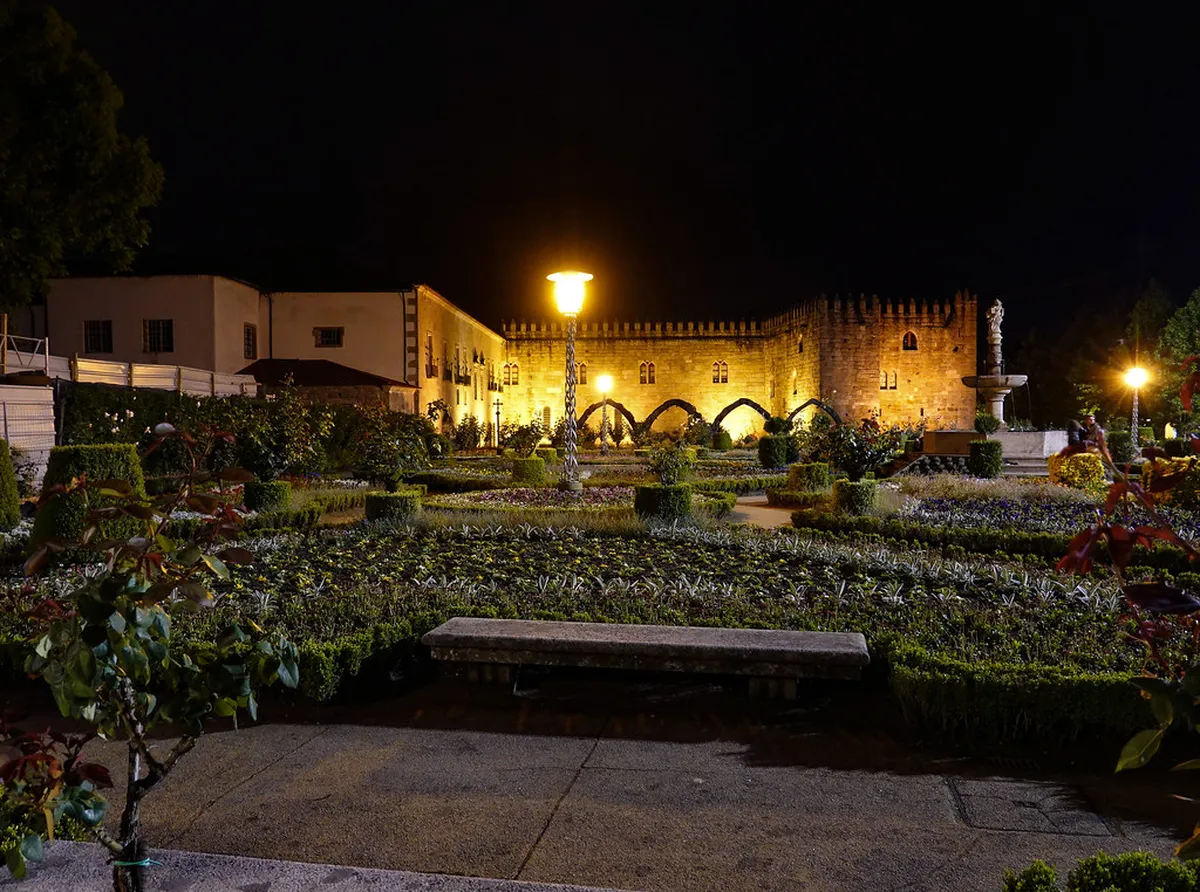
The central fountain features a statue of Saint Barbara dating to the 17th century. Visit in late spring when the roses reach full bloom, typically late May. The garden is small — allow fifteen minutes — but it is a useful rest stop between the Cathedral and Praça da República. The best photographs are taken from the western side of the garden with the palace arches in the background.
Praça da República: The Heart of Local Culture
Braga's main square has been the city's social hub since the 14th century. The Arcada building on the north side dates to 1885 and once sheltered grain merchants under its arches. Today those arches are lined with café terraces. The square also contains the Torre de Menagem, a 30-metre granite tower and the only surviving fragment of Braga's medieval castle; the rest was demolished in 1906 to make room for the expanding city.
Local Insight: The two cafés that locals actually use are Café Vianna (established 1871, beneath the Arcada arches) and A Brasileira at the southern end of the square. A bica (espresso) costs €0.80 at both. Vianna is where the older generation still reads the paper in the morning; A Brasileira draws students and professionals. Sit outside at either one and watch the square fill up — market day on Saturday morning is particularly lively. Avoid the tourist-facing cafés on the east side; they charge nearly double for the same coffee.
The Convento dos Congregados dominates the east side of the square. Designed by André Soares, it took over 250 years to complete — construction started in 1703 and the exterior was not finished until 1964. The interior azulejo panels from the 18th century are worth a look if the door is open. The square is also the meeting point for most free tip-based walking tours, which generally start at 10:00 and run for about two hours.
Palácio do Raio: Baroque Architecture at its Peak
The Palácio do Raio stops most walkers in their tracks. Its entire facade is covered in vivid blue azulejo tiles — but those tiles are actually a 19th-century addition, paid for by Miguel José Raio, a merchant who made his fortune in Brazil and wanted the building to announce his wealth. The real architectural story is the granite frame underneath, designed by André Soares in 1752. Look closely at the window pediments: no two are exactly alike. Soares used convex and concave curves on every frame, creating a sense of movement across what would otherwise be a flat wall.
The building is open Tuesday through Saturday from 10:00 to 17:30. The exterior is always free. The small museum inside charges €2. We found twenty minutes enough to appreciate both the facade and the ground-floor exhibition. The surrounding Largo de Santa Cruz also contains the Igreja de São Marcos (note the life-sized apostle statues along the roofline) and the Igreja de Santa Cruz with its dark granite facade and blue-tile interior panels — allow another fifteen minutes here.
Bom Jesus do Monte: Funicular vs. the 577-Step Stairway
No visit to Braga ends without Bom Jesus. The UNESCO-listed sanctuary sits on a wooded hillside 5 kilometres from the centre. The baroque stairway climbing 116 metres across 577 steps was built between 1722 and 1811 as a Sacred Mountain — a way for pilgrims who could never reach Jerusalem to walk the Passion of Christ closer to home. The grounds are free and the church stays open until sunset.
The choice between funicular and stairs is not simply one of effort. They offer genuinely different experiences. The Elevador do Bom Jesus is the world's oldest funicular still running on its original water-counterbalance system, built in 1882. Each ascent works like this: a 3,000-litre tank in the upper car is filled with spring water, and the extra weight pulls the lower car up the 274-metre track. At the base, the water drains out with an audible hiss. The three-minute ride uses polished brass fittings and varnished wood interiors restored to their 1882 appearance. Cost: €2 single, €3 return.
The stairway has three distinct sections that most visitors do not realise are separate in character. The lowest Portico Staircase winds through shaded woodland past chapels containing life-sized terracotta scenes of the Passion — slow and contemplative. The middle Stairway of the Five Senses is the famous baroque zigzag, with fountains pouring from carved faces representing the purification of the pilgrim's senses (eyes, nose, ears, mouth, hands). The upper Stairway of the Three Virtues (Faith, Hope, Charity) uses a forced-perspective trick: the steps narrow progressively as they rise, making the church above appear larger than it is. The recommended approach for most visitors is to take the funicular up and walk down — the Three Virtues and Five Senses sections read better descending when you are not short of breath.
The Elevador do Bom Jesus (1882) is the world's oldest water-counterbalance funicular still running — a 3-minute ride costs €2 single. The 577-step stairway takes 40–90 minutes depending on fitness. Plan 90 minutes total for the full sanctuary visit on foot or funicular, including the grounds.
| Option | Time | Cost | Best for |
|---|---|---|---|
| Funicular up, walk down | ~25 min | €2 | Most visitors; saves knees on ascent, lets you see stairway detail going down |
| Walk up, funicular down | ~40 min up | €2 | Pilgrimage experience; very demanding in summer heat above 25°C |
| Funicular both ways | ~10 min | €3 | Limited mobility; still gives full access to church and gardens at top |
| Walk both ways | ~90 min | Free | Fit walkers wanting the full traditional pilgrimage experience |
Tips for Navigating Braga on Foot
Braga's historic centre is paved with traditional calcada portuguesa — smooth limestone cobblestones that become dangerously slippery when wet. Wear shoes with rubber soles and good grip. Trainers or light hiking shoes work well; leather-soled dress shoes do not. Most of the centre is flat, but the streets between the Arco da Porta Nova and Praça do Município have a gentle incline that catches some visitors off guard.
The 5-kilometre morning loop on calcada portuguesa (Portuguese cobblestones) becomes slippery in rain — plan this walk for dry weather. Allow 2–3 hours at a comfortable sightseeing pace, not a rushed march.
The centre is almost entirely pedestrianised, so navigation is intuitive. Public water fountains are scattered through the main squares — carry a refillable bottle to stay hydrated between stops. The 'Próximo' electric shuttle buses are affordable (€1.50 per trip) and stop near major landmarks if your legs tire in the afternoon. The bus app 'Move-me' shows real-time Próximo locations.
On wheelchair and stroller accessibility: the main pedestrian streets from Arco da Porta Nova to Praça da República are fully paved and manageable with a wheelchair or pushchair, with dropped kerbs at most crossings. The Jardim de Santa Bárbara has a slightly uneven gravel path but is navigable. The Cathedral has a ramped side entrance. The challenging sections are the cobbled alleys east of Largo São João do Souto and the stairway at Bom Jesus — the funicular completely solves the Bom Jesus problem. Most museums and the Cathedral have accessible entrances; call ahead to confirm if in doubt.
Keep a small amount of cash. Some smaller cafes and the funicular do not accept card payments. An ATM is located on Rua do Souto, two minutes from the Arco da Porta Nova. Emergency pharmacies are signalled with green crosses throughout the centre.
Where to Eat Along the Route
The best lunch stop on this walk is the cluster of restaurants in the pedestrianised streets around Largo São João do Souto, midway through the morning loop. Dona Sé sits directly beside the Cathedral and serves reliable Portuguese classics — try the bacalhau à Braga (codfish with potatoes and olive oil), which is a regional signature dish. Antù Braga on Rua Dom Diogo de Sousa puts a modern twist on Minho cooking and is consistently busy with locals at lunch. Budget around €12–18 per person including a glass of Vinho Verde.
For coffee, the espresso at Café Vianna under the Arcada arches in Praça da República costs €0.80 and is one of the better cups in the city. If you want somewhere quieter mid-morning, the bookshop-café Centésima Página on Rua do Souto has a small back garden and is popular with university students. Avoid the tourist-facing cafes on the east side of Praça da República — they charge close to €2 for the same bica. The regional pastry to try is Pastéis de Braga, a flaky pastry with a sweet egg custard filling sold in most bakeries for €1–1.50 each.
Frequently Asked Questions
How long does a walking tour of Braga take?
A full walking tour of the old town takes about three to four hours. If you include the trip to Bom Jesus, plan for a total of eight hours. This allows time for lunch and museum visits.
What is the best starting point for a Braga walking tour?
The Arco da Porta Nova is the best starting point. It is located near the train station and leads directly into the historic center. Most major landmarks are within a ten-minute walk from here.
Are there free walking tours in Braga?
Yes, several companies offer tip-based free walking tours in the city center. These usually start at Praça da República and last about two hours. I recommend booking your spot online in advance.
Braga rewards walkers who look beyond the obvious. The Roman street grid underfoot, the archbishop's baroque master plan overhead, and the world's oldest water-powered funicular waiting at the end of the day — these details add up to a city that is genuinely different from anywhere else in northern Portugal. We hope this braga old town walking guide helps you navigate it confidently. For wider context on the region, see our guide on 10 Best Day Trips From Braga: The Ultimate Minho Guide and the full 12 Best Things to Do and Places to Stay in Braga overview.
 Day Trips From Guimaraes: 3-Day Minho ItineraryJune 8, 2026
 Porto To Guimaraes Day Trip Travel GuideJune 8, 2026