
Porto To Guimaraes Day Trip Travel Guide
Plan your porto to guimaraes day trip with top picks, neighborhood context, timing tips, and practical booking advice for a smoother trip.
On this page
Your Essential Porto To Guimarães Day Trip
A Porto to Guimarães day trip is one of the most rewarding excursions in northern Portugal. The city sits just 50 km northeast of Porto and is often called the birthplace of Portugal — a title it earns at every cobblestone turn. This guide covers how to get there, what to see, and how to structure your time so you don't leave anything important behind.
Guimarães is compact, walkable, and genuinely historic. Its medieval core is a UNESCO World Heritage Site, and the key landmarks cluster tightly enough that a single day is enough to do them justice. Leave Porto before 09:00, and you can be back in time for dinner on the waterfront.
Highlights of a Day Trip to Guimarães
Guimarães punches above its weight for a city of 160,000 people. The historic centre holds more concentrated medieval heritage than almost anywhere else in Portugal, and the whole area is pedestrian-friendly. Most visitors cover the main sites on foot in four to five hours, leaving time for a long lunch and an optional cable-car ride up Penha Hill.
The headline attractions are the Guimarães Castle, the Palace of the Dukes of Braganza, and the medieval squares of Largo da Oliveira and Praça de São Tiago. Together they tell the full story of Portugal's founding. The castle is where the nation's first king, Afonso Henriques, was born in 1109. The palace next door, built three centuries later, shows what Portuguese royal life looked like once the country was secure.
Beyond the famous pair, the Igreja de Nossa Senhora da Oliveira anchors Largo da Oliveira with a Gothic canopy shrine and centuries of religious art inside. The narrow lanes between the squares are lined with medieval granite facades, outdoor café tables, and small shops selling regional ceramics. If you have an extra two hours, the Teleférico de Guimarães cable car climbs 617 metres to Monte da Penha, where forest trails and panoramic views across the Minho stretch to the Atlantic on clear days.
- Guimarães Castle (Castelo de Guimarães) — 10th century, open daily except Monday, €2 adults
- Palace of the Dukes of Braganza (Paço dos Duques) — 60+ rooms, €6 adults, combo ticket with castle available
- Largo da Oliveira — the city's most photogenic square, free
- Alberto Sampaio Museum — religious art, €3, closed Monday
- Teleférico de Guimarães — cable car to Penha Hill, €4.50 return, operates 10:00–18:00 (19:00 in summer)
Day Trip From Porto: Getting There
The train is the standard choice for independent travellers. Direct urban services (Linha do Minho) run from Porto's São Bento station to Guimarães throughout the day. The journey takes 75–85 minutes and costs €3.60 one-way for an adult in 2026. Return tickets are €7.20. Trains run roughly hourly, with a reduced timetable on Sundays and public holidays — afternoon gaps of up to two hours are common, so check the schedule on CP's timetable page before you travel. The most reliable afternoon return trains are typically at 15:51 (daily) and 17:06 (weekdays) or 17:56 on weekends.
Guimarães station sits about 700 metres south of the historic centre — a ten-minute walk along Avenida Dom João IV. There are no steep hills between the station and the old town, so even travellers with heavy bags can manage it comfortably. By car, Guimarães is around 45 minutes from Porto via the A7 motorway. Street parking in the historic centre is very limited; use the main tourist car park north of the Paço dos Duques instead. Uber and Bolt are also available from Porto and cost roughly €35–45 per trip, making them cost-effective for groups of three or four.
If you prefer a structured day, guided tours departing from São Bento typically run nine hours and cost €50–75 per person. They cover both Guimarães and Braga in a single loop, which is useful if you want to see both cities without worrying about train connections between them.
| Transport Mode | Journey Time | Cost (2026) | Notes |
|---|---|---|---|
| Train (Linha do Minho) | 75–85 minutes | €3.60–7.20 one-way | Direct from Porto São Bento, roughly hourly, check CP timetable for afternoon gaps |
| Car (Via A7) | 45 minutes | Fuel only | Street parking limited in centre; use tourist car park north of Paço dos Duques |
| Uber / Bolt | 50–60 minutes | €35–45 | Cost-effective for groups of 3–4 |
| Guided Tour | 9 hours total | €50–75 per person | Covers Guimarães and Braga; no public transport connections to manage |
The Carriage-Split Trap First-Timers Keep Falling Into
There is one logistical trap that catches a disproportionate number of first-time visitors on this route, and no official timetable mentions it clearly. Some Porto–Guimarães trains split their carriages at Lousado junction, roughly halfway along the line. When this happens, the front portion of the train continues to Guimarães while the rear carriages divert north to Braga. If you board from the wrong end of the platform at São Bento or Campanhã without checking the destination board on your specific carriage, you can end up in Braga — 25 km in the wrong direction — with no easy way back to Guimarães in the same morning.
The fix is simple: always check the electronic destination display on the carriage door before you board, not just the departure board on the platform. The display on each carriage shows its own final stop. On split-service trains, the conductor also typically announces the split at Lousado, but announcements can be easy to miss. Sitting in the first few carriages from the front gives you the most reliable route to Guimarães. If you are unsure, ask any station staff at São Bento — they deal with this question daily.
Some Porto–Guimarães trains split at Lousado junction roughly halfway along the route. The rear carriages divert to Braga (25 km in the wrong direction) while the front continues to Guimarães. Always check the electronic destination display on your carriage door before boarding — don't rely on the platform departure board alone. Conductors announce the split at Lousado, but it's easy to miss. When in doubt, sit in the front carriages or ask station staff at São Bento.
The Linha do Minho service is frequent and reliable for most of the day, but afternoon gaps of up to two hours are common, especially on Sundays and public holidays. Check the CP timetable before you travel so you can plan your return journey with confidence. The most reliable afternoon departures back to Porto are typically the 15:51 (daily) and 17:06 (weekdays) or 17:56 (weekends) services.
Guimarães Castle: A Medieval Marvel Steeped in History
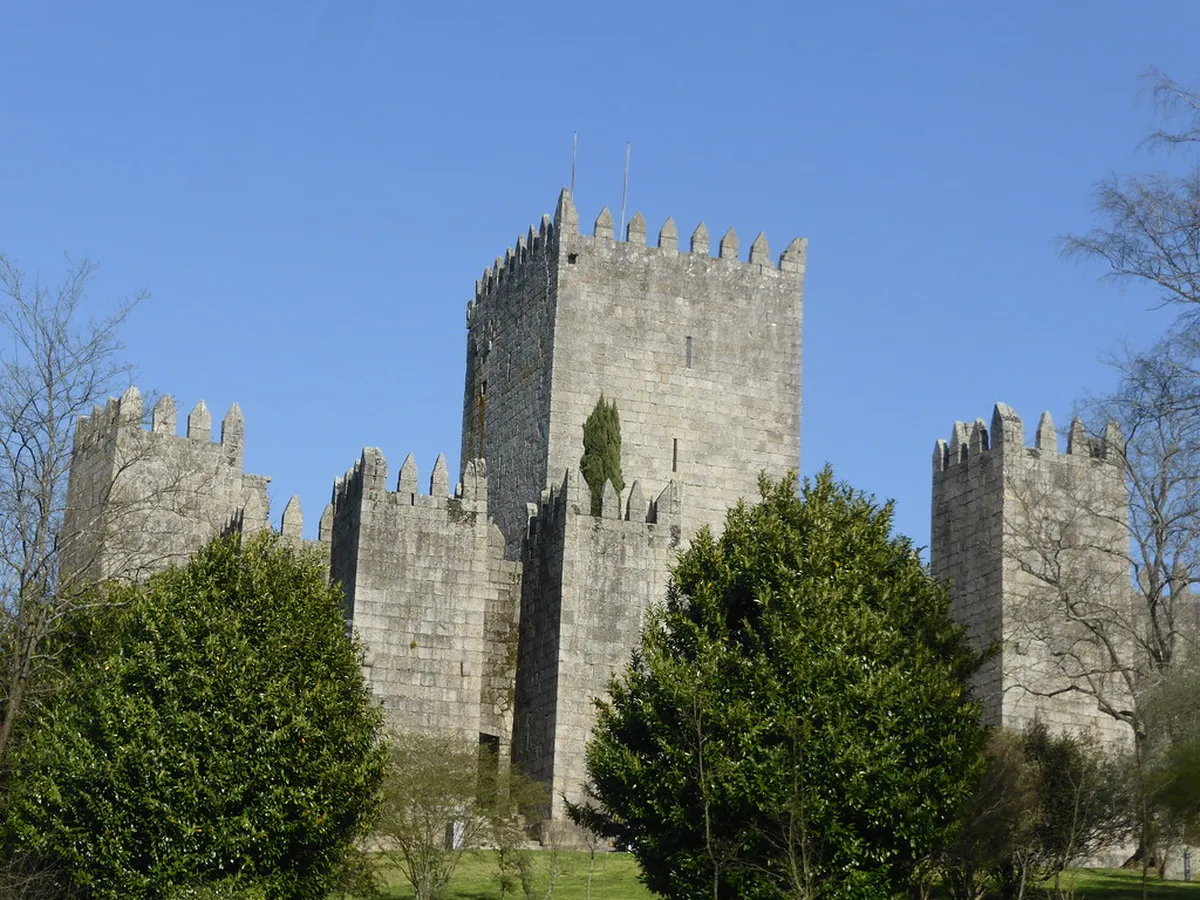
Castelo de Guimarães is the most historically loaded site on this itinerary. The original fortress was built in the 10th century by Countess Mumadona Dias to defend the local monastery against Moorish and Norse raids. It was later expanded by Henry of Burgundy, and it is where his son Afonso Henriques — Portugal's first king — was born in 1109. The castle became a national monument in 1881 and has been carefully preserved since.
Seven square towers connected by curtain walls rise from a granite outcrop. A walkway runs along the top of the walls and offers excellent views over the city's terracotta rooftops. The central keep, added in the 13th century, can be climbed for even wider panoramas. The castle is open daily except Monday, typically 10:00–18:00 (hours sometimes extend to 19:00 in summer). Adult admission is €2, and a combo ticket with the Palace of the Dukes of Braganza is available for around €8–10.
Between the castle and the palace stands the tiny Igreja de São Miguel do Castelo, a 12th-century Romanesque chapel where Afonso Henriques is traditionally said to have been baptised. The original baptismal font is still in place near the entrance, and the floor contains tombstones of the medieval knights who fought in Portugal's founding battles. It is easy to walk past without going in — don't. The chapel takes ten minutes to visit and adds enormous context to everything else you see in the castle complex.
A Suggested 1-Day Tour of Guimarães
The ideal Guimarães day trip follows a natural loop from the train station through the historic core and back. Start early — take the 08:00 or 08:30 departure from Porto São Bento, arriving at Guimarães station by 09:30. Walk up Avenida Dom João IV into the historic centre and begin at Largo da Oliveira to get your bearings. The square is calm in the morning before day-trippers from Porto arrive around midday.
- 09:30–10:00 — Arrive at Guimarães station, walk to Largo da Oliveira.
- 10:00–12:00 — Visit Guimarães Castle and the Palace of the Dukes of Braganza (allow at least 45 minutes for the palace interior). The Igreja de São Miguel do Castelo is free and takes ten minutes; do not skip it.
- 12:00–13:30 — Lunch near Praça de São Tiago or Largo da Oliveira. Budget €12–18 for a full meal with a glass of vinho verde. Solar do Arco on Rua de Santa Maria is a local institution; Taberna Dom José near Largo do Toural is the best value option.
- 13:30–15:30 — Walk the medieval lanes, Largo do Toural, and the "Aqui Nasceu Portugal" inscription on the old city walls. Visit the Alberto Sampaio Museum if religious art interests you (€3, closed Monday, closes at 17:30).
- 15:30–17:30 — Optional: Teleférico de Guimarães cable car to Penha Hill. The lower station is a 15-minute walk southeast from Largo do Toural. Return tickets cost €4.50. Check operating hours before making the walk — the last car down is typically at 18:00 or 19:00 depending on season.
- 17:30–18:30 — Return to the station and catch the 17:06 or 17:56 train back to Porto.
The walking tour covers roughly 5 km inside the historic centre. Cobblestones are unavoidable — wear comfortable shoes. If you skip Penha Hill, you have more time in the afternoon to explore the quieter streets south of the old city walls, which see far fewer tourists than the castle-and-palace circuit.
Braga and Guimarães: Should You Combine Them?
Braga is 25 km from Guimarães and 55 km from Porto — close enough that many visitors consider combining both cities into a single day. The short answer is that this is only realistic on a guided tour. Independently, each city deserves a full day. Trying to do both by public transport means rushed visits to each and significant time lost waiting for buses between the two cities, where connections are less frequent and reliable than the Porto–Guimarães train.
If your schedule only allows one day in the Minho region, Guimarães is the stronger choice for first-time visitors. The medieval streetscape, the founding-of-Portugal narrative, and the sheer photogenic quality of Largo da Oliveira give it an edge over Braga's more spread-out religious monuments. Braga rewards a dedicated day for its own highlights: the Cathedral of Braga (Sé de Braga), which dates to 1070 and is the oldest in Portugal; Bom Jesus do Monte, with its remarkable 577-step baroque staircase and optional funicular ride (€2 one-way); and the Sanctuary of Our Lady of Sameiro, the second-largest Marian sanctuary in Portugal after Fátima, set at the highest point in the city with panoramic views across the region.
Those with an extended Porto stay should treat Guimarães and Braga as separate day trips — Guimarães on day one, Braga on day two. The contrast between Guimarães' secular medieval history and Braga's baroque religious grandeur makes the two cities genuinely complementary rather than repetitive. You can also visit the Citânia de Briteiros, an Iron Age hillfort settlement, as an afternoon add-on from Guimarães if you have a car or join a local tour.
Delving into Portugal's Origins in Guimarães
Guimarães is not just informally called the birthplace of Portugal — the claim is inscribed on the city walls in stone: "Aqui Nasceu Portugal" (Here Portugal was Born). The city received its founding charter in 1128, and the battle of São Mamede, fought near here in the same year, established Afonso Henriques as the de facto independent ruler of what would become Portugal. The formal declaration of independence from the Kingdom of León came in 1139. Most of this history is concentrated in the hilltop complex around the castle.
The Palace of the Dukes of Braganza, built in 1420, shows a later chapter of the same story. Its 60+ rooms display Flemish tapestries depicting the Portuguese conquest of Arzila in North Africa, medieval furniture, and an impressive weapons collection. The building was controversially restored in the 1930s under the Salazar government — some historians consider the restoration too complete — but the interior is still the richest period collection in northern Portugal. Allow 45 minutes minimum for the palace.
The streets around Largo da Oliveira contain their own layers of history. The Gothic canopy shrine in the square marks the spot where, according to local legend, a dead olive tree miraculously sprouted leaves in 1342. The church beside it, Nossa Senhora da Oliveira, was originally founded as a monastery around 950 AD and rebuilt by King João I after his victory at Aljubarrota in 1385. The silver altarpiece inside and the actual tunic João I wore in battle are both on display. This is what makes Guimarães worth visiting even for travellers who have already been to Lisbon and Porto: the density of genuinely significant history in a very small area.
Frequently Asked Questions
Which porto to guimaraes day trip options fit first-time visitors?
First-time visitors should focus on Guimarães' historic center, including the Castle and Ducal Palace. A self-guided train trip is easy and cost-effective. Consider a guided tour for deeper historical context.
How much time should you plan for a porto to guimaraes day trip?
Plan for a full day, about 8-10 hours, including travel time. This allows 4-6 hours for exploring the city's main attractions. An early start from Porto maximizes your sightseeing.
What should travelers avoid when planning a porto to guimaraes day trip?
Avoid visiting on Mondays, as many museums and attractions are closed. Do not forget comfortable walking shoes for the cobblestone streets. Also, try to avoid peak midday sun in summer.
Is a porto to guimaraes day trip worth including on a short itinerary?
Absolutely, a Guimarães day trip is highly recommended even on a short itinerary. Its historical significance and compact size make it a perfect addition. It offers a great contrast to Porto's city vibe.
A Porto to Guimarães day trip is one of the most straightforward, high-return excursions in northern Portugal. The train connection is easy and cheap, the historic core is compact enough to walk in a morning, and the density of genuine medieval history is hard to match anywhere else in the country. Take the early train, check your carriage destination board before boarding, and you will have time for the castle, the palace, a proper lunch, and the cable car — all in a single day.
Use this guide to plan your visit in 2026, and consider adding a dedicated day for Braga on a separate trip if the Minho region captures your interest. The two cities reward the Minho region as a whole, and Guimarães is the perfect starting point.
Use our complete Guimarães guide to map out your whole trip.
 Day Trips From Guimaraes: 3-Day Minho ItineraryJune 8, 2026
 9 Essential Tips for Visiting Guimarães CastleJune 8, 2026
 One Day in Guimarães Itinerary Travel GuideJune 8, 2026