
One Day in Guimarães Itinerary Travel Guide
Plan one day in Guimarães itinerary with top picks, neighborhood context, timing tips, and practical booking advice for a smoother trip.
On this page
One Day in Guimarães Itinerary: Portugal's Birthplace
Guimarães is where Portugal began. The country's first king, Afonso Henriques, was born within these walls in 1109, and the medieval city that grew around that fact has barely blinked since. The historic centre is a UNESCO World Heritage Site, compact enough to cover on foot in a single day without ever feeling rushed. This guide gives you a single, logical route for 2026, including the best time to arrive, where to eat, what to skip if you're short on time, and one stop that almost every travel article ignores.
The total walking distance through the historic centre is around 3–4 km. If you add the optional cable car trip to Penha Hill, budget an extra 1.5–2 hours. A day trip from Porto is entirely feasible — trains run regularly from São Bento station and the journey takes 75–85 minutes each way.
Getting to Guimarães from Porto
The train is the easiest option. Direct urban trains run from Porto's São Bento station to Guimarães throughout the day. The return ticket costs €7.20 (€3.60 for children). Trains run roughly hourly, but afternoon services can have gaps of up to two hours on weekends — check the timetable at www.cp.pt before you go. The station in Guimarães is 700 metres south of the historic centre, about a 10-minute walk along Avenida Dom João IV.
By car, Guimarães is 50 km from Porto via the A7 motorway, roughly 45 minutes in normal traffic. Park in the main car park north of the historic centre near the Paço dos Duques — street parking in the old town is extremely limited. For groups, Uber and Bolt charge around €35–45 from Porto, which works out cheaper than four train tickets.
Aim to arrive before 09:30. The Castle and Palace of the Dukes are the busiest sites and lines build quickly after 11:00, especially on weekends and in summer. Starting early also leaves your afternoon free for Penha Hill without time pressure.
Monday closures are standard in Portugal, but Guimarães is a partial exception — most museums here close on Tuesdays instead. Always check the schedule before booking a Tuesday visit. The Castle (€2), Palace (€5), and Alberto Sampaio Museum (€3) are all closed on Tuesdays. Tickets for the Palace should be pre-booked online in summer when gate queues can exceed 30 minutes.
A Suggested 1-Day Tour of Guimarães
This walking route runs roughly north to south through the historic centre, then circles back through the main squares. It minimises backtracking and handles the steepest uphill section in the morning when you have the most energy. The castle and palace sit on a granite hill above the old town — do these first, then descend through the medieval streets to the squares and churches below.
From the train station or your hotel, walk north along Avenida Dom João IV into the UNESCO zone. Your entry point is Largo República do Brasil, where the modern town gives way to medieval cobblestones. Continue to Largo da Oliveira for a quick coffee before the uphill climb.
- 09:30–10:15 — Largo da Oliveira and Igreja de Nossa Senhora da Oliveira. Quick coffee, photograph the Gothic canopy shrine.
- 10:15–11:15 — Guimarães Castle. Arrive early to beat queues. Allow 45–60 minutes including the tower climb.
- 11:15–11:30 — Igreja de São Miguel do Castelo. The tiny chapel between the palace and castle. Five minutes that most visitors miss entirely (see the section below).
- 11:30–12:30 — Palace of the Dukes of Braganza. Allow at least 45 minutes for the interior. Buy tickets online in advance at weekends.
- 12:30–14:00 — Lunch in the historic centre. Praça de São Tiago is the obvious choice for outdoor tables. Solar do Arco on Rua de Santa Maria is a local institution for traditional Minho cuisine; expect to pay around €15–20. For a budget option, Taberna Dom José near Largo do Toural serves grilled meats and fish for well under €10.
- 14:00–15:00 — Praça de Santiago, Rua de Santa Maria, and Largo do Toural. Wander the squares, find the "Aqui Nasceu Portugal" inscription on the old city walls.
- 15:00–17:00 — Optional: Penha Hill by cable car. The lower station is a 15-minute walk southeast from Largo do Toural.
| Time | Stop | Duration | Notes |
|---|---|---|---|
| 09:30–10:15 | Largo da Oliveira | 45 min | Coffee and photograph the Gothic canopy shrine |
| 10:15–11:15 | Guimarães Castle | 1 hour | Tower climb, city and countryside views; arrives before peak queues |
| 11:15–11:30 | Igreja de São Miguel do Castelo | 15 min | Romanesque chapel with Afonso Henriques' baptismal font, free entry |
| 11:30–12:30 | Palace of the Dukes of Braganza | 1 hour | 60 rooms, tapestries, ceramics, wooden ceiling; book tickets online for weekends |
| 12:30–14:00 | Lunch (historic centre) | 1.5 hours | Solar do Arco (€15–20), Taberna Dom José (€10), or Praça de São Tiago outdoor tables |
| 14:00–15:00 | Praça de Santiago + Rua de Santa Maria + Largo do Toural | 1 hour | Medieval squares, "Aqui Nasceu Portugal" inscription on city walls |
| 15:00–17:00 | Penha Sanctuary (optional) | 2 hours | Cable car (€4.50 return), modernist sanctuary, forest walks, 360° views |
If you skip Penha, use the afternoon for the Alberto Sampaio Museum (closed Mondays, €3), the Convento de Santo António dos Capuchos, or simply a longer lunch followed by browsing the craft shops along Rua de Santa Maria. The city rewards slow walking.
Guimarães Castle: Birthplace of Portugal
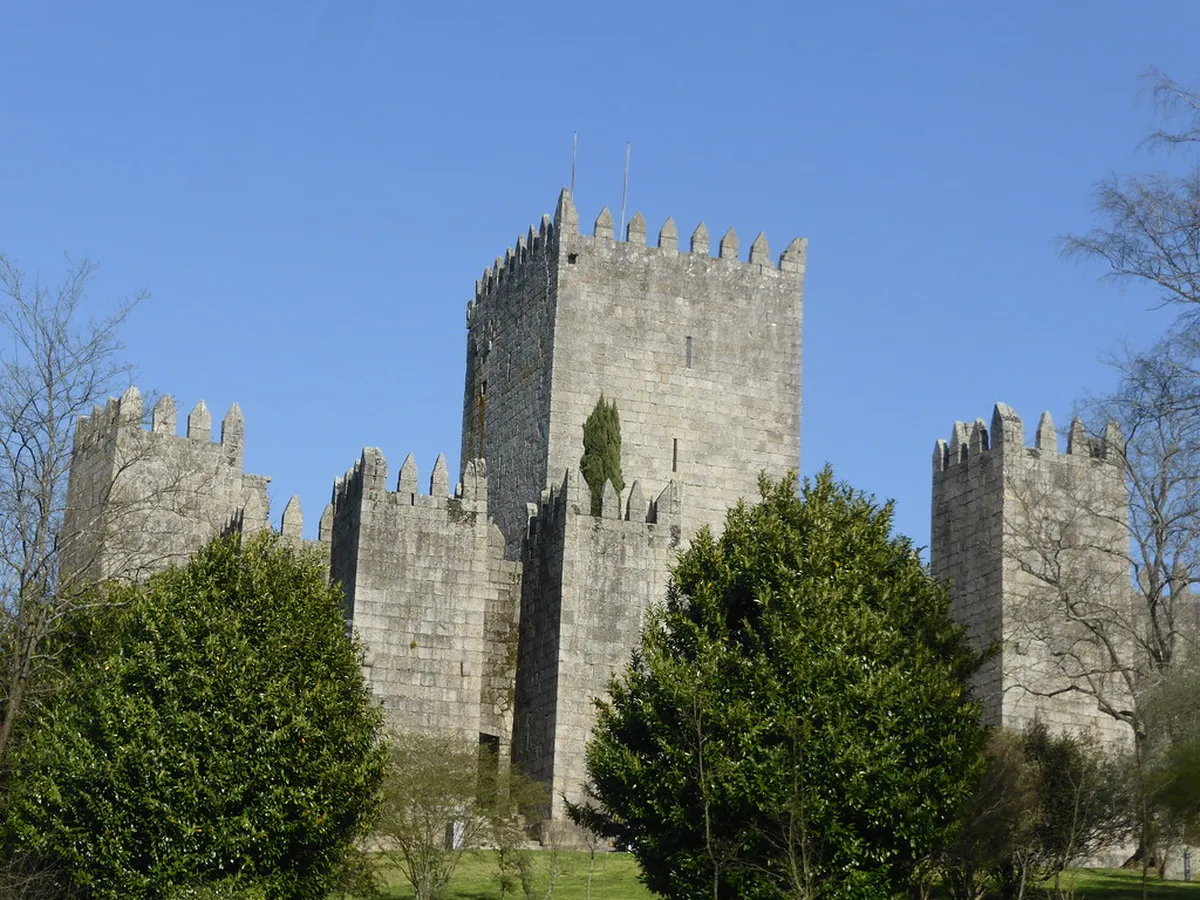
The Castelo de Guimarães sits on a granite outcrop at the top of the historic hill. First built in the 10th century by Countess Mumadona to defend against Viking and Moorish raids, it was later expanded into the fortress you see today. Afonso Henriques — Portugal's first king — was born here in 1109, and this is where he likely proclaimed independence from León in 1139. The castle is the founding monument of the Portuguese state, which is why you see the phrase "Aqui Nasceu Portugal" (Here Portugal Was Born) everywhere in the city.
The seven towers are linked by wall walks with battlements you can lean over for views of the city and the Minho countryside. The central keep, added in the 13th century, can be climbed for the best panorama. There is not a huge amount inside the towers themselves, but the exterior walls, the courtyard, and the views are worth the admission. Allow 45–60 minutes.
Admission is €2 per person. The castle is typically open 10:00–18:00, with last entry at 17:30. It is closed on Tuesdays. Tickets can usually be bought on the day, but check for online options during peak summer months when queues at the gate can stretch 20–30 minutes.
The Chapel Most Visitors Walk Past
Between the Palace of the Dukes and the castle entrance stands the Igreja de São Miguel do Castelo, a small Romanesque chapel that almost every travel article overlooks. It takes five minutes to see and is free to enter. The chapel dates from the 12th century and witnessed the baptism of Afonso Henriques himself — the original baptismal font is still here, a plain granite basin sitting near the entrance, unchanged since Portugal's first king was baptised in it. The floor is set with tombstones of medieval knights who fought in the founding battles of the Portuguese nation.
There is no gift shop, no audio guide, and no queue. The chapel is usually open during the same hours as the castle, though hours can vary. It is the single most historically charged room in Guimarães, and the contrast with the grand palace 50 metres away — which costs €5 and draws big crowds — makes it all the more striking. Do not walk past it on your way up to the castle.
The Palace of the Dukes of Braganza: A Royal Legacy
The Paço dos Duques de Bragança is the most substantial indoor attraction in Guimarães. Built in 1420 by the first Duke of Braganza — the illegitimate son of King João I — the palace shows marked French influence in its distinctive brick chimneys and layout, unusual for Portugal at the time. After centuries of abandonment it was controversially restored in the 1930s, and opinions among architectural historians remain divided. What is not in dispute is how good the interior looks today: 60 rooms with period furniture, Flemish tapestries depicting the Portuguese conquest of North Africa, an impressive weapons collection, and the great hall with its soaring wooden ceiling and massive fireplaces.
One room you should not miss is the "chest room," packed with silver-mounted chests that once held the ducal household's valuables. Another is the room with the tapestries — eight large panels made in Tournai around 1450, depicting scenes of warfare and conquest in remarkable detail. The collection of 17th- and 18th-century Portuguese ceramics is also excellent.
Admission is €5 per person. The palace is typically open 10:00–18:00, closed on Tuesdays. On weekends, pre-buying tickets online via the official Guimarães municipality website saves meaningful time — lines at the ticket booth in the afternoon can run 20–30 minutes. Use the QR code on the sign outside if you have not already booked.
Praça de Santiago: The Heart of Old Guimarães
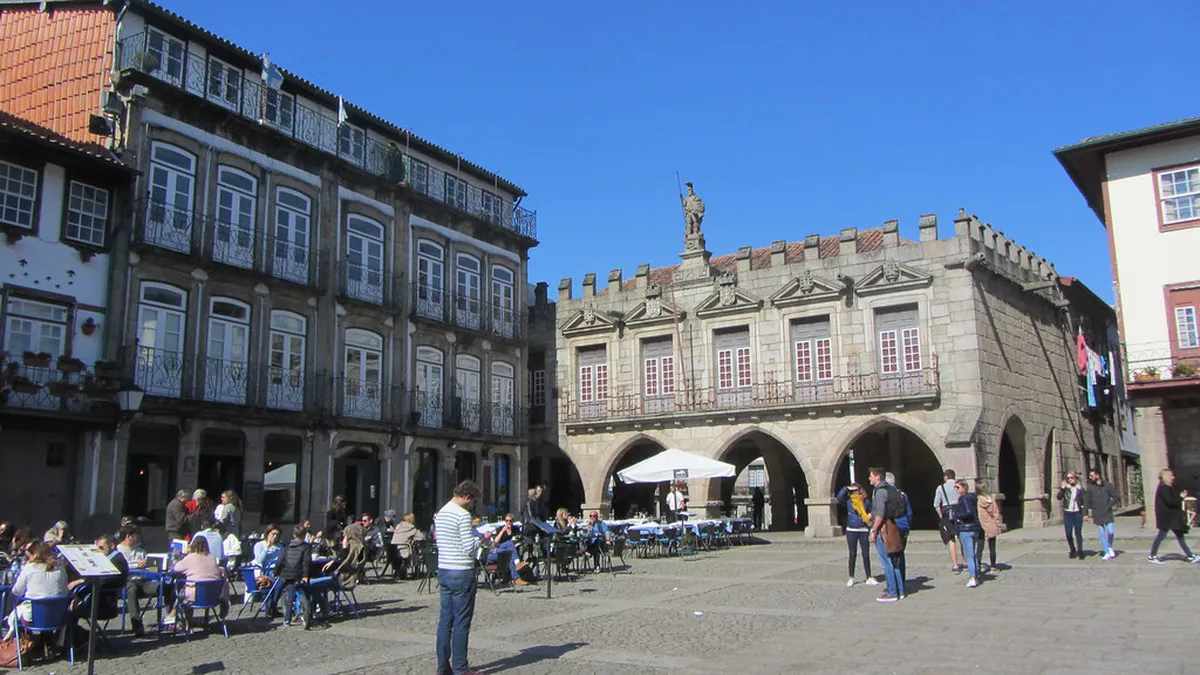
After the castle and palace, descend through Rua de Santa Maria — the oldest street in Guimarães, narrow enough that you can nearly touch the walls on both sides as you walk. The street leads you past centuries-old stone façades into Praça de Santiago (also called Praça de São Tiago), the most intimate of the city's medieval squares. In summer, the square fills with restaurant tables. In winter, it is quieter but no less atmospheric — this is where locals as well as tourists gather, which is rarer than it sounds in a UNESCO centre.
The adjacent Largo da Oliveira is the other key square. Its name comes from the ancient olive tree beside a Gothic canopy shrine at the centre of the square. The 14th-century Igreja de Nossa Senhora da Oliveira faces the square — the church was originally founded as a monastery in 950 and rebuilt by King João I after his victory at Aljubarrota. Entry costs €2. The adjoining cloister houses the Museu de Alberto Sampaio, which displays religious art including the silver altarpiece and the tunic João I reportedly wore in battle at Aljubarrota. The museum is worth 30–45 minutes if religious art is your thing; skip it if you are short on time and keep the €3 for coffee.
A few minutes' walk from Largo da Oliveira brings you to Largo do Toural, the city's main square and traditional meeting point. It marks the boundary between the historic centre and the modern city. From here, a short detour to the old city walls reveals the famous inscription: "Aqui Nasceu Portugal" — four words that explain why an entire nation treats this town as a pilgrimage destination.
Penha Sanctuary: A Spiritual Retreat with a View
Monte da Penha sits south of the city at 617 metres. The cable car — the Teleférico de Guimarães — runs from a station that is a 15-minute walk southeast from Largo do Toural. Return tickets cost €4.50; singles cost €2.30. The ride takes about 10 minutes and the views looking back over the city are excellent. Operating hours are typically 10:00–18:00, extended to 19:00 in summer. Check the schedule before you leave the city centre — missing the last car down means a long walk back.
At the summit, the Santuário da Penha immediately commands attention. Built between 1930 and 1947, the modernist sanctuary is integrated directly into the granite boulders — massive rocks form part of the walls and floors of the building in a way that has no equivalent in Portugal. The surrounding 50 hectares of forest are laced with walking paths that wind between enormous boulders, some of them balanced in positions that look structurally improbable. For non-religious visitors, the boulders and the views are the real draw; for pilgrims, the sanctuary remains an active site of devotion.
Hidden among the rocks is the Gruta Ermida Nossa Senhora do Carmo, a small cave shrine where hermits once lived in isolation. It predates the modern sanctuary by centuries and maintains a different atmosphere — quieter, more contemplative, largely ignored by day-trippers who stay near the cable car station. Follow the walking path signs to find it. From the sanctuary, a short climb leads to the summit at 613 metres with 360-degree views across the Minho region, and on clear days as far as the Atlantic.
Penha is genuinely worth the extra 1.5–2 hours if you arrive in Guimarães before 10:00 and keep a reasonable pace through the castle and palace. If you are arriving on the midday train from Porto, drop it from the plan — you will not have time to do it justice before the cable car closes.
Cobblestones dominate the historic centre, so wear comfortable walking shoes rather than heels. The uphill section to the Castle is steep — anyone with significant mobility issues should prioritize the Palace of the Dukes (which sits at the top) over the Castle tower climb. Pace yourself: the city is better experienced slowly with frequent café stops rather than rushed between checkpoints.
Where to Eat in Guimarães on a Day Trip
The historic centre has a solid range of options for every budget. The key decision is whether to take a proper sit-down lunch or eat quickly and save the time for Penha Hill. A full lunch at a sit-down restaurant will cost 45–60 minutes at the table; a counter tasca runs 20–25 minutes.
For a sit-down meal, Solar do Arco on Rua de Santa Maria is the best-known traditional option, occupying a 17th-century manor house. Their rojões (pork chunks in lard) are a regional classic, and the house vinho verde is served cold. Expect to pay €15–20 per person including a drink. Histórico by Papaboa, near the castle, offers a more refined version of regional food on an outdoor terrace — useful on warm days. For a genuinely affordable lunch, Taberna Dom José near Largo do Toural is a tiny tasca serving grilled meats and fish for under €10 — no frills, no English menu, and usually full of locals.
If you have a specific dietary requirement, Cor de Tangerina in the historic centre is the best vegetarian-friendly option, with salads, quiches, and daily specials plus courtyard seating. Café Oriental on the main shopping street is popular for its cheap daily specials — most mains under €10 and a purely local crowd. Neither of these requires a booking. Solar do Arco and Histórico are worth calling ahead for weekend visits.
Guimarães vs Braga: Which Should You Visit?
Many tours combine Guimarães and Braga in a single day from Porto. This is technically possible but genuinely unsatisfying for both cities. Braga is 25 km southwest of Guimarães and is worth a full day of its own — its baroque monuments, the Bom Jesus do Monte sanctuary with its famous zigzag staircase, and the Cathedral are all substantial attractions that deserve time and attention.
If you have one day and must choose, Guimarães wins for medieval atmosphere and coherent walking. Braga wins for sheer volume of monuments and religious architecture. The two complement each other rather than overlapping — Guimarães is secular and historical, Braga is devotional and baroque. If your schedule allows two separate day trips from Porto, do both. If you only have one day and want to see both, an organised tour with a guide is more efficient than trying to navigate both independently by train.
One thing to note: the Porto-to-Braga train takes 50 minutes from São Bento, and Braga to Guimarães takes another 30–35 minutes by train. On public transport, visiting both cities adds significant travel time. Driving or joining a tour simplifies this considerably. A combined day with transport included is the most practical option for first-timers with a tight schedule. See the Porto to Guimarães day trip guide for full transport details.
Practical Tips for One Day in Guimarães
The historic centre is entirely walkable and flat enough once you have climbed the hill to the castle. Wear shoes you can walk on cobblestones in — the streets are uneven throughout the old town and heels are impractical. The uphill section to the castle is steep enough that it will slow down anyone with mobility issues; the Palace of the Dukes alone (at the top of the hill) is worth doing even if the castle tower climb is not.
Most major attractions are closed on Tuesdays, not Mondays. This includes the Castle, Palace of the Dukes, and Alberto Sampaio Museum. Monday closures are standard in Portugal, but Guimarães is a partial exception — check before booking a Tuesday trip. The museums observe standard Portuguese public holiday schedules in 2026.
Guimarães is a university city and the streets are noticeably livelier during term time (September–December, February–June). The student population gives the old town evening bars and cafés a local energy that purely tourist towns lack. If you are arriving in summer, book the palace tickets online — the queue at the booth in July and August can be 30+ minutes. The castle ticket (€2) is almost always available on the spot. For a deeper look at what the city has to offer year-round, see the things to do in Guimarães guide.
Frequently Asked Questions
Which one day in Guimarães itinerary options fit first-time visitors?
First-time visitors should focus on the historic center. Prioritize Guimarães Castle, the Palace of the Dukes, and the charming Old Town. A trip up to Penha Sanctuary offers great views and a peaceful escape.
How much time should you plan for one day in Guimarães itinerary?
For a comprehensive one day in Guimarães itinerary, plan for 8-10 hours. This allows ample time for sightseeing, a leisurely lunch, and travel to Penha Mountain. Start early to maximize your experience.
What should travelers avoid when planning one day in Guimarães itinerary?
Avoid trying to combine Guimarães with another city like Braga on a single day. Each city deserves its own dedicated time to fully appreciate its unique character. Also, avoid visiting on Mondays when some museums are closed.
Is one day in Guimarães itinerary worth including on a short itinerary?
Yes, absolutely. A one day in Guimarães itinerary is highly recommended, especially as a day trip from Porto. The city's compact size and significant historical sites make it a rewarding short visit. It offers a deep dive into Portugal's origins.
Guimarães rewards visitors who arrive early and walk slowly. The castle, the palace, the medieval squares, and the cable car to Penha all deliver — but the city's real character lives in the narrow streets between the landmarks, in a good lunch at a counter tasca, and in the five minutes spent inside a tiny Romanesque chapel that the tour groups walk straight past. One day is enough to feel the weight of what this place means to Portugal. It is rarely enough to see everything you will want to see.
For the best time to visit Guimarães, spring (April–June) and early autumn (September–October) offer the most comfortable weather and smaller crowds than midsummer. Whatever time of year you go, Guimarães will leave you wishing you had booked two nights.
 Óbidos Castle: Complete Visitor's Guide (2026)June 11, 2026
 9 Essential Tips for Visiting Guimarães CastleJune 8, 2026