
Day Trips from Lisbon: 7 Best Excursions Within 2 Hours (2026 Guide)
Lisbon is one of Europe's best day trip bases — 7 distinct destinations within 2 hours. This 2026 guide covers Sintra, Cascais, Évora, Óbidos, Setúbal, Arrábida, and Tomar with real fares and times.
On this page
Lisbon is arguably the best day-trip base in Western Europe. Within 90 minutes of the city you can reach a fairy-tale Moorish palace, a UNESCO-listed Roman temple, a medieval walled town, a wild Atlantic coastline, and one of Portugal's top wine regions — all reachable on affordable trains and buses. Very few European capitals offer that kind of variety without a rental car. In this 2026 guide I'll walk you through the seven best day trips from Lisbon, with real fares, real travel times, and the honest trade-offs between them. Whether you have one day or seven, you'll find something here that fits. For in-city planning, see our pillar guide on things to do in Lisbon, which works as the hub for this entire Lisbon cluster.
How to plan day trips from Lisbon
Lisbon has four practical ways to reach its surroundings. Train (CP — Comboios de Portugal) is the cheapest and most reliable for Sintra, Cascais, Setúbal, Évora, and Tomar. Trains depart from Rossio (Sintra line), Cais do Sodré (Cascais line), Oriente (Évora, Tomar), and Sete Rios (buses and some long-distance trains). Bus — mainly Rede Expressos and Flixbus from Sete Rios terminal — is the go-to option for Óbidos, Nazaré, and Fátima, where train connections are slow or indirect.
Rental car is worth it only if you plan to combine destinations (Óbidos + Nazaré + Alcobaça in one loop, for example) or you're visiting beaches in Arrábida where public transport is thin. Expect €35-55/day plus tolls. Organized tours from Lisbon typically run €55-90 and bundle two sights — useful if you want zero logistics and a guide.
Two rules to remember. First: avoid Mondays. The Jerónimos Monastery, the Convento de Cristo in Tomar, and several museums in Évora close on Mondays. Second: book intercity trains (Évora, Tomar) a day or two ahead on cp.pt — seats are assigned and cheaper in advance. Urban lines to Sintra and Cascais don't need pre-booking; just tap a Viva Viagem card at the gate.
Intercity trains to Évora and Tomar (Oriente station) are cheaper when booked a day or two ahead on cp.pt — seats are assigned, so last-minute tickets can sell out or cost more. For Sintra and Cascais, no advance booking is needed; a Viva Viagem card covers both urban lines.
Sintra — the most popular day trip
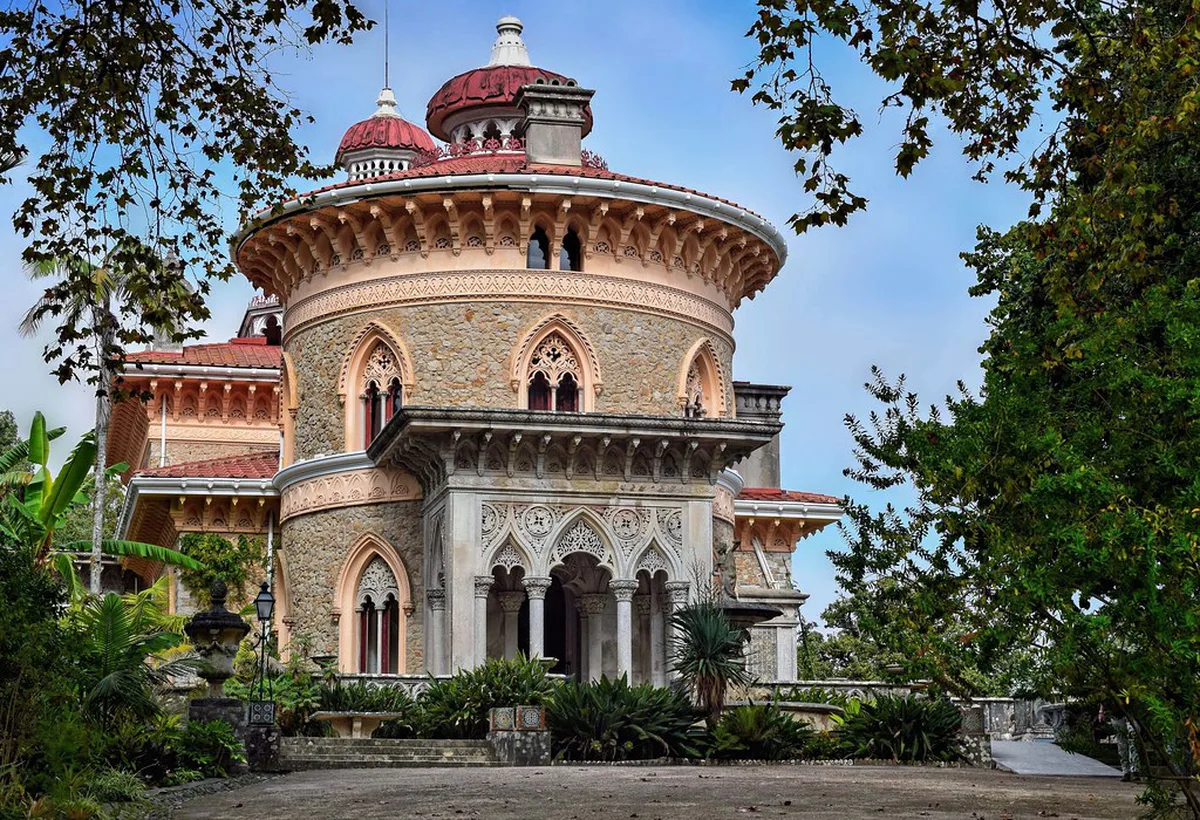
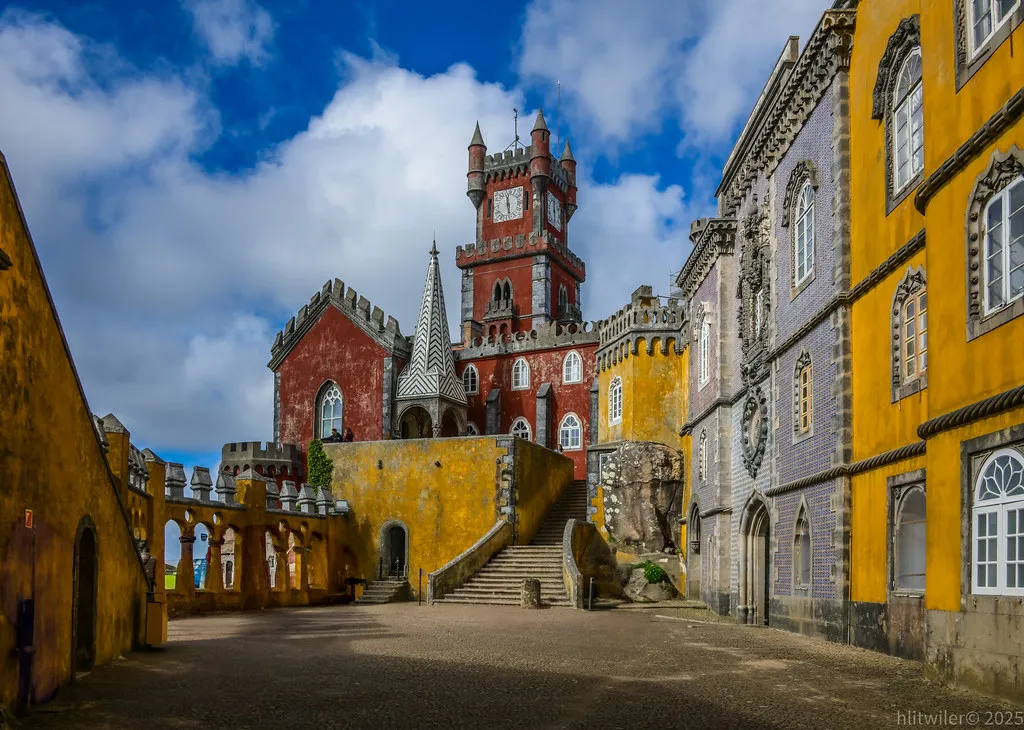
Sintra is the day trip most visitors take, and for good reason: Pena Palace, Quinta da Regaleira, the Moorish Castle, and Monserrate are all within a short shuttle ride of one small town. The Sintra train from Rossio runs every 30 minutes and takes 40 minutes, with a 2026 one-way fare of €2.45. Because Sintra is enormous in scope — easily a full-day or two-day trip on its own — we've given it a dedicated deep guide as part of our Sintra cluster. Start there: best time to visit Lisbon covers when to visit in general, and our Sintra spoke covers the palaces, the shuttle routes, and the smartest one-day itinerary to avoid the worst crowds.
Cascais & Estoril coast
If Sintra is about palaces, the Cascais line is about the coast. Trains from Cais do Sodré run every 20 minutes, take 30-40 minutes, and cost just €2.30 one way in 2026. The line hugs the Tagus estuary the whole way — grab a seat on the right-hand side for the best water views as the river opens out to the Atlantic.
Cascais itself is a former fishing village turned chic seaside town. The compact old quarter around Largo Luís de Camões is made for wandering: pedestrianized streets, azulejo-tiled façades, and a string of casual seafood restaurants. Walk 15 minutes west along the coast path to Boca do Inferno ("Hell's Mouth"), a dramatic sea cave where Atlantic waves crash through a blowhole in the cliffs. Praia da Rainha, a tiny pocket beach in the center of town, is the easiest swim stop — it's protected and family-friendly, though it fills up fast in summer.
Estoril, one stop before Cascais, is famous for Europe's largest casino (which partly inspired Ian Fleming's Casino Royale) and for its elegant belle-époque seafront. For a wilder experience, take a 15-minute bus or taxi from Cascais to Praia do Guincho — a kite-surfing beach backed by dunes and Sintra's mountains. Guincho is one of the best sunset spots near Lisbon. Because it's all reachable without a car and there's a proper beach in the mix, Cascais is the most family-friendly day trip in this list.
Évora — UNESCO Alentejo capital
Évora is my personal favorite day trip from Lisbon, and I say this as someone who's done it half a dozen times. The walled city is a UNESCO World Heritage Site, the historic center is small enough to cover on foot, and it offers a real change of pace from the coast: whitewashed houses, olive groves, and the slow rhythm of Alentejo.

Trains from Oriente take about 1 hour 35 minutes and cost €13 one way in 2026 on the Intercidades service. Buses via Rede Expressos are similar in time (around 1h 30m) and slightly cheaper. Both are comfortable. The old town is a 10-minute walk from the station.
Once inside the walls, three sites anchor the visit. The Templo Romano (often wrongly called the Temple of Diana) is the best-preserved Roman monument in Portugal, with 14 of its original Corinthian columns still standing after nearly 2,000 years. A five-minute walk away, the Capela dos Ossos (Chapel of Bones) is one of the most unsettling sights in Europe — the walls and pillars are decorated with the bones of an estimated 5,000 monks, arranged by 17th-century Franciscans as a meditation on mortality. The inscription above the door reads "Nós ossos que aqui estamos pelos vossos esperamos" ("We bones that are here, for yours we wait").
Beyond the walls, the Almendres Cromlech — a megalithic stone circle older than Stonehenge — sits 15 km west and is easiest to reach by taxi or tour. Évora is also the heart of Alentejo wine country: several quintas within 20 minutes of town offer tastings. Honest advice: Évora is doable as a long day trip (leave by 8am, return on the 7pm train), but it shines as an overnight — dinner in a candlelit taverna makes the trip. For a full rundown of what to see once you're inside the walls, see our complete guide to things to do in Évora.
Óbidos — medieval walled town
If you want to be transported straight into a children's storybook, go to Óbidos. The entire town sits inside a ring of 12th-century Moorish walls, topped by a castle that's now a pousada (historic inn). There's no train; take a Rede Expressos bus from Sete Rios bus terminal. The ride takes about 1 hour and costs €8-10 one way in 2026.
Buses drop you at Porta da Vila, the painted main gate. From there, a single cobblestone street — Rua Direita — runs the length of the town, lined with whitewashed houses trimmed in blue and yellow, small craft shops, and bakeries. The castle walls are open and walkable (free, but narrow and with no railings in places — not for anyone uneasy with heights). A full loop takes about 30 minutes.
Don't leave without tasting ginjinha de Óbidos, a sour-cherry liqueur poured into edible dark-chocolate cups. Several bars along Rua Direita serve it for €1.50-2; drink the shot, then eat the chocolate cup. In December, the town hosts a well-known Christmas Village with markets and lights. In July, the Medieval Market takes over the streets with jousting and costumes.
If you're renting a car, Óbidos combines beautifully with Nazaré (a fishing village famous for world-record giant waves at Praia do Norte in winter) and the Cistercian monastery of Alcobaça — all three in one loop, about 2.5 hours' driving total.
Setúbal & Arrábida Natural Park
Setúbal is the day trip locals take when they want a beach and tourists generally don't. It's 50 minutes south of Lisbon on the Fertagus train line (around €5 one way in 2026, or drive over the red 25 de Abril bridge). What makes it special isn't Setúbal town itself — though the fish market and seafood restaurants are excellent — but the Serra da Arrábida Natural Park just west of the city.
Arrábida's limestone cliffs drop straight into impossibly turquoise water. Praia do Portinho da Arrábida is regularly voted among the most beautiful beaches in Portugal: a sheltered cove with calm, almost-Caribbean water, backed by pine-covered hills. Praia de Galapinhos and Praia dos Coelhos are quieter alternatives a short walk further along. In summer (mid-June to mid-September), access is restricted to shuttle buses from Setúbal to prevent overcrowding — check the park authority's website for the current shuttle schedule before going.
From mid-June to mid-September, private cars are banned from the Arrábida coastal road. Access to the beaches is by shuttle bus only, departing from Setúbal. Check the park authority's website for the current timetable before you go — shuttles fill up fast on weekends.
Dolphin-watching tours run year-round from Setúbal's marina into the Sado estuary, where a resident pod of around 30 bottlenose dolphins lives in the mouth of the river. Tours last 2-3 hours and cost €35-45. Because Arrábida sees far fewer day-trippers than Sintra or Cascais, this is the trip I recommend when someone tells me they've already "done" Lisbon and want something off-script.
Tomar — Knights Templar town
Tomar is the furthest of the seven day trips, and the one that rewards history nerds the most. The Intercidades train from Oriente takes about 2 hours and costs €11.30 one way in 2026. The town itself is small, walkable, and sits under a hill crowned by the main reason to come: the Convento de Cristo.
This is one of Portugal's most significant historic sites. Tomar's Convento de Cristo was the seat of the Knights Templar in Portugal until 1314, when the order was suppressed and its assets transferred to the new Order of Christ — which went on to fund Portugal's Age of Discoveries. The complex wraps a round 12th-century Templar church (the Charola, modeled on the Holy Sepulchre in Jerusalem) inside a 500-year sprawl of cloisters, chapter houses, and Manueline stonework. The famous carved window of the Chapter House is one of the most photographed pieces of architecture in Portugal.
Plan at least 2 hours inside the complex. Add another hour for the old town and lunch by the Nabão river, and you'll catch the 5pm train back to Lisbon comfortably. It's a long day — but for anyone interested in the Templars, the Discoveries, or Manueline architecture, it's worth every minute on the train.
Frequently Asked Questions
What is the best day trip from Lisbon?
For first-time visitors, Sintra is the best single day trip — the concentration of palaces, the forested setting, and the easy train from Rossio (40 minutes, €2.45 in 2026) make it unmatched. For repeat visitors or travelers who want depth over spectacle, Évora is the stronger pick: fewer crowds, genuine Alentejo character, and some of Portugal's best Roman and medieval architecture.
Can you do Sintra and Cascais in one day?
Yes, but only if you start early and accept a fast pace. The common route is: train to Sintra from Rossio around 8:30am, visit Pena Palace and Quinta da Regaleira by early afternoon, then take the 403 bus (or a taxi) over the Serra de Sintra to Cascais — a scenic 40-minute ride that passes Cabo da Roca, mainland Europe's westernmost point. From Cascais, the train back to Lisbon runs every 20 minutes until around midnight. You won't see Sintra in depth, but you'll get both flavors in one day.
Should I rent a car for Lisbon day trips?
For single destinations (Sintra, Cascais, Évora, Tomar) — no. Trains are cheaper, faster, and avoid the nightmare of parking in old towns. For combined loops like Óbidos + Nazaré + Alcobaça, or for Arrábida's quieter beaches, a rental car is genuinely useful. A 1-day rental from central Lisbon starts around €35 plus fuel and tolls. For in-city Lisbon travel, you don't need a car at all — our pillar guide on things to do in Lisbon explains how to get around without one.
Are organized day tours worth it?
Organized tours are worth it in two cases. First: if you want to combine two or three destinations that aren't on the same train line (Sintra + Cascais + Cabo da Roca, or Fátima + Batalha + Nazaré + Óbidos). Second: if you're visiting in peak summer and want to skip the Pena Palace queue — some tours include timed entry tickets. Otherwise, DIY by train is cheaper, more flexible, and gives you more time at each site. Typical small-group tour prices in 2026 run €55-90 per person.
Which day trips are best in winter?
Portugal's mild winters (daytime highs of 14-17°C in Lisbon) make most of these trips comfortable year-round. In winter, Óbidos (Christmas Village in December), Évora (no heat, no crowds, cozy tavernas), and Tomar (indoor sightseeing) shine. Skip Arrábida beaches until spring — the water is too cold to swim — and note that Sintra gets genuinely damp and foggy from December to February (atmospheric, but bring a jacket). For a full seasonal breakdown, see our guide on best time to visit Lisbon to visit Lisbon.
 Day Trips From Guimaraes: 3-Day Minho ItineraryJune 8, 2026