Tram 28 Lisbon: Complete 2026 Guide to the Yellow Tram Route
Tram 28 is Lisbon's most famous ride — a 1930s yellow tram climbing 7 hills through Alfama, Graça, and Estrela. This 2026 guide covers the route, prices, crowd-free timings, and pickpocket warnings.
On this page
Tram 28 Lisbon: Complete 2026 Guide to the Yellow Tram Route
By Sofia Almeida — Portugal Wander
Tram 28 is Lisbon's most famous public transport line: a small, buttercup-yellow Remodelado tram built in the 1930s that rattles, lurches and squeals its way through seven historic neighborhoods on a 7-kilometer loop. It is simultaneously a working commuter line for Lisboetas heading to the market and the single biggest tourist attraction in the city — which is why half the passengers are locals with grocery bags and half are visitors with cameras. This guide covers everything you need to ride Tram 28 in 2026: the full route and what you'll see from each window, 2026 ticket prices and where to board, when to ride to actually get a seat, the real pickpocket warning you should take seriously, and how Tram 28 compares to Tram 12 and the red Hills Tramcar. If you are building a Lisbon itinerary, Tram 28 belongs on it — but only if you ride it the smart way.
A brief history of Tram 28
Lisbon's tram network started in 1873 with horse-drawn cars — what locals still call the americanos, because the technology was imported from the United States. The system was electrified in 1901, and at its peak in the 1950s the capital had 27 electric tram lines criss-crossing the city.
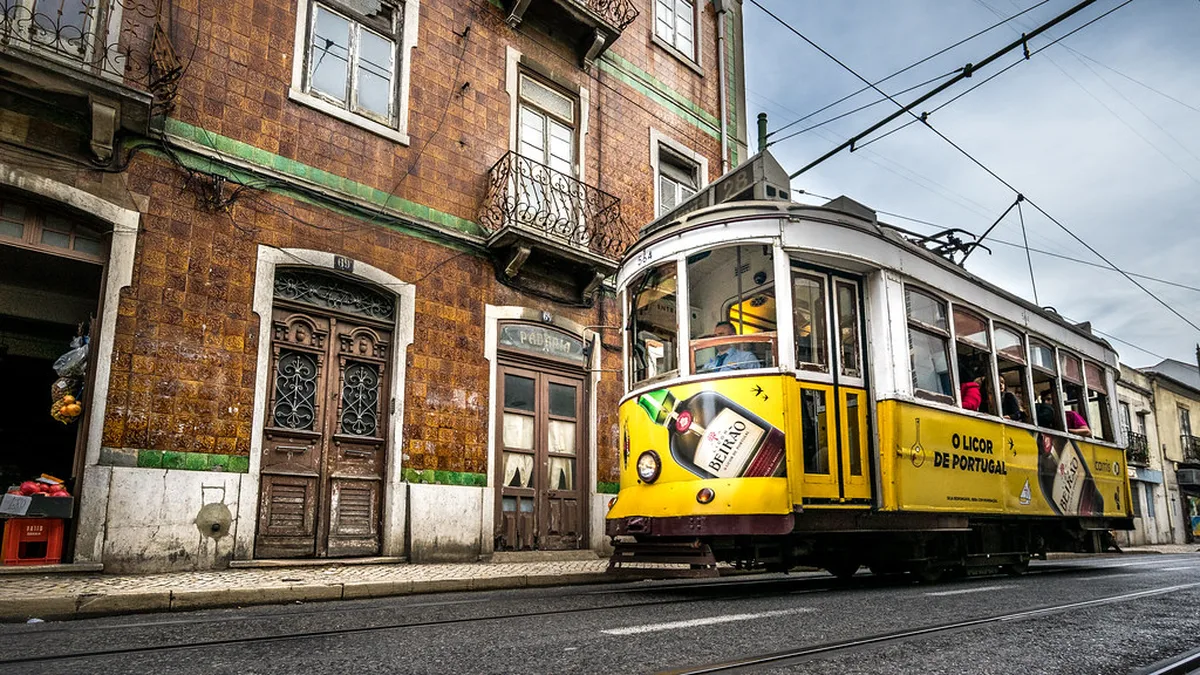
The little yellow carriages you see on Line 28 today are called Remodelado trams, and they date from the 1930s. They were "remodeled" in the mid-20th century but kept their original wooden interiors, brass fittings and compact 2.4-meter width. That narrow body is the whole reason they survived. When most European cities tore out their trams in the 1950s and 60s in favor of modern buses, Lisbon tried the same — and discovered that the twisting, near-vertical lanes of Alfama and Graça were simply too tight and too steep for standard buses to handle. The old Remodelados stayed because nothing else fit.
Today only five tram lines remain in service: 12, 15, 18, 24 and 28. Line 15 to Belém uses modern articulated trams, but the other four still run the original 1930s Remodelado cars. Of the five, Line 28 is by far the most famous — and the most crowded.
The Tram 28 route — what you'll see
Tram 28 runs from Martim Moniz in the east to Campo de Ourique in the west, a 7-kilometer route that takes roughly 40 minutes end to end in light traffic and closer to 60 minutes when it's packed. Along the way it climbs and drops through seven of Lisbon's historic neighborhoods — hence the marketing line you'll see everywhere: "Tram 28 climbs 7 of Lisbon's 7 hills on its 7km route."
Here is the route in order from east to west, with the highlights you'll pass:
- Martim Moniz — the eastern terminus. A flat square at the bottom of the hill where the tram starts its climb.
- Graça — after a steep uphill grind, the tram stops near Miradouro da Graça, one of Lisbon's best sunset viewpoints. Sit on the right side heading west for the best city views climbing up.
- Largo das Portas do Sol — a photo-famous stop overlooking the Tagus river and the terracotta rooftops of Alfama. Sit on the left side heading west here.
- Sé Cathedral — Lisbon's 12th-century cathedral, and the most iconic photo spot of the whole line: the yellow tram framed against the Romanesque stone facade.
- Alfama — the tram skirts the edge of Lisbon's oldest neighborhood, a labyrinth of fado bars and azulejo-tiled walls. If you want to actually explore it, get off here and read our Alfama walking guide.
- Baixa-Chiado — the elegant downtown shopping district, with connections to the metro and Praça do Comércio a short walk away.
- Chiado & Bairro Alto — the tram climbs again past literary cafés and Rua Garrett.
- Estrela Basilica — an enormous white-domed 18th-century church, often skipped by tourists. Sit on the right side heading west for the best view.
- Prazeres — close to the western terminus, with one of Lisbon's most atmospheric old cemeteries.
- Campo de Ourique — the western endpoint. A quiet, residential neighborhood with a wonderful food market most tourists never reach.
The most scenic — and most photographed — section is between Graça and Sé, where the tram squeezes through lanes so narrow you can touch the buildings from the window.
How to ride Tram 28 — practical guide
Where you board matters more than anything else. The two realistic options are Martim Moniz (the eastern terminus) and Praça do Comércio area via Baixa-Chiado. Board at Martim Moniz if your priority is getting a seat — the tram is empty here because everyone has just gotten off at the end of the line. Expect to queue 15–30 minutes at peak times, but you'll ride the full route sitting down. Board at Praça do Comércio / Baixa-Chiado if you're already downtown and don't mind standing — it's more central, but the tram will usually be full when it pulls up.
Ticket options for 2026:
- Single ticket onboard: €3.00, paid in cash to the driver. Valid for one ride only.
- Viva Viagem 24-hour pass: €6.45, loaded onto a reusable €0.50 paper card bought at any metro station. Covers unlimited rides on trams, buses, metro and funiculars. This is the best value — two tram rides already beat a single, and you can hop on and off freely.
- Lisboa Card: includes all public transport plus free entry to 35+ museums and attractions. Worth it if you're sightseeing intensively.
If you use a Viva Viagem card, tap the yellow reader next to the driver when you board to validate. Single tickets don't need validation — the driver prints them.
Trams run from roughly 6:00 am to 11:00 pm, with service every 10–15 minutes during the day and every 20 minutes in early morning and late evening. There is no service on 25 December.
When to ride Tram 28 to avoid crowds
The honest truth: between 10:00 am and 4:00 pm from April through October, Tram 28 is genuinely unpleasant. You will stand pressed against strangers, you will not see out the windows, and a 40-minute ride stretches to 60+ minutes because the tram has to wait at every stop for people to force their way on and off.
The realistic crowd-free windows are:
- Early morning, 7:00–8:30 am: the single best window. Mostly commuters, plenty of seats, soft morning light. Board at Martim Moniz before 8:00 am and you'll have your pick.
- After 7:00 pm: the day-trip tourists have left and the tram thins out. You get sunset light at Graça if you ride westbound around 7:30–8:00 pm in summer.
- Weekend mornings before 9:00 am: surprisingly empty because tourists sleep in.
- Off-season (November–March): crowds drop by roughly half. You can ride mid-morning and still get a seat.
Weather also shifts the calculation — rainy days thin the crowds significantly. If you need help timing your whole trip, see our guide to the best time to visit Lisbon.
The single best window for a crowd-free ride is 7:00–8:30 am from Martim Moniz — mostly commuters, plenty of seats, and soft morning light. Board before 8:00 am and you'll have your pick of window seats for the full 7km route.
Pickpocket warning and safety
This needs to be said plainly: Tram 28 is the single worst pickpocket spot in Lisbon. Lisbon police post warnings at the terminus, every guidebook mentions it, and it is a real, daily problem — not a scare story. The crowds, the sudden lurching stops and the distraction of the view make it perfect hunting ground.
The tram itself is completely safe — the risk is 100% theft, not violence. Ride these rules and you'll be fine:
- Wallet and phone in front pockets only. Never back pockets. Never.
- Bags on your lap or across your body in front, never on the floor and never on the luggage shelf.
- Be extra alert at Sé Cathedral, Largo das Portas do Sol and Baixa-Chiado — these are the busiest stops and where most thefts happen during the boarding scrum.
- Watch for the classic distraction tactic: someone bumps into you or asks for directions while a partner lifts your wallet. If someone crowds you unnecessarily, move.
- Don't wear an open backpack. Front-carry it or zip it fully.
Follow these and Tram 28 is no riskier than any crowded European metro.
Tram 28 is the single worst pickpocket spot in Lisbon — police post warnings at the terminus. The highest-risk moment is the boarding scrum at Martim Moniz and the busy stops at Sé Cathedral and Baixa-Chiado. Keep your wallet and phone in front pockets only, and carry bags across your body in front.
Tram 28 vs Tram 12 vs the Tourist Tram (Hills Tramcar)
Tram 28 isn't your only option for the yellow-tram experience. There are two alternatives worth knowing about.
Tram 12 is a short circular loop that runs through Alfama and around Castelo de São Jorge. It uses the same vintage Remodelado carriages, climbs the same narrow streets and delivers very similar scenery — but almost no tourists know about it. A Tram 12 ride takes about 20 minutes and is often half-empty when Tram 28 is jammed. It's the insider move if you just want the tram experience without the crowds.
Hills Tramcar (Colinas Tour / "Tram 28 tourist") is a bright red vintage tram operated as a hop-on-hop-off tourist service. It runs roughly the same route as Tram 28 with recorded audio commentary in multiple languages, guaranteed seats and no pickpocket risk — but costs around €22 per adult in 2026, compared to €3 for a single on the real Tram 28 or €6.45 for a full-day Viva Viagem.
Our verdict: ride the real Tram 28 at 7:30 am for the authentic experience, and take Tram 12 later in the day if you want an easy photo-friendly loop. Skip the red tourist tram unless mobility or budget makes the other options impractical.
Tram 28 stop-by-stop: a deeper route map
If you only have one ride and want to know exactly where to look, get off, or take photos, here is the route in finer detail than most guidebooks publish — keyed to the order you'll encounter the stops heading west from Martim Moniz to Campo de Ourique. Use it alongside the Lisbon transport guide for the wider network context, and the Lisbon itinerary if you want to weave several of these stops into a single day.
| # | Stop | What's there | Best photo / use |
|---|---|---|---|
| 1 | Martim Moniz | Eastern terminus. Flat multicultural square at the foot of the hill; queue forms here for fresh, empty trams. | The yellow tram lined up against Mouraria's painted murals — best from the square's south corner. |
| 2 | Praça da Figueira | Grand 19th-century square with a statue of João I and easy walking access to Rossio and Baixa. | Tram threading between the square and the rising Castelo skyline behind it. |
| 3 | Sé (Cathedral) | Lisbon's 12th-century Romanesque cathedral. The single most photographed stretch of the line. | The "iconic curve" — tram framed against the cathedral's twin towers. Stand on Rua Augusto Rosa. |
| 4 | Limoeiro / Santa Luzia | The climb past the old law school, with the first views opening up over Alfama's rooftops. | Window shot of terracotta roofs sloping toward the Tagus. |
| 5 | Largo Portas do Sol | Postcard miradouro. Hop off here if you do nothing else — the view is the cover-photo of Alfama. | Get off and shoot the tram disappearing down the lane with the river behind. |
| 6 | Graça | Working-class hilltop neighborhood with two miradouros (Graça and Senhora do Monte) within a 5-minute walk. | Sunset over the castle and downtown — the highest miradouro on the route. |
| 7 | São Vicente / Voz do Operário | The tram briefly skirts the National Pantheon and the Tuesday/Saturday Feira da Ladra flea market. | Domes of São Vicente from the tram window. |
| 8 | Baixa-Chiado | Lisbon's elegant downtown shopping spine. Major transfer point with metro Blue and Green lines. | Skip photos here — too crowded; use it to hop off for coffee or shopping. |
| 9 | Chiado / Bairro Alto edge | Literary cafés (A Brasileira), Rua Garrett, the climb toward Bairro Alto. | The tram squeezing past the Pessoa statue at A Brasileira. |
| 10 | Estrela | Vast white-domed 18th-century basilica plus the leafy Jardim da Estrela across the street. | Wide shot of the basilica facade with the tram passing in front. |
| 11 | Prazeres | Lisbon's most atmospheric historic cemetery, with marble mausoleums and views west. | Quiet, locals-only stop — good for a calm midpoint break. |
| 12 | Campo de Ourique | Western terminus. Residential, calm, and home to the Mercado de Campo de Ourique food hall — locals' favorite lunch. | Skip the photo, eat the lunch. |
For the most cinematic three-stop sequence, plan for Sé → Largo Portas do Sol → Graça in that order. That's the section where the tram earns its reputation.
Best photography spots from Tram 28 (and how to time them)
The yellow tram in front of stone facades is one of the most-shot images in Europe, but most travelers walk away with the same crowded, blurry frame. A few tactical choices fix that.
- The Sé Cathedral curve — the iconic shot. Stand on Rua Augusto Rosa just east of the cathedral as the tram approaches uphill. The yellow against the cream-stone Romanesque facade is the postcard. Shoot before 9:00 am for soft, side-on light without harsh tower shadows.
- Largo das Portas do Sol miradouro — get off the tram here. Walk to the railing and shoot back at the tram as it disappears down the lane with the Tagus and São Vicente in the background. Best light: golden hour (about 6:30–7:30 pm in summer, 4:30–5:30 pm in winter).
- Graça hill descent — the western-side window seat catches the city falling away beneath you. Sit on the right side heading east (toward Martim Moniz) for the rooftop sweep.
- Narrow Alfama lanes (between stops 4 and 5) — open the window if it slides, or shoot through it: stone walls so close you can touch them, with locals' laundry hanging overhead. Phone cameras handle this better than DSLRs because the tram lurches.
Three practical rules for the "tram approaching" shot from outside: (1) stand on the inside curve, not the outside — the tram leans toward the inside and the angle compresses better. (2) Shoot at 1/250 or faster to freeze the lurch. (3) Time arrivals using the Carris real-time app — trams run every 10–15 minutes during the day, so a 20-minute wait gets you two trams to choose from.
Best light overall: 7:30–9:00 am for soft front-lighting on the cathedral and empty streets, or 5:00–7:00 pm for golden hour at the miradouros. Midday (11:00–2:00) is the worst — high contrast, harsh shadows, peak crowds.
More Tram 28 alternatives: lines 12, 15 and 24
If Tram 28 is mobbed and you still want the vintage-tram experience, three other Carris lines deliver versions of the same ride at different price points and crowd levels. All four use the same Viva Viagem 24-hour pass (€6.60 in 2026), so adding one to your day costs nothing extra.
- Tram 12E (Praça da Figueira loop) — a short circular line of about 20 minutes that climbs the same Alfama lanes as Tram 28 but loops back to Figueira instead of pushing on to Estrela. It uses identical 1930s Remodelado carriages and delivers near-identical scenery for the Sé-to-Portas-do-Sol stretch — but with a fraction of the crowd because tourists don't know about it. The insider's pick.
- Tram 15E (Belém line) — the modern articulated tram (not vintage) that runs from Praça da Figueira out to Belém, past the riverside MAAT museum, the Padrão dos Descobrimentos and Jerónimos Monastery. Longer (roughly 30 minutes one-way), wider, less charming inside, but it's the easy way to combine downtown sightseeing with Belém's pastéis de nata and the Tower of Belém.
- Tram 24E (Praça Luís de Camões → Campolide) — relaunched in 2018 after a 23-year hiatus and still mostly used by locals. Twenty minutes through Príncipe Real and the leafy upper city, ending in residential Campolide. The shortest Remodelado ride and the closest you'll get to "the tram as Lisboetas use it." Almost no tourists.
Tickets are identical across all four lines: €3.00 single onboard (cash to driver) or €1.80 with a Viva Viagem card (plus the €0.50 one-time card fee). If you're going to ride more than once in a day — and most visitors do — load €6.60 onto Viva Viagem and you've covered unlimited tram, bus, metro and funicular for 24 hours.
Tram 28 ticket prices and passes for 2026
Lisbon's transport authority Carris confirmed 2026 fares in February. Here is the full 2026 price comparison so you can pick the right ticket for the way you'll actually use the tram:
| Option | 2026 Price | How it's used | Best for |
|---|---|---|---|
| Single ticket onboard | €3.00 | Cash to driver, valid one ride only. | One-off tourist photo ride. |
| Viva Viagem card — single fare | €1.80 (+ €0.50 card fee, one-time) | Tap reusable paper card on yellow reader at boarding. | First day in Lisbon if you'll ride at least twice. |
| Viva Viagem 24-hour bus + tram pass | €6.60 (+ €0.50 card fee, one-time) | Unlimited rides on Carris trams, buses, metro, funiculars and Santa Justa elevator for 24h. | Most visitors — pays back in three rides. |
| Lisboa Card (24h) | €22 | Includes all public transport plus free entry to 35+ museums and discounts at attractions. | Heavy sightseeing days that include Jerónimos, Belém Tower or the Castle. |
| Lisboa Card (48h / 72h) | €36 / €45 | Same as above but extended. | Multi-day intensive sightseeing. |
A few buyer-traps to know about: (1) Viva Viagem cards bought at one metro station work everywhere — there's no need to re-buy. (2) The €0.50 card fee is one-time, so reuse the same card across your whole trip. (3) The Lisboa Card is sold at the airport, ASK ME desk in Praça do Comércio, and online — buying online is the same price but skips the queue. (4) Children under 4 ride free; ages 4–12 get roughly half-fare on Viva Viagem.
Pickpocket-avoidance: 2026 tactics most guides skip
The pickpocket warning earlier in this article covers the basics. A few additional practical points specific to 2026 conditions are worth knowing if you're going to ride at peak hours regardless:
- The Martim Moniz boarding scrum is the highest-risk moment of the entire ride. Police statistics shared by PSP (Polícia de Segurança Pública) consistently flag the boarding queue at Martim Moniz as the single most-targeted spot on the line. Stay in the middle of the queue, not the edges; carry your bag in front of your body before you reach the doors.
- Money belt or front-pocket only. A money belt under your shirt or a front pocket are the only safe places for cards and cash. Crossbody bags worn to the front (not the side or back) are the next-best option. Back pockets, open totes and unzipped backpacks are routinely emptied within the first 60 seconds of boarding.
- Beware the staged distraction. Common 2026 scams: someone "accidentally" spills coffee or water on you and apologetically tries to wipe you down (their partner lifts your wallet). Someone bumps you hard from behind during a stop (lifts in the moment of impact). Someone asks for help finding a street on a map shoved in your face (blocks your view while a partner works your bag). If anyone touches you, gets too close, or tries to engage you on a packed tram — move, even if you have to push past.
- If something happens, file a report with the PSP Tourism Police. The dedicated tourism unit is at Praça dos Restauradores in the Foz Palace and is staffed with multilingual officers. Reporting at the regular police station won't generate the report you need for a travel-insurance claim — the tourism unit will. Carry your hotel address and passport copy; they'll process the report in English.
- Travel insurance: check the per-item limits. Standard policies cap individual electronics at €300–€500 — below the cost of most modern phones. If you're carrying a recent iPhone or a camera, get a top-up policy or specifically schedule the items.
None of this should put you off — pickpocketing is property crime, not violent crime, and Lisbon as a whole is one of Europe's safer capitals. But the math on Tram 28 is real: when you pack 60 tourists into a 30-seat carriage, professional thieves work the carriage. Front-pocket discipline solves 90% of it.
Frequently Asked Questions
How much does Tram 28 cost in 2026?
A single ticket bought onboard from the driver costs €3.00 in cash. A Viva Viagem 24-hour public transport pass costs €6.45 (plus a one-time €0.50 card fee) and covers unlimited rides on all Lisbon trams, buses, metro and funiculars — this is the best value for most visitors. The Lisboa Card also includes Tram 28.
Is Tram 28 safe?
The tram itself is completely safe. The real risk is pickpocketing, which is common and well-organized, especially in crowded daytime hours. Keep valuables in front pockets, carry bags in front of your body, and stay alert during boarding at Sé and Baixa-Chiado. Follow those rules and you'll have no problem.
How long does the Tram 28 ride take?
The full route from Martim Moniz to Campo de Ourique is 7 kilometers and takes about 40 minutes end to end in light traffic. During peak hours (10 am–4 pm), expect 60 minutes or more because the tram has to wait at every stop for crowds to load and unload.
Where should I board Tram 28?
Board at Martim Moniz, the eastern terminus, if getting a seat matters to you — the tram is empty when it starts there. Queue 15–30 minutes at peak times. Board at Baixa-Chiado or near Praça do Comércio if you're already downtown and don't mind standing for part of the ride.
Is Tram 28 worth it?
Yes — but only if you ride it the smart way. At 7:30 am from Martim Moniz it's one of the most charming 40 minutes you can spend in Lisbon. At 2:00 pm in July it's a sweaty, crowded ordeal where you won't see anything. Plan it into your Lisbon itinerary as an early-morning activity, not a midday one, and the experience lives up to its reputation.
Is Tram 28 free with Lisboa Card?
Yes — Tram 28 is included in the Lisboa Card at no extra charge. The 24-hour Lisboa Card costs €22 in 2026 and covers unlimited rides on every Carris tram (28, 12, 15, 24, 18), buses, metro, funiculars and the Santa Justa elevator, plus free entry to 35+ museums and attractions. You still need to tap the card on the yellow reader when boarding to validate the ride. If you only plan to ride trams and not visit paid attractions, the €6.60 Viva Viagem 24-hour pass is the better-value option.
How long is the Tram 28 route?
The Tram 28 route is 7 kilometers long from end to end, running between Martim Moniz in the east and Campo de Ourique in the west. The line passes through 7 historic neighborhoods, climbs and descends 7 of Lisbon's hills, and covers roughly 12 named stops between the two terminals. End-to-end ride time is about 40 minutes in light traffic and 60+ minutes during peak tourist hours (10 am–4 pm).
What time does Tram 28 start running?
Tram 28 starts at approximately 6:00 am from both terminals (Martim Moniz and Campo de Ourique) and runs until about 11:00 pm daily. Service frequency is every 10–15 minutes during the day and every 20 minutes in the early morning and late evening. There is no service on 25 December (Christmas Day). The single best time to board for an empty tram and a guaranteed seat is between 7:00 and 8:30 am from Martim Moniz, before the day-trip and cruise-ship crowds arrive.
 How to Get to Braga: 6 Best Ways to TravelJune 4, 2026