

Lisbon to Evora: Complete Transport and Sightseeing Guide
Plan your trip from Lisbon to Evora with our guide to trains, buses, and driving. Includes top UNESCO sights, local dining secrets, and airport transfer tips.
On this page
How to Get from Lisbon to Evora: The Best Travel Options
Évora sits 130 km east of Lisbon in the Alentejo region, and the trip takes around 90 minutes by train, bus, or car. The walled UNESCO old town is compact enough to see in a single day, with the Roman Temple, Chapel of Bones, and Cathedral all within a 10-minute walk of each other. This guide covers the 2026 schedules, prices, station logistics, and on-the-ground details you need to plan with confidence.
All transport prices below are accurate at the time of writing for early 2026 and should be reconfirmed on the official operator sites before booking. The trip is one of the best day trips from Lisbon, but a single overnight stay rewards travelers who want to see the monuments after the day-trippers leave.
Quick Comparison: Train, Bus, or Car
None of the three options is dramatically faster than the others, so the right choice depends on departure flexibility, where you are staying, and whether you want to detour to Alentejo sights that public transport cannot reach. The table below summarizes the trade-offs at the time of writing.
- Intercidades train: €12.50 (2nd class) or €16.65 (1st class), 1h30m, only 5 daily departures on weekdays and 3 on weekends, departs Oriente / Entrecampos / Sete Rios.
- Rede Expressos bus: around €12.00 single, 1h30m to 1h45m, departures roughly every hour from Sete Rios bus terminal, the most flexible option.
- FlixBus from Lisbon Airport: from around €7.48, around 2 hours, very limited daily departures, the only direct airport-to-Évora coach.
- Self-drive: 130 km via the A2 and A6, around 1h15m to 1h30m, tolls roughly €13 each way, plus rental and fuel — the only option that reaches the Almendres Cromlech and rural cork forests.
| Option | One-Way Price | Journey Time | Frequency | Departs From |
|---|---|---|---|---|
| Intercidades Train (2nd class) | €12.50 | ~1h 30m | 5/day (weekdays), 3/day (weekends) | Oriente / Entrecampos / Sete Rios |
| Intercidades Train (1st class) | €16.65 | ~1h 30m | 5/day (weekdays), 3/day (weekends) | Oriente / Entrecampos / Sete Rios |
| Rede Expressos Bus | ~€12.00 | 1h 30m–1h 45m | ~Hourly | Sete Rios bus terminal |
| FlixBus (from airport) | From €7.48 | ~2h | 1–2/day | Lisbon Airport (LIS) Terminal 1 |
| Self-Drive (A2 + A6) | ~€13 tolls | 1h 15m–1h 30m | Any time | Central Lisbon |
If you have already arrived in central Lisbon and want predictable comfort, take the Intercidades train. If you are time-flexible and want hourly departures, the Rede Expressos bus is the better default. If you are landing at Lisbon Airport (LIS) and skipping the city, FlixBus to Évora is the cheapest direct option.
Taking the Train from Lisbon to Évora
The Intercidades service operated by Comboios de Portugal (CP) is the most comfortable public transport option, with reserved seats, more legroom than the bus, and a scenic crossing through the Alentejo plains. Departures originate at Oriente Station and call at Entrecampos and Sete Rios before heading south, so you can board at whichever station is closest to your accommodation.
At the time of writing, weekday departures from Oriente are roughly 7:02, 9:02, 13:32, 17:02, and 19:02. Weekend service is reduced to three trains, so check the official Comboios de Portugal site or the CP app before locking in your plan. Returns are equally limited, which is why some travelers miss the last train and end up booking a last-minute room — always note both directions before you set out.
- Buy tickets on cp.pt or in the CP app up to 30 days in advance for the best chance of securing a 1st-class seat.
- 2nd-class tickets are €12.50; 1st class is €16.65 and adds power outlets, a more spacious seat, and a quieter carriage.
- You can also buy at the ticket counter at Oriente — never on board, where there are no sales.
- Bring printed or in-app QR tickets; the conductor scans them once underway.
- The journey is the final stop, so you cannot accidentally miss your station.
Weekend train service to Évora is reduced to just three daily departures, so check the schedule in the CP app the night before and note both your outbound and return train times. The 5 weekday departures do sell out in summer — book in advance to secure your seat.
Évora's train station sits about 1 km south of the medieval walls. Cross the road, follow Avenida Dr. Francisco Barahona, and continue up Rua da República for around ten minutes to reach Praça do Giraldo, the main square. Taxis usually wait outside the station for visitors with heavy luggage, and a short ride into the historic core costs roughly €5 to €7.
Bus Stations and Stops in Lisbon and Évora
Rede Expressos runs the most useful intercity service from Lisbon, with departures every hour or two throughout the day. Buses leave from Sete Rios bus terminal, which sits beside the Jardim Zoológico metro stop on the blue line and is a short ride from Baixa neighborhood hotels. The fleet is modern, air-conditioned, and assigns seats in the booking system — check the "Lugar" line on your ticket before you board.
Tickets are sold at the station counter and on rede-expressos.pt for around €12.00 one way. The website occasionally times out under load, so arriving 20 minutes early to buy at the counter is a reliable backup. Confirm your departure bay on the overhead screens because Sete Rios uses several numbered platforms and the assignment can change a few minutes before boarding.
The Évora bus station is more central than the train station — turn right out of the building, walk down Avenida de São Sebastião, and you reach the medieval gateway in under five minutes. From there, Rua de Serpa Pinto leads straight to Praça do Giraldo, which is signposted and has a tourist office that sells the Évora discount card.
Lisbon Neighborhood-to-Station Guide
One detail competitor guides skip is which Lisbon station is actually closest to your hotel, which can save 30 to 40 minutes of metro time. Use this rough rule: pick the train if you are staying near Oriente or Saldanha, pick the bus if you are anywhere central, and check the airport-direct FlixBus if you are not staying in Lisbon at all.
- Baixa, Chiado, or Rossio: Take the blue metro line to Jardim Zoológico for Sete Rios bus terminal — around 12 minutes underground. The bus is the most efficient choice from these neighborhoods.
- Alfama or Castelo: The walk-and-tram combo to Sete Rios is awkward; take the red metro line to Oriente Station and ride the train, even though Oriente looks farther on the map.
- Príncipe Real or Avenida da Liberdade: Yellow line to Entrecampos is the smoothest train boarding point and avoids the long Oriente concourse.
- Belém: Tram 15 or train to Cais do Sodré, then change to blue line for Sete Rios — budget 35 to 45 minutes to the station alone.
- Parque das Nações: Walk or short metro ride to Oriente; this is the only neighborhood where the train is dramatically faster than the bus.
The single-journey metro fare is €1.80 with a Viva Viagem card, which you can buy at any station for a one-time €0.50. Charging the card with a 24-hour Carris/Metro ticket (€6.80) makes sense if you are also using city transit on the day of travel. The detailed Lisbon Metro Guide shows interchanges if you need to switch lines.
Easy Airport Transfers: Lisbon Airport to Évora with FlixBus
If you are flying into Lisbon (LIS) and skipping the city entirely, FlixBus runs the only direct coach from the airport to Évora, with fares from around €7.48 / $7.48 at the time of writing. The bus stop is outside Terminal 1 arrivals — follow the orange FlixBus signage past the taxi rank. The transfer takes around 2 hours, slightly longer than the city-center options because the route exits Lisbon via the A12 and Vasco da Gama Bridge.
Daily departures are limited (often just one or two), and the earliest is typically the 12:45 service. If your flight lands earlier, the workaround is to take the metro red line from the airport to Oriente Station (€1.80) and either catch the next train or transfer at Sete Rios for an hourly Rede Expressos bus. Save the FlixBus option for late afternoon arrivals, evening flights, or when you want to skip the city entirely. Our Lisbon airport guide covers terminal navigation in more detail.
- FlixBus accepts credit cards, Google Pay, Apple Pay, and PayPal at booking — the driver does not sell tickets on board.
- One checked bag (up to 20 kg) and one carry-on are included; extra bags cost around €5 each if pre-purchased.
- You do not need to print the ticket; the QR code in the FlixBus app is scanned at boarding.
- Buses are equipped with free Wi-Fi, USB power outlets, and a toilet at the rear.
- Children under 4 travel free if they sit on a parent's lap; ages 4–14 receive a discount.
Tracking Your Trip: Digital Tickets and Live Bus Updates
One of the underrated improvements for 2026 is that all three operators now publish live tracking and digital tickets, which significantly reduces the platform anxiety that used to come with this trip. The FlixBus app shows the bus's GPS position in real time on the day of travel, and the Real-Time Bus Tracker pushes a notification when the coach is approaching your stop. Rede Expressos publishes live bay assignments inside the Sete Rios station hall and sends SMS updates if the bus runs late.
For the train, the CP app stores your ticket and shows platform numbers usually 10 to 15 minutes before departure. Save your QR code as a screenshot in case the airport or station Wi-Fi drops at the worst moment — the conductor only needs to scan the image. If you are connecting from another European country, IATI Seguros and similar travel insurance providers will reimburse missed connections caused by an upstream delay, but you must preserve the original ticket as proof.
Driving from Lisbon to Évora
Driving makes sense in two cases: if you want to visit the prehistoric Almendres Cromlech (a 7,000-year-old stone circle 12 km west of Évora that no public transport reaches), or if you are continuing into the wider Alentejo region after Évora. The 130 km route takes around 1h15m without traffic, but Lisbon's morning rush can add 30 minutes to the city exit, so an early start before 8:00 or after 10:00 is wise.
Cross the 25 de Abril Bridge to reach the A2 highway, then merge onto the A6 east toward Évora. The Vasco da Gama Bridge is the recommended alternative when 25 de Abril is congested — it connects to the A12 and feeds into the same A2/A6 corridor with usually lighter traffic. Tolls run roughly €13 one way, and many rentals charge a separate Via Verde transponder fee, so confirm before pickup. From the south or east, the A6 to N114 approach passes the city walls directly. Our Lisbon transport guide covers metro and rental pickup logistics in central Lisbon.
Must-See Évora Attractions
Évora's historic center is a UNESCO World Heritage Site and the entire walled city can be walked in a single day — see our full guide to the things to do in Évora for the complete list. The Templo de Diana — actually a 1st-century Roman temple likely dedicated to Emperor Augustus — stands at the highest point of the old town, with fourteen granite columns still intact. It is free to view from the surrounding plaza and most photographers visit twice, once at midday and again at golden hour.
The Capela dos Ossos (Chapel of Bones), attached to the Church of São Francisco, is the city's most-visited monument. The walls are lined with the bones of around 5,000 people, exhumed by 16th-century Franciscan monks to free up overcrowded cemeteries. Two glass-cased mummified bodies — long thought to be a father and son but identified by 2019 forensic analysis as a woman and a young girl — sit in a side chapel. Tickets are €5 and include the museum upstairs.
The Cathedral of Évora (Sé de Évora) is the largest medieval cathedral in Portugal and the rooftop terrace gives a 360-degree view across the Alentejo plains — pay the extra €1 for the rooftop access, not just the cloister ticket. The Roman Aqueduct (Aqueduto da Água de Prata) on the city's edge has tiny houses and shops built into its arches, a quirky photographic detour few day-trippers notice.
Museums, Art, and Culture in Évora
Beyond the headline monuments, Évora rewards a slower pace. The Museu de Évora on Largo do Conde de Vila Flor displays Roman, Visigothic, and Manueline sculpture in a former 16th-century episcopal palace; entry is €3 and most visitors spend 45 minutes. The University of Évora, founded by Jesuits in 1559, is the second-oldest in Portugal and tours of the cloistered courtyards run on weekdays.
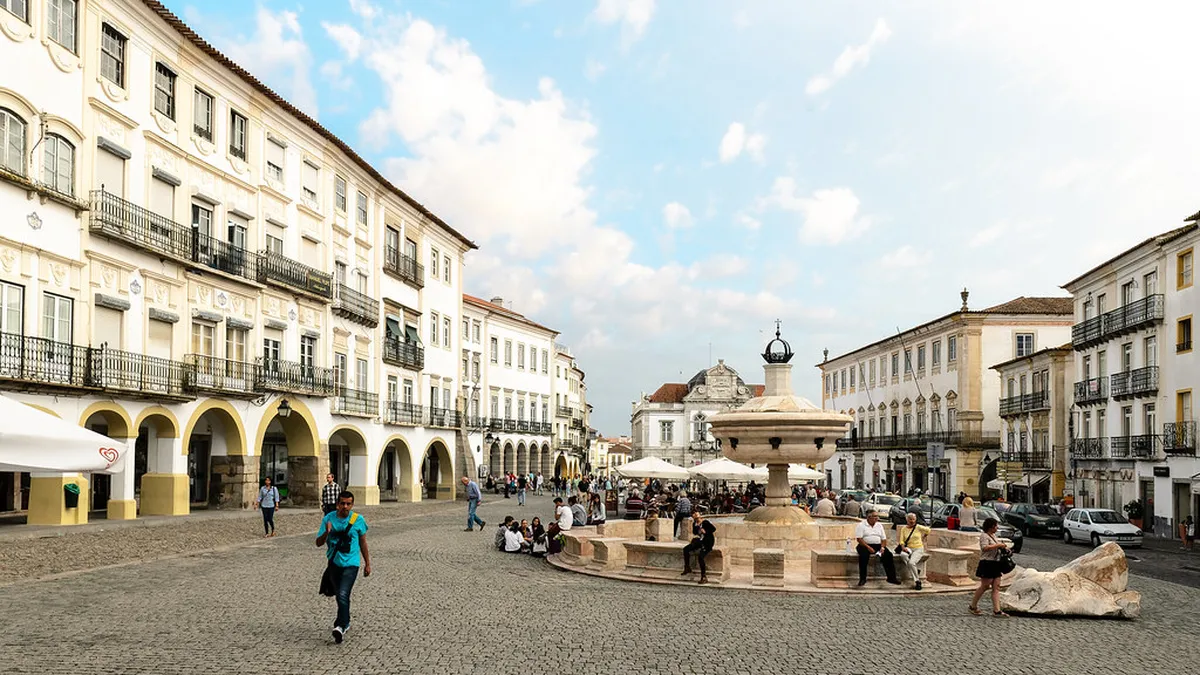
Praça do Giraldo, the central square, is a calmer cultural anchor than its monuments suggest. The Henriquina fountain in the middle has eight spouts that represent the eight streets radiating outward, and the bordering cafés are where locals do morning espresso rather than the tourist traps near the Roman Temple. Rua Cinco de Outubro is the artisan-shop strip — cork wallets, hand-painted tiles, and Ginjinha (cherry liqueur) served in edible chocolate cups are the standout buys.
Parks, Gardens, and Outdoor Spots
Jardim Diana, the small garden adjacent to the Roman Temple, has a kiosk that serves cold beer and pistachios with one of the best free views in the city — sit on the south wall around 18:30 in summer for sunset over the Alentejo plains. Jardim Público de Évora, by the Igreja de São Francisco, is the larger green space with peacocks roaming freely, a 19th-century palace ruin, and shade trees that drop the temperature 5 °C below the open streets in July and August.
For something more ambitious, the Almendres Cromlech (a Neolithic stone circle of 95 standing granite menhirs) is a 20-minute drive west of Évora and predates Stonehenge by around 2,000 years. There is no admission fee and no public transport — taxi from Évora costs around €25 each way, and many guesthouses can arrange a half-day group tour for €30 to €45 per person.
Family-Friendly and Budget Options
The Évora discount card sold at the Praça do Giraldo tourist office bundles the Cathedral roof, the museum, and the Chapel of Bones for around €15 (€8 for ages 12–25), saving roughly €4 if you visit all three. Children under 12 receive free entry to most municipal sites, and the chapel and museum allow strollers, but the cathedral rooftop has a narrow spiral staircase that is impractical with very young children.
For budget travelers, midweek visits (Tuesday through Thursday) avoid the Lisbon weekend day-tripper surge and many guesthouses drop their nightly rate by 15 to 20%. Picnic on the grass at Jardim Público or pack lunch from the Mercado Municipal de Évora, where bread, queijo de Nisa cheese, and Alentejo black pork chouriço can be assembled for under €8 per person. Tap water in Évora is safe to drink and cold from public fountains in Praça do Giraldo.
Local Dining: Taberna Típica Quarta Feira
Taberna Típica Quarta Feira is widely cited as one of the top five restaurants in Portugal and is the single hardest reservation to book in Évora. The Peixinho family runs a fixed, no-menu tasting that starts with cheese, black sausage, and pumpkin or chilli jam, moves to slow-braised pork neck with breaded cauliflower, and finishes with walnut-and-honey cake or a creamy nata. Wine pairings are chosen for the table — there is no wine list to debate.
Reservations are essential and the dining room only holds around 25 covers — book on the restaurant's Facebook page at least a week ahead, and ideally two for weekends. The full meal is around €40 to €45 per person including wine, and dinner runs from roughly 19:30 to 22:00. There is also a "first-timer" version of the menu for diners with picky palates, which the hosts will offer when you sit down. Plan your visit around lunch in Évora — the Best Time To Visit Lisbon for cooler Alentejo weather is March to May or September to October.
Where to Stay: Old World Charm at Casa dos Teles
If you decide to stay overnight rather than day-trip, Casa dos Teles is the most-recommended budget guesthouse inside the medieval walls — a 19th-century family home with eight rooms, a black-and-white photo-lined reception, and rates around €60 to €80 per double in low season. The location is its real value: a five-minute walk to the Roman Temple, the Cathedral, and Praça do Giraldo. Rooms are simple — no minibar, no air-con in some — but include a fridge, kettle, and en-suite.
For more modern comfort, the M'AR De AR Aqueduto is a five-star property built into a 16th-century palace near the aqueduct, with rates from €180 in summer. Vitória Stone Hotel is the mid-range modern alternative, around €110 per night with a small spa. If you only want one base for a longer Portugal trip, the Best Hotels In Lisbon list covers properties closer to the rail and bus stations for early-morning departures.
Accessibility on the Lisbon–Évora Route
Accessibility is the single biggest gap in most Évora guides, so here are the specifics. CP Intercidades trains have one wheelchair space per train (in the carriage marked with a wheelchair icon, usually carriage 3 or 4) with a folding ramp deployed by station staff — request assistance at least 24 hours in advance via the CP "Integrated Mobility Service" line or the cp.pt accessibility form. Oriente, Entrecampos, and Sete Rios all have step-free access from the metro to the platform, and the Évora train station has a ramp at the south exit.
Rede Expressos buses on the Lisbon–Évora line are progressively being upgraded to low-floor coaches with hydraulic lifts, but the rollout is uneven — call the operator (+351 707 22 33 44) the day before to confirm whether your specific service has a lift. FlixBus from Lisbon Airport requires advance accessibility booking at least 36 hours before departure; the airport bus stop has a level approach and the bus uses a hydraulic platform. Inside Évora, the medieval streets are cobblestone and steeply pitched in places, but Praça do Giraldo, the cathedral square, and Rua 5 de Outubro are flat enough for manual wheelchairs. The Chapel of Bones has step-free access from a side entrance — ask at the ticket counter rather than queuing at the main door.
Évora's historic cobblestone streets are uneven and steeply pitched in several places. Wheelchair users and travelers with strollers should plan routes around the main squares and request the Chapel of Bones' side entrance at the ticket counter. CP Intercidades trains require accessibility assistance requests at least 24 hours in advance.
How to Plan a Smooth Évora Day
If you have one day, the optimum route is: 7:02 train from Oriente, arrive 8:30, walk to Praça do Giraldo, coffee at Café Arcada, Chapel of Bones at opening (9:00), Cathedral and rooftop at 11:00, lunch in Praça do Giraldo around 13:00, Roman Temple and Jardim Diana at 15:00, return on the 17:02 or 19:02 train. This gets you home for a relaxed Lisbon dinner — and you can finish the evening at one of the Best Restaurants In Lisbon if you want a contrast to Alentejo cooking.
- Book Taberna Típica Quarta Feira on Facebook a week ahead if dining there matters — the dining room is tiny.
- Pre-book CP train tickets in the CP app on travel day morning to confirm seat — the 5 daily services do sell out in summer.
- Carry a refillable water bottle; Alentejo summer temperatures regularly exceed 38 °C and shaded streets are limited.
- Wear flat, grippy shoes; the cobbled streets are uneven and polished smooth in places.
- If the cathedral rooftop ticket is sold out by mid-afternoon, the next-best free view is from Jardim Diana behind the Roman Temple.
- Carry small change for the public toilets near the Roman Temple, which charge €0.50.
Frequently Asked Questions
How long is the airport transfer from Lisbon to Évora?
The bus ride from the airport takes about ninety minutes depending on traffic conditions. It usually costs around €12.00 / ~$13.00 for a one-way ticket. This is a very convenient option for those arriving on international flights.
How much does a bus ticket to Évora cost?
Standard bus tickets typically cost between €12.00 and €14.00 / ~$13.00 and ~$15.00. You can find cheaper rates by booking your seat several days in advance. Many travelers check the Best Time To Visit Lisbon before planning.
Is Évora accessible for travelers with limited mobility?
Most modern trains and buses on this route offer dedicated spaces for wheelchairs. However, the historic center of Évora has many steep and uneven cobblestone streets. Travelers with limited mobility should plan their routes carefully around the main squares. For a wider look at every Lisbon neighborhood, day trip, and itinerary, see our full Things To Do In Lisbon guide. Pair this guide with our Free Things to Do in Lisbon and Baixa Lisbon Travel Guide for a fuller Lisbon picture.
 9 Essential Tips for Visiting Guimarães CastleJune 8, 2026