
15 Magical Things To Do In Óbidos, Portugal (2026)
Discover the best things to do in Óbidos, Portugal, with our guide covering top attractions, day trip itineraries, local tips, and where to stay for an unforgettable visit.
On this page
15 Magical Things To Do In Óbidos, Portugal: A Complete Guide
Óbidos is one of Portugal's most rewarding other popular day trips from Lisbon and one of its best overnight stops. This walled medieval town sits roughly 85 km north of Lisbon, small enough to cover on foot yet dense enough in history, food, and literary culture to fill two full days. Whether you are coming for the afternoon or staying the night, this guide covers exactly what to do, where to stay, how to get there, and what no other travel site bothers to explain about the town's famous bookshop obsession.
Most visitors find that a half-day to a full day is sufficient to explore the main attractions within the walled town. If you plan to delve deeper into local shops, enjoy a leisurely meal, or visit nearby sites, an overnight stay is highly recommended.
Key Takeaways
- Walk the medieval walls at golden hour — no railings, so wear sturdy shoes and go after the day-trip crowds thin out.
- Try Ginja in a chocolate cup from a street stall on the main street; €1–2 per shot.
- Óbidos has been a UNESCO City of Literature since 2015 — five independent bookshops are hidden across the walled town, each in a different historic building.
- The best base for exploring central Portugal: Nazaré, Caldas da Rainha, and Peniche are all under 30 km away.
- Avoid driving inside the walls. Park outside (free on the east side of town) and walk through Porta da Vila.
How to Get to Óbidos
The Rápida Verde bus (operated by Rodoviária do Oeste) is the single best way to reach Óbidos from Lisbon. Buses depart from Campo Grande station roughly every 60–90 minutes and take just over an hour. The ticket costs around €9, paid in cash to the driver, and the bus stops right outside the town walls — no uphill walk required. Service is reduced on weekends, so check the timetable the night before.
Driving gives you far more flexibility, especially if you plan to combine Óbidos with Nazaré or Alcobaça. The A8 motorway from Lisbon takes about an hour and there is free parking on the eastern side of the walls near the aqueduct. Do not drive inside the walled town — the streets are too narrow and turning around is genuinely difficult.
Avoid the train. The Óbidos railway station is a 20-minute walk from the historic center along a country road with no pavement. The journey from Lisbon also takes over two hours with changes. Unless you are a committed train enthusiast, the bus wins on every measure.
Day 1: Essential Things To Do In Óbidos
On your first day, concentrate everything inside the walls. The circuit from Porta da Vila to the castle and back along the top of the walls covers the non-negotiable highlights. Start as early as you can — day-trip coaches arrive by mid-morning and the main street fills up quickly.
Walk Through Porta da Vila
The double-arched main gate is the entry point for every visitor, but most people hurry through without pausing. Step inside the inner archway and look up — the entire vaulted ceiling and walls are clad in 18th-century blue and white azulejo tiles, with a small devotional altar set into an alcove. It is one of the most photographed details in Óbidos and easy to miss in the rush. Give it five minutes.
Wander the Cobblestone Streets
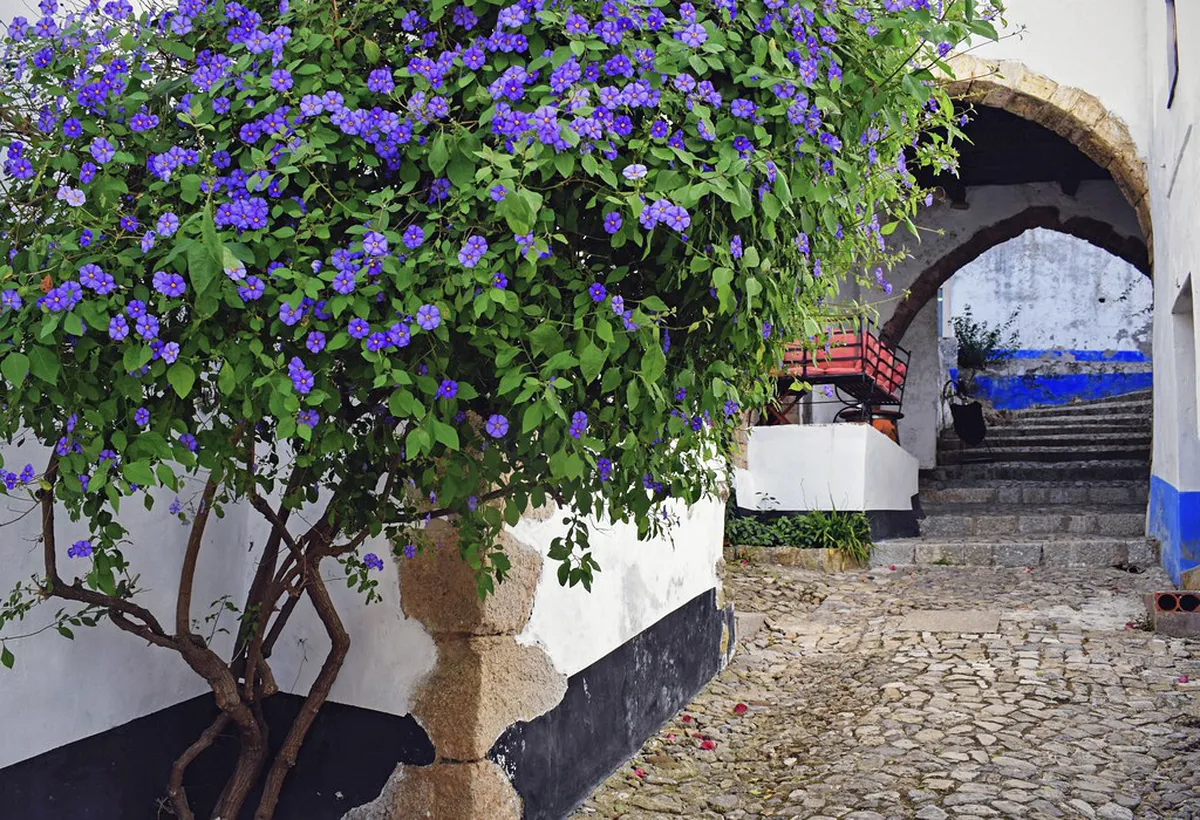
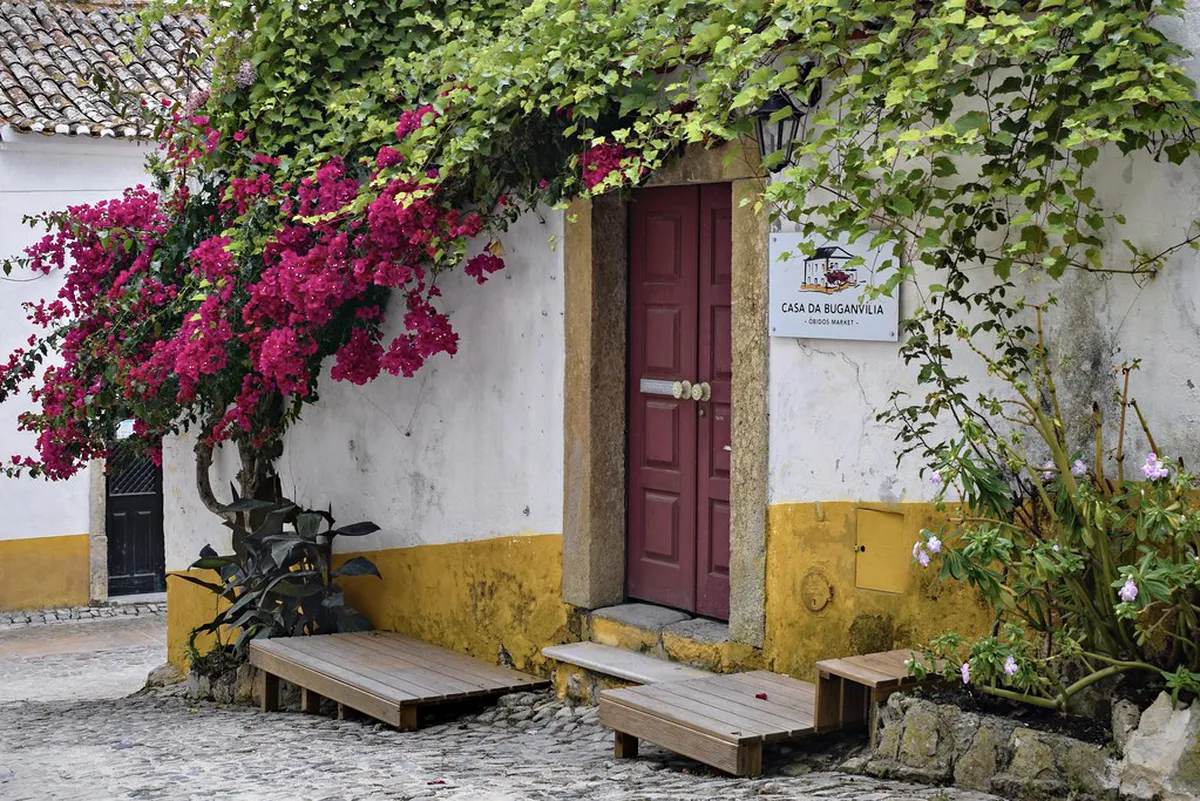
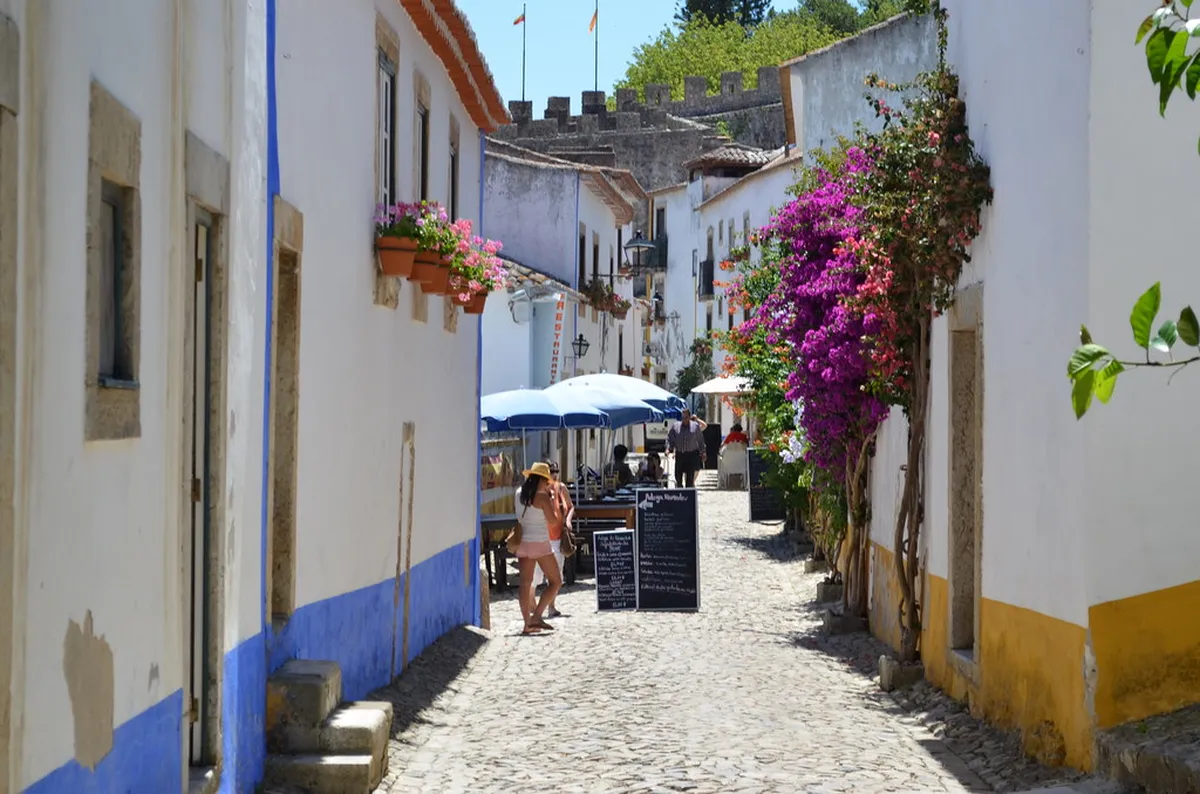
The main street, Rua Direita, runs the length of the town from Porta da Vila to the castle and is lined with cherry liqueur stalls, ceramic shops, and small restaurants. It is busy by 10:00 and very busy by midday. The real charm of Óbidos starts the moment you turn off Rua Direita into any side alley. The whitewashed houses with their blue and yellow painted borders, the unexpected courtyards, the cats sleeping in doorways — all of it is accessible in ten minutes of deliberate detour.
Plan at least two hours for unstructured wandering. Comfortable shoes are essential: the cobblestones are uneven and the streets slope significantly between the gate end and the castle end of town.
Visit the Igreja de Santa Maria
The main church on the central square has a plain exterior that gives nothing away. Inside, floor-to-ceiling azulejo panels from the 17th century cover three walls in deep blue and white, depicting scenes from the life of Saint Catherine. This was also the site of the royal wedding of King Afonso V and his young cousin Isabella in 1441 — the king was ten, Isabella was eight, and the marriage was used to give Óbidos as a gift to the queen. The church is open daily from approximately 09:30 to 12:30 and 14:30 to 17:00; entry is €1–2.
Look for the tomb of João de Noronha near the main altar, with its notable Renaissance carving. Also worth finding: a painting attributed to Josefa de Óbidos, the most important female Baroque painter in Portuguese history and a native of the town.
Walk the Medieval Walls
The full circuit of the walls takes 30–45 minutes and reaches a height of around 13 metres in places. The path is wide but completely unrailed — this is not the place for loose sandals, young children on their own, or anyone who genuinely dislikes heights. The view from the top is the best in the region: the castle to the west, the aqueduct to the east, and open agricultural countryside in every direction.
Golden hour (roughly 19:00–20:30 in summer, earlier in winter) is when the walls are at their best. The day-trip crowds have left by then, the light is warm, and the town takes on a noticeably different quality. If you are spending the night, save the walls for late afternoon and go up again after dinner if the light holds.
Visit the Castle of Óbidos
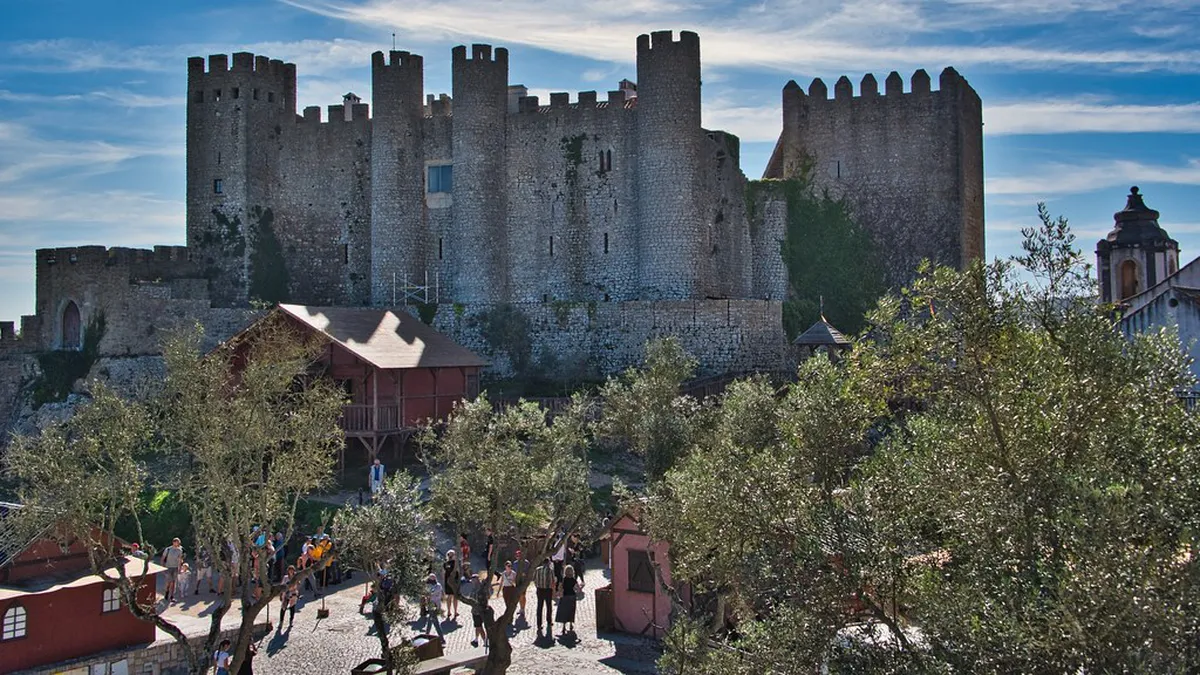
The Castelo de Óbidos dates from the 12th century Moorish period with major rebuilding under King Dinis I in the 13th century. Most of the interior now functions as the Pousada (see accommodation section), but the outer grounds, courtyard, and towers are accessible to non-guests. The courtyard hosts major town events, including the Medieval Market in July and the Chocolate Festival in spring. Even a 30-minute walk around the exterior gives a good sense of the castle's scale.
Try Ginja in a Chocolate Cup
Ginja de Óbidos is a sweet cherry liqueur made by macerating sour ginja cherries (Prunus cerasus) in aguardente with sugar for several weeks. Óbidos is strongly associated with the drink partly because it is served here in a small edible dark chocolate cup rather than a glass — a tradition linked to the local chocolate industry. A single shot in a chocolate cup costs €1–2 at any of the street stalls on Rua Direita. Shoot the liqueur first, then eat the cup. Do not sip it; the chocolate is only designed to hold the liquid briefly.
You can also buy bottled Ginja to take home — most stalls have a shop behind them selling 500ml bottles for €8–12. The Ginja de Óbidos guide covers producers and varieties in more detail.
Browse Local Artisan Shops and the São Tiago Church Bookstore
The shops on Rua Direita stock the full range of Portuguese souvenirs: cork products, ceramic bowls and tiles, embroidered linen, and local food products including Ginja, jams, and honey. Prices are reasonable and most are locally produced rather than generic imports. Allocate 45–60 minutes and a rough budget of €20–40 if you plan to buy anything.
Just before the castle, look for the Igreja de São Tiago — a former royal chapel that is now a full-sized independent bookstore. The altar end of the nave is still visible behind shelves of Portuguese and international titles. It is one of five bookshops in the walled town and one of the most atmospherically unusual retail spaces in Portugal. Entry is free; books range from €5 to €40.
Óbidos as a UNESCO City of Literature: What It Actually Means
In 2015, Óbidos became the first city in Portugal to join the UNESCO Creative Cities Network as a City of Literature. The designation was not simply honorary — the town council used it as the anchor for a deliberate municipal policy of converting empty or underused historic buildings into independent bookshops. The logic was that books would draw a different type of visitor, extend stays, and diversify the local economy away from pure day-trip tourism.
The result is five independent bookstores distributed across the walled town, each in a different kind of historic building: a deconsecrated church (São Tiago), a former wine press, a wine shop that doubles as a bookshop, the main hall of a hotel, and a small space inside an old market building. No other town of 3,000 people in Portugal has anything close to this density of independent booksellers. Most visitors notice the bookshops and assume they are quirky tourist traps. They are actually a planned urban strategy that has been running for over a decade.
The Literary Man Hotel (A Escola, formerly), with its 55,000 books arranged throughout every room and corridor, is the most visible expression of this policy. The hotel's restaurant, Book and Cook, serves full dinners with menus printed inside second-hand novels. Book ahead in summer; the restaurant fills up most evenings.
Day 2: Deeper Dive into Óbidos and Its Surroundings
A second day in Óbidos rewards a slower pace. Start with a late breakfast at Capinha d'Óbidos, a small traditional bakery tucked into the walls near the main entrance. The baker works at an open counter visible from the street — watch the pastéis de nata and folhados de carne (meat pastries) being made before ordering. This is one of the most authentic bakeries in the entire region and easy to walk past if you are not looking for it specifically.
Visit The Literary Man Hotel and Bookstore
Even if you are not staying here, the hotel is worth entering. The ground floor is effectively a public bookstore: 55,000 books arranged in wooden shelves through sitting rooms, corridors, and former classrooms. You can browse, buy, have coffee, or simply walk through and take it in. The building is a converted 19th-century school and the atmosphere — quiet, slightly eccentric, warm — is unlike anywhere else in Portugal. It is located just outside Porta da Vila, a three-minute walk from the main gate.
Explore the Aqueduto de Usseira
The 16th-century aqueduct was commissioned by Queen Catherine of Austria to bring fresh water from the Usseira spring to Óbidos, roughly 3 km to the east. It still stands almost entirely intact and is visible from the main parking area on the eastern side of town. The best viewing angle is from the road that runs along the base of the arches — the full length of the structure is around 3 km and you can walk a portion of it. Access is free and takes 20–30 minutes. Combine it with the walk around the outer perimeter of the walls for a broader view of the town than you get from inside.
Find the Baloiço Óbidos (the Swing)
The swing viewpoint sits on a small hill on the western side of the town, a five-minute walk from the castle. Search "Baloiço Óbidos" in any maps app for the exact location. The view frames the castle and the full length of the northern wall — it is the best wide-angle perspective of Óbidos from ground level and one of the more photogenic spots in the region. Go early morning on day two to beat the queue that builds by mid-morning. Access is free.
Explore São Pedro Church and the Municipal Museum
São Pedro Church, near the castle end of Rua Direita, has a more restrained interior than Santa Maria but is worth ten minutes if you have time. The ornate gilded altar is the main feature; the church is free to enter. The Municipal Museum of Óbidos is housed in a 17th-century manor a short walk from the main square. It holds a permanent collection of local archaeological finds, Portuguese decorative arts, and works by Josefa de Óbidos. Entry is approximately €1–2; open Tuesday to Sunday, 10:00–13:00 and 14:00–18:00, closed Mondays.
Day Trips from Óbidos
Óbidos makes an excellent base for exploring the Silver Coast. Nazaré is 30 km north and worth a half-day for the clifftop viewpoint (Sítio) and the beach. Peniche is 22 km west and has a well-preserved 16th-century fortress as well as the departure point for Berlenga Island. Caldas da Rainha is 6 km north — a working market town with a famous ceramics tradition and a Thursday market that draws locals from the entire region. None of these require an overnight stay if you have a car. The Lagoa de Óbidos beaches guide covers the coastal lagoon that sits between Óbidos and the Atlantic coast, about 10 km west.
Festivals and Events in Óbidos (2026)
Óbidos runs a year-round calendar of themed festivals that transforms the town several times a year. The International Chocolate Festival (Festival Internacional do Chocolate) typically runs for two to three weeks in April or May. Chocolatiers from across Portugal and Europe set up inside the castle grounds; there is a fee for the main tasting area (around €4–8) though the outer castle grounds are often free. Book accommodation months in advance if your visit coincides with the festival.
The Medieval Market (Mercado Medieval) takes over the town for two weeks in July or August. The entire walled center is converted into a medieval fair with costumed traders, period food, jousting, and live music. It is spectacular but extremely crowded — hotel prices in the area roughly double and the town's narrow streets can feel genuinely overwhelming at peak times. If you prefer a quieter visit, avoid those dates.
The Opera Festival (October) and the Christmas Village (December) are two of the quieter seasonal events that give Óbidos a distinctive character without the summer-scale crowds. The Christmas market in particular — with the castle illuminated and the streets decorated — is one of the most photogenic versions of the event in Portugal. Check turismo.obidos.pt for confirmed 2026 dates before you book.
Where to Stay in Óbidos
Staying inside the walls is the single biggest upgrade you can make to an Óbidos visit. Once the day-trip coaches leave in the late afternoon, the town becomes quiet in a way that is genuinely hard to find in popular tourist destinations. Cobblestones echo, cats appear, and the castle is lit gold. You need to be here for that.
Pousada Castelo de Óbidos is the highest-profile option — a hotel occupying the medieval castle itself. Rooms have stone walls, antique furnishings, and views over the rooftops. Rates start around €200–300 per night depending on season; book several months ahead for summer. It is expensive by Portuguese standards but the experience of sleeping in a 14th-century fortress is genuinely unlike anything else in the country.
The Literary Man Hotel is the better-value choice for most travelers. Rooms are comfortable and bookshelf-lined, breakfast is included, and the restaurant is one of the best in the area. It sits just outside the main gate rather than inside the walls, which loses something, but it is a five-minute walk to everything. Rates are typically €100–180 per night.
Casa das Senhoras Rainhas, near the castle ramparts, offers well-appointed rooms with some private balconies and a small courtyard garden. It is quieter than either of the above and popular with couples. Hostel Argonauta, housed in a 17th-century wine press, is the best budget option — shared dorms from around €20–25 per night in a genuinely characterful building in the artisan quarter. The where to stay in Óbidos guide covers all options with current pricing.
Planning Your Visit: Practical Tips for 2026
The best seasons to visit are spring (April–May) and autumn (September–October). The weather is mild (15–22°C), the festivals are interesting rather than overwhelming, and the town has not yet reached peak summer saturation. July and August bring the most events but also the most crowds and highest accommodation prices.
Óbidos is entirely walkable but not entirely flat, and the cobblestones are genuinely challenging for pushchairs, wheelchairs, and anyone with limited mobility. The main street (Rua Direita) is the most accessible route through town but still uneven. Mobility-impaired visitors can see most of the town from street level — the castle courtyard and church interiors are accessible — but the wall walk is not recommended for wheelchair users or anyone with significant balance or height issues.
There are no ATMs inside the walls. Cash is useful for street Ginja stalls and smaller shops, though most restaurants and hotels accept cards. The town has no supermarket inside the walls; the nearest is in Caldas da Rainha or Leiria. If you are staying overnight and self-catering, stock up before you arrive. For a full day-by-day itinerary framework, see the one-day Óbidos itinerary and Óbidos festivals and events guide.
Frequently Asked Questions
How much time do you need for Óbidos?
Most visitors find that a half-day to a full day is sufficient to explore the main attractions within the walled town. If you plan to delve deeper into local shops, enjoy a leisurely meal, or visit nearby sites, an overnight stay is highly recommended.
Is Óbidos worth visiting?
Absolutely. Óbidos is widely considered one of Portugal's most charming and well-preserved medieval towns, offering a unique glimpse into the country's history. Its picturesque setting and distinct atmosphere make it a memorable stop for any traveler.
What is Óbidos famous for?
Óbidos is most famous for its remarkably preserved medieval castle and town walls, which you can walk along. It is also renowned for Ginja de Óbidos, a sweet cherry liqueur often served in edible chocolate cups, and its vibrant annual festivals.
Can you walk the walls of Óbidos castle?
Yes, you can walk a significant portion of the medieval walls surrounding Óbidos. This experience offers incredible panoramic views of the town and surrounding landscapes. Be aware that the path is uneven and lacks railings in many sections, so caution is advised.
How do you get to Óbidos from Lisbon?
The easiest way to get to Óbidos from Lisbon is by taking the Rapida Verde (Green Express) bus from Campo Grande station. The direct bus journey typically takes about one hour. Alternatively, driving offers flexibility, taking roughly an hour via the A8 highway.
Óbidos rewards the traveler who slows down. The town is small enough that you can cover its core sights in a single afternoon, but layered enough — in history, food culture, literary heritage, and sheer visual appeal — that a second day feels entirely justified. Walk the walls at golden hour, stop in the bookshop inside the church, eat dinner somewhere with a novel for a menu, and leave by the back alleys rather than the main street. That combination is hard to find anywhere else in Portugal, or anywhere in Europe.
Explore More Óbidos Guides
Deep-dive guides for every part of an Óbidos trip — the castle and walls, where to eat and stay, the best season to visit, and how to spend your day.
Top Experiences in Óbidos
Plan Your Óbidos Trip
 12 Best Things to Do in Aveiro (2026)June 8, 2026
 11 Best Things to Do in Évora, Portugal (2026)June 8, 2026