
Bom Jesus Do Monte Braga: The Ultimate Visitor's Guide
Discover the Sanctuary of Bom Jesus do Monte in Braga. Learn about the iconic Baroque stairs, the world's oldest water-powered funicular, and essential travel tips.
On this page
Bom Jesus Do Monte Braga: The Ultimate Visitor's Guide
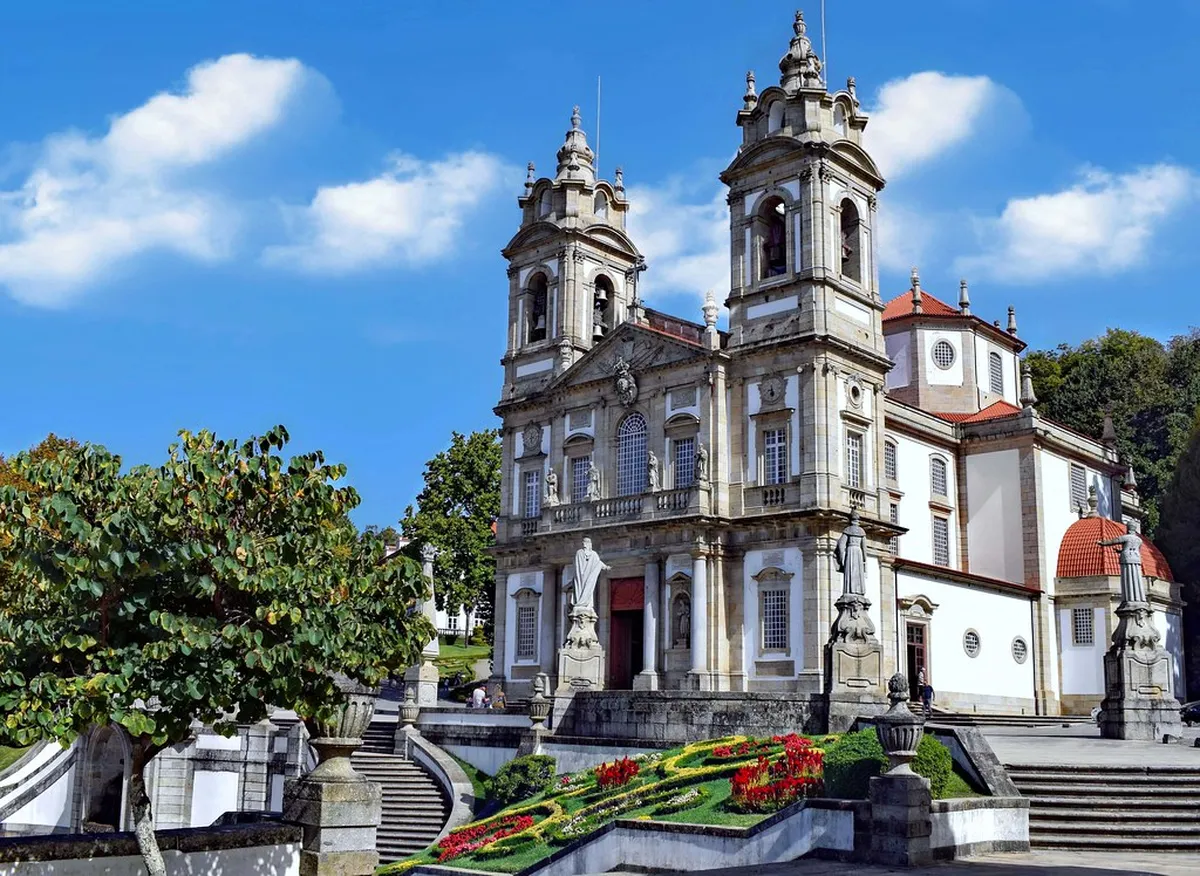
The Sanctuary of Bom Jesus do Monte is a magnificent hilltop pilgrimage site located just outside the city of Braga. This sacred destination stands as one of the most photographed landmarks in all of Portugal due to its stunning zigzag staircases, lush gardens, and sweeping views over the Minho region. Visitors from around the world come to admire the blend of Baroque architecture with the natural landscape of Monte Espinho. Exploring this site consistently ranks as one of the most rewarding 12 Best Things to Do and Places to Stay in Braga for any traveler.
The grounds offer far more than just religious significance. There is a historic water-powered funicular, a lake where you can rent rowboats, hidden grottoes, and a park extensive enough to fill a full afternoon. The atmosphere here remains genuinely serene, even during the busier summer months of 2026. This guide covers everything you need to make the most of your visit — from the symbolism behind each fountain to the exact bus stop, ticket prices, and funicular schedule.
The History and UNESCO Significance of Bom Jesus do Monte
Worshippers have been climbing Monte Espinho since at least the 14th century. The earliest documented chapel on the hill dates to 1373, dedicated to the Holy Cross. It was rebuilt in 1494 and again in 1522. The grand sanctuary visible today began taking shape in 1722, when Archbishop Rodrigo de Moura Teles of Braga — troubled by the temple's state of abandonment — funded the first two stairways and their flanking chapels.
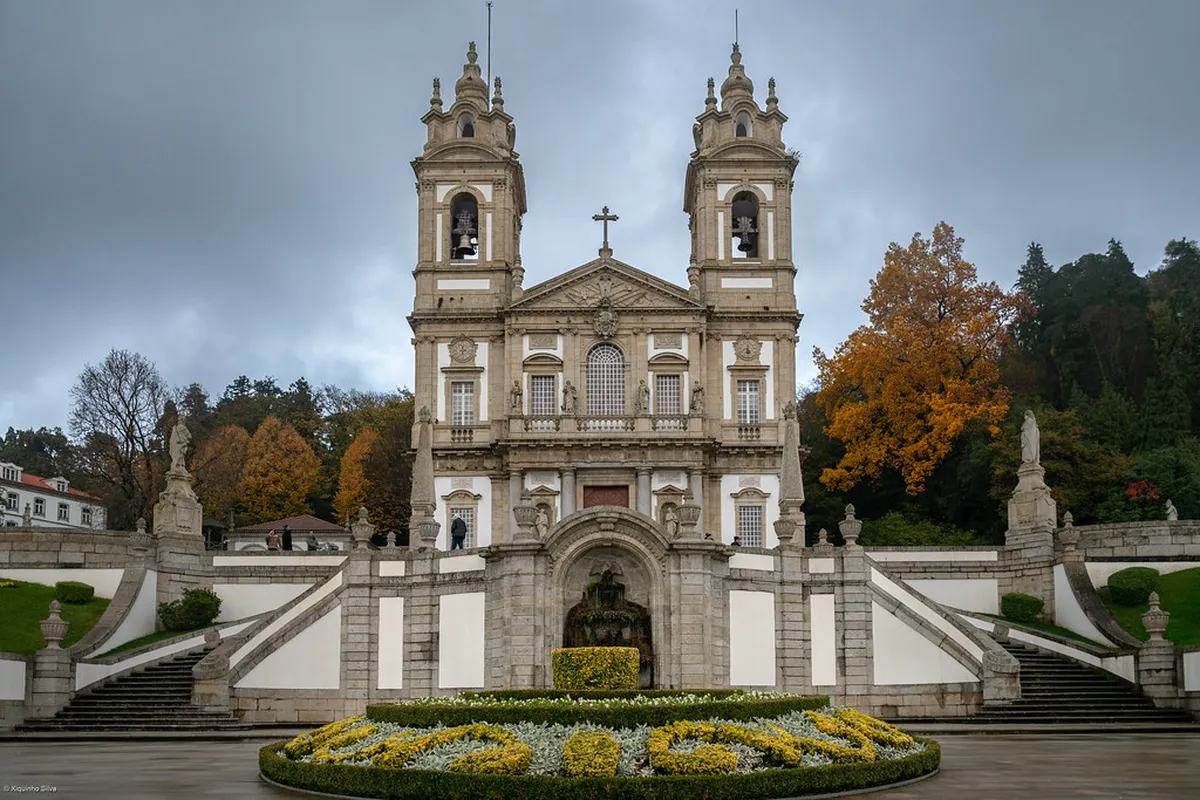
The project expanded over the following decades. Pope Clement XIV issued three religious briefs regarding the sanctuary, drawing larger and larger numbers of devotees to the hill. By 1784, the existing church was too small, and the architect Carlos Amarante laid the first stone of the present Neoclassical Basilica. Archbishop Gaspar de Bragança oversaw the final staircase, the Three Virtues Stairway, completing the processional route as we know it today. The Basilica's twin bell towers were finished in 1812.
In 2019, UNESCO inscribed the sanctuary as a World Heritage Site under the "Sacri Monti" category — a network of sacred mountain pilgrimage sites in southern Europe. The designation recognises its unique fusion of landscape architecture, allegorical sculptural programme, and its uninterrupted role as a living place of worship. The site represents the Passion of Christ in physical form, with each chapel, fountain, and statue placed to guide pilgrims through a meditation on redemption.
The sanctuary continues to function as an active church in 2026. Sunday masses draw local families alongside international visitors, and religious festivals throughout the year bring thousands to the slopes. Respecting the sacred character of the site — keeping noise low near worshippers and dressing modestly inside the Basilica — ensures a positive experience for everyone.
The Sacred Way: Navigating the Iconic Baroque Stairways
The climb begins at the Portico, a small archway flanked by two peaked chapels and shaded by tall trees. The Portico Staircase — also called the Via Crucis or Way of the Cross — winds gradually uphill through 376 steps set into a wide, manageable slope. Fourteen chapels line this section, each containing a terracotta tableau depicting a Station of the Cross. The canopy of trees keeps this stretch cool even in summer, making it the easiest part of the ascent.
Above the Portico Staircase, the trees fall away and you arrive at the base of the Stairway of the Five Senses. A wide landing opens before you with the first unobstructed view of Braga and the surrounding hills. The stairs split into two symmetrical zigzag flights comprising 104 steps. Each of the five human senses is represented by an allegorical fountain. Water flows from the eyes of one statue to symbolise sight, from the ears of another for hearing. Smell, taste, and touch each have their own sculptural grouping. Chapels continue along the sides throughout this section.
A short landing separates the Five Senses from the Three Virtues Stairway, the final 93 steps. This section is dedicated to the theological virtues of Faith, Hope, and Charity, each again personified by an ornate fountain and statuary. The transition from the zigzag pattern to the more open upper plaza creates a genuine sense of arrival. The total step count from Portico to churchyard is 577 — most fit walkers complete it in 20 to 30 minutes.
Walking the stairs allows you to study the tile work and sculptural detail at close range. Many visitors find the descent equally rewarding: walking down offers a completely different perspective of the valley below. Either way, wear shoes with grip — the granite steps become slippery when wet, and they are frequently damp from the fountain water. You can include the full staircase experience in a well-planned 10 Essential Stops for a One Day in Braga Itinerary without rushing.
The Basilica and Summit: What to See at the Top
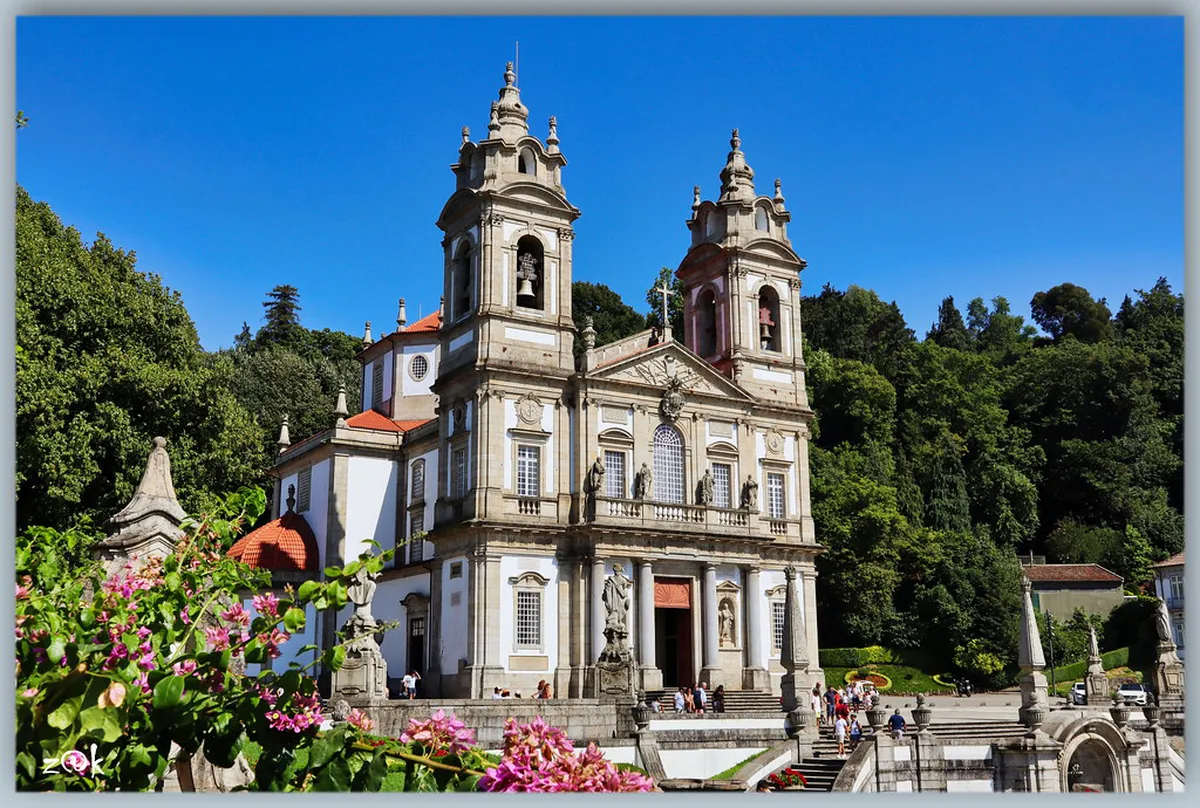
The Neoclassical Basilica of Bom Jesus do Monte sits at the crown of the grand staircase, overlooking the Court of Moses — a manicured forecourt with statues of biblical figures. Construction spanned from 1784 to 1812. Inside, exposed grey stonework and whitewashed plaster give way to a vaulted interior decorated in ivory, pink, and gold. Beams of light pierce through the dome at certain times of day. The back altar depicts the Crucifixion in detailed polychrome sculpture. Entrance to the Basilica is free, and it is open 08:00–19:00 in summer and 09:00–18:00 in winter.
Behind the Basilica lies the park complex — an area many visitors overlook after the visual drama of the staircase. The park contains artificial grottoes, gazebos, hidden fountains, and wooded paths. A small lake sits at its centre where rowboats are available for hire at €2 per 15 minutes (maximum two persons per boat, available daily 10:00–13:00 and 14:00–19:00). A teahouse beside the lake serves drinks and light snacks. Families often spend a full afternoon here after a quick look at the Basilica.
One sub-attraction that most visitors skip is the High Choir and Bell Tower inside the Basilica. For €1 per person you can climb into the choir gallery and then up into one of the twin bell towers, which offers a vantage point directly above the Three Virtues Stairway. The perspective from this height — looking straight down the zigzag staircases you just climbed — is one of the most striking views on the entire site. Access is open 08:00–12:30 and 14:00–19:00 in summer (14:00–18:00 in winter). It is low-key and never crowded.
For photography, arrive about two hours before sunset. The sun sets directly in front of the staircase facade, casting warm golden light across the whitewashed Baroque walls. In the final minutes before the horizon swallows the sun, the entire Basilica turns a brief, vivid rose. After dark, floodlights illuminate the structure against the night sky — a completely different but equally worth-staying-for scene.
The Bom Jesus Funicular: A Marvel of 19th-Century Engineering
The Funicular do Bom Jesus, opened in 1882, is the oldest water-powered funicular still in operation in the world — and one of only three of its kind. The mechanism is elegantly simple: the cabin at the top fills a tank with water until it becomes heavier than the cabin waiting at the bottom. As the heavier cabin descends, a counterweight cable pulls the lighter cabin up the steep slope. No engine is involved. The wooden interiors of both cabins have been carefully preserved in their original 19th-century form.
Funicular Timing: The funicular departs at 25 and 55 minutes past each hour. If you arrive at 14:30, your next departure is 14:55. A one-way ticket costs €2, return €3. Summer hours: 09:00–20:00; winter: 09:00–19:00. The three-minute ride brings you directly to the Court of Moses — ideal when walking the 577 steps in one direction.
The ride takes roughly three minutes from the lower station to the Court of Moses at the foot of the Basilica. A one-way ticket costs €2, and a return ticket costs €3. The funicular runs 09:00–20:00 in summer and 09:00–19:00 in winter. Crucially, it departs at 25 and 55 minutes past each hour — so if you arrive at the lower station at, say, 14:30, your next departure is at 14:55. Build this into your timing to avoid a 20-minute wait at the platform.
The funicular is the most practical option for visitors with limited mobility or those travelling with young children. It brings you directly to the upper complex, bypassing the 577 steps entirely. The lower station is conveniently positioned near the main bus stop, the parking area at the foot of the hill, and the beginning of the Portico Staircase — so you can easily ride up and walk down, or vice versa, without backtracking.
If you plan to walk the staircase, taking the funicular in one direction is the best compromise. Walking up gives you the full symbolic experience of the Sacred Way; riding down saves your knees for the rest of the day. Staff at the lower station can answer basic questions about timing and the mechanism.
Practical Visitor Information: Getting to Bom Jesus and Accessibility
The sanctuary is located at Estrada do Bom Jesus, 4715-056 Tenões, approximately 7 kilometres from Braga's city centre. The most affordable way to reach it is the city bus line 2, which departs from the Liberdade bus stop on Avenida de Liberdade. Buses run every 30 minutes throughout the day, the journey takes about 20 minutes, and the fare is €1.65 paid directly to the driver (cash or a rechargeable Andante card). Bom Jesus is the final stop, so you cannot miss it. Note: in practice, buses can run late during peak hours — if you wait longer than 30 minutes, an Uber or taxi from the city centre costs under €10 and is usually faster.
If you are travelling from Porto, the train to Braga is the most convenient option. Trains depart from Porto's São Bento and Campanhã stations roughly one to two times per hour throughout the day. The first service leaves São Bento at 06:15; the last train from Braga returns at 23:32. The journey takes about an hour and costs €3.50 one-way. Check the CP train schedule before you go. From Braga station, take line 2 to Bom Jesus. This makes the sanctuary an easy addition to a Porto to Braga Day Trip: The Ultimate 1-Day Itinerary.
Drivers will find parking at the bottom of the hill near the bus stop (free, for those who want to walk the full staircase) and a paid car park at the top of the hill in the Bom Jesus gardens. The top car park is convenient for a quick visit to the Basilica and park only. The approach road to the top is narrow and one-way in sections; allow extra time on busy summer weekends.
For visitors with reduced mobility: the most practical route is to park at or take the bus to the lower station, then ride the funicular (€2 one-way) directly to the Court of Moses. From there, the Basilica, gardens, and lake are all accessible on relatively flat ground. The Bell Tower climb involves stairs and is not suitable for wheelchairs, but the rest of the upper complex is manageable. There is no dedicated accessibility parking at the lower funicular station; the general car park at the bottom is about 50 metres from the funicular entrance.
Reduced Mobility Access: The funicular bypasses 577 steps and delivers you directly to the upper complex. However, the Bell Tower involves stairs and is not wheelchair accessible. Summer hours (longer days) make it easier to visit the Basilica and gardens without time pressure. In winter, daylight ends earlier — plan afternoon arrival.
Frequently Asked Questions
How many steps are in the Bom Jesus do Monte staircase?
There are exactly 577 steps from the bottom portico to the top of the Basilica. The climb is divided into several stages, including the Sacred Way and the Stairway of the Five Senses. Most people take about 20 to 30 minutes to reach the top at a steady pace.
Is there an entrance fee for Bom Jesus do Monte?
Entry to the sanctuary grounds, the staircases, and the Basilica is free for all visitors. You only need to pay if you choose to use the funicular or rent a rowboat on the lake. This makes it one of the best value attractions in the region.
How do I get from Braga city center to Bom Jesus?
The easiest way is to take the local bus number 2 from Avenida da Liberdade. You can find more details on transit in our guide on How to Get to Braga: 6 Best Ways to Travel. Taxis and ride-sharing apps are also widely available and very affordable for the short trip.
What is the best time to visit Bom Jesus do Monte?
Late afternoon is the best time to visit for beautiful light and smaller crowds. Arriving about two hours before sunset allows you to explore the gardens and then watch the sun go down over the city. Weekdays are generally much quieter than weekends or religious holidays.
Why is Bom Jesus do Monte famous?
It is famous for its unique Baroque zigzag staircase and its status as a UNESCO World Heritage site. The sanctuary is also home to the world's oldest water-powered funicular. It remains a major pilgrimage site and a masterpiece of European landscape architecture.
Bom Jesus do Monte is a must-see destination that perfectly captures the spirit of Braga. The combination of architectural beauty and natural tranquility creates an unforgettable experience for every visitor. Whether you climb every step or take the historic lift, the views from the top are worth the effort. This site stands as a testament to the rich history and enduring faith of the Portuguese people.
Take your time to explore the hidden corners of the park and the symbolic details of the fountains. The sanctuary offers a unique blend of physical challenge and spiritual reflection. It remains one of the most significant cultural landmarks in Northern Portugal for a good reason. Your visit will likely be one of the most memorable parts of your time in the Minho region.
As you plan your trip for 2026, remember to check for any local festivals that might be happening. The sanctuary is a living monument that continues to welcome people from all walks of life. Enjoy the fresh air, the history, and the incredible panoramas that only this hilltop can provide. Safe travels as you discover the wonders of Bom Jesus do Monte in Braga.
 10 Best Tips for Timing Your Visit to GuimarãesJune 8, 2026
 9 Essential Tips for Visiting Guimarães CastleJune 8, 2026