

Uber, Bolt, and Taxis in Lisbon: 10 Essential Transport Tips
Compare Uber, Bolt, and taxis in Lisbon. Learn about airport pickup points, current pricing, safety scams to avoid, and which app is best for your trip.
On this page
Uber, Bolt, and Taxis in Lisbon: 10 Essential Transport Tips
Lisbon offers three main options for car-based travel: Uber, Bolt, and licensed taxis. Each fits a different budget and situation. This guide covers how each service works in 2026, what you will actually pay, and how to avoid the traps that catch first-time visitors — especially at the airport.
The city is compact, only 7km from the airport to the historic centre, so most rides are short and affordable. But surge pricing, scam drivers, and the hidden airport pickup location can turn a simple trip into a frustrating detour. Knowing the rules ahead of time saves both money and stress.
Lisbon Ride-Hailing Overview
Uber and Bolt together dominate the app-based market in Lisbon. Both are officially classified under Portugal's TVDE framework — Transporte Individual e Remunerado de Passageiros em Veículos Descaracterizados — which means every legal ride-hailing vehicle must display a TVDE sticker on both the front and rear windows. This is a national legal requirement, not a voluntary badge. Checking for the sticker before you get in is the single fastest way to confirm a vehicle is legitimate. For official Lisbon transport guidance including TVDE regulations, visit the Visit Lisboa traveller information page.

Traditional taxis operate under a separate regulatory framework managed by the AMT (Mobility and Transport Authority). They are easily identified by their black-and-green or beige livery and are always metered. Both systems coexist well, and most visitors end up using all three depending on where they are and what time it is.
Prices across all three options are reasonable by European standards. A typical city-centre ride runs €5–€15 depending on distance and demand. The our Lisbon transport overview covers the full picture — metro, bus, and ferry included — if you want to compare all modes before deciding.
Uber in Lisbon: Service Tiers and Expectations
Uber operates three main tiers in Lisbon in 2026: UberX (standard), Uber Green (electric or hybrid), and Uber Comfort (larger, newer vehicles with more experienced drivers). UberX is the default and covers most journeys well. Uber Comfort is worth paying for at peak hours, on rainy evenings, or when catching a flight — drivers on this tier are less likely to cancel short or awkward rides.
Uber requires vehicles to meet a minimum standard — at least a Peugeot 308 or equivalent. In practice this means the cars are generally newer and in better condition than the Bolt fleet. English-speaking drivers are common, and all payments go through the app, so you never need to carry cash or negotiate a fare.
Wait times in the city centre are typically three to five minutes during the day. In the evenings from 17:00 onwards, and especially on Friday and Saturday nights, waits can stretch much longer as drivers prioritise higher-value fares. If you need a guaranteed pickup during peak hours, booking Comfort in advance through the app's scheduled-ride feature removes most of the uncertainty.
Bolt in Lisbon: The Local Price Leader
Bolt consistently undercuts Uber on base fares by 15–25%. For short trips around Lisbon's centre — Baixa to Bairro Alto, Intendente to Mouraria — you can regularly find Bolt rides for under €5. The Estonian company has captured a large share of the Portuguese market, and availability is strong even in residential neighbourhoods well away from the tourist zones.
The trade-off is fleet quality. Bolt does not enforce a minimum vehicle standard the way Uber does, which means you occasionally get an older, higher-mileage car. Drivers also frequently work both apps simultaneously. During busy weekend nights, cancellation rates are noticeably higher on Bolt — a driver who sees a longer, more profitable Bolt or Uber request will abandon a short city hop.
The fix is the same as with Uber: choose the 'Bolt Comfort' category instead of the standard tier. It costs slightly more but dramatically reduces cancellations. Bolt also runs frequent promo codes for new accounts and repeat users, which narrows the gap with Uber further. If you link a Portuguese phone number or email, you often receive a welcome discount on your first few rides.
- Cancellation risk is highest during rain, weekend evenings (20:00–24:00), and during major events near the NOS Alive or Super Bock Super Rock festival weeks in summer.
- Bolt's app design is nearly identical to Uber's, so switching between them requires no learning curve.
Bolt typically undercuts Uber by 15–25% on base fares in Lisbon. Upgrading to Bolt Comfort costs a little more but significantly reduces the chance of a driver cancelling your short city-centre ride.
Traditional Taxis: Rules, Meters, and Ranks
Official Lisbon taxis are black-and-green or beige. The driver must run the taximeter from the moment you depart — this is a legal requirement, not optional. Current 2026 regulated fares are €0.96 per km during the day (Tariff 1, urban), rising to €1.21 per km at night (21:00–06:00), on weekends, and on public holidays. The minimum fare is €3.32 (day) and €3.98 (night). There is a flat luggage surcharge of €1.60 for items placed in the boot — this covers all luggage in a single trip, not per bag. Licensed taxis rank outside Terminal 1 arrivals as confirmed by the Humberto Delgado Airport official site.
Taxis have one major practical advantage: the rank is directly outside the Terminal 1 arrivals doors, so there is no walking required. They are also faster to board than an app ride during peak airport periods when Uber and Bolt waits stretch beyond 20 minutes. The downsides are the 20–40% night and weekend surcharges and the occasional driver who "forgets" to start the meter — a tactic that typically results in a €40 flat-rate demand at the end.
Always watch for the meter starting within the first 30 seconds of the ride. If the driver claims a flat price at the outset, step out and use the app instead. Many taxis now accept Multibanco card payments, but the machine is not always functional. Carrying €20 in cash as backup is sensible, especially for airport arrivals late at night when connectivity for apps can be slow.
Price Comparison: Uber vs. Bolt vs. Taxi
For a standard city-centre journey of 4–6km in 2026, Bolt typically costs €5–€10, Uber runs €7–€14, and taxis land at €10–€18 (more on evenings and weekends with the night tariff). The airport to Baixa — roughly 7km — usually comes in at €8–€12 on Bolt, €10–€15 on Uber, and €15–€20 by taxi. These are base estimates; surge pricing on apps can push the same route to €20+ during a rainy Friday evening.

| Service | City trip (4–6km) | Airport to centre | Night/weekend surcharge | Luggage fee |
|---|---|---|---|---|
| Bolt | €5–€10 | €8–€12 | Dynamic surge | None |
| Uber | €7–€14 | €10–€15 | Dynamic surge | None |
| Taxi | €8–€15 | €15–€20 | +20–40% fixed | €1.60 per trip |
One pricing nuance that no app shows you: taxis charge a regulated surcharge for airport departures, which is added automatically on top of the meter reading. App-based rides include all fees in the upfront price. During heavy rain or major public events — Lisbon's summer festivals, New Year's Eve — app surge pricing can temporarily make taxis the cheaper option. Checking both apps before confirming is a two-minute habit that can save €5–€10 per ride.
Tipping is not customary in Portugal. Portuguese passengers rarely tip taxi or app drivers. A €1 or €2 coin for a smooth airport run is appreciated but never expected — do not feel pressured by silence or a driver's pointed glance at the tip screen in the app.
Airport Logistics: Pickup Points at Terminal 1
The Uber and Bolt pickup zone at Lisbon Airport (LIS, Humberto Delgado) moved in June 2023. It is no longer at the Kiss & Fly parking area in front of departures. Drivers now wait in P2, the short-stay car park on the ground floor directly north of the arrivals hall. To reach it: exit the arrivals hall, walk past the Starbucks coffee shop, continue through the two sets of doors, and the car park entrance is directly ahead. Follow the blue "pre-reservas online" signs. The walk takes two to three minutes from customs exit. For current confirmation, check the official airport transport guide.
The taxi rank remains at its original location: directly outside the arrivals doors, unmissable on exit. If you cannot get an app ride quickly and do not want to walk to P2, a licensed taxi is the fastest way out of the airport. Do not request your app ride while you are still collecting luggage inside the terminal — request it only once you are through customs and heading for the door, otherwise drivers accept the fare and then cancel when they see the wait is longer than expected.
Terminal 2 is used only for departing low-cost flights (Ryanair, Wizz Air). All arriving passengers land at Terminal 1 regardless of carrier. There is a shuttle bus between the two terminals, but for arriving passengers this is irrelevant. Both Uber and Bolt pickups operate exclusively from the P2 location at Terminal 1. For full details on getting around after landing, the Lisbon Airport Guide covers every onward option in detail.
Internet connectivity in P2 can be patchy. If the Uber or Bolt app is not loading, connect to the airport's free Wi-Fi before you leave the terminal building — it does not reliably extend to the parking area. Having your app set up with a saved payment method before you land eliminates the most common source of delay.
Safety First: Avoiding Common TVDE Scams
Every legal TVDE vehicle must carry the TVDE sticker on both the front and rear windshields. This sticker is issued by the AMT and confirms the driver and car are registered for paid passenger transport. Never enter a vehicle that lacks it. The sticker is small, rectangular, and typically placed in the lower corner of the windshield. If it is missing, walk away — no amount of persuasion from a driver changes the legal reality.
The most common scam at Lisbon Airport is the unofficial driver who approaches you in the arrivals hall and offers a "private transfer." These individuals have no TVDE registration, no insurance, and no fixed fare. They typically demand €40–€60 for a trip that would cost €12 on Bolt. If you cannot immediately book an app ride and want a car, walk to the licensed taxi rank outside — it is always staffed, the price is metered, and the driver is accountable.
For app rides, always verify the driver's name, photo, and license plate number in the app before opening the car door. Ask the driver to confirm your name before you sit down. If a driver ever asks you to cancel the trip and pay cash, refuse immediately and report the incident through the app. All app journeys are tracked and insured — the cash request removes both protections.
Unofficial drivers who approach you inside the arrivals hall at Lisbon Airport have no TVDE registration and no fixed fare — they commonly demand €40–€60 for a ride that costs €12 on Bolt. Never follow anyone who offers a "private transfer" inside the terminal.
Essential Apps and Account Setup
Download Uber, Bolt, and FreeNow before you travel. FreeNow (formerly MyTaxi) operates in Lisbon and acts as a hailing app for licensed taxis — useful when you want a metered taxi but prefer to book digitally and pay by card without carrying cash. Having all three apps installed means you always have a fallback if one service has a surge or a driver shortage in your area.
Link a credit card to each app before you arrive. First-time setup — entering card details, verifying the account, and making a first booking — is genuinely painful when you are tired after a long flight and standing in a crowded arrivals hall. Doing it at home takes five minutes and saves considerable frustration at the airport. Both Uber and Bolt accept major Visa and Mastercard cards; Bolt also accepts PayPal.
Bolt frequently releases promo codes for new accounts and seasonal campaigns. Checking the Bolt app's "Promotions" tab on the first day of your trip often reveals a discount valid for 48 hours. New Uber accounts in Portugal sometimes receive a welcome discount on the first two or three rides. These codes are worth claiming before your first airport trip, where the fare is typically the most expensive of your stay.
Beyond Cars: When to Take the Metro or Tram
The Lisbon Metro (operated by Metro de Lisboa) is the fastest option for journeys that follow the four lines. A single fare costs €1.90, or €1.72 with a Navegante Zapping card (a reloadable card that also works on buses, trams, and ferries). The metro runs 06:30 to 01:00 daily. For airport arrivals, the red line connects Aeroporto station directly to Alameda (green line connection) and São Sebastião (blue line connection) in under 25 minutes for €1.90 — significantly cheaper than any car option.
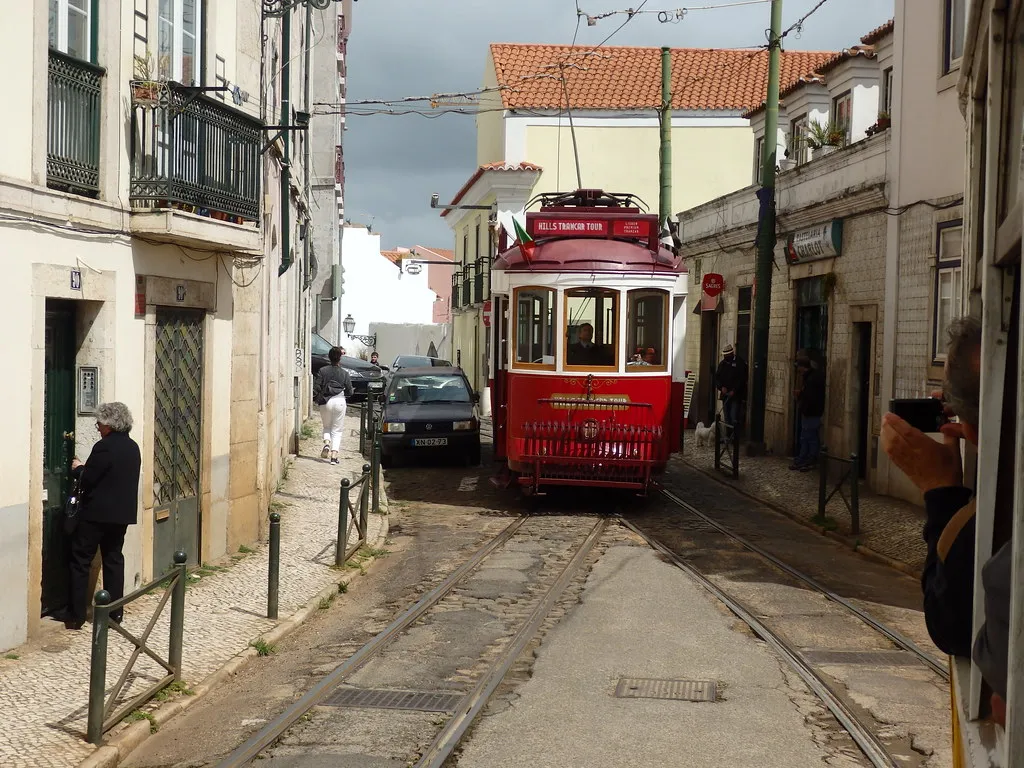
The metro does not serve all neighbourhoods. Alfama, Graça, Mouraria, Belém, and Alcântara have no metro stations. If your accommodation is in any of these areas, an app ride or taxi is your only practical option from the airport. Checking the metro map against your hotel address before you land is a two-minute task that can save you €15.
The historic trams (operated by Carris) are useful for specific routes but are deliberately slow and extremely crowded in summer. Tram 28 through Alfama and Tram 15E to Belém are scenic but impractical as timed transport. Use them for the experience, not for getting somewhere on a schedule. For day trips to Sintra or Cascais, the train from Rossio or Cais do Sodré stations is far cheaper than any car option — see our guide to getting the train to Sintra for full schedules and fares.
Frequently Asked Questions
Is Uber or Bolt cheaper in Lisbon?
Bolt is generally cheaper than Uber in Lisbon. It frequently offers discounts and lower base rates. Most budget-conscious travelers prefer Bolt for short city trips.
Where is the Uber pickup point at Lisbon Airport?
The pickup point is at the 'Kiss & Fly' parking lot. You must go to the departures level at Terminal 1. Follow signs for the parking area across the street.
Do Lisbon taxis take credit cards?
Many modern taxis now accept credit cards. However, some older drivers still prefer cash payments. Always ask the driver before starting your journey to be sure.
What does the TVDE sticker mean in Portugal?
The TVDE sticker identifies legal ride-hailing vehicles. It stands for Transport of Passengers in Unmarked Vehicles. This ensures the driver and car meet local safety standards.
Navigating Lisbon is much easier when you understand the car-based transport options. Uber provides a premium experience with high reliability for international travelers. Bolt wins on price and is the favorite of many local residents. Taxis remain a solid choice for quick departures from official ranks. For cheaper everyday journeys, compare ride costs against the the Lisbon Metro network and the Viva Viagem and Navegante card.
Always look for the TVDE sticker to ensure your ride is legal. Plan your airport pickup by heading to the P2 car park north of arrivals for app rides — not the old Kiss & Fly location. With these tips, you can explore the City of Seven Hills with confidence. Enjoy your time in beautiful Lisbon and travel safely.
 How To Get To Aveiro Travel GuideJune 8, 2026
 How to Get to Braga: 6 Best Ways to TravelJune 4, 2026