Lisbon Airport Guide: 16 Things to Know for 2026
Master Lisbon Humberto Delgado Airport (LIS) with our 2026 guide. Covers Terminal 2 transfers, Metro Red Line tips, lounge access, and how to avoid taxi scams.
On this page
Lisbon Airport Guide: 16 Things to Know for 2026
Lisbon Humberto Delgado Airport (LIS) sits 7km north of the historic centre and handles roughly 35 million passengers a year across two terminals. Most travellers reach Baixa within 30 minutes of clearing immigration, but the airport's age, the low-cost/full-service terminal split, and a quirky passport-control layout trip up first-timers more than almost any other Western European gateway.
This guide covers what you need to know in 2026: the right terminal, how to reach your hotel for under €2 by metro or €15 by taxi, the lounges worth paying for, and the specific ways travellers lose money or miss flights here. Plan ahead and your Lisbon 3-day itinerary starts the moment you step off the jetbridge. Fares, lounge access, and Terminal 2 details have been cross-checked against the independent Lisbon Airport guide and the recent Terminal 2 modernisation works.
Humberto Delgado Airport Overview
LIS is operated by ANA Aeroportos de Portugal (part of Vinci Airports) and sits inside the city limits between the Alvalade and Olivais districts — which is why your descent feels uncomfortably close to apartment blocks. Capacity strain shows in long passport-control queues and tight gate areas, but most passengers move through in under two hours with a sensible buffer.
The airport runs 24/7, but Terminal 2 closes its public areas overnight (roughly 00:30–03:30) — a detail that catches out travellers booking very early budget flights. Three transport modes link the airport to the city: the Metro Red Line (under T1), licensed taxis (rank outside arrivals), and Uber/Bolt (pickup at the P2 short-stay car park). The dedicated Aerobus express service was retired in recent years; ANA now points most travellers to the metro.
Terminal 1 vs. Terminal 2 Logistics
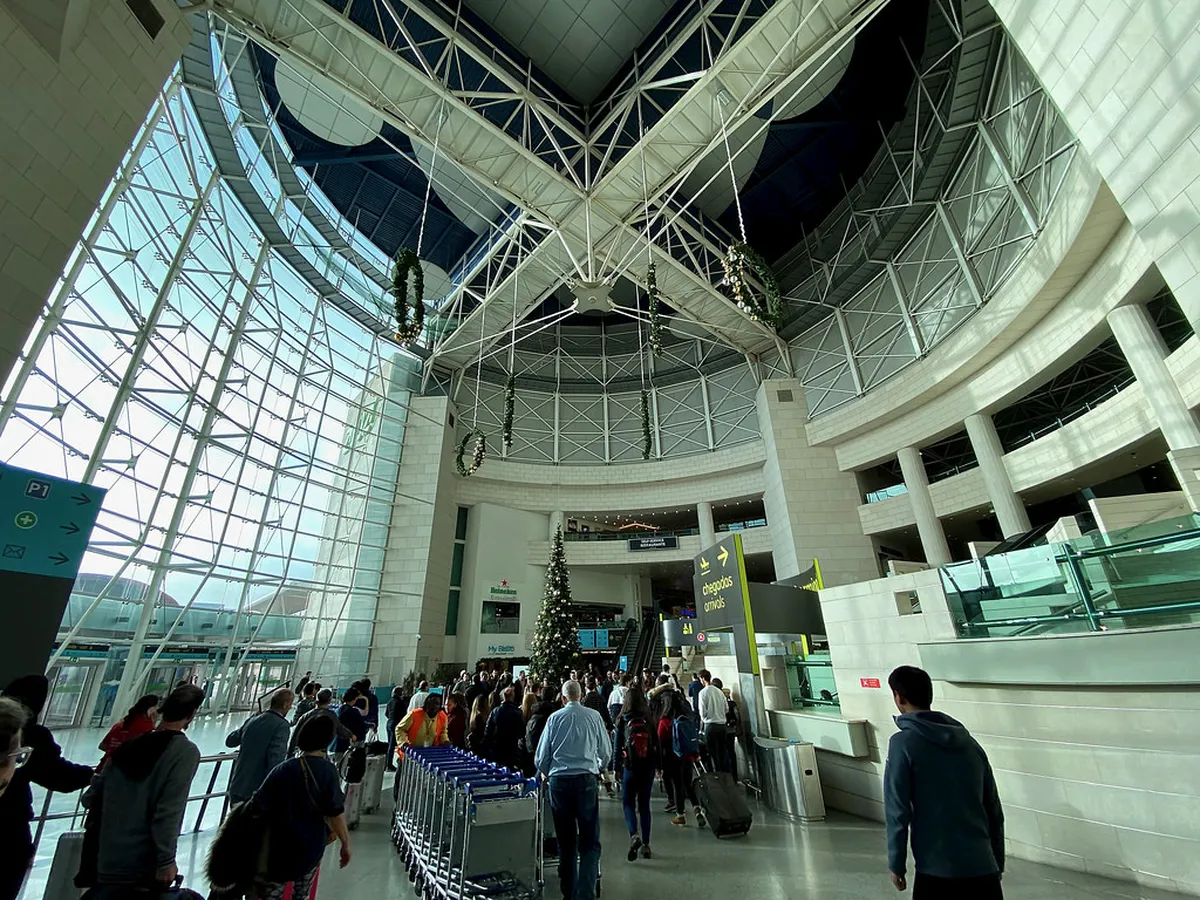
Terminal 1 is the main building. It handles arrivals for every flight (low-cost included) and departures for TAP Air Portugal, Star Alliance carriers, British Airways, Emirates, Delta, United, and Iberia. T1 gates use an "N" prefix for non-Schengen and "S" for Schengen — a quick way to tell whether you'll face passport control before the gate. All lounges, full duty-free, baby-changing rooms, and the Living Spot rest area near gates S19–S20 are inside T1.
Terminal 2 is a stripped-down departures-only building used by Ryanair, easyJet, Wizz Air, Transavia, and Vueling. It has no airline lounges, no rest zones, and a far smaller food court (essentially a McDonald's plus grab-and-go counters). Recent expansion works enlarged the gate area but seating is still scarce at peak times.
A free shuttle bus links the two terminals every 10–20 minutes, 24/7, from the dedicated stop outside T1 departures. With waiting and walking, allow 25–30 minutes door-to-door. There is no airside connection: a TAP arrival in T1 to a Ryanair departure in T2 means clearing immigration, collecting bags, exiting, riding the shuttle, checking in again, and re-clearing security — plan a 3-hour minimum layover for that combination.
Major Airlines and Global Destinations
TAP Air Portugal is the dominant carrier and uses Lisbon as its global hub. Its long-haul network is unusually strong for a city this size: nonstops to New York (JFK and Newark), Boston, Miami, Toronto, São Paulo, Rio, Luanda, and several West African capitals. Star Alliance partners (Lufthansa, United, Air Canada, Turkish) align lounges and tier benefits accordingly. Other T1 carriers include Iberia, British Airways, Air France-KLM, Emirates, Delta, and United. From Terminal 2, Ryanair is the largest operator, followed by easyJet, Wizz Air, Transavia, and Vueling on routes covering most of Europe and Morocco. Always confirm your departure terminal on the boarding pass — a few low-cost flights still operate from T1 during peak summer.
The Arrivals Process (Schengen vs. Non-Schengen)
If you're flying in from another Schengen country, there is no passport control. You'll deplane, follow signs to baggage reclaim, and walk straight into the public arrivals hall — typically out of the building within 40 minutes of touchdown.
Arriving from outside Schengen — UK, US, Canada, Brazil, anywhere with a non-EU layover — means passport control before baggage. At peak times (06:00–10:00 when transatlantic and Brazilian flights cluster, and 17:00–19:00) queues can run 60–90 minutes. e-Gates are open to biometric passport holders from the EU, EEA, UK, US, Canada, Australia, New Zealand, Japan, South Korea, and Singapore; using them cuts wait times to under 15 minutes. Children under 12 can use e-Gates with an accompanying adult under recent rule changes — meaningful for families flying from the US or UK.
The Departures Process and Timing
For Terminal 1 departures, arrive 2 hours ahead for Schengen flights and 3 hours ahead for non-Schengen. TAP self-service kiosks let you print bag tags before joining the bag-drop queue. T1 security has multiple lanes and a fast-track option (about €10 booked online) that is worth it on summer Saturdays.
For Terminal 2, arrive 2.5 hours ahead at minimum. The terminal opens around 03:30 and the single security funnel can produce 40-minute queues at 05:00 and 09:00. Ryanair check-in at T2 closes 40 minutes before departure with no exceptions; once you miss it, the airline will not put you on the next flight. T1 gate signage uses an "N" prefix (Gates N1–N16, north pier) for non-Schengen and "S" prefix (Gates S19–S55, south pier) for Schengen.
The Passport Control Trap (Non-Schengen Departures)
Lisbon's most expensive design quirk: when you depart on a non-Schengen flight, passport control is positioned after the airside duty-free area, not before it. Most European airports do the opposite. The result is that travellers clear security, wander into a concourse of Port wine and Pastéis de Belém, then realise they need to clear immigration when their flight is already boarding.
The non-Schengen passport queue can take 30–60 minutes during transatlantic peaks (09:00–13:00 and 17:00–22:00). Combined with a long walk to gates N1–N16, missing your flight is a real risk if you linger. The rule: once your gate is announced (or no later than 60 minutes before departure for non-Schengen), head directly through passport control. Shop on the inside of immigration if you must — the same Port wine, cork, and Pastéis brands are stocked at the gate-side stalls. e-Gates work in both directions and can save 20+ minutes; US-bound passengers should add another 30 minutes for secondary gate screening.
At non-Schengen departure peaks (09:00–13:00 and 17:00–22:00), passport control queues at LIS can run 30–60 minutes — and it sits after the duty-free area, so many travellers are caught out. Head through immigration no later than 60 minutes before departure for non-Schengen flights.
Metro Red Line: The Best Way to the City
The Metro Red Line (Linha Vermelha) starts directly under Terminal 1, signposted from the arrivals hall. Service runs 06:30–01:00 daily, trains every 5–9 minutes. Buy a Navegante card from the vending machines: the card costs €0.50 (reusable), then load a single fare (€1.90) or "zapping" credit (€1.72 per metro ride, also valid on buses and trams).
For most central destinations — Baixa, Chiado, Avenida da Liberdade, Marquês de Pombal — you'll change once at Alameda (Green Line) or São Sebastião (Blue Line). Total airport-to-Baixa is 25–30 minutes. The metro is the only method reliably immune to airport-area traffic; on a weekday at 17:30 it beats a taxi by 15–25 minutes. The downside is the changeover with luggage, particularly at Alameda where the connecting platform is a flight of stairs (lift available but slow). Anyone with three or more bags or mobility limits should consider a taxi.
Taxis, Rideshares, and Avoiding Scams
Licensed Lisbon taxis (cream/beige with a green roof, or all black) form a rank directly outside the T1 arrivals exit. The metered fare to the centre should be €10–15 daytime and €13–18 at night (21:00–06:00), plus €1.60 luggage supplement. By law the taximeter must be running. There has been a documented uptick in Lisbon Airport taxi scams: drivers refusing the meter and quoting €40–60, claiming routes are closed, or using long-route detours. Three rules protect you: insist on the meter before getting in; keep luggage in the boot, not the back seat; pay with a card so receipts include GPS data for any dispute. Our getting around Lisbon covers passes for the rest of your stay.
Uber and Bolt are cheaper than taxis: €8–12 off-peak, €12–18 in evening surge. Rideshare drivers cannot pick up at the taxi rank. The official pickup zone is the P2 short-stay car park, signposted "Kiss & Fly," across from arrivals and slightly north past the Starbucks. If 3 app drivers reject in a row at peak hour, switch to a taxi.
Uber and Bolt pickups at LIS are only permitted at the P2 "Kiss & Fly" short-stay car park — not at the taxi rank outside arrivals. The metered taxi fare to the city centre should be €10–15 during the day; insist on the meter before getting in to avoid the documented overcharging scam.
Aerobus, Bus Lines, and the Sete Rios Connection
The dedicated Aerobus express service has been retired. Current bus options are city lines 705, 722, 744, and 783 from the stop in front of arrivals, stopping at Cais do Sodré, Marquês de Pombal, and Saldanha. Single fares are €2.10 from the driver or €1.72 with zapping credit; expect 45–70 minutes to the centre and a 50x40x20cm baggage size limit per passenger.
For long-distance buses at Sete Rios station (services to Cascais, the Algarve, and Spain via Rede Expressos, Eva, and Flixbus), take Red Line metro to Saldanha then Yellow Line one stop. Tram 15 doesn't reach the airport but is the famous riverside tram to Belém — take Red Line to Cais do Sodré, then Tram 15 westbound for the Jerónimos Monastery and Pastéis de Belém.
Transport Decision Matrix: Airport to City
Pick the right transport for your situation. All figures assume travel to the historic centre.
- Metro Red Line — €1.72–1.90, 25–30 minutes with one change. Best for solo travellers or pairs with carry-on. Avoid with three-plus bags or reduced mobility.
- Licensed taxi — €10–18 plus €1.60 luggage, 20–40 minutes. Best for groups of three or four, late-night arrivals after 01:00 metro shutdown, or anyone with children or heavy bags.
- Uber / Bolt — €8–18, 20–40 minutes. Best for fixed in-app pricing and a non-Portuguese-speaking driver. Pickup at P2 "Kiss & Fly" only.
- City bus (705/722/744/783) — €1.72 zapping, 45–70 minutes. Slowest option; only useful if you're staying near a stop on these lines.
- Pre-booked private transfer — €25–40 fixed, 25–35 minutes. Best for groups of four-plus, families with car seats, or direct trips to Sintra, Cascais, or the Algarve.
Gare do Oriente: The Closest Train Station
Gare do Oriente is the airport's effective railway station — three Red Line stops from LIS, about 8 minutes by metro. Designed by Calatrava for Expo '98, it serves CP intercity trains north to Coimbra and Porto, south to the Algarve via the Alentejo, and regional services. Alpha Pendular runs Lisbon–Porto in 2h45; tickets are cheaper booked 5+ days ahead via cp.pt. Oriente also hosts a major long-distance coach terminal serving every Portuguese region plus Madrid, Seville, and Paris.
The Vasco da Gama mall is built into the station with restaurants and supermarket-priced groceries — useful for 90 minutes between trains. If you're going straight to Sintra, Cascais, or the Algarve, plan from Oriente: same metro ride, no need to drag bags into the centre. See our day trips from Lisbon guide for regional inspiration.
Car Rental Village and Requirements
The Car Rental Village sits 800 metres from Terminal 1 with a free shuttle every 5–10 minutes from outside arrivals. Operators include Europcar, Hertz, Avis/Budget, Sixt, Goldcar, Enterprise, and Guerin. Allow 30 minutes for returns: drop the car, ride the shuttle, reach check-in.
You need a valid driving licence (held 12+ months), a credit card in the main driver's name, and a passport. UK drivers need only a domestic licence post-Brexit. US, Canadian, and Australian drivers technically need an International Driving Permit — most desks don't check but Portuguese roadside checks do, with fines of €120–600 if missing. Buy excess insurance from a third party rather than the rental desk (saves around €15/day) and inspect for chips before driving away.
Parking Zones (P1 to P3) and Rates
ANA operates four main parking zones. P1 is the multi-storey attached to T1, for short stays at roughly €4 first hour and €27 per day. P2 is the open-air short-stay lot used by rideshares and pickups, at similar rates. P3 is the long-term lot 5 minutes from T1 (free shuttle) at roughly €18 per day with multi-day discounts. Online prepayment via the ANA website saves 15–30%.
The Kiss & Fly drop-off zone (free up to 10 minutes) sits at the front of T1 departures and is the only legal Uber/Bolt pickup spot; over 10 minutes triggers a steep per-minute rate. Several nearby Hotels near Lisbon Airport offer "park and fly" packages with a stay plus 7–14 days of parking, often cheaper than P3 alone.
Premium Lounges and Relaxation Zones
Lisbon Airport has three primary airside lounges, all in T1. The ANA Lounge (Schengen, 6th floor, 06:00–22:00) has showers and €38 pay-at-door; Priority Pass and Lounge Key get free entry. TAP Premium Lounge Tejo (Schengen, 6th floor) and TAP Premium Lounge Atlântico (non-Schengen, 5th floor) both have showers from €27 pay-at-door, with free access for Star Alliance Gold and TAP Business. Landside, the ABC Airport Business Centre is a pay-as-you-go workspace before security. T2 has no airline lounges.
For travellers without lounge access, Living Spot is the airport's free designated rest area in T1 airside near gates S19–S20: reclining loungers, charging, and quiet zoning. Perfect for 1–3 hour waits but not designed for overnight sleeping. Overnight sleepers camp near Gate 16 or on the landside Burger King benches; security tolerates them but does ID checks between 02:00 and 04:00.
Terminal 2 Survival Checklist
Terminal 2 is functional but bare. Post-modernisation works improved the gate area, but seating, food, lounges, and amenities remain significantly more limited than the main terminal.
- Arrive at least 2.5 hours early — one main security lane builds queues between 05:00 and 09:00.
- Eat before you arrive — once airside, options are McDonald's and grab-and-go; no sit-down restaurants and no lounge.
- Bring a portable charger — airside outlets are limited and patchy.
- Skip the duty-free — airside shopping is a small kiosk, not comparable to T1.
- Don't arrive overnight — T2 closes around 00:30 and reopens around 03:30. If connecting late from T1, wait at T1 until 03:00 before taking the shuttle.
- Confirm your terminal on the boarding pass — a few low-cost flights still depart T1 in peak summer.
Shopping and Dining Highlights
Terminal 1 has the largest shopping concourse, with airside duty-free covering Port wine (Sandeman, Graham's, Taylor's), Madeira, olive oil, cork goods, and Pastéis de Belém in branded gift boxes. Prices are competitive on alcohol and tobacco for non-EU passengers. 1st Cafe and Go Natural run 24-hour landside; airside, McDonald's, McCafé, and Express Market are open round-the-clock.
Sit-down T1 airside restaurants include Portuguese brasseries serving bifanas, bacalhau, and grilled chicken at airport markups (€18–25 a main). Free water bottle refill stations are airside in T1 — bring an empty bottle through security. There is a VAT refund counter (eTax kiosks) for non-EU residents on purchases over €50; allow 20 minutes.
Essential Passenger Services and WiFi
Free unlimited WiFi runs throughout both terminals on the "VINCI Airports wifi" network. T1 speeds are adequate for streaming; T2 WiFi can be slow at peak times. Luggage storage at multiple T1 locations is open 24/7, from €3 for a small item to €16 for 24 hours of large-bag storage — useful if you have an evening flight and want to spend the day in central Lisbon. Avoid Euronet's high-fee ATMs; use Santander, Caixa Geral de Depósitos, or Millennium BCP instead.
Family services include baby-changing rooms in T1 landside and airside, a Family Room landside with kitchen and seating, free strollers airside, and a children's play area near the Schengen gates. Travellers with reduced mobility should pre-book ANA's MyWay assistance service at least 48 hours before flying via the ANA website or airline; it covers wheelchair pushers from kerb to gate and bridge boarding, free of charge.
Immigration, Customs, and Security Rules
Standard EU security rules apply: liquids in 100ml containers in a single one-litre transparent bag, laptops out of the bag in a separate bin. Some T1 lanes use modern CT scanners that allow laptops and liquids to stay in the bag — clearly signed and faster. Fast-track lanes are around €10 booked online. Non-EU personal allowances: 1L spirits or 4L wine, 200 cigarettes, €430 of other goods; cash declarations required at €10,000 or more. Departing non-EU residents can claim VAT refunds on purchases over €50 via the eTax kiosk in T1 departures.
The EU Entry/Exit System (EES) is fully active at LIS as of 2026. First-time non-EU arrivals must complete a fingerprint and facial-image registration at a dedicated kiosk (5–8 minutes) before reaching passport control on first entry; subsequent entries within three years use the e-Gates in under a minute. Build an extra 15 minutes of buffer into your first 2026 arrival if you're a US, UK, Canadian, or Australian passenger who hasn't yet enrolled.
Layover Strategy: Using Spare Time Well
The airport is close enough to the city for layovers of 5+ hours to leave productively. The metro reaches Praça do Comércio in 30 minutes, so a 5-hour layover gives you 2 hours in the centre after security, transit, and return buffer. For shorter windows, head two stops east on the Red Line to Oriente (8 minutes): outside the station you have Parque das Nações, the Vasco da Gama mall, and the Lisbon Oceanarium — a one-hour visit fits inside a 3-hour layover. Under 3 hours, stay airside.
Travelling to Sintra, Cascais, and Beyond
For Sintra, take Red Line metro to Oriente, then a CP regional train direct to Sintra — 1h15 total, €1.90 metro plus €2.30 train, departures every 20 minutes. For Cascais, take metro to Cais do Sodré (25 minutes via a São Sebastião change), then the Linha de Cascais coastal train in 35 minutes — 1h10 total and €3.60, hugging the Tagus estuary and Atlantic coast. For the Algarve, take metro to Oriente and catch Alfa Pendular or Intercidades south; Lisbon to Faro is roughly 3 hours. If you're staying in Lisbon first, our best areas to stay in Lisbon and best time to visit Lisbon guides will help, with options at the best hotels in Lisbon close to onward transport.
Frequently Asked Questions
How do I get from Terminal 1 to Terminal 2?
A free shuttle bus connects the two terminals every 10 minutes. The bus stop is located directly outside the departures hall of Terminal 1. The journey takes approximately 10 minutes, so ensure you leave enough time before your low-cost flight departs from Terminal 2.
Is there a train station inside Lisbon Airport?
There is no mainline train station inside the airport, but there is a Metro station on the Red Line. For regional and international trains, you must take the metro three stops to Gare do Oriente. This hub provides connections to Porto, Faro, and other major Portuguese cities.
Where is the best place to pick up an Uber at the airport?
Uber and other rideshare drivers are required to pick up passengers at the "Kiss & Fly" parking area. This zone is located near the Terminal 1 departures hall, not the arrivals exit. Follow the signs for departures and cross the street to find the designated pickup point.
Can I store my luggage at the airport for a few hours?
Yes, luggage storage lockers are available in Terminal 1 near the P2 parking area. They operate 24 hours a day and accept various bag sizes. This is a convenient option for travelers who want to visit the city center during a long layover without carrying heavy bags.
Lisbon Humberto Delgado Airport rewards travellers who plan ahead and punishes those who treat it like any other Western European hub. The two-terminal split, the duty-free-then-passport-control layout, and the documented taxi scams are all manageable once you know about them. The metro is the cheapest fast option, the Kiss & Fly zone is the only legal Uber pickup, and Terminal 2 demands its own arrival buffer. For ideas on what to do once you're in town, see our companion piece on things to do in Lisbon. Pair this guide with our Obidos From Lisbon Travel Guide and Mouraria Lisbon for a fuller Lisbon picture.