
Guimaraes Old Town Walking Guide: A Perfect 1-Day Itinerary
Plan your Guimaraes Old Town walking guide with top picks, neighborhood context, timing tips, and practical booking advice for a smoother trip.
On this page
Your Ultimate 1-Day Guimaraes Old Town Walking Guide
Guimarães is the birthplace of Portugal — and its UNESCO-listed historic centre is one of the most intact medieval old towns in the country. This self-guided Guimaraes Old Town walking guide is built for visitors who want to cover the essential sights in a single day without feeling rushed. The route is roughly 5 km on foot, entirely within the pedestrianised core, and requires no transport once you arrive.
The guide covers where to start, which landmarks to prioritise, what to eat, how to get here from Porto, and a few practical details that most itineraries skip. In 2026 the castle and palace remain the two ticketed anchor sights; everything else along Rua de Santa Maria and the main squares is free to walk.
How to Get to Guimarães
The easiest approach from Porto is by urban train from São Bento station. Trains run roughly every hour on weekdays and every 90 minutes on weekends; the journey takes 70–85 minutes depending on the service. A single ticket costs around €3.60–€4.00 in 2026. Check current schedules on the CP timetable page before you travel, since afternoon services can have gaps of up to two hours.
One practical warning that most guides skip: some trains departing São Bento split partway along the route, with certain carriages branching to Braga and others continuing to Guimarães. If you board the wrong carriage, you will end up in the wrong city. Look for the destination board on the carriage door or ask station staff to confirm your carriage before departure. It is an easy mistake and entirely avoidable.
Check the carriage destination board before boarding trains from São Bento—some split mid-route to Braga while others continue to Guimarães. Confirm with staff if unsure.
If you are driving from Porto, the A7 motorway covers the 50 km in about 45 minutes. Do not attempt to park inside the historic centre — it is largely pedestrianised. The main tourist car park is north of the centre, near the Paço dos Duques. Guimarães train station is a straightforward 700-metre walk south of the old town along Avenida Dom João IV.
Must-See Guimarães Attractions on the Walking Route
The old town clusters its key sights within a compact area. Start at the hilltop and work your way down through the medieval streets toward the main squares — this approach means you tackle the steep section first and finish at the liveliest spots.
Castelo de Guimarães is the logical starting point. The 10th-century fortress rises from a granite outcrop and is directly linked to Afonso Henriques, Portugal's first king. Its seven towers are connected by a walkable rampart, and the views over the city and surrounding Minho hills are the best in town. Allow 45–60 minutes. Entry is around €2 in 2026; closed Mondays.
Igreja de São Miguel do Castelo sits immediately below the castle. This small Romanesque chapel from the 12th century is said to be where Afonso Henriques was baptised, though historians debate this. The original baptismal font is still inside, and the floor holds tombstones of medieval knights. Entry is free; the interior is open during daylight hours.
Paço dos Duques de Bragança is a 15th-century palace with distinctive brick chimneys inspired by French manor houses. Inside, more than 60 rooms display period tapestries, medieval furniture, and weapons from the Portuguese conquest of North Africa. Allow at least 45 minutes. Entry is around €5; check hours as the palace is typically closed on Mondays. Tickets for the castle and palace can often be purchased together at a combined rate — worth asking at the entrance.
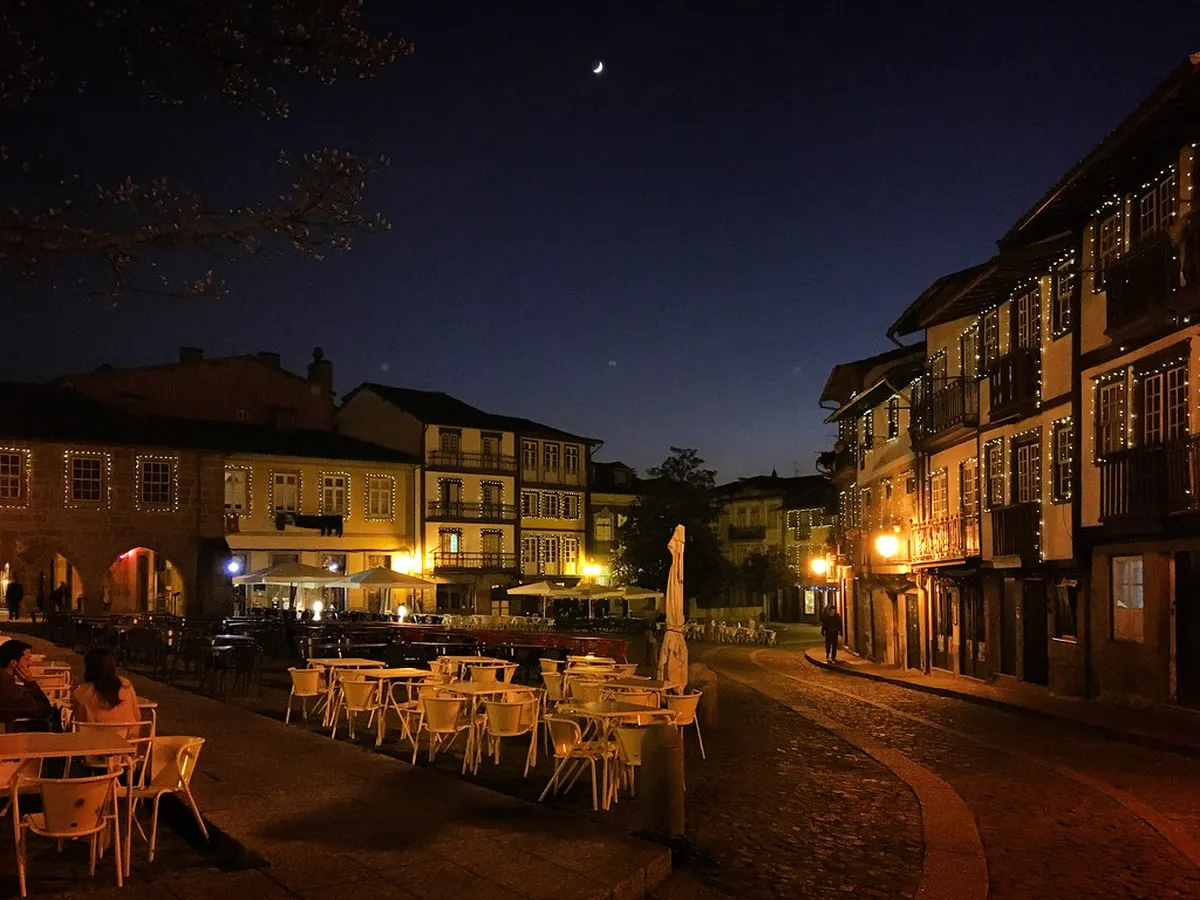
Largo da Oliveira is the medieval heart of the old town. The square takes its name from an ancient olive tree beside a 14th-century Gothic canopy shrine. The adjoining Igreja de Nossa Senhora da Oliveira was founded in the 10th century and rebuilt after the Battle of Aljubarrota in 1385 — its silver altarpiece and the battle tunic of King João I are inside. Entry to the church is free. The square fills with café tables and is one of the best spots in northern Portugal for an afternoon coffee or a glass of vinho verde.
Praça de Santiago connects directly to Largo da Oliveira through a narrow passage. It has a more intimate scale and draws a younger crowd of students and locals in the evenings. The difference between the two squares is worth noting if you plan to return at night: Largo da Oliveira is quieter and more atmospheric after dark, while Praça de Santiago stays livelier well into the evening.
Largo do Toural marks the southern boundary of the medieval centre. Originally a cattle-fair ground, it is now a handsome square lined with 18th-century buildings and the unofficial meeting point for the modern city. The tourism office nearby stocks free printed maps of the old town.
Rua de Santa Maria: The Old Town's Oldest Street
Running between the castle area and Largo da Oliveira, Rua de Santa Maria is the oldest continuously inhabited street in Guimarães. It is worth walking slowly. Look up at the wrought-iron balconies, azulejo tile panels on building facades, and door knockers shaped like hands — a Moorish-influenced detail found across northern Portugal but particularly dense here. Noble houses sit beside small craft workshops and independent bookshops.
The street also connects the hilltop sights to the main squares without requiring any backtracking. Walk it southbound from the castle, and you arrive directly at Largo da Oliveira. Many visitors miss Rua de Santa Maria entirely by taking the more obvious route along the wider roads — coming down this narrow lane gives the clearest sense of what the city looked like in the 14th century.
Wear shoes with grip when walking Rua de Santa Maria—the cobblestones are uneven and polished smooth, making them slippery on the descent from the castle, especially in wet conditions.
Museums, Art, and Culture in Guimarães
The Museu de Alberto Sampaio occupies the former cloisters of the Nossa Senhora da Oliveira monastery, immediately behind the church on Largo da Oliveira. Its collection covers medieval religious art, textiles, and silverwork — but the standout piece is the tunic said to have been worn by King João I at the Battle of Aljubarrota in 1385. The cloister itself, with its orange trees and painted Gothic vaulting, is worth the entry fee even if the collection does not appeal. Entry is around €3; closed Mondays and Tuesdays.
The Paço dos Duques functions partly as a museum and partly as an official presidential residence (it was used as a second official residence through much of the 20th century). The restoration carried out in the 1930s under Salazar is controversial among architectural historians — much of the interior is reconstructed rather than original — but the scale and contents still make it one of the most absorbing sites in the city.
Guimarães was named European Capital of Culture in 2012, and the investment from that period is still visible. The Centro Cultural Vila Flor, housed in an 18th-century palace with formal gardens, runs a year-round programme of theatre, dance, and music. The gardens are free to enter and offer good views back over the old town. Even without a performance scheduled, it is worth the 10-minute walk southwest from Largo do Toural.
A Craft You Won't Find Elsewhere: Bordado de Guimarães
Guimarães has a specific embroidery tradition — Bordado de Guimarães — that is distinct from other regional Portuguese needlework. The style uses white thread on linen or cotton with open-weave geometric patterns, quite different from the colourful Viana do Castelo embroidery found elsewhere in the Minho. Several specialist shops in the historic centre sell tablecloths, placemats, and smaller pieces; prices start from around €10 for a small item and rise steeply for large hand-worked pieces.
This is one of the few places in Portugal where you can buy this embroidery directly from local producers rather than souvenir aggregators. If you want a functional, regionally specific gift that is not found in Lisbon or Porto airport shops, this is it. Look for shops along and just off Rua de Santa Maria — most are easy to miss because they have understated storefronts.
Where to Eat in Guimarães Old Town
The historic centre has a wide range of restaurants, from small tascas serving daily specials under €10 to a Michelin-starred option for special occasions. Northern Portuguese cooking dominates: expect bacalhau (salt cod), rojões (fried marinated pork), arroz de pato (baked duck rice), and vinho verde as the default table wine.
Histórico by Papaboa, near the castle, serves elevated versions of regional dishes in a restored granite building. Their outdoor terrace is good on warm days and the vinho verde list is particularly well chosen. Budget €20–30 per head for a full meal. Taberna Trovador is a cosy stone-walled tavern better suited to petiscos (small plates) and cured meats. A Cozinha por António Loureiro holds a Michelin recommendation; the lunch tasting menu offers the best value and booking is essential.
For a quick and cheap lunch, Café Oriental on the main shopping street serves daily specials — most mains under €10 — and is popular with office workers rather than tourists. If you want a vegetarian or lighter option, Cor de Tangerina in the historic centre has a courtyard terrace and good coffee. The Francesinha sandwich (a Porto dish that has spread to Guimarães) is on the menu at several spots near Largo do Toural for those wanting to try it outside Porto.
A Suggested 1-Day Tour of Guimarães
This sequence minimises backtracking and puts the steeper section (the castle hill) at the start of the day when energy is highest. The green walking route covering the historic centre is roughly 5.3 km including the walk from the train station.
| Time | Activity | Duration & Notes |
|---|---|---|
| 09:00–09:15 | Arrive at station & walk to historic centre | Walk 700 m north along Avenida Dom João IV. Stop at Igreja de Nossa Senhora da Consolação for a photo. |
| 09:15–10:30 | Guimarães Castle | Climb, walk the ramparts and central keep. Arrive early to beat school groups (arrive by 10:30). |
| 10:30–11:00 | Igreja de São Miguel & Statue | Igreja de São Miguel do Castelo (free, 10 min) and Estátua de Dom Afonso Henriques outside the castle. |
| 11:00–12:00 | Palace of the Dukes of Bragança | Explore interior rooms (45–60 minutes). |
| 12:00–12:30 | Walk to Largo da Oliveira | Walk south via Rua de Santa Maria. Visit Igreja de Nossa Senhora da Oliveira (free). |
| 12:30–13:30 | Lunch | Café on Praça de Santiago or Largo da Oliveira (Taberna Trovador or Café Oriental recommended). |
| 13:30–14:30 | Museu de Alberto Sampaio | Monastery cloisters (entry ~€3). Closed Mondays & Tuesdays. |
| 14:30–15:30 | Shopping & wander | Browse Rua de Santa Maria for Bordado embroidery; walk to Largo do Toural (tourism office here). |
| 15:30 onwards | Penha Mountain (optional) | Cable car from Teleférico station (15 min SE of Largo do Toural). Tickets ~€4.50; runs until ~18:00–19:00. |
If you are coming on a day trip from Porto and want to catch the early evening train back, skip Penha and use the extra time to sit on one of the squares with a coffee. The late afternoon light on Largo da Oliveira between 16:00 and 17:30 is excellent, and the tourist crowds thin noticeably after 16:00.
How Long to Spend in Guimarães Old Town
One full day is sufficient for most first-time visitors. The castle, palace, main church, museum, and a slow walk through Rua de Santa Maria and the key squares can be done comfortably in six hours. Many visitors come on a day trip from Porto and find that one day leaves them satisfied — the old town is compact enough that you genuinely do cover it without feeling rushed.
Two days is a better choice if you want to add Penha Mountain properly, visit Citânia de Briteiros (the Iron Age Celtic settlement 20 minutes from the city by car), or use Guimarães as a base for a day trip to Braga. Braga is just 25 minutes away and the two cities complement each other — Guimarães has stronger medieval character, Braga has more Baroque monuments and is more architecturally dramatic. Trying to combine them in a single day from Porto is possible but leaves both feeling rushed.
An overnight stay also changes the atmosphere significantly. Once the day-trip crowd leaves in the late afternoon, Guimarães becomes noticeably quieter and more local in feel. The university population means there is reliable evening activity in Praça de Santiago and along the small bar streets flanking the historic centre. If you plan to stay overnight, the historic centre itself is the obvious choice for accommodation — you are within two minutes of everything, and the cobbled setting in the evening is the point of being here.
Practical Tips for the Guimarães Old Town Walk
Wear shoes with grip. The cobblestones in the historic centre are uneven and polished smooth in places — this is particularly relevant on the descent from the castle and along Rua de Santa Maria. Flat-soled trainers are fine; sandals or smooth-soled shoes will cause problems on steep or wet sections.
The castle and palace are closed on Mondays. The Museu de Alberto Sampaio is closed on Mondays and Tuesdays. If your day trip falls on a Monday, you can still see the exteriors and walk the old town freely, but budget accordingly — the two ticketed anchor sights will be unavailable.
Spring (April–June) and early autumn (September–October) are the most comfortable times to visit in terms of weather and crowd levels. July and August are busy with summer visitors, particularly on weekends. The student academic festival in late May — Semana Académica — brings parades and concerts to the old town squares and is worth timing a visit around if the energy appeals to you.
Free printed maps of the historic centre are available at the tourism office on Largo do Toural. The map marks all major landmarks with brief descriptions and is useful for navigating the narrower back streets between the main squares. Alternatively, the walking route can be followed on Google Maps or offline apps without needing a data connection once downloaded.
Frequently Asked Questions
How do I access my walking tour in Guimaraes?
Our guide is designed for self-guided exploration, so no special access is needed. Simply follow the suggested itinerary and map out your route. You can download or print this guide for easy reference.
Where is Guimarães located in Portugal?
Guimarães is in northern Portugal, within the Minho region. It is about 50 kilometers (31 miles) northeast of Porto. This location makes it an ideal day trip destination from Porto.
Is one day enough time to explore Guimarães Old Town?
Yes, one full day is generally enough to see the main highlights of Guimarães Old Town. This includes the castle, palace, and historic squares. However, two days allows for a more relaxed pace and deeper exploration.
What should travelers avoid when planning a Guimaraes Old Town walking guide?
Avoid wearing uncomfortable shoes, as the cobblestone streets can be challenging. Also, try to avoid peak midday sun in summer. Lastly, don't try to cram too many attractions into one day.
Guimarães Old Town is one of those places that delivers more than the photos suggest. The castle and palace are the headline attractions, but the real quality of the visit is in the streets between them — Rua de Santa Maria, the two adjacent medieval squares, the quiet cloister of the Alberto Sampaio museum. A well-planned day covers all of it without feeling hurried. Use the suggested sequence above, get to the castle before 10:30, and leave the afternoon open for slower wandering and a long lunch.
Whether you are coming on a day trip from Porto or building it into a longer northern Portugal itinerary, Guimarães is a straightforward city to navigate independently and one of the most rewarding half-days or full days you can spend anywhere in the Minho region.
For the full picture, see our complete guide to things to do in Guimarães.
 Day Trips From Guimaraes: 3-Day Minho ItineraryJune 8, 2026
 One Day in Guimarães Itinerary Travel GuideJune 8, 2026
 Porto To Guimaraes Day Trip Travel GuideJune 8, 2026