Almendres Cromlech: Évora's Megalithic Stone Circle Travel Guide
Visit the Almendres Cromlech near Évora, one of Europe's oldest megalithic stone circles. Get directions, the best times to go, and what to see in 2026.
On this page
Almendres Cromlech: Évora's Megalithic Stone Circle
Discover the ancient mysteries of Almendres Cromlech, a remarkable megalithic stone circle near Évora, Portugal. This prehistoric site offers a captivating glimpse into early human civilization. It stands as one of Europe's largest and oldest monuments.
First-time visitors should focus on simply walking through the stone circle and the nearby menhir. Allow time to appreciate the scale and ancient craftsmanship. A self-guided tour with a basic map or information from the Évora tourism office works well.
Travelers often compare it to Stonehenge, but Almendres Cromlech possesses its own unique charm. Its serene setting in the Alentejo countryside provides a peaceful escape. Visitors can explore the stones and feel a profound connection to the past.
This guide helps you plan your visit to Almendres Cromlech with ease. We cover everything from how to get there to what to expect. Prepare for an unforgettable journey into ancient history and natural beauty.
What Is the Almendres Cromlech?
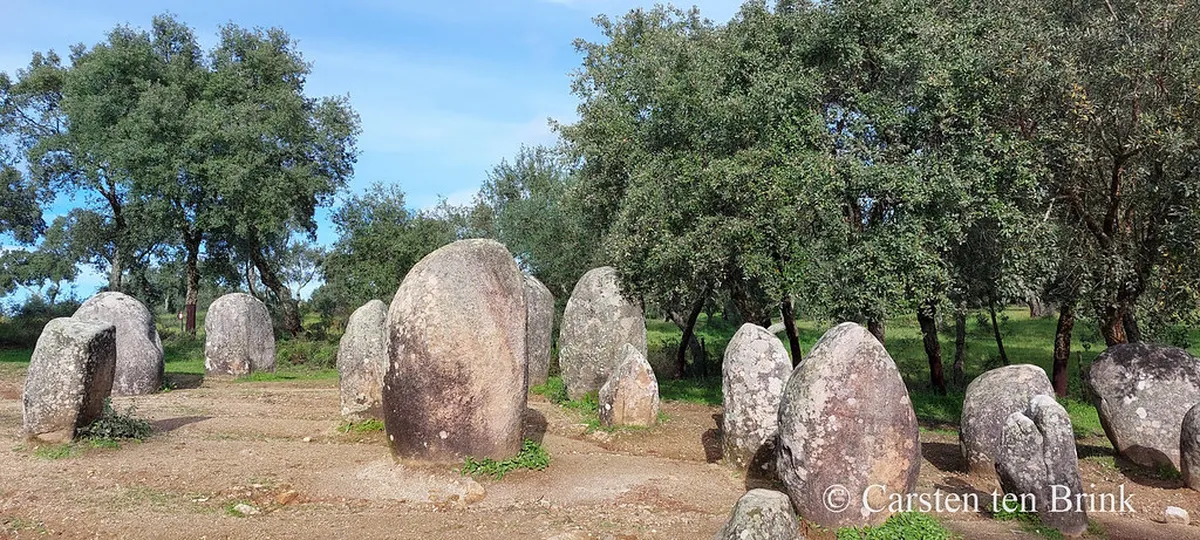
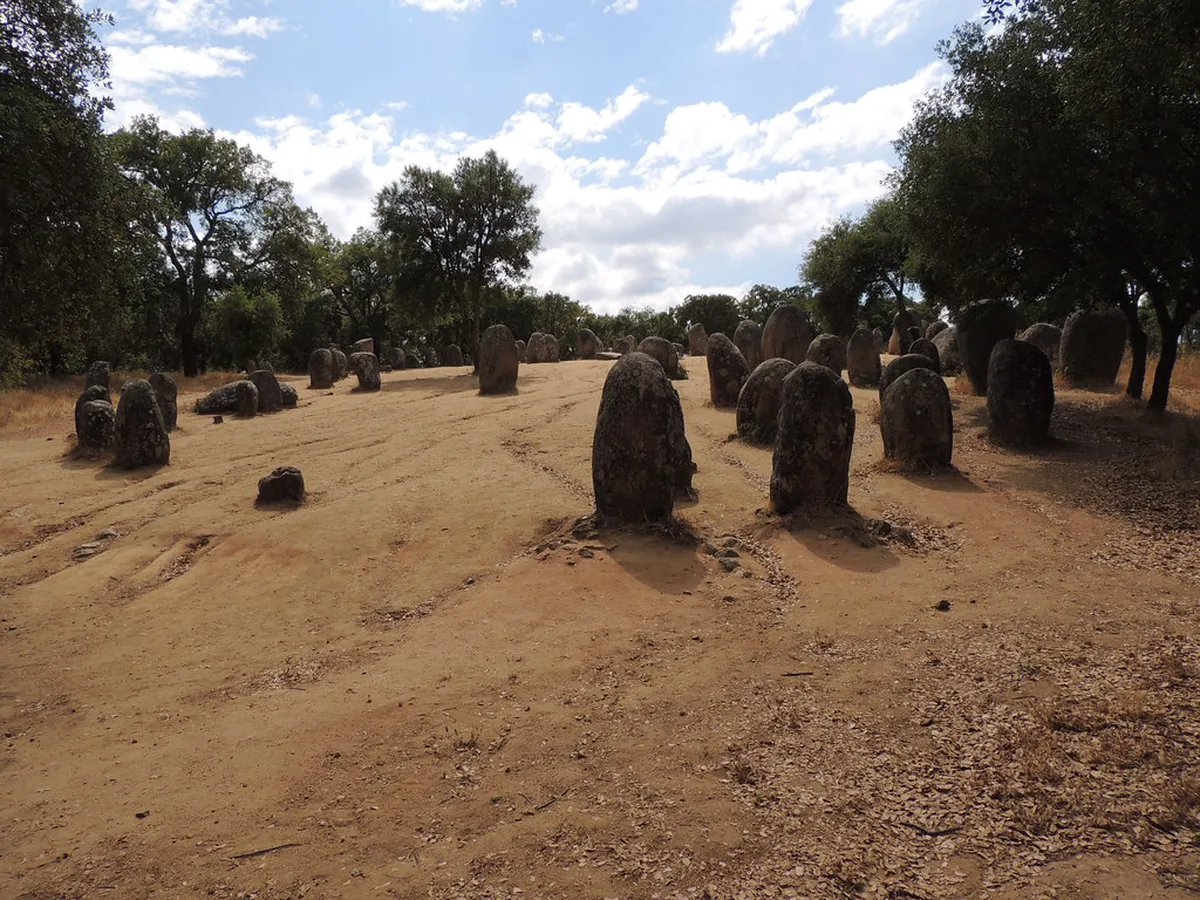
The Almendres Cromlech (Cromeleque dos Almendres) is the largest group of structured menhirs on the Iberian Peninsula and one of the most important megalithic monuments in Europe. It consists of 95 surviving granite monoliths arranged in two main enclosures — an earlier circular layout to the west and a later double-oval to the east — spread across a gentle slope in the Alentejo cork-oak landscape. Many stones reach 2 to 2.5 metres tall, and the whole complex measures roughly 60 by 30 metres.
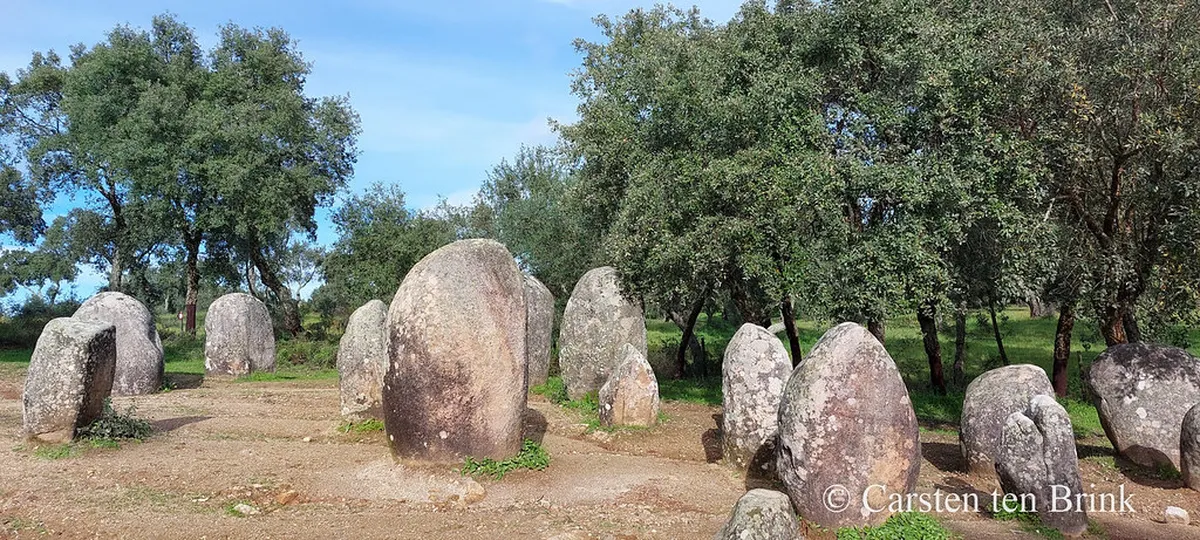
These granite monoliths were not placed at random. Archaeologists believe the cromlech functioned as a ceremonial and astronomical site, with the arrangement of stones aligned to solar and lunar events. Around a dozen of the stones carry faint engravings — spirals, circles, wavy lines and small cupmarks — that hint at the symbolic and ritual meaning the Neolithic builders attached to them.
Unlike the fenced and ticketed monuments many travellers expect, Almendres Cromlech is a free, open and unguarded site. You can walk directly among the stones, touch them, and circle the enclosures at your own pace — an unusually intimate way to experience a monument this old. The site sits about 15 km west of Évora, near the village of Guadalupe.
History & Dating: Older Than Stonehenge
The Almendres Cromlech was not built in a single phase. Archaeological study shows it was raised, rearranged and added to over thousands of years, with the earliest stones dated to around 6000 BC during the early Neolithic. That makes it roughly 2,000 years older than the first phase of Stonehenge and around 3,000 years older than Stonehenge's iconic sarsen circle — the comparison that earns it the nickname the "Portuguese Stonehenge."
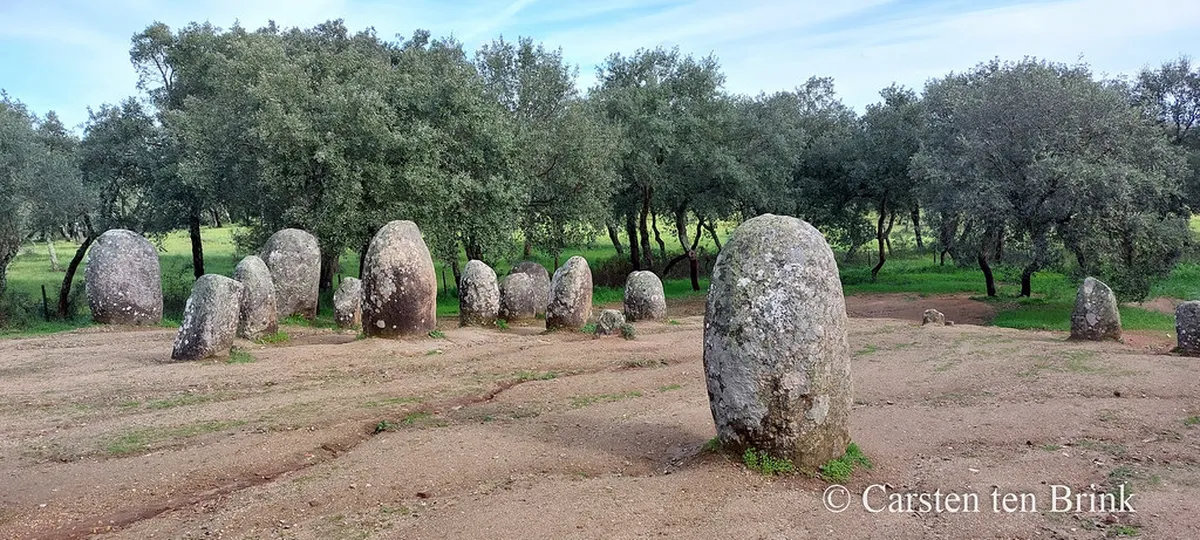
The monument was effectively lost for millennia and only rediscovered in 1966 by researcher Henrique Leonor Pina during fieldwork in the area. Excavation and restoration since then have re-erected fallen stones and clarified the two construction stages — a first circular cromlech, followed centuries later by the larger double-oval still visible today.
Why it was built remains debated, but the leading interpretation is astronomical. The east-facing axis of the enclosures appears oriented toward the equinox sunrise, and the relationship between the cromlech and the nearby Almendres Menhir suggests the site served as a Neolithic calendar marking the seasons. For deeper cultural context, the Évora Museum displays prehistoric artefacts from the wider Alentejo, helping visitors picture the people who quarried and raised these stones.
The Almendres Menhir Nearby
About 1.3 km northeast of the stone circle stands the Almendres Menhir, a single granite standing stone roughly 4 metres tall. It is widely considered part of the same ceremonial complex as the cromlech, and many researchers think it acted as a sighting marker: from the centre of the enclosures, the menhir lines up with the sunrise at the spring and autumn equinoxes, reinforcing the astronomical reading of the site.
The menhir carries a faint carved "crook" or shepherd's-staff motif near its top — one of the clearest pieces of Neolithic symbolic engraving in the area. Reaching it takes a short walk or drive along the dirt tracks that cross the surrounding cork-oak and olive estate, so pairing it with the cromlech makes for a more complete picture of the prehistoric landscape.
The setting itself is part of the appeal. The stones sit in open, sun-soaked Alentejo countryside dotted with cork oaks, with long views across rolling farmland. There are no fences, ticket booths or crowds — just the monoliths, the grass and the quiet, which is exactly why many visitors find it more atmospheric than busier, more managed sites.
Best Time to Visit & What to Bring
Almendres Cromlech is free and open 24 hours a day, year-round — there is no entrance fee, no ticket and no gate. That freedom is its biggest practical advantage: you can simply turn up. The best time to arrive is early morning or late afternoon, when the low Alentejo sun rakes across the stones, the light is best for photographs, and the few other visitors have usually gone. The equinoxes (around 20 March and 22 September) are popular with those who want to see the alignment with the rising sun.
Plan for about 1 to 2 hours on site to walk both enclosures at an unhurried pace and detour to the menhir if you have time. There is almost no shade and no facilities — no café, toilets or shop — so come prepared. Bring water, a hat and sunscreen in summer, when Alentejo afternoons regularly climb above 35°C, and a light layer in winter, when mornings can be cold and the access track muddy.
Wear sturdy, closed shoes: the ground is uneven, grassy and rocky, and the final approach is unpaved. The open setting suits families and curious children, who can explore safely among the stones, but the lack of barriers means it pays to keep an eye on little ones near the larger monoliths. Packing a small picnic to enjoy under the cork oaks is a low-cost way to make the trip feel like a proper outing rather than a quick stop.
How to Get There from Évora
Almendres Cromlech sits about 15 km west of Évora, near the small village of Guadalupe, and there is no public transport to the site — a car (or a guided tour) is effectively the only practical way to get there. From Évora the drive takes around 25 to 30 minutes: head west on the N114 toward Montemor-o-Novo, turn off at Guadalupe and follow the brown heritage signs for "Cromeleque dos Almendres."
The final stretch is the part to plan for. After Guadalupe the road becomes a narrow, unpaved dirt track that runs roughly 4 km through a private cork-oak and olive estate. It is usually fine for a standard rental car driven slowly, but it can be dusty in summer and rutted or muddy after rain, so take it gently. Set your GPS to "Cromeleque dos Almendres" rather than the village alone, as the turn-offs are easy to miss. The Almendres Menhir is signposted separately along the same dirt road.
There is a free, unattended gravel parking area at the end of the track, a short walk from the stones. Many visitors rent a car in Évora or Lisbon, since combining the cromlech with other Alentejo stops is far easier with your own wheels. If you would rather not drive the dirt road yourself, a taxi from Évora is possible — agree the round-trip fare and waiting time in advance — or join an organised tour, covered in the next section.
A personal perspective on megalithic structures in Southern Portugal
Visiting Almendres Cromlech offers a profound sense of connection to ancient civilizations. These megalithic structures are more than just stones; they are silent witnesses to millennia of human history. Their purpose remains debated, adding to their mystique.
From a local's viewpoint, these sites represent the deep roots of our culture in the Alentejo. They remind us of the ingenuity and spiritual beliefs of our ancestors. The landscape itself feels imbued with their presence.
Many similar sites exist across Southern Portugal, each with its own story. The Almendres Cromlech stands out due to its sheer scale and excellent preservation. It truly feels like stepping back in time.
Consider the practical constraints of visiting remote sites like this. While Almendres is accessible, others may require more effort. Always plan routes carefully and check for local conditions. This ensures a safe and rewarding exploration.
Why Almendres Is Worth the Detour
For a monument of its age and scale, Almendres Cromlech remains remarkably uncrowded — and that, paradoxically, is part of why it is so worth the detour. Where the better-known megalithic sites of Europe are roped off and ticketed, here you can stand inside a 6000 BC enclosure with nothing between you and the stones, which gives the visit an intimacy that polished attractions rarely manage.
It also tells a story you can't get from Évora's Roman and medieval landmarks alone. The cromlech, the Almendres Menhir and the scattered dolmens of the surrounding countryside push the region's timeline back thousands of years before the city's UNESCO-listed historic centre existed, anchoring the whole Alentejo in deep prehistory. Seeing the stones first makes the later layers of Évora read more clearly.
Practically, it slots neatly into almost any visit. The site is free, open at all hours and only 25 to 30 minutes from town, so even travellers on a tight day trip can fit it in around the main sights — it works equally well as an early stop on an Évora day trip from Lisbon or as the opening morning of a longer stay. If you are basing yourself in town, sort out where to stay in Évora and the best restaurants in Évora first, then build the cromlech into your route. Combine it with a sunrise or sunset for the best light, allow a couple of hours, and you come away with one of the most memorable — and least commercialised — stops in southern Portugal.
Written by Rui Alves
As someone who grew up in the shadow of these ancient stones, the Almendres Cromlech holds a special place. It's more than just an archaeological site; it's a living part of our heritage. The whispers of the past are truly felt here.
I remember school trips where we'd learn about the Neolithic people who built these structures. Their understanding of the cosmos, without modern instruments, is truly astounding. This site reflects their deep connection to the earth and sky.
The light at sunrise or sunset transforms the stones, casting long shadows and revealing their ancient textures. This is the best time to visit for a truly immersive experience. It offers a moment of quiet contemplation.
For those looking to truly understand Évora, a visit to Almendres Cromlech is essential. It provides context for the city's later Roman and medieval history. This journey into the deep past enriches your entire trip to Portugal.
Guided Megalithic Tours from Évora
Because the site is unstaffed and there are no on-site information panels, a guided megalithic tour can add a lot of value — especially if you want the astronomy, dating and symbolism explained on the spot rather than read beforehand. Several Évora-based operators run half-day "megalithic" or "prehistoric Alentejo" tours that bundle the cromlech with the Almendres Menhir, and often a dolmen or the Zambujeiro burial chamber, removing the worry of driving the dirt access road yourself.
Typical half-day tours last around three to four hours, run morning or late-afternoon to catch the best light, and include round-trip transport from central Évora. They suit travellers without a car, anyone nervous about the unpaved track, and visitors who want context they can't get from the silent stones alone. Self-drivers, by contrast, get full flexibility on timing and can linger for sunrise or sunset.
The cromlech also pairs naturally with Évora's other landmarks if you build it into a wider day. Many visitors combine it with the Roman Temple, the Chapel of Bones, or a tasting at the Cartuxa Winery, and a planned Évora itinerary makes it easy to slot the stones in without backtracking. For the full picture of things to do in Évora around your megalithic visit, start with the city's UNESCO-listed historic centre.
Frequently Asked Questions
Which Almendres Cromlech: Évora's Megalithic Stone Circle options fit first-time visitors?
First-time visitors should focus on simply walking through the stone circle and the nearby menhir. Allow time to appreciate the scale and ancient craftsmanship. A self-guided tour with a basic map or information from the Évora tourism office works well.
How much time should you plan for Almendres Cromlech: Évora's Megalithic Stone Circle?
Plan for 1 to 2 hours at Almendres Cromlech to fully explore the site. This includes walking around the stones and taking photographs. Add travel time from Évora, which is about 30 minutes each way by car.
What should travelers avoid when planning Almendres Cromlech: Évora's Megalithic Stone Circle?
Avoid visiting in the middle of a hot summer day without adequate sun protection and water. The site offers minimal shade. Also, do not expect extensive visitor facilities; it's a raw, natural archaeological site. Respect the ancient stones and do not climb on them.
Is Almendres Cromlech: Évora's Megalithic Stone Circle worth including on a short itinerary?
Yes, Almendres Cromlech is definitely worth including, even on a short Évora itinerary. It offers a unique historical perspective distinct from Évora's Roman and medieval sites. It provides a deeper understanding of the region's ancient past.
Which Must-See Almendres Cromlech: Attractions options fit first-time visitors?
First-time visitors should prioritize the main stone circle and the nearby Almendres Menhir. These are the primary attractions and showcase the site's megalithic significance. Consider a guided tour for deeper historical context.
The Almendres Cromlech offers a truly unique journey back in time, revealing the mysteries of ancient Portugal. Its impressive stone formations stand as a testament to early human ingenuity and spiritual life. This site provides a peaceful, reflective experience amidst the Alentejo landscape.
Visiting Almendres Cromlech enhances any trip to Évora, adding a crucial layer of prehistoric history. Combine your exploration of the stones with the rich cultural offerings of Évora. This creates a comprehensive and unforgettable Portuguese adventure.
Remember to plan your visit with practical considerations in mind for a smooth experience. Embrace the tranquility and historical depth of this remarkable megalithic monument. It is a place where history truly comes alive.
 Best Time to Visit Évora Travel GuideJune 8, 2026