Weather in Lagos Algarve by Month: Your 2026 Guide
Lagos Algarve weather by month for 2026 with full data on temperatures, sea temps, sun hours, wind speed and sunset times, plus beach climate notes and a what-to-pack matrix.
On this page
Weather in Lagos Algarve by Month: Your 2026 Guide
Planning a trip to the southern coast of Portugal starts with understanding the weather in Lagos Algarve by month. Lagos enjoys a sunny Mediterranean-Atlantic climate with roughly 300 sunny days a year, mild winters averaging 15°C highs, and dry summers peaking near 29°C. The limestone cliffs of Ponta da Piedade catch the full Atlantic breeze, which keeps the town 3–5°C cooler than inland Faro or Seville even in August. For the wider regional picture, see our Algarve weather by month overview.
This 2026 guide pairs a comprehensive month-by-month data table — covering high, low, sea temperature, sun hours, rain days, rainfall, average wind speed, and approximate sunset time — with practical advice on the best month for each activity. Travelers often look for a balance between warm temperatures and manageable crowd levels, and the Algarve rewards anyone willing to travel in the shoulder months. For a wider comparison, see our Portugal weather by month guide and the honest best month to visit Portugal breakdown.
Lagos Weather by Month: 2026 Full Data Table
The table below summarizes typical weather in Lagos Algarve by month using climate normals published by the Portuguese Institute for Sea and Atmosphere (IPMA) for the Algarve western coast, which matches Lagos closely. Sunset times are local WET/WEST. Wind speed reflects average afternoon conditions (Nortada peak); morning winds run 30–40% lower. In 2026, expect temperature values to hold within roughly 1–2°C on either side of the long-term average.
| Month | High °C | Low °C | Sea °C | Sun hrs/day | Rain days | Rain (mm) | Wind (km/h) | Sunset |
|---|---|---|---|---|---|---|---|---|
| January | 15 | 9 | 16 | 6 | 8 | 75 | 18 | 17:45 |
| February | 16 | 9 | 15 | 6 | 7 | 60 | 17 | 18:20 |
| March | 18 | 11 | 16 | 7 | 6 | 45 | 18 | 19:00 |
| April | 20 | 12 | 17 | 9 | 5 | 35 | 20 | 20:35 |
| May | 23 | 14 | 18 | 10 | 3 | 20 | 22 | 21:10 |
| June | 26 | 17 | 20 | 12 | 1 | 5 | 25 | 21:35 |
| July | 29 | 19 | 21 | 12 | 0 | 1 | 28 | 21:25 |
| August | 29 | 20 | 22 | 11 | 0 | 2 | 26 | 20:45 |
| September | 27 | 18 | 22 | 9 | 3 | 15 | 21 | 19:50 |
| October | 23 | 16 | 20 | 7 | 6 | 55 | 17 | 18:55 |
| November | 19 | 12 | 18 | 6 | 8 | 80 | 16 | 17:20 |
| December | 16 | 10 | 17 | 5 | 9 | 90 | 15 | 17:10 |
Quick read: The hottest month is July and August at 29°C, the coldest nights fall in January and February at 9°C, the wettest month is December with 90 mm across 9 days, and the sea peaks at 22°C in August and September. The windiest afternoons are July (28 km/h average Nortada) — choose a sheltered cove if you visit then. Sunset in June runs until 21:35, giving you genuinely long beach evenings.
Beach-by-Beach Climate Notes: Camilo, Dona Ana & Meia Praia
Not all Lagos beaches experience identical conditions. The town's coastline faces two directions — southwesterly ocean-facing cliffs and a flatter, eastward-opening bay — creating genuine microclimate differences that matter when you're deciding where to spend the day. Here's what to expect at each of the three main beaches across the year.
Praia do Camilo
Praia do Camilo sits in a deep notch cut into the sandstone cliffs roughly 2 km east of Lagos marina. The cliff walls rise 30–40 metres on three sides, which means the beach stays sheltered from the prevailing Nortada even when that wind reaches 25–30 km/h at exposed Meia Praia. In July and August, Camilo can feel noticeably warmer than other spots because the rock faces absorb and radiate heat back onto the sand. Water clarity is exceptional year-round as the cove geometry limits currents. The access staircase (200+ steps) deters large crowds in winter, making it one of the best spots for a sheltered January or February stroll in bright sunlight. During peak summer, plan to arrive before 10 a.m. or after 4 p.m. as the small beach fills quickly.
Best months at Camilo: May–June for uncrowded warmth, September for warm water and gentler crowds. Avoid windy July afternoons if you dislike sand spray from the staircase path.
Praia da Dona Ana
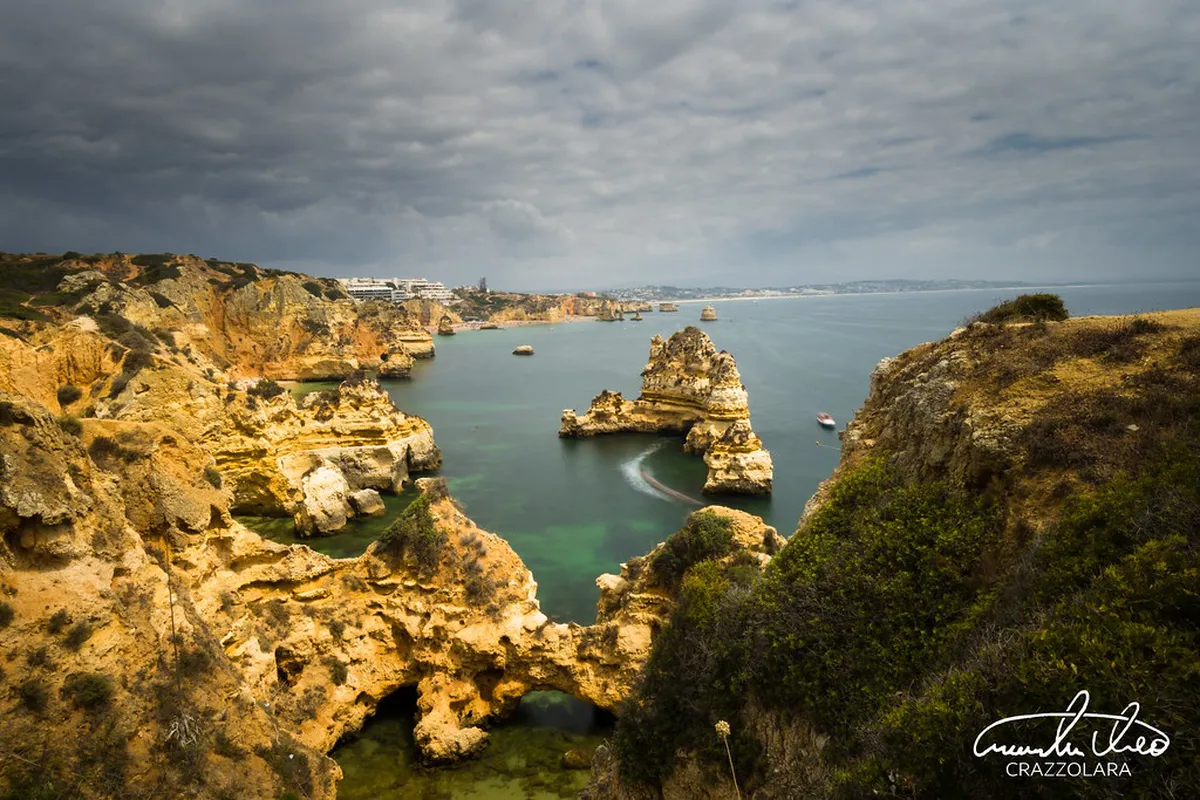
Praia da Dona Ana is perhaps the most photographed beach in the Algarve, with towering amber and ochre cliffs framing a crescent of white sand. It faces directly south-southwest, which gives it maximum afternoon sun throughout the year — great news in winter, when the low sun angle means other spots fall into cliff shadow by 3 p.m. In summer, the south-facing aspect means full UV exposure from sunrise to sunset; combined with reflective pale sand, the effective UV index can exceed the official 9–10 reading. The beach receives the Nortada obliquely rather than head-on, so it is less breezy than Meia Praia but less sheltered than Camilo. October and November visitors often find Dona Ana the most pleasant choice: warm afternoon sun, sea still at 18–20°C, and very few people.
Best months at Dona Ana: October for near-deserted warm swimming; June for long afternoon sun before July crowds peak. Bring SPF 50+ in summer — the reflective sand amplifies UV intensity.
Meia Praia
Meia Praia is a 4 km arc of open sand stretching east from Lagos bay toward Alvor. Its exposure is the highest of any major Lagos beach: it faces almost directly into the Nortada, and there are no cliffs to break the wind. On summer afternoons with 28 km/h winds, Meia Praia can feel dramatically different from the sheltered coves — great for kitesurfing and windsurfing (the Lagos Kite & Surf school operates from here), but uncomfortable for families with young children or beach umbrellas. The flip side: shallow, gently sloping sand warms faster, and the water is calmer and shallower than the cliff coves, making it the best Lagos beach for small children to paddle. In spring (April–May), morning sessions before the Nortada picks up at noon are genuinely idyllic — warm sand, flat sea, virtually no other visitors.
Best months at Meia Praia: April–May mornings for calm flat water, September for the last warm sea days with reduced wind. Avoid July–August afternoons if you dislike wind; arrive before 10 a.m. or switch to a cove beach.
Spring Weather in Lagos Algarve by Month
Spring serves as a beautiful bridge between the rainy winter and the hot summer months. March marks the beginning of this shift with average highs reaching 18°C. You will notice the landscape turning bright green as wildflowers bloom along the coastal cliffs, and almond orchards west of Lagos finish their pink-white blossom. Pack a light jacket for the evenings, as temperatures often dip to 11°C after sunset. Rain frequency drops from 6 days in March to just 3 in May, and afternoon sunshine climbs to 7–10 hours a day across the three spring months.
April and May bring more stability and longer daylight — about 13 hours by mid-May. Daily sunshine climbs to 9–10 hours, making it perfect for exploring Lagos Portugal on foot. Occasional showers still occur, but April averages just 5 rain days and May drops to 3. These are the best months for active travelers who find the summer heat too intense for cliff hiking along the Seven Hanging Valleys trail. The Seven Hanging Valleys route runs about 6 km along the cliff tops between Marinha and Benagil, with coastal viewpoints that are far more comfortable to enjoy at 20°C than at 30°C.
May is particularly pleasant because the Atlantic water begins its slow warming process. The ocean sits at about 18°C — refreshing but swimmable for sun-starved Northern Europeans. Local cafes begin to extend their hours, seasonal beach bars reopen around Easter, and you can enjoy popular viewpoints like Ponta da Piedade without the mid-summer congestion. Wind speeds pick up through May (averaging 22 km/h afternoons) but Camilo and Dona Ana remain sheltered enough for comfortable beach days.
Direct answer: April and May in Lagos deliver 20–23°C highs, 9–10 sun hours a day, and only 3–5 rain days per month — ideal for hiking, sightseeing, and early-season beach days if you don't need warm water.
Summer Sunshine: Peak Beach Weather in Lagos
Summer is the most popular time to visit the Algarve for guaranteed heat and dry skies. July and August are the hottest months, with daytime highs averaging 29°C and frequent afternoons reaching 32°C when the inland Alentejo wind shifts. The Atlantic Nortada breeze usually keeps Lagos 3–5°C cooler than Seville or Lisbon on the same day, which is why the town remains liveable when much of southern Europe is sweltering.
Sea temperatures finally reach a comfortable 21–22°C in late July and August. Swimmers flock to the best beaches in Lagos to enjoy the clear, calm conditions — Meia Praia for space, Praia da Dona Ana and Praia do Camilo for photo-postcard cliffs. Expect essentially zero rainfall across the three summer months combined (under 10 mm total). The UV index averages 9–10 from 11 a.m. to 4 p.m. from June through mid-September, which is classed as "very high" — SPF 50 and a hat are non-negotiable. Sunset in June stretches to 21:35, giving you long, warm evenings on rooftop terraces.
June offers a slightly quieter alternative to the peak crowds of August. For a full month-by-month base trip plan, see our complete Lagos Portugal guide. Daylight lasts for nearly 15 hours, providing plenty of time for late-night dinners outdoors. Prices for accommodation and tours reach their highest levels from mid-July through the first three weeks of August. Benagil cave kayak tours and sunset dolphin cruises often sell out 7–14 days in advance for 2026 travelers. Wind reaches its annual peak in July (28 km/h average afternoon), so exposed Meia Praia gets choppy — stick to the sheltered coves if conditions feel too breezy.
- June: 26°C high / 17°C low / 20°C sea / 12 sun hours / 1 rain day / 5 mm rain / Sunset 21:35
- July: 29°C high / 19°C low / 21°C sea / 12 sun hours / 0 rain days / 1 mm rain / Sunset 21:25
- August: 29°C high / 20°C low / 22°C sea / 11 sun hours / 0 rain days / 2 mm rain / Sunset 20:45
Autumn Transitions: Warm Water and Mild Air
Many locals consider autumn the most rewarding time to experience the Lagos climate. September holds summer heat with 27°C highs but far fewer tourist crowds once European school holidays end on August 31. The sea temperature is actually at its annual peak in September at 22°C, because the Atlantic lags air temperature by about a month. You can often find better deals on boutique hotels as the peak season concludes, with rates typically 25–30% below August. Sunset still reaches 19:50, providing ample time for golden-hour cliff walks.
October brings a noticeable change as the air freshens and the first real rains return. Daytime temperatures stay pleasant at 23°C, which is great for golf on the Lagos-Vale do Lobo courses, cycling the Via Algarviana, or long cliff walks in soft golden light. Expect about 6 days of rain throughout October, usually as short afternoon bursts rather than all-day drizzle. Sea temperatures hold at 20°C well into mid-October, so swimming is still comfortable for most visitors. Wind speed drops to a calmer 17 km/h average, making October one of the best months for paddleboarding and kayak tours through the Ponta da Piedade arches.
November marks the true start of the wetter season. While it is cooler, the 19°C average high remains warmer than most of Northern Europe. Rainfall increases to roughly 80 mm across 8 days, so an indoor backup — the Lagos Slave Market Museum, a Lagos wine bar crawl through the old town — is worth planning. This is a transition month where many seasonal beach bars begin to close for winter, though the main town restaurants and cafes stay open year-round.
Direct answer: September is the single best month to visit Lagos if you want warm sea swimming without August crowds — 27°C air, 22°C water, 9 sun hours a day, and hotel prices 25–30% below peak.
September is the sweet spot for budget-conscious swimmers: sea temperatures remain at their 22°C peak (the ocean lags air temperature by a month), while hotel rates typically drop 25–30% compared to August once European school holidays end.
Winter in Lagos: A Mild Off-Season Escape
Winter in Lagos is far from the freezing conditions of central or northern Europe. January is typically the coldest month, with daytime highs of 15°C and overnight lows around 9°C. Sunlight is still abundant at 6 hours a day on average, and you'll get long stretches of clear blue winter sky between weather systems. The afternoon wind calms considerably in winter — December and January average only 15–18 km/h, so even the exposed Meia Praia becomes walkable for sunset strolls. Visitors exploring Lagos in winter can enjoy the town's authentic local atmosphere, with marina cafes still full of regulars and hotels running mid-week rates 40–60% below August.
December is the wettest month with roughly 90 mm of rain spread over 9 days. Despite the rain, temperatures rarely drop below 9°C at night, and frost is essentially unheard of along the coast. Heating is not always standard in older Portuguese apartments, so check your accommodation listing for "aquecimento" or a heat pump. Lighter crowds mean you can walk the historic center without any rush, and the Christmas lights strung through Rua 25 de Abril give the old town a genuinely festive atmosphere without the chaos of northern European capitals.
February shows the first signs of the coming spring as almond trees blossom across the western Algarve. The weather can be unpredictable, ranging from stormy sea days to warm, 20°C sunny afternoons. Surfers actively prefer this season because the Atlantic swells at Sagres and Amado are more consistent and powerful — and the beach crowds have completely disappeared. Wetsuits (4/3 mm minimum) are mandatory as the ocean drops to 15°C in February, its annual low.
Is Lagos warm in winter? Compared to most of Europe, yes. January and February average 15–16°C during the day with 6 hours of sunshine, making Lagos one of the warmest winter sun destinations in mainland Europe. You will not sunbathe on the beach, but you can walk the cliff tops in a light jacket and eat outdoors at lunch most days.
Understanding the Lagos Wind Factor
The weather in Lagos is heavily influenced by a prevailing wind known as the Nortada. This north-to-northwesterly wind typically blows during spring and summer afternoons at 15–28 km/h, with gusts up to 40 km/h on the windiest July days. It helps keep the town cool and the air quality exceptional, but it can make exposed beaches feel quite breezy by 2–3 p.m. Selecting a sheltered cove like Praia da Bonêca, Praia do Pinhão, or the north end of Praia da Dona Ana protects you from these gusts while still giving you the same warm, clear Atlantic water.
Wind speed typically increases around 3 p.m. and tapers off after sunset. Sailing and windsurfing enthusiasts find these conditions ideal; the Lagos harbor marina is home to several sailing schools that run summer courses specifically targeting Nortada conditions. If you plan to dine on a terrace, a light layer for 9 p.m. onward is wise from May through September. The Nortada makes a 29°C July afternoon feel closer to 25°C, which is why Lagos remains bearable when Seville bakes at 40°C.
Lagos sits at a point where the coastline turns southeast, creating different microclimates on each beach. Meia Praia faces directly into the Nortada and can be difficult on windy August days. Smaller coves nestled between high cliffs — Praia do Camilo, Praia do Pinhão, Praia dos Estudantes — offer much better protection. Check wind forecasts on Windguru or IPMA before booking a small kayak trip to the Ponta da Piedade caves; tours are typically cancelled at sustained winds above 25 knots.
Ponta da Piedade cave kayak tours are routinely cancelled when sustained winds exceed 25 knots — a common occurrence on July and August afternoons when the Nortada averages 26–28 km/h. Check Windguru or the IPMA forecast the morning of your booking.
What to Pack by Month: Lagos Packing Matrix
Packing for Lagos depends heavily on when you visit. The four seasonal buckets below reflect the distinct climate phases in the Algarve, so you can travel light and still be prepared for any condition you'll actually encounter.
January–March: Mild Winter / Early Spring
Temperatures range from 9°C nights to 18°C afternoons, with genuine rainfall and occasional Atlantic storms. The climate is more like a warm autumn in London than a classic winter — but you do need layers.
- Mid-layer fleece or light down jacket (essential for evenings and stormy days)
- Waterproof outer layer — a packable rain jacket takes almost no bag space
- Comfortable walking shoes or light hiking boots for cliff trails (wet surfaces)
- Sunscreen SPF 30+ for bright winter afternoons (UV still reaches index 3–4)
- Swimsuit — optional, for hot-tub hotels or particularly warm February days above 20°C
- Layers: 2–3 long-sleeve tops + 1 T-shirt base. Mornings will be chilly; afternoons can surprise you
April–June: Spring / Early Summer
Daytime highs climb from 20°C (April) to 26°C (June). Rain becomes rare by late May. This is the widest temperature swing bucket, so layering is key for the first half of the period.
- Light cotton or linen trousers and a mix of T-shirts and light long-sleeves
- Swimsuit and beach bag — beaches are swimmable from late May for most visitors
- SPF 50 sunscreen from May onwards (UV index rises to 8–9 by June)
- Sunglasses and a wide-brim hat — cliff walks get intense midday sun
- Light cardigan or denim jacket for evenings in April and May
- Comfortable sandals or flip-flops for the promenade; trainers for cliff trails
- A compact umbrella for April showers (rare but possible)
July–September: Peak Summer
This is the hot, dry, reliably sunny season. High 29°C, almost no rain. Pack for pure heat management.
- Lightweight breathable clothing (linen, cotton, technical fabrics) — pack more T-shirts than you think you'll need
- SPF 50+ sunscreen in generous quantities — the reflective beaches amplify UV. Reapply every 2 hours
- Wide-brim hat and UV-protective sunglasses (category 3 or 4 lenses)
- Swimsuit(s) — at least two so one can dry overnight
- A light layer (linen shirt or light cardigan) for 10 p.m. terrace dinners when the Nortada picks up
- Reef-safe sunscreen if you're swimming in the coves — clear water highlights impact on sea life
- Insect repellent for evening coastal walks in August (occasional midges near freshwater streams)
October–December: Autumn / Early Winter
Transitional weather: 16–23°C highs, increasing rain frequency, beautiful golden light. October is still very pleasant; December gets genuinely wet.
- Light jacket for October; warmer mid-layer from November
- Waterproof layer — more important than in any other bucket for November and December
- Comfortable walking shoes waterproofed or with good grip for wet cliff paths
- Swimsuit for October swimming (sea still 18–20°C)
- Scarf and thin gloves for evenings from November — not essential but welcome
- Layering base: mix of T-shirts and long-sleeves; heavy jumper for December evenings
- SPF 30 for October bright days (UV index 4–5, still relevant for fair-skinned visitors)
Best Month for Each Activity in Lagos
Different activities peak at different times. The matrix below pairs each travel style with its optimal month based on temperature, conditions, and crowd level for 2026 travelers. For a full day-by-day itinerary during any of these seasons, see our Lagos 2-day itinerary.
- Beach swimming: August and September (22°C sea, 27–29°C air). September is the sweet spot — same warm water, fewer crowds, calmer winds (21 km/h vs 26–28 km/h in peak summer).
- Surfing: October through March. Atlantic swells are most consistent, and Sagres (30 min west of Lagos) delivers 3–6 ft waves on most days. Wetsuit required from October; full 4/3 mm from December.
- Cliff hiking (Seven Hanging Valleys, Ponta da Piedade trails): April, May, and October. Temperatures of 20–23°C, low rain risk, soft light for photos, and trails free of the summer crush.
- Golf: March through May and September through November. Mornings in the low 20s with no heat exhaustion on the back nine; courses are in top condition after winter rains.
- Festivals & nightlife: June through mid-September. Santo António (June 12–13), Lagos Banho 29 (late August), and the Fátima pilgrimage season drive the cultural calendar.
- Budget travel: January, February, and November. Hotel rates drop 40–60% vs. August, flights to Faro are at their cheapest, and car rentals fall to 15–25 euros/day.
- Digital nomad / long stays: October through April. Mild weather, low prices, and thriving coworking scene in old town. November and February particularly suit longer-term visitors who want authentic local life.
- Kayaking and boat tours: May, June, September, and early October. Calm Nortada (20–22 km/h), warm air, and reliable visibility. Most caves & grotto tours operate daily without cancellations in these windows.
Direct answer for 2026 travelers: if you can only pick one month, book September. It wins on sea temperature, sun hours (9/day), rain risk (3 days), crowd level, and wind calmness all at once.
Frequently Asked Questions
Is Lagos warm in winter?
Yes, Lagos is genuinely warm by European winter standards. January and February average 15–16°C during the day with 6 hours of sunshine — warmer than any city in France, Germany, or the UK at the same time of year. Overnight lows of 9°C are cool but rarely uncomfortable if you have a light jacket. Frost is virtually unknown on the Algarve coast, and snow has never been recorded in the modern meteorological record for Lagos. You will not sunbathe in January, but you can walk the cliff tops comfortably and eat lunch outdoors most days.
What is the best month for swimming in Lagos?
September is the best month for swimming in Lagos. The Atlantic sea temperature peaks at 22°C in September (the same as August) because the ocean lags air temperature by about a month. Air highs remain a comfortable 27°C, there are only 3 rain days across the whole month, and the Nortada wind calms to 21 km/h on average — less choppy than the July–August peak. The added bonus: hotel prices drop 25–30% from August levels once European school holidays end, and the beaches are noticeably less crowded. For purely warm water from a swimming perspective, the window runs from late July through mid-October.
When is rainy season in the Algarve?
The rainy season in the Algarve runs from November through March, peaking in December (90 mm, 9 rain days in Lagos). More than 70% of annual rainfall — roughly 480 mm total — falls within these five months. Rain comes in heavy Atlantic frontal bursts rather than all-day drizzle; sunny intervals often return within hours of a heavy shower. June through September is the dry season, with virtually no measurable rain at all (under 10 mm combined across all three months). April and October are shoulder months where occasional showers are possible but unlikely to ruin a beach day.
Which month has the best weather in Lagos Algarve?
September offers the best balance of warm air and peak sea temperatures in Lagos. You can enjoy 27°C highs with the Atlantic at its annual warmest of 22°C, plus 9 sun hours a day and only 3 rain days across the month. Crowds also drop 25–30% from August as European school holidays end, and average afternoon wind calms to 21 km/h. For those who prioritise pure sun hours and don't mind crowds, July and August edge it out with 12 sun hours a day and zero rain.
What is the hottest month in Lagos?
July and August are tied as the hottest months in Lagos, with average highs of 29°C and overnight lows of 19–20°C. Individual days can reach 32–35°C when the inland wind shifts off the Alentejo, but the Nortada breeze from the Atlantic typically keeps Lagos 3–5°C cooler than Seville or Lisbon on the same afternoon. Sunset in July falls around 21:25, giving you long, warm evenings long after the heat of the day has eased.
What is the rainiest month in Lagos?
December is the rainiest month in Lagos, receiving about 90 mm of rainfall spread across 9 rain days. November follows closely at 80 mm over 8 days. Rain typically falls in heavy afternoon bursts rather than all-day drizzle, and sunny intervals are common between storms even in the wettest weeks. The saving grace for winter visitors is that these rain events rarely last more than a few hours, so a flexible itinerary can work around them.
Can you swim in Lagos in October?
Yes, swimming in Lagos in October is comfortable through about the 20th of the month. Sea temperatures stay at 20°C in early October and drop to 18°C by the end, while air highs average 23°C. The Nortada calms to 17 km/h in October, making Meia Praia noticeably less choppy than in August. After late October, the combination of cooler water and increasing Atlantic swell makes most travelers switch to surfing or beach walks rather than swimming.
Is April a good month to visit Lagos?
April is a very good month for Lagos if your trip focuses on hiking, sightseeing, and shoulder-season prices rather than beach swimming. Expect 20°C highs, 9 sun hours a day, 5 rain days, and a sea temperature of 17°C — swimmable only for the brave. Hotel rates run 30–40% below August peaks, and cliff trails are at their most wildflower-covered. The Seven Hanging Valleys trail is at its absolute best in April, with green coastal meadows dotted with yellow and purple wild flowers framing the Atlantic views.
How many days does it rain in Lagos each year?
Lagos averages roughly 60–65 rain days per year, with total annual rainfall around 480 mm. More than 70% of that rain falls between November and March, while July and August typically record zero measurable rain. This makes Lagos one of the driest cities in mainland Europe — comparable to Valencia and split roughly between a wet Mediterranean winter and a near-Saharan dry summer.
Is Lagos warmer than Lisbon?
Lagos is consistently warmer than Lisbon, by roughly 2–3°C on annual average. Winter highs in Lagos sit at 15–16°C versus 14–15°C in Lisbon, and the Algarve sea is 2°C warmer than the Lisbon coast in summer. Lagos also gets more sun hours per year (roughly 3,000 vs. 2,800) and less than half the rainfall, which is why it is Portugal's most reliable winter sun destination.
Understanding the weather in Lagos Algarve by month allows you to tailor your 2026 trip to your priorities. Summer is unbeatable for beach lovers, spring and autumn suit those who enjoy active exploration, and even the quiet winter months offer a peaceful retreat with plenty of bright, sunny days. The beach-by-beach climate differences between Praia do Camilo, Praia da Dona Ana, and Meia Praia mean even your choice of sand can be optimised for the season and wind conditions. For wider planning see our best beaches in Lagos Portugal guide and Lagos in summer deep-dive; no matter when you visit, the dramatic Algarve coastline rewards careful planning.