Algarve Weather By Month: Climate Data and Monthly Averages
Complete Algarve weather data by month: average highs, lows, sea temperatures, rain days, sunshine hours, humidity and wind for all 12 months. Raw climate averages, not travel opinions.
On this page
Algarve Weather By Month: Climate Data and Monthly Averages
This page is a climate reference — 12 months of raw weather averages for the Algarve: air temperature highs and lows, sea temperature, rainfall days, sunshine hours, humidity, and prevailing wind direction. If you want activity-focused advice on which month suits your trip, that is covered separately in the best time to visit the Algarve guide. These two articles serve different intents: this one is data, that one is decision-making.
The Algarve records around 3,000 hours of sunshine per year — among the highest in Europe — thanks to its subtropical Mediterranean climate moderated by the North Atlantic. Sea temperatures follow a separate rhythm from air temperatures, peaking in September–October rather than July–August. Regional variation is significant: the western Atlantic coast is cooler and windier than the sheltered eastern Algarve, and the Monchique mountain range creates its own inland microclimate with higher rainfall year-round.
Algarve Monthly Climate Overview (2026 Averages)
| Month | High (°C) | Low (°C) | Sea (°C) | Rain Days | Sun Hrs/Day | Humidity (%) | Wind |
|---|---|---|---|---|---|---|---|
| January | 16 | 8 | 15 | 8 | 5.5 | 77 | W / NW |
| February | 17 | 9 | 15 | 7 | 6.5 | 74 | W / NW |
| March | 19 | 10 | 16 | 7 | 7.5 | 72 | NW / W |
| April | 21 | 12 | 17 | 5 | 8.5 | 70 | NW / SW |
| May | 23 | 14 | 18 | 3 | 10.0 | 67 | N / NW |
| June | 26 | 17 | 19 | 1 | 11.5 | 63 | N / NE |
| July | 29 | 19 | 20 | 0 | 12.5 | 60 | N / NE |
| August | 30 | 20 | 21 | 0 | 12.0 | 61 | N / E (Levante) |
| September | 27 | 17 | 22 | 2 | 9.5 | 64 | N / NW |
| October | 23 | 14 | 21 | 5 | 7.5 | 69 | W / SW |
| November | 19 | 11 | 18 | 8 | 6.0 | 74 | W / SW |
| December | 16 | 9 | 16 | 10 | 5.0 | 79 | W / SW |
Averages based on Faro meteorological station data. Western coast (Sagres, Aljezur) runs 2–3°C cooler in summer and 3–5 more rain days in winter. Eastern coast (Tavira, Monte Gordo) runs 1–2°C warmer in summer.
Algarve Climate Classification: Subtropical Mediterranean with Atlantic Moderation
The Algarve carries a Csa Köppen climate classification — subtropical Mediterranean — modified by its Atlantic exposure. This combination produces hot, dry summers and mild, wet winters rather than the cold winters typical of inland Mediterranean climates. Annual rainfall in coastal areas averages 450–550mm, concentrated almost entirely between October and March. Summers are reliably dry.
The Atlantic Ocean acts as a thermal buffer in both directions: it limits summer heat extremes (the coast rarely exceeds 35°C / 95°F compared to 40°C+ inland Alentejo), and it keeps winters mild (below-zero temperatures are virtually unknown on the coast). The prevailing winds year-round come from the north and northwest, generated by the Azores High pressure system that dominates the eastern Atlantic in summer and retreats south in winter.
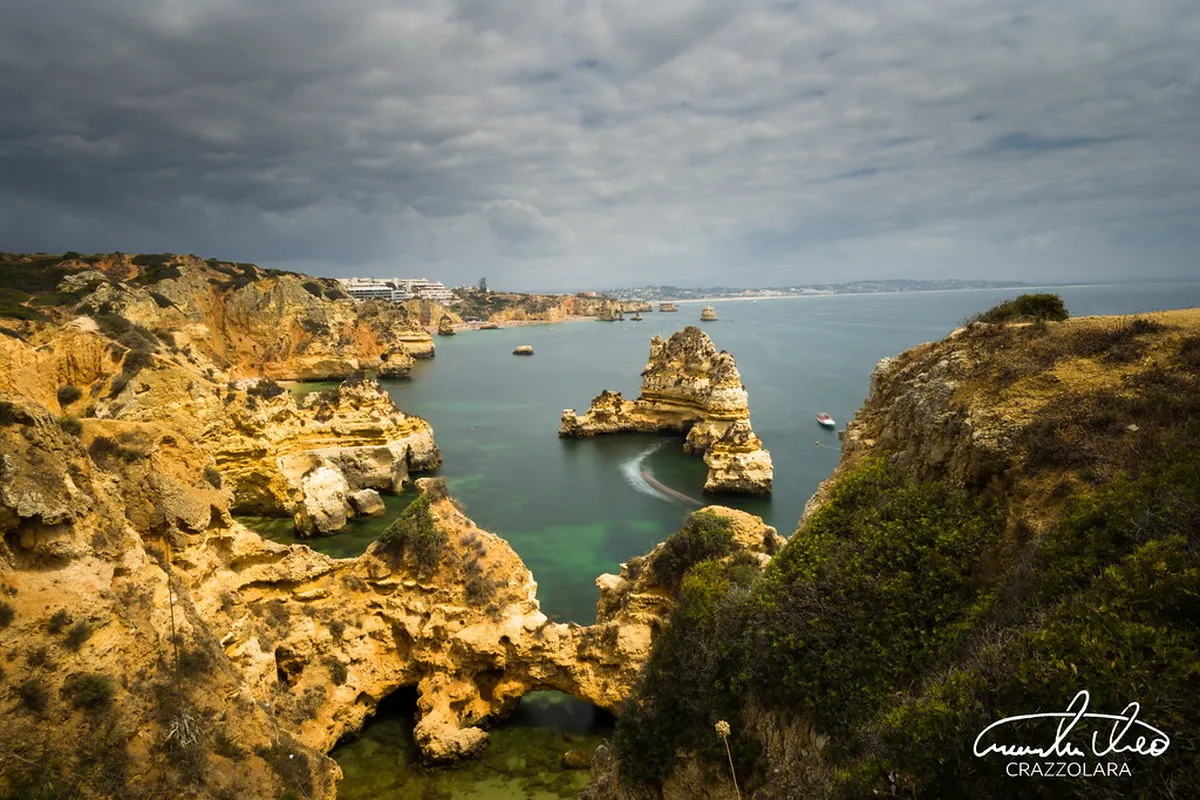
The Monchique mountains intercept Atlantic moisture, resulting in annual rainfall of 900–1,200mm at altitude — double the coastal average. This explains why the Monchique foothills stay green year-round while the coastal plain turns golden-brown by July. Coastal microclimates also exist at a finer scale: cliff-top locations channel the north wind, while sheltered coves like Praia da Marinha or Benagil can be 3–4°C warmer than an exposed headland a few kilometres away on the same day.
January: Mild Winters and Quiet Streets
January averages: high 16°C / 61°F, low 8°C / 46°F, sea 15°C / 59°F, 8 rain days, 5.5 sunshine hours/day, 77% humidity, prevailing wind W/NW.
January is the coolest month in the Algarve, but mild by European standards. Afternoons frequently reach the mid-teens and clear sunny days are common between rain spells. Rainfall averages around 8 days per month, though showers are typically short and followed by clear skies. The sea at 15°C / 59°F is cold for recreational swimming but workable in a 4mm wetsuit for surfing or cold-water swimming. Pack a waterproof jacket and a warm layer for evenings, when temperatures drop to around 8°C / 46°F.
Humidity is at its annual high at 77%, making damp evenings feel cooler than the thermometer suggests. The westerly wind is consistent through January — wind chill is a real factor on coastal walks and exposed headlands. January is a genuine sweet spot for golfers: green fees drop significantly, the courses are uncrowded, and daytime temperatures are comfortable for 18 holes. Faro and Lagos remain lively with local residents and long-stay visitors; smaller resort towns like Vilamoura are much quieter, with many restaurants operating reduced hours.
February: Almond Blossoms and Crisp Air
February averages: high 17°C / 63°F, low 9°C / 48°F, sea 15°C / 59°F, 7 rain days, 6.5 sunshine hours/day, 74% humidity, prevailing wind W/NW.
February is the month that surprises most first-timers. Temperatures hold at 17°C / 63°F and the countryside transforms as thousands of almond trees burst into white and pink blossoms. The bloom typically peaks in late January through mid-February, concentrated inland around Tavira and Silves. It is one of the most photogenic moments in the Algarve calendar and completely missed by anyone who only visits in summer.
Sunshine hours increase to 6.5 per day compared to 5.5 in January — a perceptible difference. Humidity drops slightly to 74% and rainfall averages around 7 days, making it the driest of the three core winter months. Wind patterns remain westerly and moderate. February is also a productive month for digital nomads chasing winter sun: accommodation costs are at their annual low, co-working spaces in Lagos and Faro are well-established, and the daytime light is strong enough to work outdoors without a jumper.
March: The Arrival of Spring Sunshine
March averages: high 19°C / 66°F, low 10°C / 50°F, sea 16°C / 61°F, 7 rain days, 7.5 sunshine hours/day, 72% humidity, prevailing wind NW/W.
March sees temperatures climb toward 19°C / 66°F as daylight hours increase noticeably. Sunshine hours jump to 7.5 per day and humidity eases to 72%. Sea temperatures creep up to 16°C / 61°F — still cold for casual swimming but reflecting the slow warming of the Atlantic. Wildflowers begin to cover the coastal cliffs and the Seven Hanging Valleys trail is at its most colourful. This is one of the best months for hiking: cool enough to walk for hours without overheating, and trails remain uncrowded.
Expect around 7 rainy days, though these tend to fall in concentrated spells rather than persistent drizzle. A light waterproof and layers for evenings is the right packing strategy. The northwesterly wind remains active — useful context if you are planning coastal kayaking or boat trips, which can be cancelled on windier days. Early-March visitors often find that Easter week (when it falls in March) brings a noticeable spike in domestic Portuguese visitors, pushing up restaurant waits and road traffic in coastal towns.
April: Ideal Conditions for Hiking and Golf
April averages: high 21°C / 70°F, low 12°C / 54°F, sea 17°C / 63°F, 5 rain days, 8.5 sunshine hours/day, 70% humidity, prevailing wind NW/SW.
April is widely considered one of the best months for active travel in the Algarve. Highs reach 21°C / 70°F, sunshine hours extend to 8.5 per day, rainfall drops to around 5 days per month, and the landscape is still green from the winter rains. Golf courses are in peak condition and trail walking is excellent — the heat has not yet arrived to make afternoon exertion uncomfortable. Humidity continues to ease, reaching 70% — comfortable for outdoor activity.
Beach days are possible in April, especially in sheltered eastern coves near Tavira, but the sea temperature at 17°C / 63°F is bracing. Western areas like Sagres feel windier and cooler in April than the central Algarve. The Atlantic northwesterly and southwesterly wind alternation is strongest on the western coast through spring — reliable surf conditions at Arrifana and Praia do Amado, but less ideal for sunbathing on exposed cliff beaches. Prevailing wind direction shifts between NW and SW depending on Atlantic pressure patterns, which also affects afternoon cloud cover inland.
May: Warm Days Before the Summer Rush
May averages: high 23°C / 73°F, low 14°C / 57°F, sea 18°C / 64°F, 3 rain days, 10.0 sunshine hours/day, 67% humidity, prevailing wind N/NW.
May is the start of genuine beach weather for most visitors. Temperatures average 23°C / 73°F and there are typically only 3 rainy days across the whole month. Sunshine hours reach double figures for the first time in the year at 10 per day. Humidity drops to 67% — noticeably drier than winter months. The days are long: sunset is after 21:00 by late May, giving plenty of time for both activity and relaxation. Accommodation prices are still below peak-season rates, making May one of the best-value months on the calendar.
The ocean at 18°C / 64°F is still cool, though manageable for a short swim. Atlantic northerly winds remain a factor on west-facing beaches; east-facing beaches around Meia Praia and Armação de Pêra tend to be calmer in May. The wind direction in May shifts toward northerly, which is the dominant summer pattern generated by the Azores High — this means clearer skies on the coast but increased chop on west-facing surf beaches. Restaurants and beach bars begin to open up fully in May after the quieter winter months. For summer conditions at Lagos and the central Algarve, the transition begins clearly in late May.
June: Perfect Beach Weather and Long Days
June averages: high 26°C / 79°F, low 17°C / 63°F, sea 19°C / 66°F, 1 rain day, 11.5 sunshine hours/day, 63% humidity, prevailing wind N/NE.
June delivers the combination most visitors look for: consistent sun, warm sea, long daylight hours, and beaches that are busy but not overwhelmed. Average highs reach 26°C / 79°F and rainfall is almost non-existent — typically just 1 day with any measurable rain. Sunshine reaches 11.5 hours per day, close to its annual peak, and humidity falls to 63% — the driest, most comfortable air of the year alongside July. The sea crosses 19°C / 66°F, which is comfortable for swimming for most people.
Wind direction consolidates to northerly and northeasterly in June, driven by the fully established Azores High. This creates the classic Algarve summer pattern: clear mornings, light northerly breeze building through the afternoon, and calm evenings. The northerly flow is the mechanism behind the Atlantic upwelling that keeps the western Algarve sea temperatures 1–2°C cooler than the east during summer. June is the month before the main school holiday rush, meaning high-season conditions at slightly lower prices and shorter queues at popular spots. The best beaches in the Algarve are at their most accessible in June before the peak-August crowds arrive.
July: Peak Heat and Vibrant Coastal Life
July averages: high 29°C / 84°F, low 19°C / 66°F, sea 20°C / 68°F, 0 rain days, 12.5 sunshine hours/day, 60% humidity, prevailing wind N/NE (with Levante episodes in the east).
July is the hottest and sunniest month, with the highest sunshine hours of the year at 12.5 per day and humidity at its annual low of 60% on the central coast. Average highs reach 29°C / 84°F and virtually no rain falls — the monthly average is under 2mm. Beaches are at capacity by 10:00, particularly around Albufeira and Vilamoura. Plan beach visits for before 09:00 or after 17:00 to avoid the worst crowds and strongest UV.
The Levante wind — a warm, dry wind that blows from the African interior — can affect the eastern Algarve for stretches of 2–5 days in July. When the Levante is active, temperatures in Tavira and Vila Real de Santo António can reach 38–40°C / 100–104°F and humidity rises sharply at night, making sleeping uncomfortable. On the western coast, the dominant Atlantic northerly provides a counterbalance: Lagos and Sagres rarely feel the Levante's full force. Sea temperature reaches 20°C / 68°F in July — comfortably warm for swimming. Surfing conditions on the western Algarve coast are best in July and August when consistent northerly swells arrive.
During Levante episodes in July and August, temperatures in the eastern Algarve (Tavira, Monte Gordo) can spike to 38–40°C / 100–104°F for 2–5 days at a stretch, with humidity rising sharply overnight. The western coast (Lagos, Sagres) stays 8–10°C cooler under Atlantic influence during the same events.
August: The Hottest Month for Swimming
August averages: high 30°C / 86°F, low 20°C / 68°F, sea 21°C / 70°F, 0 rain days, 12.0 sunshine hours/day, 61% humidity, prevailing wind N/E (Levante risk in east).
August combines the highest air temperatures with the warmest sea water of the year — 21°C / 70°F on the central coast, and closer to 22–23°C / 72–73°F in the far east near Monte Gordo. Sunshine hours remain at 12.0 per day and humidity holds at 61%, virtually identical to July. This makes August the undisputed best month for sea swimming in terms of water comfort. Average highs stay at 30°C / 86°F and sunset is around 20:45, giving long beach afternoons.
The northeasterly wind pattern and occasional Levante episodes mean that wind direction data alone does not capture the full picture: on Levante days, the easterly flow brings hot, dry air from North Africa and pushes humidity higher in the east while the west stays cooler under Atlantic influence. The trade-off for August conditions is price and crowds. Book accommodation at least 3 months in advance for the Golden Triangle (Vale do Lobo, Quinta do Lago) and Albufeira. Evening temperatures hold around 19–20°C / 66–68°F, making outdoor dining and waterfront promenades pleasant well after dark. The best beaches in the Algarve require early arrival in August to secure a spot.
September: Peak Sea Temperature and Thinning Crowds
September averages: high 27°C / 81°F, low 17°C / 63°F, sea 22°C / 72°F, 2 rain days, 9.5 sunshine hours/day, 64% humidity, prevailing wind N/NW.
September's sea temperature — 22°C / 72°F — is the highest of the year, a full 2°C warmer than July. This is the Atlantic's thermal inertia in action: the ocean has been absorbing summer heat since May and its peak release comes in late summer and early autumn. Air temperatures average 27°C / 81°F, rainfall is still minimal at 2 days, and sunshine holds at 9.5 hours per day. Beaches thin out noticeably after the first week of September as schools return across Europe, and prices drop 20–30% from August peaks.
Humidity rises slightly to 64% as the first Atlantic fronts of autumn begin to interact with the land. Wind direction shifts back toward northwesterly, signalling the retreat of the Azores High. These early fronts rarely bring significant rain in September, but they can bring dramatic cloud formations and brief overnight showers. The overall character of September is more mellow and golden than August — lower UV, longer shadows, cooler evenings — which suits hiking and sightseeing as much as beach use.
September has the warmest sea water of the year at 22°C / 72°F — 2°C warmer than July — because the Atlantic retains its summer heat into early autumn. Beaches thin out after the first week of September as European schools return, and accommodation prices drop 20–30% from August peaks.
October: Golden Light and Warm Sea
October averages: high 23°C / 73°F, low 14°C / 57°F, sea 21°C / 70°F, 5 rain days, 7.5 sunshine hours/day, 69% humidity, prevailing wind W/SW.
October brings daytime highs of 23°C / 73°F and a genuinely relaxed atmosphere. Sea temperature holds at 21°C / 70°F — warmer than June (19°C) — because the Atlantic retains its summer heat well into autumn. This thermal lag catches first-timers off guard in the best possible way: October swimming in the Algarve is noticeably more comfortable than May despite the cooler air. Sunshine averages 7.5 hours per day and humidity rises to 69% as the Atlantic's influence strengthens.
Rainfall starts to increase — around 5 days — but most falls overnight or in short afternoon showers, and the light has a warm golden quality that makes the cliff formations and whitewashed towns especially photogenic. The resort towns have quieted down and prices are at shoulder-season lows. Wind direction shifts to westerly and southwesterly in October, the first clear sign of the autumn pattern taking hold. For detail on the off-season Algarve experience as winter approaches, October is the practical transition month.
November: Autumn Rains and Cozy Evenings
November averages: high 19°C / 66°F, low 11°C / 52°F, sea 18°C / 64°F, 8 rain days, 6.0 sunshine hours/day, 74% humidity, prevailing wind W/SW.
November is when the Algarve's seasonal split becomes visible in the climate data. Rainfall climbs to around 8 days, matching January, and average highs drop to 19°C / 66°F. Sea temperature falls back to 18°C / 64°F — cooler than summer but still warmer than March. Sunshine averages 6.0 hours per day and humidity returns to 74%, comparable to February. The westerly and southwesterly winds bring Atlantic weather systems that may deliver sustained rain for 2–3 days at a time rather than the short winter showers of December–January.
Daytime is still pleasant — T-shirt weather in the early afternoon is common — but evenings require a jacket. The Ria Formosa nature reserve near Faro is at its best in November, with flamingos and migratory birds arriving along the boardwalk trails. Many seasonal beach businesses close in November. Water parks stay shut, boat tour operators switch to weekend-only schedules, and smaller resort towns of Armação de Pêra and Praia da Rocha go quiet. Faro, Lagos, and Tavira stay open with active local populations and year-round restaurant scenes.
December: Wettest Month, Mild Temperatures
December averages: high 16°C / 61°F, low 9°C / 48°F, sea 16°C / 61°F, 10 rain days, 5.0 sunshine hours/day, 79% humidity, prevailing wind W/SW.
December is the wettest month — 10 rain days and the highest average rainfall of the year (around 115–120mm on the central coast, higher in the Monchique foothills). Humidity peaks at 79% and sunshine hours fall to their annual low of 5.0 per day. Despite the rain, many days are bright and clear; frontal systems typically move through in 1–2 days and give way to settled conditions. Average highs of 16°C / 61°F and lows of 9°C / 48°F are mild by northern European standards.
This is the cheapest month for accommodation, and luxury resorts often run significant winter offers. Sea temperatures sit at 16°C / 61°F — cold for recreational swimming but fine for cliff walks and coastal photography. The Algarve's Christmas markets and festive decorations in Faro and Lagos create a relaxed seasonal atmosphere very different from chaotic Northern European winters. Sunset comes early — around 17:30 — so plan outdoor activities for the middle of the day. Pack a waterproof jacket, warm layers for evenings, and comfortable shoes.
Average Sea Temperatures Throughout the Year
The Algarve's sea temperatures follow the Atlantic Ocean's slow seasonal rhythm, not the air temperature curve. The water is coldest in February and March at around 15–16°C / 59–61°F — well below what most swimmers find comfortable. It warms gradually through spring and early summer, reaching 19–20°C / 66–68°F by late July. The annual peak — 21–22°C / 70–72°F — comes in September on the central coast and into October in the far east near Monte Gordo.
This thermal inertia explains why October swimming often beats June. The Atlantic Ocean is a slow-moving heat reservoir that absorbs warmth all summer and releases it gradually into autumn, so water in late September or early October is warmer than it was in May or June despite the cooler air temperatures above it. If sea swimming is your primary goal, September gives you the warmest water combined with manageable crowds.
Regional differences matter here too. The far eastern coast — Monte Gordo, Vila Real de Santo António — can see sea temperatures 1–3°C warmer than the western coast near Sagres and Aljezur. The west faces open Atlantic upwelling currents that bring colder deep water to the surface, particularly when northerly winds are strong. Eastern beaches near the Spanish border are more sheltered, benefit from warmer calmer water year-round, and experience less of the wind-driven chop that characterises Sagres in summer. For surf conditions that depend directly on Atlantic sea state and swell, see the Lagos surfing guide.
Regional Climate Variation: West vs East vs Monchique
The Algarve spans roughly 150 km from Sagres to Vila Real de Santo António and the climate at each end is measurably different. Understanding these regional patterns explains discrepancies you may notice between different weather data sources.
Western Algarve (Lagos to Sagres, Costa Vicentina): Exposed to full Atlantic fetch. Average summer highs run 2–3°C cooler than the east on any given day. Prevailing northerly and northwesterly winds are stronger and more consistent, generating reliable surf conditions at Arrifana, Praia do Amado, and Castelejo. The western coast also receives more rain in winter — up to 600mm annually at Sagres versus 450mm at Faro. For summer weather at Lagos and the central Algarve, the moderating Atlantic influence keeps temperatures comfortable even in August. The western Algarve rarely experiences Levante wind effects at full force.
Eastern Algarve (Tavira, Olhão, Monte Gordo): More sheltered from the prevailing Atlantic wind, closer to Spain's semi-continental influence. Summers are hotter and calmer. The Levante — a warm, dry wind from the African interior — hits the east hardest. When active, it drives temperatures in Tavira to 38–40°C / 100–104°F while western coastal areas stay 8–10°C cooler. The Levante is most common in July and August and typically lasts 2–5 days per episode. Eastern sea temperatures run 1–3°C warmer than the west year-round due to reduced upwelling.
Monchique mountains (inland microclimate): The Serra de Monchique intercepts Atlantic weather systems moving inland from the west, causing orographic rainfall: annual totals of 900–1,200mm at altitude versus 450–550mm on the coast. The foothills stay green year-round and the mountains provide a natural wind shelter for the coastal plain north of Portimão and Lagos in winter. Summer temperatures at Monchique town (elevation ~450m) average 5–7°C cooler than the coast — a useful refuge on extreme heat days. The spa town of Caldas de Monchique at 250m is a cooler base if you want day trips to the coast without staying in the heat. Hiking trails in the Monchique range are accessible year-round but trail conditions can be muddy from November through March.
Atlantic Storm Season and Weather Risks
The Algarve does not sit in a tropical hurricane belt, but it is exposed to Atlantic extratropical cyclones — the mid-latitude low-pressure systems that drive European autumn and winter storms. These differ fundamentally from tropical hurricanes: they form over the open North Atlantic, are fuelled by temperature contrasts rather than warm tropical seas, and typically track northeast toward the British Isles or northwest Iberia.
The peak risk period for significant Atlantic storm events affecting the Algarve is December through February, with secondary risk in November and March. During active storm periods, wind gusts on exposed western headlands can exceed 80–100 km/h, and rough seas make boat trips and coastal walks on cliff tops dangerous. Storm events rarely last more than 2–3 days before a high-pressure ridge restores settled conditions. The Algarve is located on the southern flank of the typical storm track, which means it receives fewer direct hits than northern Portugal or the Atlantic coasts of France and the UK.
Tropical cyclones very occasionally interact with the Algarve indirectly. Post-tropical remnants can bring enhanced rainfall and southerly or southwesterly winds in September–October, but genuine tropical storm conditions reaching the Portuguese coast are historically rare (fewer than five events on record in the past century). The practical implication is that if you visit in autumn or winter, check extended forecasts before committing to cliff walks, offshore boat trips, or long coastal drives on the western coast.
Frequently Asked Questions
What is the average temperature in the Algarve in summer?
Average highs in peak summer (July–August) are 29–30°C / 84–86°F on the central coast at Faro. The western coast (Sagres, Lagos) runs 2–3°C cooler due to Atlantic wind exposure. The eastern Algarve (Tavira, Monte Gordo) can exceed 35°C / 95°F during Levante wind episodes, which can last 2–5 days. Nights average 19–20°C / 66–68°F in high summer.
When is the sea warmest in the Algarve?
The warmest sea temperatures occur in September on the central Algarve coast, reaching 22°C / 72°F. This is warmer than July (20°C) because the Atlantic Ocean takes the entire summer to reach its peak temperature. The eastern coast near Monte Gordo holds warm water into October. The coldest sea temperatures are in February–March at 15–16°C / 59–61°F.
How many sunshine hours does the Algarve get per month?
Sunshine hours in the Algarve range from 5.0 hours/day in December to 12.5 hours/day in July, totalling around 3,000 hours per year — one of the highest totals in Europe. June and July are the sunniest months. Even in January and December, the Algarve averages over 5 hours of sunshine per day, which is more than much of northern Europe gets in summer.
Does it rain a lot in the Algarve in winter?
December is the wettest month with around 10 rain days and 115–120mm of precipitation. January and November each average 8 rain days. Rain falls in frontal spells of 1–3 days followed by clear, sunny conditions — it rarely rains continuously for a week. Annual coastal rainfall is 450–550mm, comparable to London's annual total but concentrated in October–March rather than spread across the year.
Is the western Algarve windier than the eastern Algarve?
Yes. The western Algarve (Sagres, Aljezur, Lagos) is exposed to the full Atlantic northerly and northwesterly flow and is consistently windier than the eastern Algarve (Tavira, Olhão, Monte Gordo). In summer, the northerly wind generates surf at western beaches but can make sunbathing uncomfortable on exposed headlands. The eastern coast is calmer and hotter, but more susceptible to the Levante easterly wind from Africa in July–August.
The table and monthly sections above cover the raw climate averages for the Algarve across all 12 months. The headline numbers — 3,000 sunshine hours per year, sea temperatures peaking in September at 22°C, 10 rain days in December, and a 10°C temperature gap between the sheltered east and windswept west in summer — are the data points that underpin any planning decision.
For the activity-focused interpretation of these numbers — which months are best for golf, hiking, families, or budget travel — see the best time to visit the Algarve guide. For the wider regional picture, the Algarve beaches guide covers the coast from east to west with specific notes on each area's seasonal character. For winter and shoulder-season specifics at Lagos, see the off-season Algarve guide. And to see how the Algarve's climate compares with Lisbon, Porto, and Madeira across the year, see our nationwide Portugal weather by month guide.
Explore More Algarve Weather Guides
This page covers region-wide Algarve climate averages. For city-level detail, sea temperatures, and season-by-season planning, use the guides below.
Weather by City
Sea Temperature & Best Time to Go
Seasonal Guides
 Faro Weather By Month: 8 Key Climate InsightsJune 4, 2026