Faro Cathedral and Bone Chapel: The Ultimate Visitor Guide
Plan your visit to Faro's Cathedral and the famous Bone Chapel. Includes up-to-date hours, ticket prices, history, and tips for seeing both sites in one day.
On this page
Faro Cathedral and Bone Chapel Guide
Faro is the historic gateway to Portugal's Algarve, and most visitors walk straight past two of its most compelling landmarks on their way to the coast. The Sé de Faro cathedral and the Capela dos Ossos — the bone chapel at Igreja do Carmo — sit less than ten minutes apart on foot and together tell a story spanning nearly two thousand years. This guide covers both sites in full: opening hours, ticket prices, the history you need to appreciate what you're looking at, and a practical route for seeing everything in a single morning.
One source of genuine confusion for first-time visitors is that Faro actually has two bone shrines, not one. They are different in scale, character, and location. Sorting that out before you arrive saves time and prevents the frustration of discovering you went to the wrong one. Exploring both landmarks is one of the most rewarding things to do in Faro and costs under €10 in total.
Essential Visitor Information: Hours, Prices, and Location
The two sites are managed separately and keep different schedules, so plan accordingly. The Cathedral sits inside the Old Town walls at Largo da Sé, 11 — enter through the 19th-century Arco da Vila or the medieval Arco do Repouso. The Igreja do Carmo and its bone chapel are at Largo do Carmo, roughly a seven-minute walk north of the marina, outside the old walls.
Faro Cathedral (Sé de Faro): Adult entry costs €5.00; students and seniors pay €3.50 with valid ID. This covers the main nave, bell tower, museum treasury, and the outdoor bone shrine. Hours vary by season: November to February, open Monday to Friday 10:00–17:00 and Saturday 09:30–13:00. March to October, weekday hours extend to 18:00 or 18:30; Saturday remains 09:30–13:00. The Cathedral is closed to tourists on Sundays. Last entry is enforced 30 minutes before closing.
Igreja do Carmo and Bone Chapel (Capela dos Ossos): Entry costs €2.00, covering both the church and the ossuary. The complex closes daily for a midday siesta. Monday to Friday: 10:00–13:00 and 15:00–17:30. Saturday: 10:00–13:00 only (closed in the afternoon). Sundays: closed to tourists. The chapel is only 24 square metres, so it gets crowded in July and August — arriving at opening (10:00) is the most reliable way to see it without a queue.
Refer to the Faro Cathedral visitor's guide for any last-minute schedule changes before you travel, particularly around public holidays.
The Sé de Faro: A Journey Through Algarve's History
The cathedral stands on a site that has been sacred for nearly two thousand years. It began as a Roman temple serving the ancient city of Ossonoba, then became a Visigothic basilica, then a Moorish mosque for five centuries of Islamic rule. When King Afonso III took Faro in 1249, completing the Reconquista in the south, the mosque was immediately consecrated for Christian worship. Construction of the current Gothic structure began in 1251, and the building was granted to the Order of Santiago as recognition of their military support.
The most traumatic event in the cathedral's history came in 1596, when the Earl of Essex sailed into Faro during the Anglo-Spanish War. English troops sacked the city, ransacked the Cathedral, and set it on fire. The blaze collapsed the roof and destroyed most of the medieval interior. Essex also stole the Bishop's extensive library — those books now sit in the Bodleian Library at Oxford, making Faro's cathedral a minor footnote in the history of English scholarship. Architects rebuilt the nave in the 17th century using the sober Tuscan-order Estilo Chão (Plain Style), choosing strength over ornament as a deliberate lesson from the fire.
The 1755 earthquake that flattened much of Portugal shook Faro badly, but the medieval tower and the new 17th-century walls held firm. Repair work that followed introduced Baroque and Mannerist details into the chapels. This layering of Roman foundations, Gothic structure, post-fire Tuscan rebuilding, and Baroque decoration makes the building an unusually compact record of Portuguese history.
- Before 1249: Roman temple, Visigothic basilica, then Moorish mosque on the same site
- 1251: Christian construction begins under King Afonso III
- 1596: English sack destroys the medieval interior; Bishop's library taken to Oxford
- 17th century: Nave rebuilt in plain Tuscan order
- 1755: Earthquake shakes the structure; tower and outer walls survive intact
Visit between January and May to see White Storks tending their large nests at the top of the Cathedral tower. These birds return to the same nests each year and can be observed at close range from the bell tower platform.
Highlights of Faro Cathedral: Bell Tower and Chinoiserie Organ
The bell tower is the primary survivor of the original 13th-century church. Its thick masonry walls and pointed arches were built with a dual purpose: to ring the hours and to serve as a watchtower for Barbary pirate raids from the sea. Around 68 steps lead to the summit, where the view south over the Ria Formosa natural park is the best panoramic shot available anywhere in the city. The staircase is narrow and steep — allow extra time if you have mobility concerns. The tower gets warm in the afternoon, so the morning ascent is cooler and the light is better for photography.
The great organ in the high choir is the most visually striking object in the interior. Built between 1715 and 1716 by German master organ builders working in Portugal, the instrument was decorated in 1751 in a bold Chinoiserie style — the fashionable 18th-century European interpretation of Chinese lacquerware. The casing is painted a vibrant red and covered in gold designs, with trumpet-blowing angels set alongside East Asian motifs. This combination of sacred European imagery and secular East Asian decoration in a central liturgical space is genuinely rare. A twin of this organ was later commissioned by the Portuguese king and sent to the Cathedral of Mariana in Brazil.
Pro Tip: Visit between January and May to see the White Storks tending to their large nests at the top of the tower. These birds return to the same nests each year and are one of the symbols of the Algarve. From the bell tower platform you can observe them at close range — an experience that most visitors never anticipate.
The Chapel of St. Domingos, to the right of the chancel, retains its original Gothic vault and window from the 13th or 14th century — the one interior space that survived the English fire of 1596 intact. It also contains the 15th-century tomb of nobleman Ruy Valente, a rare piece of medieval funerary art. The Museum Treasury on the upper level houses gold-embroidered vestments and silver chalices that church keepers hid from pirate raids over the centuries.
The Cathedral's Bone Shrine: What's Actually Here
Many visitors arrive at the Cathedral expecting the famous bone chapel and are surprised to find something much smaller. The Cathedral has its own bone shrine, but it is an open-air altar located in the outdoor courtyard near the Chapel of St. Michael rather than an enclosed room. Built in the 18th century, the altar incorporates human bones into its construction as a memento mori, and it sits among the orange trees of the cloister garden.
The Cathedral shrine is worth a few minutes of your time if you are already exploring the courtyard. The exposure to the elements means the bones have weathered differently from those inside the Carmo chapel, giving this site a more organic, unadorned quality. It is easy to walk past without noticing it — look for the small alcove in the corner of the garden wall.
What the Cathedral's shrine is not is the famous, dedicated bone chapel that most people have seen in photographs. That is at the Igreja do Carmo, a separate church a ten-minute walk north. Knowing this before you visit prevents the common disappointment of tourists who tick off the Cathedral and assume they've already seen the bone chapel. They haven't.
The Igreja do Carmo: Gateway to the Bone Chapel
The Igreja do Carmo dominates the Largo do Carmo with an imposing stone facade built by master mason Diogo Tavares beginning in 1747. The design follows the fachada-retábulo style — deliberately shaped like a giant altar facing outward into the public square, effectively turning the church inside out. Twin bell towers completed in the late 19th century flank the facade, their flame-shaped finials symbolizing the light of faith. Niches hold statues of St. Elias and St. Teresa of Avila, the spiritual founders of the Carmelite order.
Inside, the single nave is covered in talha dourada — gilded woodcarving created by master sculptor Manuel Martins and his workshop. The gold leaf here was financed directly by wealth flowing into Portugal from Brazil during the 18th century. The main altar follows the National Style with a concave plan and a pyramidal trono eucarístico (Eucharistic throne) designed to elevate the Blessed Sacrament high above the congregation. The painted ceiling uses trompe l'oeil perspective to create the illusion of an opening to the sky.
The interior's exceptional state of preservation is not accidental. When the Portuguese state dissolved religious orders in 1834 and confiscated most monastery property, the Igreja do Carmo was designated a Third Order church — effectively private property of a lay brotherhood of wealthy local citizens rather than a monastic institution. State seizure did not apply. While comparable churches across Portugal were looted, this building's talha dourada survived intact. That legal technicality is the reason the interior looks the way it does today.
You must pass through the main church to reach the bone chapel. Walk through the sacristy, which houses rare carved images of the Passion of Christ, then exit into the rear garden (quintal) where the ossuary stands.
Inside the Capela dos Ossos: A Memento Mori Experience
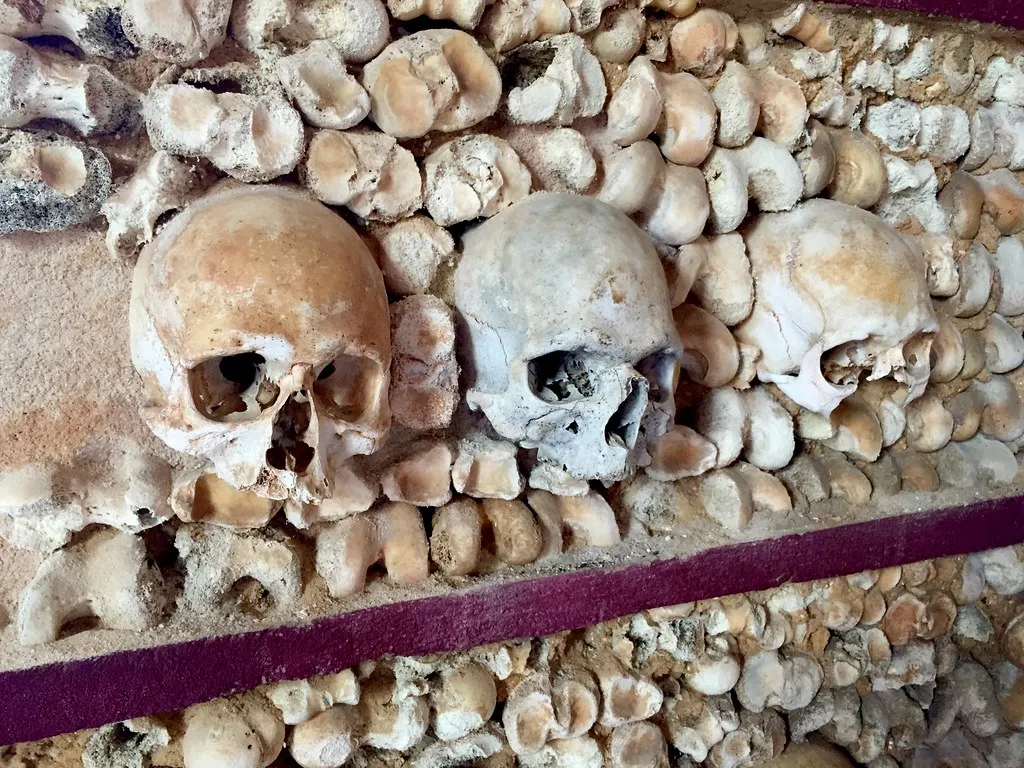
The bone chapel was completed in 1816 when Faro's cemeteries had reached capacity. Rather than placing exhumed remains in a common pit, the Carmelite Third Order chose to display them as architecture. The chapel measures just 2 by 4 metres and contains the remains of approximately 1,245 monks. Skulls and long bones — femurs, tibias — are arranged in strict geometric patterns along every surface, including the barrel-vaulted ceiling. Long bones form architectural features such as cornices and arches; skulls are placed at regular intervals as decorative bosses. The precision is neoclassical, not chaotic.
Above the limestone lintel at the entrance, an inscription reads: "Pára aqui a considerar que a este estado hás-de chegar" — "Stop here and consider, that you will reach this state too." This is an imperative command, not a suggestion. The designers intended this to be uncomfortable. The term memento mori translates as "remember that you will die," and the entire room is a visual sermon on that theme, designed to redirect the visitor's attention from earthly concerns to spiritual ones.
One myth worth clearing up: older travel guides sometimes claim the chapel contains a complete skeleton covered in gold. This is false — likely a conflation with other ossuaries or an exaggeration of the church's gilded interior. The chapel's power comes from the collective weight of the 1,245 individuals, not from any single dramatic relic. A glass-encased skeleton near the front does serve as the room's focal point, but it carries no gold ornamentation. Refer to the full Chapel of Bones guide at Algarve-Tourist for deeper historical context.
Families with young children should make an honest judgment call. Most older children find the geometric arrangement genuinely fascinating rather than frightening. Very young children may be unsettled by the imagery. Photography is permitted but should be approached with respect for those who are interred here.
The Igreja do Carmo closes daily for a midday siesta from 13:00 to 15:00. On Saturdays it opens only 10:00–13:00 with no afternoon session, and it is fully closed to tourists on Sundays.
Comparing Faro's Two Bone Chapels: Which Should You Visit?
To be precise, Faro has one bone chapel and one bone shrine, and they are meaningfully different. The shrine at the Cathedral is an open-air alcove in the courtyard — weathered, quiet, and easy to miss. The chapel at Igreja do Carmo is a dedicated enclosed space measuring 2 by 4 metres, with floor-to-ceiling geometric arrangements and the weight of 1,245 monks behind it. If you can only visit one, the Carmo chapel is the one most people have come to Faro to see.
If you've already visited the Bone Chapel of Évora (Chapel of Bones at Igreja de São Francisco), Faro's version will feel smaller but more precise. The Évora chapel is cavernous and overwhelming in scale. The Faro chapel is intimate, almost claustrophobic, with a geometric discipline that Évora's chapel doesn't share. Both are worth seeing if your travels bring you to both cities, but they are distinct experiences rather than repetitions of each other.
Both Faro sites together cost €7.00 for an adult (€5.00 Cathedral + €2.00 bone chapel). Both are walkable from each other. Anyone following a Faro in one day itinerary can comfortably cover both in a single morning without rushing.
Planning Your Route: Walking Between the Cathedral and Carmo Church
Start at the Cathedral at 10:00 when it opens. Allow around 45–60 minutes: 20 minutes for the nave and chapels, 15–20 minutes for the bell tower ascent and views, and 5–10 minutes in the courtyard bone shrine. Leave by 11:00 at the latest. Walk north through the Arco da Vila gateway, cross the Jardim Manuel Bivar near the marina, and continue to Largo do Carmo — roughly ten minutes on foot.
Arrive at the Igreja do Carmo by 11:15. Allow 20–30 minutes: a few minutes in the church interior to appreciate the talha dourada, then through the sacristy and into the garden. The bone chapel itself takes around 10–15 minutes. This puts you out before 12:00, with an hour to spare before the 13:00 siesta closures.
Use that buffer for a slow coffee or pastry at one of the cafes on Largo do Carmo or along the route back toward the old town. Most local restaurants open for lunch between 12:30 and 13:00, which aligns neatly with the moment the monuments close. If you want to extend your morning, the area around Igreja do Carmo is less touristy than the Largo da Sé and gives a clearer sense of how Faro operates as a working city rather than a museum piece.
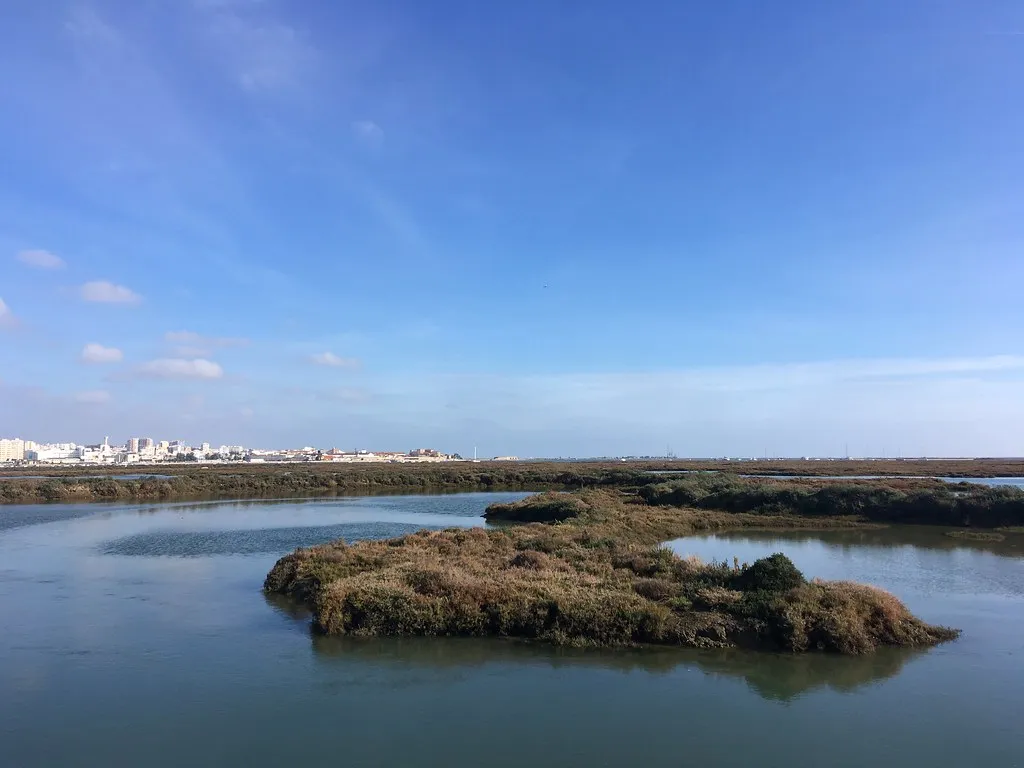
After lunch, the afternoon is well suited to the waterfront and the Ria Formosa. Ferries leave from the marina to the barrier islands — a very different kind of Algarve experience. For help deciding where to base yourself, our guide on where to stay in Faro covers the key neighborhoods and their trade-offs.
Frequently Asked Questions
Is the Bone Chapel in Faro the same as the one in Évora?
No, they are different sites located in different cities. The Bone Chapel in Évora is much larger and more famous, while the Faro version is smaller and located behind the Igreja do Carmo. Both serve as memento mori reminders of mortality. You can find more travel tips on our blog.
How much does it cost to enter Faro Cathedral?
Entry to the Faro Cathedral currently costs €5.00 for adults. This ticket includes access to the main church, the bell tower, and the small museum of sacred art. Discounts are usually available for students and senior citizens upon showing valid identification at the entrance.
Can you see the Bone Chapel and Cathedral in one day?
Yes, you can easily see both in a single morning. They are only a ten-minute walk apart from each other. Start at the Cathedral when it opens at 10:00 to ensure you have enough time to visit the Bone Chapel before the 13:00 siesta closure.
Why was the Bone Chapel in Faro built?
It was built by Carmelite monks in 1816 to house the remains of over 1,000 brothers. Local cemeteries were becoming overcrowded, and the ossuary provided a respectful solution. It also served as a religious site for reflection on the temporary nature of life.
Where is the best view in Faro?
The best view in Faro is found at the top of the Cathedral bell tower. From the platform, you can see the entire Old Town, the city marina, and the lagoons of the Ria Formosa. It is a perfect spot for photography during the morning light.
Faro's two religious landmarks offer more depth than most visitors expect. The Cathedral layers Roman, Gothic, post-fire Tuscan, and Baroque history into one building — and the story of Essex stealing the Bishop's library in 1596 is a detail you won't forget once you know it. The bone chapel at Igreja do Carmo is small but deliberately precise, designed to make you pause in a way that larger, more theatrical ossuaries do not. Together they cost under €10 and take a single morning. If you want to extend the day, consider the region's islands: our guide on best day trips from Faro covers routes into the Ria Formosa and beyond.
Check opening hours before you travel, particularly around Portuguese public holidays when schedules shift. Both sites are essential stops for anyone spending time in Faro, and both reward visitors who arrive knowing what they're looking at.
For the full city overview, see our guide to our complete Faro guide. Pair this with our Faro Old Town walking guide and our one-day Faro plan guides.
 Faro Weather By Month: 8 Key Climate InsightsJune 4, 2026