

Sintra Portugal: Complete 2026 Guide to the UNESCO Town of Palaces
Sintra packs 5 palaces, a Moorish castle, and Romantic-era forest paths into a UNESCO town 40 minutes from Lisbon. Everything you need to plan a 2026 visit.
On this page
Sintra is a UNESCO World Heritage town tucked into a forested mountain range 30 km west of Lisbon — and for such a compact place, it punches far above its weight. Within a 5 km radius you will find 5 palaces, 2 castle ruins, and a tangle of Romantic-era gardens that earned the entire region the nickname "the Portuguese Camelot." Pena Palace alone draws more than 3 million visitors a year, making it the most-visited monument in Portugal outside Lisbon itself.
The poets figured this out first. Lord Byron passed through in 1809 and called Sintra "glorious Eden" in Childe Harold's Pilgrimage. Hans Christian Andersen, visiting in 1866, declared it simply "the most beautiful place in Portugal." Kings, Brazilian millionaires, and exiled European royalty all built their fantasy retreats here between 1840 and 1910, leaving behind a landscape that feels less like a town and more like an open-air museum of 19th-century Romantic imagination.
This guide covers everything you need for a 2026 visit: how to get to Sintra, which palaces are worth the ticket price, realistic day-trip itineraries, the bus 434 loop that ties the hilltop sites together, and where to eat the famous travesseiros pastries that have been made by hand in the village since 1862.
Sintra at a glance
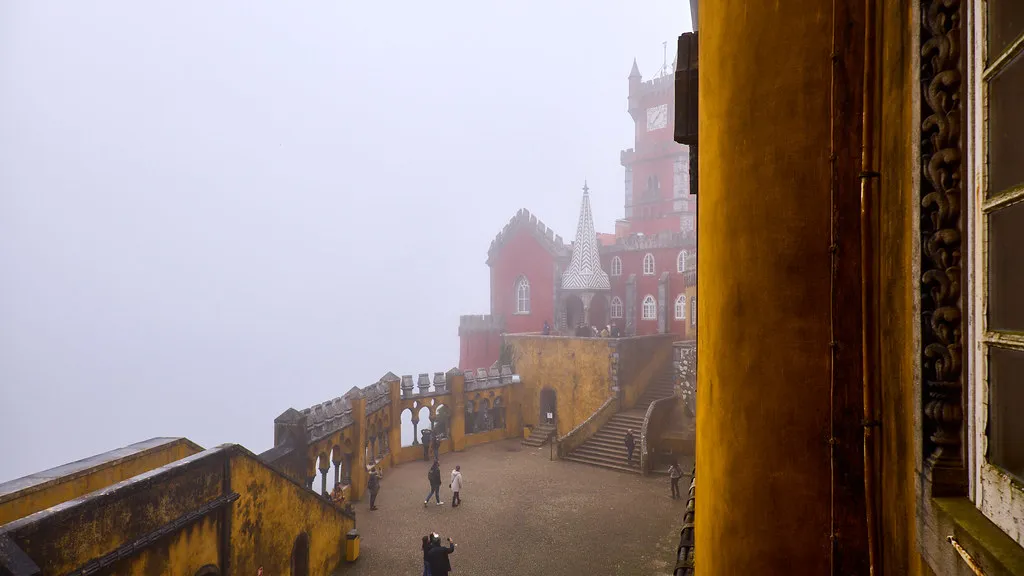
Sintra sits in the Serra de Sintra, a granite mountain range that rises straight out of the Atlantic coastal plain. That geography is responsible for almost everything that makes the town special. The hills create a distinct micro-climate — typically 3 to 5 degrees cooler than central Lisbon, often wrapped in a fine sea mist that locals call the nevoeiro. Portuguese kings started summering here in the 14th century for exactly that reason: to escape the heat.
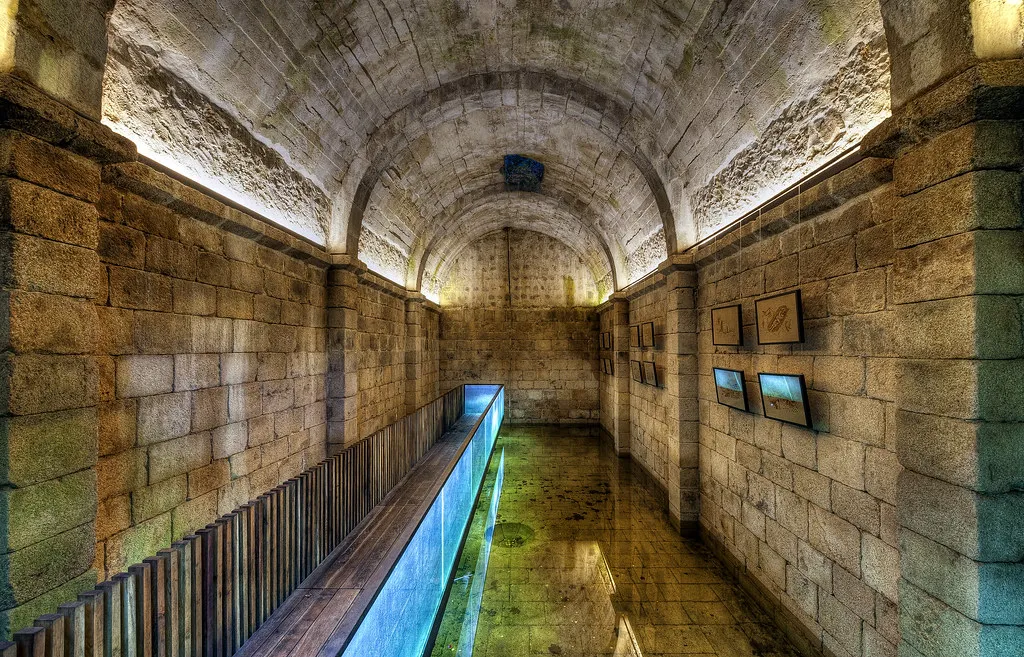
What you are visiting today is not a single monument but what UNESCO calls the "Cultural Landscape of Sintra," added to the World Heritage list in 1995. The protected zone covers the entire Serra, including the historic village, five palaces, two monasteries, the Moorish castle ruins, and 946 hectares of Romantic-era woodland crisscrossed with walking paths, follies, grottoes, and hidden viewpoints.
The headliners are the 19th-century Romantic palaces — eccentric, eclectic buildings where Gothic, Moorish, Manueline, and Mudéjar styles collide on the same facade. Pena Palace is the most famous, but Quinta da Regaleira, Monserrate, and the Sintra National Palace each tell a different chapter of Portuguese history. Above them all, the 9th-century Moorish castle walls remind visitors that this landscape was contested ground long before it became a royal playground.
How to get to Sintra from Lisbon
The train from Lisbon is the only sensible answer for 99% of visitors. Driving to Sintra in 2026 remains a logistical nightmare — the village has narrow one-way streets, almost no parking, and the route up to Pena Palace is controlled by a shuttle bus system that private cars cannot bypass.
Train from Rossio station: Direct Sintra-line trains run from Rossio station in central Lisbon every 20 minutes during the day. Journey time is 40 minutes. A single ticket costs €2.45 in 2026 (loaded onto a rechargeable Viva Viagem card, which itself costs €0.50 one-time). Rossio is on Lisbon Metro Green line — get off at Rossio or Restauradores. The train is reliable, air-conditioned, and drops you 400 metres from the historic village center.
Alternative via Oriente station: If you are staying in Parque das Nações or arriving from the airport, Urban trains also run from Oriente and Entrecampos to Sintra. Same ticket price, slightly longer journey (~50 minutes).
Self-drive: Strongly discouraged. The N-249 road gets backed up by 10 am, village parking fills before 9 am, and you cannot drive private cars up to Pena Palace or the Moorish castle anyway — the final kilometre is shuttle-only. If you are continuing to Cabo da Roca or Cascais afterwards, rent a car at Sintra station after visiting the palaces, not before.
Organized tours: Full-day group tours from Lisbon run €50 to €100 per person and typically combine Sintra with Cabo da Roca and Cascais. They are convenient but you lose flexibility on how long you spend at each palace. For most independent travellers, the DIY train + bus 434 approach saves money and gives you more time inside the sites that actually interest you. See Sintra day trip from Lisbon for a full day-trip planner. If you are weighing Sintra against the beach town next door, see Sintra vs Cascais day trip for a side-by-side comparison.
Pena Palace — the iconic Romantic castle
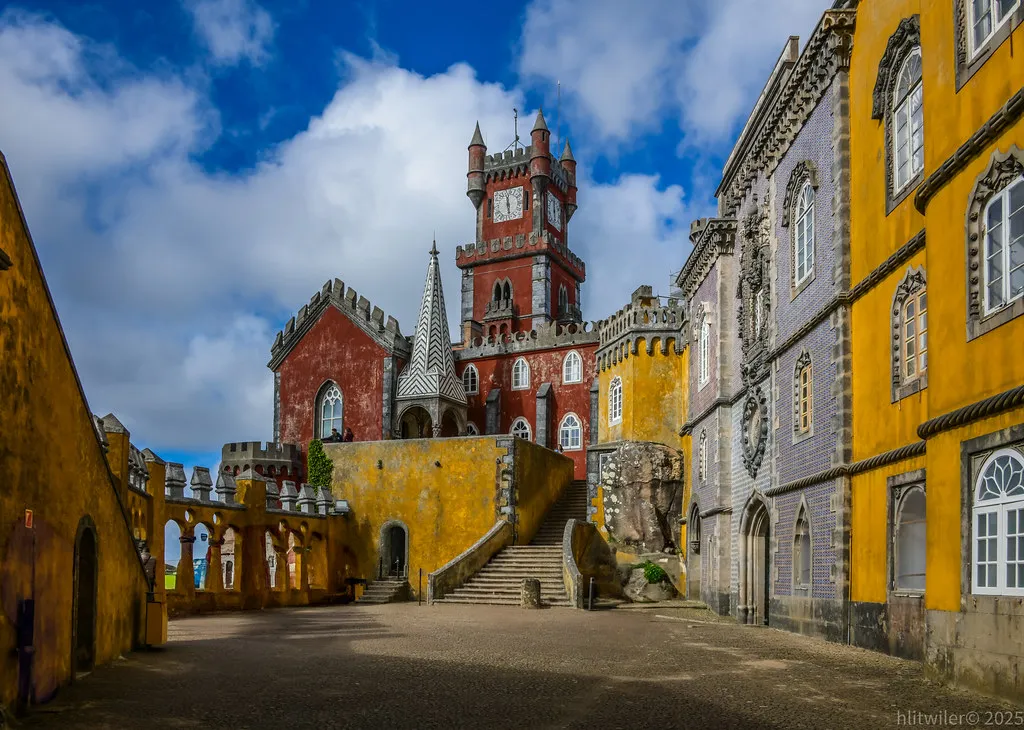
Pena Palace is the image that launched a thousand Portugal travel posters: a yellow-and-red confection perched on a forested peak at 480 metres elevation, its turrets, domes, and azulejo-clad walls looking like a Disney animator's fever dream of medieval Europe. Except it was built a century before Disney existed.
Construction ran from 1842 to 1854 under King Ferdinand II, the German-born husband of Queen Maria II and a cousin of Prince Albert. Ferdinand was a Romantic in the full 19th-century sense of the word — he loved medieval ruins, Wagner operas, and the idea that architecture should evoke emotion rather than just house people. He hired the mining engineer Wilhelm von Eschwege to transform the ruins of a 16th-century Hieronymite monastery into a summer palace that would deliberately mix every historical style Ferdinand admired: Manueline arches, Moorish minarets, Gothic vaults, Renaissance balconies, and Bavarian cuckoo-clock towers, all painted in saturated egg-yolk yellow and tomato red.
The result should not work. Somehow it does — and 172 years later Pena is the second-most-visited monument in Portugal, behind only Lisbon's Jerónimos Monastery.
Practical details for 2026:
- Entry: €15 for Park + Palace interior (the standard combined ticket). €9 for Park-only if you just want to walk the grounds.
- Hours: Open daily 9:30 am to 6:30 pm, last entry 6 pm. Closed Christmas Day and January 1.
- Crowd strategy: Arrive at 9:30 am opening or after 4 pm. Between 11 am and 3 pm the interior rooms have queues of 45 to 90 minutes, and tour groups fill every terrace.
- Getting up the hill: From Sintra village, take bus 434 (€15 day pass) or walk the 3 km forest trail (steep, about 50 minutes). Private cars stop at the lower park gate and must transfer to the internal shuttle.
Inside, the restored royal apartments show how Ferdinand and Queen Amélia actually lived in the 1890s — stucco ceilings, Meissen porcelain, and a kitchen the size of a small restaurant. The terrace views over the Serra, Cascais coast, and on clear days the Atlantic itself are worth the ticket alone. For a full room-by-room breakdown, ticket hacks, and the best photo spots, see Pena Palace visitor guide.
Pena Palace opens at 9:30 am — arriving at opening means the shortest queues. By 11 am the interior rooms can have waits of 45 to 90 minutes, and between 12 pm and 3 pm the terraces are shoulder-to-shoulder with tour groups.
Quinta da Regaleira — the mystical estate
If Pena is Sintra's extroverted showpiece, Quinta da Regaleira is its secretive, esoteric cousin. Built between 1904 and 1910 by the Brazilian coffee-and-gemstone millionaire António Augusto Carvalho Monteiro — known locally as "Monteiro dos Milhões" (Monteiro of the Millions) — the estate was designed by the Italian opera-set architect Luigi Manini as an elaborate coded landscape. Virtually every statue, grotto, chapel, and garden feature refers to alchemy, the Knights Templar, the Rosicrucians, or Masonic initiation rites.
The headline attraction is the Initiation Well — or more accurately, a 27-metre-deep inverted tower, descending in nine spiral landings that correspond to the nine circles of Dante's Inferno and the nine levels of the Templar hierarchy. You enter through a hidden door concealed behind a stone pivot, walk down the spiral staircase, and at the bottom find a tunnel that leads you through the mountainside, emerging by a hidden lake. It is the single most photographed underground space in Portugal, and in peak summer you will queue 30 minutes to descend.
Above ground, the 4-hectare estate is just as strange and lovely. The neo-Manueline palace bristles with gargoyles, pinnacles, and carved sea creatures. The Chapel of the Holy Trinity mixes Catholic iconography with Templar crosses. There are two more wells, several grottoes, a tower you can climb for Sintra valley views, and a romantic little lake crossed by stepping stones. Plan on 2 to 3 hours to do it justice.
Practical details: €15 entry, open daily 10 am to 6:30 pm (until 7:30 pm April through September). Located in the village itself — just a 10-minute walk uphill from Sintra train station, no bus required. It is noticeably less crowded than Pena, especially before 11 am. For the full grotto-by-grotto walkthrough and Initiation Well symbolism, see Quinta da Regaleira guide.
Castelo dos Mouros — the Moorish castle ruins
Long before any Romantic king built a palace on these hills, the Moors built a fortress. The Castelo dos Mouros dates to the 8th and 9th centuries, when this western edge of the Iberian Peninsula was the frontier between the Umayyad Caliphate and the Christian kingdoms to the north. The castle was taken by Afonso Henriques, Portugal's first king, in 1147 during the Reconquista — and then largely abandoned, which is exactly why it survives today in such atmospheric, unrestored condition.
What you walk through now is a ring of stone walls and square watchtowers stretched along a granite ridge, rising and falling with the natural contours of the rock. You can actually walk along the battlements, from tower to tower, the way medieval sentries once did. There are no reconstructed interiors, no furniture, no guided-tour ropes — just stones, wind, and the best panoramic views in all of Sintra. On clear days you see the Atlantic, Lisbon's Tagus estuary, and the pale limestone of Cabo da Roca's cliffs.
King Ferdinand II partially restored the walls in the 1840s, at the same time he was building Pena Palace further up the hill, but he kept the Romantic ruin aesthetic intentional. The result is the most photogenic hilltop castle in Portugal that is not a palace.
Practical details: €12 entry, open daily 9:30 am to 6 pm. From the village it is either a 45-minute uphill walk on the forest trail or a 10-minute ride on bus 434. Wear grippy shoes — the castle stones are worn smooth and become slippery when the famous Sintra mist rolls in. Allow 60 to 90 minutes to walk the full wall circuit. For a full multi-castle strategy, see Sintra castles comparison and the dedicated Moorish Castle Sintra guide.
Sintra National Palace — the medieval royal residence
The Palácio Nacional de Sintra sits in the village center, directly across from the main square. If you have seen any photograph of Sintra with two enormous white conical chimneys rising above a whitewashed building, you have seen this palace — those 33-metre medieval kitchen chimneys are the town's most photographed silhouette and the defining image of the Sintra skyline.
The National Palace is the oldest royal residence in Portugal still standing, inhabited more or less continuously by Portuguese kings and queens from the early 15th century until 1910. That gives it a 600-year layering of styles: Moorish azulejo tiles (Portugal's oldest, dating to the 1430s), Gothic halls, Manueline stone carving, and Mudéjar ceilings. Unlike Pena or Regaleira, nothing here is a Romantic fantasy — every room was actually used by medieval and Renaissance royalty. This is where King Afonso VI was imprisoned by his own brother for nine years. This is where King Manuel I received Vasco da Gama on his return from India. The walls have absorbed six centuries of Portuguese history.
Highlights include the Sala das Pegas (Magpie Room), where the ceiling is painted with 136 magpies holding banners reading Por Bem ("For the Good") — a joke by King João I at his gossiping courtiers; the Sala dos Brasões (Coat of Arms Room), with a spectacular 16th-century wooden dome painted with the arms of 72 noble families; and the two cavernous kitchens beneath the conical chimneys, still fitted with the roasting spits and copper pots that once fed royal banquets. The azulejo panels in the Arab Room are among the finest 15th-century tilework surviving anywhere in the Iberian Peninsula.
The National Palace is also one of the most strategically useful stops on any Sintra itinerary, because it sits at sea level in the village center — no bus, no hill-climbing, no shuttle required. It pairs beautifully with Quinta da Regaleira (also walkable) for a no-uphill day, or as a late-afternoon add-on after returning from Pena on the bus 434. For ticket booking tips, room-by-room guidance, and the story of those famous chimneys, see the full Sintra National Palace guide.
Practical details for 2026: €13 entry for adults, €10 for children and seniors. Open daily 9:30 am to 6:30 pm, last entry at 6 pm. Located 5 minutes' walk from the train station. Small compared to Pena — allow 60 to 90 minutes. Closed Wednesdays.
Monserrate Palace — the Romantic jewel most visitors miss
Four kilometres west of Sintra village, Monserrate is the palace that most day-trippers never reach — and therefore the one that delivers the most atmosphere per euro. Originally a 16th-century chapel and later an English merchant's country house, the current palace was built between 1858 and 1863 for the textile millionaire Sir Francis Cook by the English architect James Knowles Jr. The result is a dreamlike Indo-Gothic-Moorish fusion: pointed Islamic arches, Mughal domes, lace-like stone filigree, and a central music room whose entire ceiling is carved as a single stone lotus flower — one of the most audacious interior design gestures in 19th-century European architecture.
The surrounding gardens are what really make Monserrate worth the detour. Cook was an obsessive botanical collector, and the 33-hectare estate contains more than 2,500 plant species from five continents, arranged as themed zones: a Mexican garden of cacti and agave, a Japanese garden with camellias, a tropical fern valley fed by Sintra's perpetual sea mist, and a "Mediterranean ruin" folly built from imported classical fragments. In spring (March through May), the camellia, rhododendron, and azalea blooms are extraordinary — arguably the finest garden display in the entire Serra de Sintra.
Note for 2026 visitors: restoration works on the palace roof are ongoing until at least Q1 2027, so scaffolding is visible on the exterior. The interior rooms and all gardens remain fully open; only the roofline photos are affected.
Monserrate Palace has scaffolding on the exterior due to ongoing roof restoration expected to last until at least Q1 2027. The interior rooms and all 33 hectares of gardens are fully open, but clean roofline shots are not possible until works complete.
Because Monserrate sits outside the Sintra bus 434 loop, most visitors skip it — which is exactly why it is the quietest and most contemplative of Sintra's palaces. If you are staying overnight in Sintra, or if you have already seen Pena and want something completely different on day two, this is the move. For a full garden-zone map and visiting strategy, see the Monserrate Palace Sintra guide.
Practical details for 2026: €8 for adults, €6.50 for children (under 17) and seniors (over 65). 15% discount with Lisboa Card. Palace open daily 9:30 am to 6 pm; gardens open 9 am to 7 pm. Reached by bus 435 from Sintra station (separate from the 434 loop), or a scenic 45-minute walk along the N-375 road. No advance booking required — the site is rarely crowded.
Convent of the Capuchos — the cork-lined hermitage in the forest
If Monserrate is the palace most visitors skip, the Convent of the Capuchos is the one almost nobody reaches — and that is precisely what makes it so affecting. Founded in 1560 by Franciscan friars who wanted a life of radical austerity, the convent is built directly into the granite boulders of the Serra, its tiny cells lined floor-to-ceiling with cork to keep out the Atlantic damp. The result looks less like a religious building and more like a hobbit village carved into the rock face.
The monks lived here in voluntary poverty for 268 years — eating one meal a day, sleeping on cork-covered ledges, keeping their cells so narrow that a man cannot fully stretch his arms. Lord Byron visited in 1809 and later wrote that the Capuchos hermitage was "the most singular of all the scenes" he encountered in Sintra, more memorable even than the palaces. The cells, chapel, refectory, and kitchen survive in near-original condition because the convent was never remodelled or modernised after the friars departed in 1834.
Getting there is half the experience. The convent sits deep in the forest, about 7 km from Sintra village along a winding road. There is no regular bus service, so your options are a taxi (roughly €12 one-way from Sintra station), a rental car, or a vigorous 90-minute forest walk from the village. Many visitors combine it with Monserrate — both are off the main 434 loop and in the same general direction, making them natural partners for a "hidden Sintra" half-day if you have your own transport. For the full access guide and what to expect inside each cork-lined cell, see the Convento dos Capuchos Sintra guide.
Practical details for 2026: €7 for adults, €5.50 for children (6 to 17) and seniors (over 65). Open daily: summer season (2 March–24 October) 9:30 am to 8 pm (last ticket 7 pm); winter season (25 October–1 March) 10 am to 6 pm (last ticket 5 pm). No advance booking needed — visitor numbers are low enough that you rarely wait. Allow 60 to 90 minutes inside.
How to plan a Sintra day trip
Here is the honest reality of Sintra that most travel guides soften: you cannot see everything in a day. The palaces are spread across a mountain, the bus loop is slow in peak hours, and every major site deserves 90 minutes to 2 hours inside. Trying to check off 4 or 5 sites in one day leaves you exhausted, rushed, and barely remembering which azulejo belonged to which palace.
Realistic targets per day:
- 2 sites = the sweet spot. One major palace plus one supporting site. You arrive relaxed, eat a proper lunch, and have time to wander the village.
- 3 sites = rushed but possible if you start at 8:30 am in Lisbon and skip sit-down meals.
- 4+ sites = stay overnight. Sintra has excellent small hotels and is magical in the evening once the day-trippers leave.
Best 2-site combinations:
- Pena Palace + Quinta da Regaleira — The classic combo. Hits the two most famous sites; one is a Romantic castle, the other a mystical garden, so they feel completely different.
- Pena Palace + Castelo dos Mouros — For views and outdoor walking. Both on the same bus 434 loop, so logistics are simple.
- Quinta da Regaleira + Sintra National Palace — The no-uphill option. Both are in or near the village, so you skip the bus entirely. Good for travellers with mobility concerns or rainy weather.
- Monserrate + Pena Palace — Contrast day. Monserrate's gardens in the morning, Pena's turrets in the afternoon.
If you are building a full day trip from Lisbon including transport timings and meal breaks, see Sintra day trip from Lisbon for an hour-by-hour itinerary. For help deciding whether one day is enough or two days is better for your situation, read Sintra in one day vs two days.
Sintra train + bus 434 logistics
Once you have decided where to go, the mechanics are simple — but only if you understand how the bus 434 loop works. Get this wrong and you will waste 90 minutes standing at stops.
Step 1: Train from Rossio to Sintra. Departures every 20 minutes, 40-minute journey, €2.45 single. You want the first departure after 8:00 am if you are targeting the 9:30 am Pena opening. Buy a Viva Viagem card at the Rossio metro/train station and load it with "Zapping" credit — it works on both metro and train.
Step 2: Bus 434 at Sintra station. Exit the train station and you will see the bus 434 stop immediately to your right. This is a hop-on/hop-off loop run by Scotturb that goes: Sintra station → Sintra village (National Palace stop) → Castelo dos Mouros → Pena Palace → back to station. The full loop takes 40 minutes in light traffic, closer to 70 minutes in July and August.
The day pass is essential. In 2026 the 434 circular day pass costs €15 and gives you unlimited hop-on/hop-off all day. A single ticket is €7.60, so two rides already break even on the pass. Buy it from the driver with contactless card or cash.
Walking as an alternative. Energetic visitors can walk the forest trails between sites. The village-to-Moorish-castle trail is about 45 minutes uphill; the Moorish-castle-to-Pena trail is another 20 minutes. Going downhill is much easier — a popular strategy is to take bus 434 up to Pena, tour the palace, then walk back down through the forest past the Moorish castle to the village.
Return train to Lisbon. Last trains leave Sintra around 1:00 am, but in practice you want to be heading back by 7 pm unless you are having dinner in the village. Trains are never sold out — just tap your Viva Viagem card and board. For a full transport walkthrough including luggage storage and timings, see Lisbon to Sintra train guide. For the complete stop-by-stop breakdown of the circular hop-on/hop-off service, see the bus 434 Sintra route guide.
Where to eat in Sintra
Sintra has two pastries so famous they are legally protected regional products. The travesseiro ("little pillow") is a flaky puff-pastry envelope filled with almond-and-egg-yolk custard, created in 1940 at Casa Piriquita on Rua das Padarias. The queijada de Sintra is older — a small cheese tart made with fresh sheep's curd, sugar, egg yolks, and cinnamon, documented in local records since the 12th century when nuns at Sintra's convents sold them to pay their rent to the crown.
Casa Piriquita (Rua das Padarias 1–7) is still family-run and still the gold standard — expect a short queue at 10 am, 10 minutes longer by noon. Get one travesseiro and one queijada to go and eat them on a park bench. For sit-down lunch, Tascantiga and Incomum by Luís Santos both serve modern Portuguese small plates in the village center at reasonable prices (€15 to €25 per person). Avoid the tourist-trap cafés directly on the main square — quality drops sharply and prices double.
Where to stay in Sintra
Most visitors do Sintra as a day trip from Lisbon, and that works well — but staying overnight changes the experience entirely. By 6 pm the day-trippers have gone, the village reverts to a quieter, more local atmosphere, and you can walk the forest paths at dusk with almost no one else around. You also get a head start on Pena Palace at 9:30 am opening, well before the first Lisbon trains arrive.
Sintra has accommodation in every category, from converted manor houses and quintas tucked into the forest to small family guesthouses in the village center. Budget travellers can find clean en-suite rooms from €70 per night in shoulder season; boutique properties in historic buildings run €150 to €300. The village center, the Estefânia neighbourhood (near the train station), and the hillside estates road (Rua Barbosa du Bocage and environs) are the three main accommodation zones, each with different trade-offs between walking distance to sites and quietness.
For a curated list of options by neighbourhood and budget, see where to stay in Sintra and the companion best hotels in Sintra guide with direct booking comparisons.
Frequently Asked Questions
How long do you need in Sintra?
One full day lets you see 2 sites comfortably and eat a proper lunch. Two days lets you cover 4 to 5 sites without rushing and gives you time to walk the forest trails between them. If you only have half a day, pick Quinta da Regaleira (it is walkable from the train station) and skip the hilltop palaces entirely.
Is Sintra worth visiting?
Yes — for most Lisbon travellers Sintra is the single most memorable day trip in Portugal. The combination of UNESCO-listed 19th-century Romantic palaces, Moorish castle ruins, and forested mountain scenery 40 minutes from the capital is genuinely unique in Europe. The one caveat: it gets extremely crowded in July and August. Visit in April, May, October, or early November for the best experience.
Can you see Sintra in one day?
You can see the highlights of Sintra in one day, but not all of it. A realistic one-day plan covers 2 palaces plus the village — typically Pena Palace in the morning and either Quinta da Regaleira or the Moorish castle in the afternoon. Attempting 4 or more sites in a single day leads to exhaustion and long waits at the bus 434 stops.
Is Pena Palace worth it?
Yes — Pena Palace is the most photographed monument in Portugal after the Belém Tower, and the eclectic Romantic architecture is genuinely unlike anything else in Europe. The €15 combined ticket (park plus palace interior) is the right choice for first-time visitors. If the queues are over 60 minutes at the ticket gate, the €9 park-only ticket still lets you see the iconic exterior and terraces.
How early should you arrive at Pena Palace?
Arrive at 9:30 am opening for the shortest queues. By 11 am the interior rooms have 45–90 minute waits, and between 12 pm and 3 pm the terraces are shoulder-to-shoulder. A good alternative is to arrive after 4 pm, when tour groups are leaving — you will have less time inside but far fewer people in your photos.
Plan your Sintra visit
Sintra rewards planning. Decide which 2 sites matter most, book your Rossio train, grab a bus 434 day pass, and leave room for lunch and a travesseiro. This 2026 guide is the pillar for our full Sintra cluster — if you want to go deeper on any individual palace, logistics detail, or seasonal timing, the guides below walk you through it step by step.
Palaces & Monuments:
- Pena Palace visitor guide
- Quinta da Regaleira guide
- Sintra National Palace guide
- Monserrate Palace guide
- Convento dos Capuchos guide
- Moorish Castle Sintra guide
- Sintra castles comparison
Planning & Logistics:
- Sintra day trip from Lisbon
- Sintra in one day vs two days
- Sintra vs Cascais day trip
- Lisbon to Sintra train guide
- Bus 434 Sintra route guide
- Sintra ticket prices 2026
- Best time to visit Sintra
- Sintra weather by season
Where to Stay & Eat:
Explore More Sintra Guides
Deep-dive guides for every part of a Sintra trip — from each palace and castle, to transport, planning, lodging, and food.
Palaces & Castles
- Pena Palace Complete Guide
- Quinta da Regaleira (Initiation Well)
- Moorish Castle Walking Guide
- Sintra National Palace
- Monserrate Palace (Romantic Jewel)
- Convent of the Capuchos
- Chalet of the Countess of Edla
- Pena Park & Gardens
- All Sintra Castles & Palaces Compared
What to Do
- 15 Best Things to Do in Sintra
- One Day vs Two Days Itinerary
- Sintra Day Trip from Lisbon
- Sintra + Cabo da Roca Combined Day Trip
- Sintra vs Cascais: Which Day Trip?
Getting There & Around
- Lisbon to Sintra Train Guide
- Train vs Car vs Tour: How to Get to Sintra
- Bus 434 Tourist Loop Explained
- Sintra Ticket Prices 2026 (All Monuments)
Planning Your Visit
- Best Time to Visit Sintra
- Sintra Weather by Season
- Sintra with Kids: Family Guide
- Lisbon + Porto + Sintra First-Timer Guide
Where to Stay & Eat
 15 Magical Things To Do In Óbidos, Portugal (2026)June 11, 2026
 Free Things To Do In Guimaraes Travel GuideJune 8, 2026
 Guimaraes With Kids Travel GuideJune 8, 2026