9 Essential Things to See at the Park of Pena Sintra
Discover the magic of the Park of Pena in Sintra. Our guide covers the Valley of Lakes, the Chalet of the Countess of Edla, and tips for the best views.
On this page
9 Essential Things to See at the Park of Pena Sintra
The park of Pena Sintra hides more than 200 hectares of forest behind the palace walls. Most visitors spend fifteen minutes crossing it to reach the ticket queue, then leave having seen almost nothing. The valleys, fern gardens, hidden chapels, and viewpoints that King Ferdinand II spent decades designing are entirely separate from the palace interior — and they require a separate strategy to see properly.
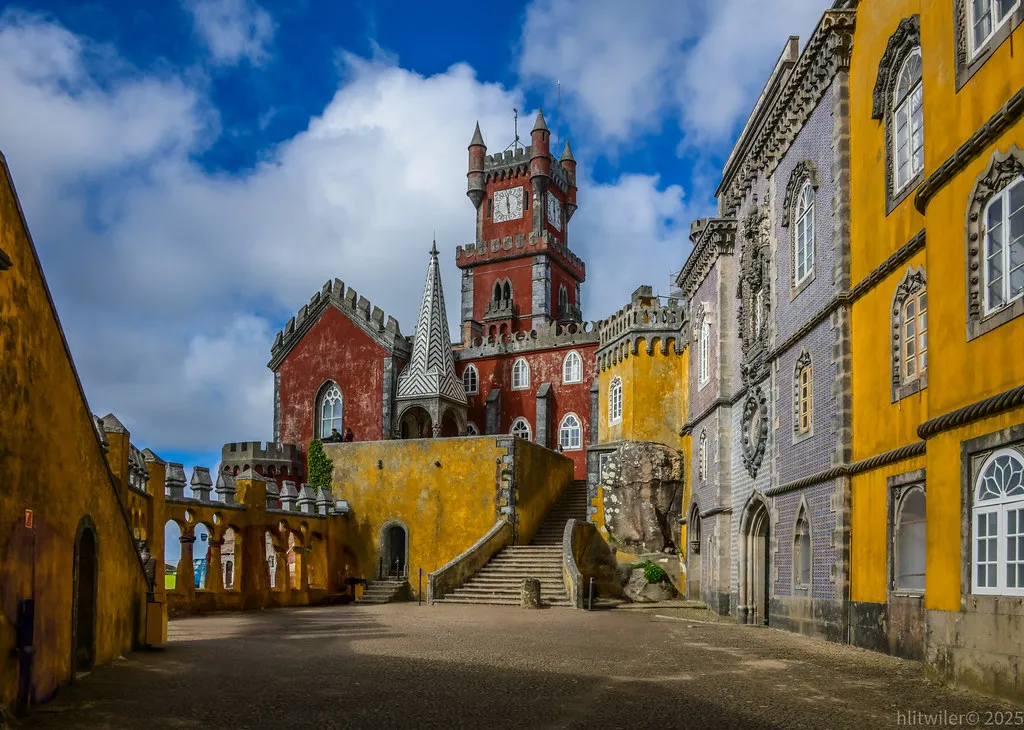
A park-only ticket (€10 in 2026) is the smartest entry for anyone on a budget or visiting on a crowded day. It covers the full grounds, the Chalet of the Countess of Edla, and the painted palace terraces — everything except the interior rooms. For many visitors, it is enough. This guide covers what to expect from each major area and how to plan your route.
Essential Visitor Information: Hours, Tickets, and Access
The park gates open at 09:00 and the last admission is at 18:00, with the park staying open until dusk. Palace interior last entry is 17:30. Both the park-only and combined tickets can be bought online at the Official Parques de Sintra website. Buying in advance is not optional in summer — peak-day palace slots sell out before noon. For current prices, see the Sintra ticket prices 2026 guide.
The park has two entrances. The Main Entrance (GPS: 38°47'16.45"N, 9°23'15.35"W) is served directly by Bus 434. The Lakes Entrance (GPS: 38°47'21.4"N, 9°23'31.9"W) sits lower on the hill and is the natural exit point for anyone doing the full clockwise loop through the park. Most first-time visitors enter at the top and exit at the lakes, catching the bus 434 Sintra route back from the main gate or walking down to Sintra town.
One important 2026 update: the electric Hop On Hop Off shuttle that previously ran inside the park is temporarily out of service. Parques de Sintra has not given a restart date. Do not plan around it — the steep internal paths must be walked. Visitors with limited mobility should book a tuk-tuk from the train station that can drop at the Main Entrance gate.
- Park-only ticket (2026): €10 adult, includes palace terraces and Chalet da Condessa d'Edla
- Combined Palace + Park: €20 adult, timed 30-minute interior window — book at least one day ahead in summer
- Bus 434 from Sintra train station loops to the Main Entrance every 20–30 minutes
- No private vehicles are permitted beyond the town centre
The History of Parque da Pena: Ferdinand II's Romantic Vision
King Ferdinand II bought the ruined Hieronymite monastery on this peak in 1838. The palace was only half his ambition. He wanted a forest around it — one that felt natural but was in fact meticulously designed. Working with Baron Wilhelm Ludwig von Eschwege on the architecture and a team of gardeners on the planting, Ferdinand had more than 500 species shipped in from across the world: sequoias from California, tree ferns from New Zealand, cedars from the Himalayas. Learn more about Pena Palace architectural history and its Romantic-era transformation. In a single generation, bare granite slopes became the lush woodland visitors walk through today.
The park reflects the ideals of Romanticism directly: nature as emotional experience, not ornamental backdrop. Winding paths were designed to produce surprise. Viewpoints were framed. Fern valleys were placed where the humidity would keep them cool. Understanding this history makes the Pena Palace Sintra grounds considerably more interesting than they first appear — every element was deliberate.
After Ferdinand's death, his second wife Elise Hensler, Countess of Edla, continued shaping the western edges of the park. Her contributions — the chalet, the Countess's Fernery, the boulder garden — are distinct from Ferdinand's work and often more intimate in scale. The park you walk today is as much hers as his.
A park-only ticket costs €10 in 2026 and covers all 200 hectares of grounds, the palace terraces, and the Chalet da Condessa d'Edla — everything except the palace interior rooms. For many visitors, this is the better-value option, especially on busy summer days.
The Warrior Statue, Temple of Columns, and Hidden Monuments
High on a granite outcrop above the main path, a stone warrior in medieval armour stands watch over the palace. He is nearly three metres tall, holding an iron spear and shield, and has been here since 1848. The work of Portuguese sculptor Ernesto Rusconi, the statue is widely believed to depict Ferdinand II himself — cast as the eternal guardian of the palace he built across the valley. Look at the shield and you will see the detail: a caravel with furled sails, the long voyage at an end. A quiet tribute from a German prince who made Portugal his home.
The Temple of Columns is a circular neoclassical structure set in a clearing further along the same path. It is a designed surprise — you come around a bend in the trees and it appears. The Grotto of the Monk (Gruta do Monge) sits nearby, a remnant of the pre-palace monastery that Ferdinand chose to preserve rather than demolish. Both take ten minutes to visit and are almost always empty.
At the foot of the Warrior's outcrop is the Mesa da Rainha — an octagonal stone table that was a favourite rest stop of Queen Amélia, the last queen of Portugal. It is an easy spot to miss but worth finding: it gives the best unobstructed ground-level view of the statue above, framed by the canopy.
The Valley of Lakes and Fountain of the Small Birds
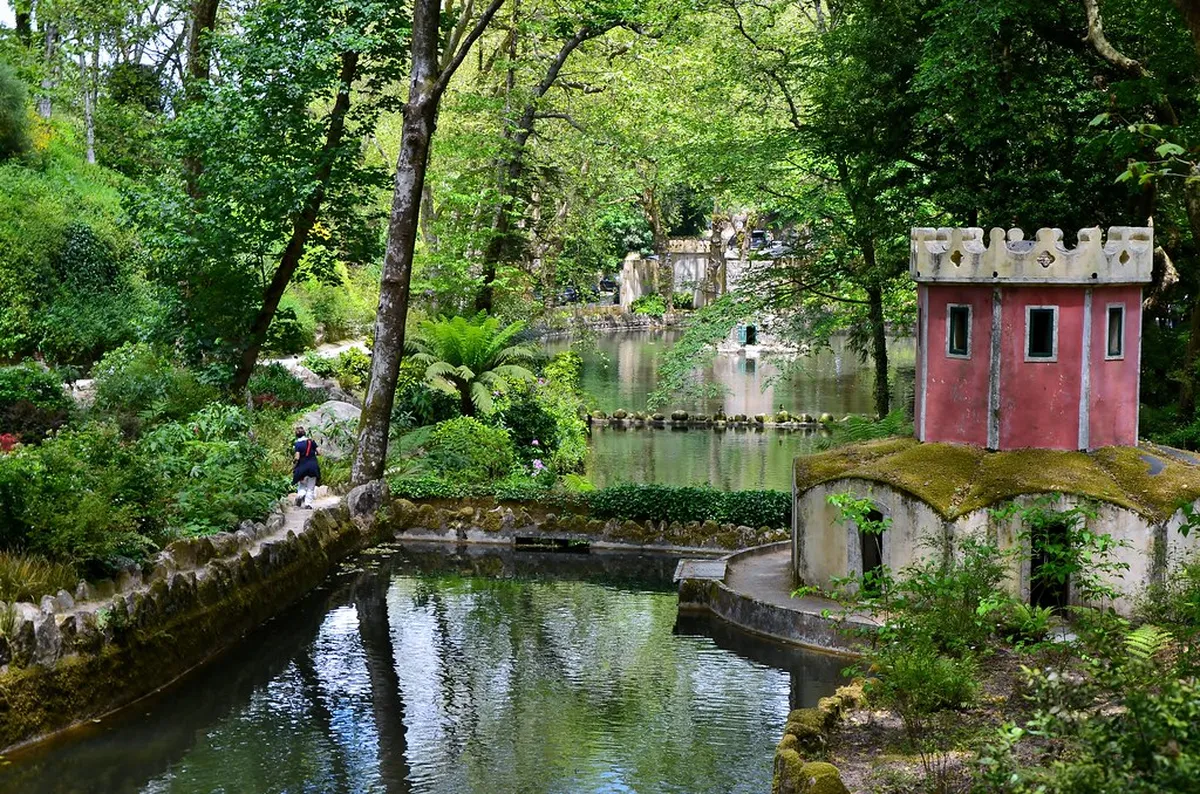
The Vale dos Lagos is a string of five interconnected ponds running down a sheltered valley to the west of the palace. The stream that feeds them was dammed in the 1840s into this sequence of lakes connected by small waterfalls. It is significantly cooler down here than on the exposed upper paths, and much quieter than the palace terraces above.
At the head of the valley stands the Fonte dos Passarinhos, the Fountain of the Small Birds. It is a small Neo-Mudéjar pavilion with a tiled dome and octagonal floor plan, Arabic inscriptions on the outer walls, and a single fountain trickling into a stone basin inside. The dome amplifies the sound of the water. You cannot enter, but there is a garden wall seat directly outside that is one of the better rest points in the park.
The most memorable detail of the vale is easy to miss: rising from the water are two miniature castles used as duck houses. Ferdinand II had them built around 1843 as shelters for waterfowl, and he had them designed as scaled-down tributes to the two great buildings of his estate — one a turreted miniature of the Moorish Castle on the adjacent hill, the other a tiny painted replica of the Palácio da Pena itself. They are still in use. The valley ends at the Lakes Entrance gate, which is the natural exit point for the full park loop.
Queen's Fern Valley and the Camellia Garden
The Feteira da Rainha, or Queen's Fern Valley, is named after Queen Maria II, Ferdinand's first wife. It sits a short walk west of the palace, dropping into a cool, stream-fed valley where the giant tree ferns Ferdinand imported from Australia and New Zealand in the 1840s have grown to full height. These exotic species are among the finest examples of tree fern collections in Europe, some exceeding six metres in height. The air is several degrees cooler than the paths above, which makes it a useful break mid-morning before the heat builds.
Note for navigation: there are two fern valleys in the park and the signage can be confusing. The Feteira da Rainha (Queen's) is the older and larger, near the palace. The Feteira da Condessa (Countess's Fernery) is a smaller private garden beside the Chalet da Condessa d'Edla at the park's western edge. They are not the same place and are separated by a 20-minute walk.
The Camellia Garden (Jardim das Camélias) adjoins the Queen's Fern Valley and holds one of the most significant collections of camellias in Europe. Ferdinand planted them specifically to provide colour through the winter months when the rest of the park is dormant. Late February to early April is peak bloom season, but the garden is worth visiting year-round for its structure and quiet.
The Chalet and Garden of the Countess of Edla
The Chalet da Condessa d'Edla sits at the western edge of the park, a 15-minute walk from the palace. Elise Hensler, an opera singer who became Ferdinand's second wife after Queen Maria II's death, designed it in 1869 as a private retreat in mock-Alpine style. The exterior is clad almost entirely in local Portuguese cork — applied in irregular sheets and shaped to suggest logs and bark. This is not decorative whimsy: cork provided genuine insulation against the Atlantic winds that hit this side of the mountain hard. No other building in Sintra uses it this way.
Inside, restored murals and delicate woodwork date to the original 19th-century fit-out. The surrounding garden was the Countess's personal project, distinct from Ferdinand's earlier planting on the upper slopes. Behind the chalet, a footpath circles the Pedras do Chalet — a jumble of colossal granite boulders where the path winds between, around, and at points beneath the rocks. In places a boulder leans across the path overhead and the walk becomes a short passage through a cave. It is one of the most dramatic features in the park and almost never mentioned in visitor guides.
The garden paths here are generally flatter and more sheltered than the main forest trails, making this section accessible to visitors who find the upper slopes difficult.
High Cross and the Best Viewpoints (Alto do Chá)
The Cruz Alta is the highest point in the entire Serra de Sintra at 528 metres, marked by a limestone cross on a pile of granite boulders. A cross has stood here since 1522 — the current replica was carved in 2008 after the previous one was struck by lightning in 1997. The walk from the palace takes about 20 minutes along a shaded, gently graded path. The view from the top stretches south to Lisbon and Cascais, west to the Atlantic, and north across the serra. What it does not give you, despite what most guides say, is a clear view of the Pena Palace — the tree canopy blocks it.
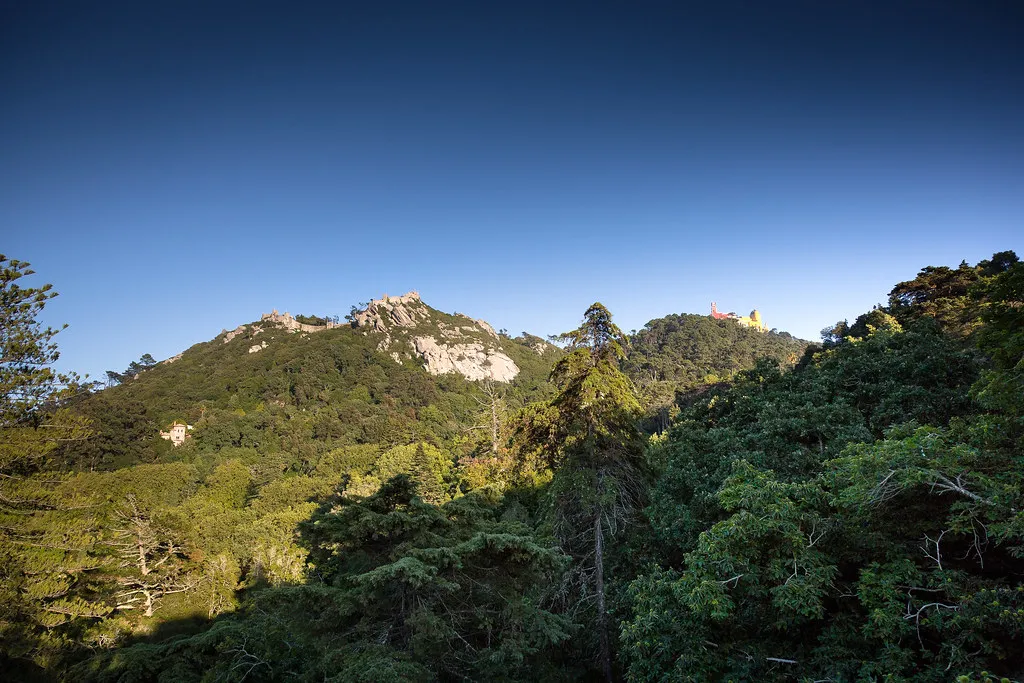
For an unobstructed view of the palace, go to the Alto do Chá (Tea Hill). It sits on the southwestern flank of the park, the third-highest peak in the range, and it is where the Atlantic winds keep the vegetation low enough that the palace rises clean above the trees to the north. Most visitors never reach it. Those who do are usually alone on the rocks when they arrive. The hill's name comes from a late 19th-century experiment: Ferdinand II's gardeners attempted to grow Camellia sinensis (the tea plant) here, believing Sintra's wet climate matched Asian tea-growing conditions. The experiment never became commercial, but the name stayed.
Clear days provide views stretching all the way to Lisbon and the Tagus. The Sintra mist can roll in quickly and change the picture entirely — check the horizon as you hike rather than waiting until you reach the summit.
Suggested Walking Routes Through the Forest
Two routes work well for most visitors. The shorter loop (around one hour) stays close to the palace: drop through the Camellia Garden to the Grotto of the Monk, continue to the Queen's Fern Valley, and then down through the Vale dos Lagos to the Lakes Entrance. This is the route for tired legs, short afternoons, or children who have already done their climbing for the day.
The longer loop (two to two-and-a-half hours) swings out across the southern and western edges of the park: Warrior Statue, Temple of Columns, Cruz Alta, Alto do Chá, Chalet da Condessa d'Edla, Countess's Fernery, old Cavalariças stables, the small English Garden, and finally the Vale dos Lagos. Both routes run clockwise and exit at the Lakes Entrance gate. Download the official Parques de Sintra PDF map before you go — the trail junctions are signed but the smaller paths are easy to miss.
Entering through the Lakes Entrance is the best strategy for avoiding the steep initial climb if you are coming from the lower town. This route lets you see the water features first before heading uphill toward the palace. The Visit Portugal official tourism portal offers comprehensive route guidance and regional context for planning your visit.
Practical Tips for Navigating the Steep Terrain
The micro-climate of the mountain means that the weather in Sintra varies dramatically from the town below. A thick Atlantic mist can roll across the park in twenty minutes, dropping the temperature by five degrees and making stone paths slippery. Always bring a light jacket, even if Lisbon was warm when you left. Grip-soled shoes matter more here than in almost any other Sintra site — the stone paths are uneven and steep sections have no handrails.
Arrive at opening (09:00) to beat both the heat and the coach groups, which typically arrive from about 10:30 onwards. Carry a full water bottle: drinks are available near the palace terraces but not on the outer trails. If you plan to do both the full park loop and the palace interior, do the palace first while you have energy, then spend the afternoon on the quieter outer paths when the crowds thin.
The park is not wheelchair accessible on the main trails due to the gradient and natural terrain. The area around the Chalet da Condessa d'Edla and the lower Vale dos Lagos is flatter and more manageable for visitors with limited mobility. Plan your Sintra day trip from Lisbon to include at least three hours for the park if you want to cover the main highlights without rushing.
As of 2026, the electric Hop On Hop Off shuttle that previously ran inside the park is temporarily out of service with no confirmed restart date. All internal paths must be walked — wear grip-soled shoes and be prepared for steep, uneven terrain throughout.
Frequently Asked Questions
Can you visit the Park of Pena without the Palace?
Yes, you can purchase a park-only ticket that grants access to all 200 hectares of the grounds. This ticket also includes the exterior terraces of the palace, which are the most colorful parts. It is a great way to see the things to do in Sintra without the palace crowds.
How long does it take to walk through the Park of Pena?
Most visitors spend between two and four hours exploring the various trails and gardens. If you plan to hike to the High Cross and visit the Chalet, allow for more time. The steep terrain can slow down your pace significantly compared to flat city walking.
Is the Park of Pena worth it?
The park is absolutely worth visiting for its unique botanical collection and romantic architecture. Many travelers find the gardens more impressive and peaceful than the crowded interior rooms of the palace. It offers some of the best photography spots and panoramic views in the entire region.
What is the best entrance for the Park of Pena?
The Main Entrance is best for those taking the 434 bus or wanting the most direct route up. However, the Lakes Entrance is ideal for those who prefer a more gradual climb through the scenic valley. Choose your entrance based on which highlights you want to see first in your itinerary.
The park of Pena Sintra is a magical destination that captures the spirit of Portuguese Romanticism. Whether you explore the exotic fern valleys or climb to the High Cross, the experience is unforgettable. A well-planned Sintra day trip from Lisbon must include time to wander these historic woods.
For broader Sintra planning context, see our complete Sintra travel guide.
For more, see our Chalet of the Countess of Edla guide.