
Sintra Castles Guide: Compare 5 Palaces & the Moorish Castle (2026)
Sintra packs 5 palaces and a Moorish castle into 5 km. This 2026 hub compares all six side by side — tickets, visit order, bus routing, and how to build the best 1- or 2-day itinerary.
On this page
Sintra packs five palaces and one Moorish castle ruin into a five-kilometer stretch of forested hills west of Lisbon, and trying to see them all in a single day is the most common mistake first-time visitors make. The town earned UNESCO World Heritage status in 1995 precisely because of this density: Romantic-era follies, medieval defensive walls, royal residences, and mystical estates all sit within a 15-minute drive of one another. The challenge is not finding castles — it is choosing which ones to skip.
This 2026 guide is the comparison hub for the entire Sintra castle cluster. Each palace has its own deep-dive linked below; this page helps you decide which to visit, in what order, and how to route between them without wasting half a day queuing for the wrong bus. For transport from Lisbon, neighborhoods, and the wider Sintra context, see our complete Sintra Portugal guide.
Sintra Castles at a Glance: Comparison Matrix
Use this table to pick your combination before reading the full castle profiles below. Walking distances are measured from Sintra train station.
| Castle / Palace | What makes it special | 2026 ticket (adult) | Time needed | Distance from village | Bus |
|---|---|---|---|---|---|
| Pena Palace | Colorful Romantic fantasy; most photogenic; Atlantic views | €15 park + palace / €9 park only | 2–3 hours | 4 km uphill | 434 |
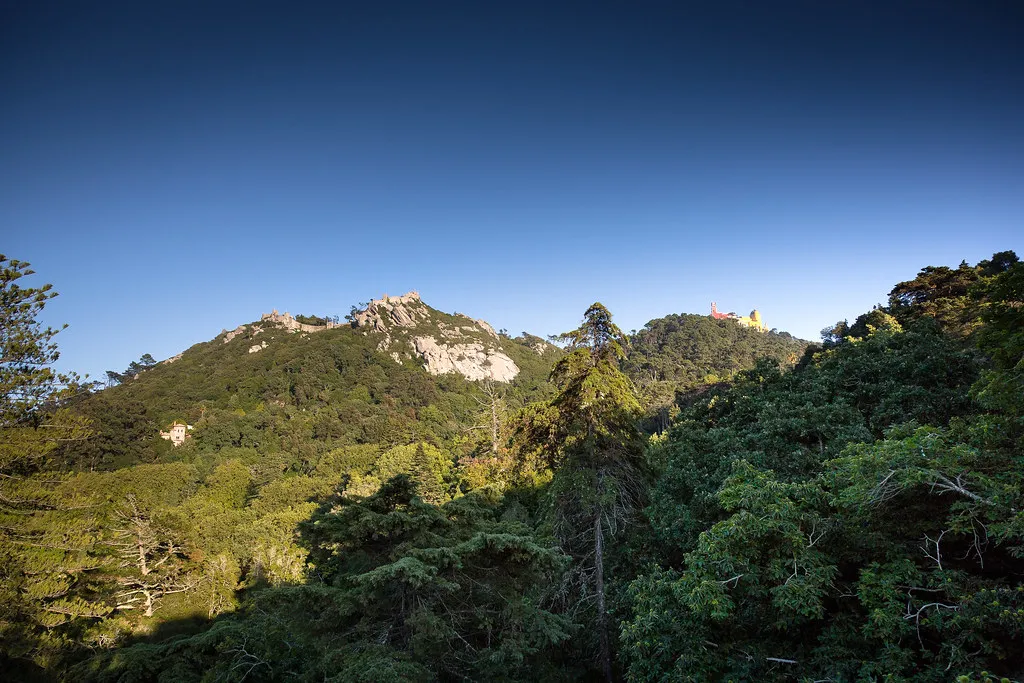
| Moorish Castle | 8th-century walls; best 360° panorama in Sintra | €12 | 90 min–2 hours | 3.5 km uphill (350 m walk from Pena) | 434 |
| Quinta da Regaleira | Initiation Well; Masonic tunnels; mystical gardens | €15 | 2–3 hours | 1 km (20-min walk) | 435 / walk |
| Sintra National Palace | 700-year royal history; twin chimneys; no bus needed | €13 | 90 minutes | In the village (200 m from station) | Walk |
| Monserrate Palace | Indo-Gothic architecture; 30-hectare botanical garden; fewest crowds | €12 | 90 min–2 hours | 4 km west | 435 |
| Capuchos Convent (bonus) | Cork-lined monks' cells; atmospheric; almost no visitors | €7 | 1 hour | 8 km west (car or limited 435) | 435 / car |
Pena Palace: The Iconic Yellow and Red Castle on the Hill
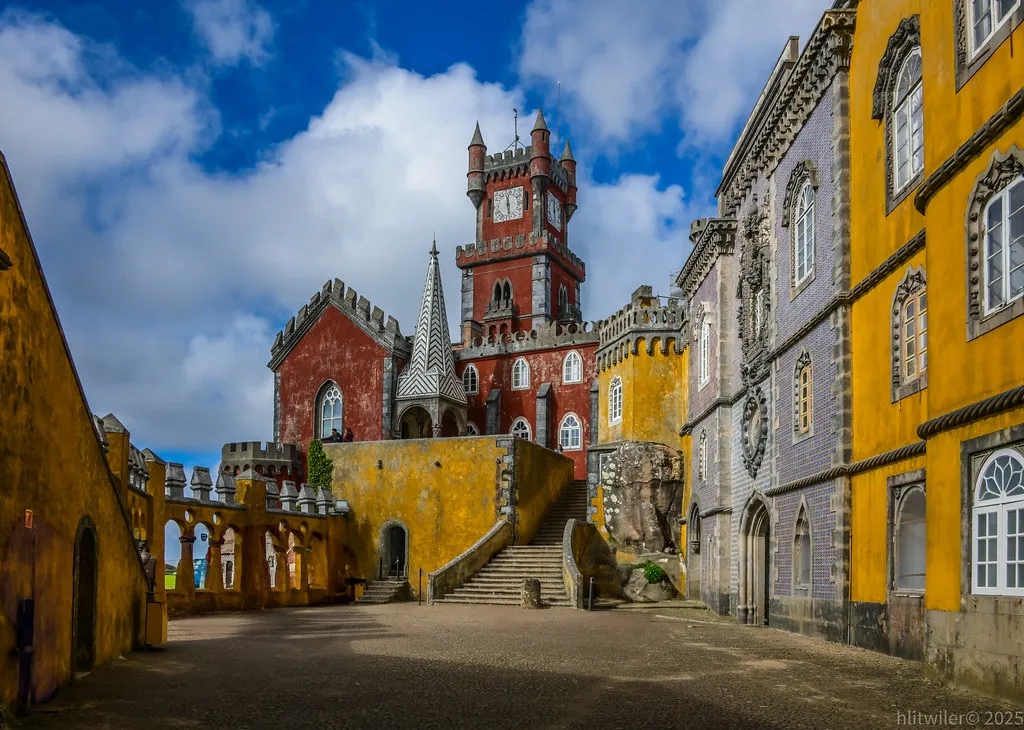
Pena Palace is the image you have already seen on Instagram. Built between 1842 and 1854 on the ruins of a Hieronymite monastery, it was King Ferdinand II's Romantic-era fantasy: yellow walls, red towers, blue tilework, Moorish arches, Manueline carvings, and a Neo-Gothic clock tower all stitched together into one improbable composition. It sits at 480 meters above sea level on the Sintra mountains, so on clear days you can see the Atlantic from the terraces.
The 2026 entry ticket is €15 for the park and palace combined, or €9 for the park only if you just want to walk the grounds without going inside. Plan two to three hours, longer if you explore the 200 hectares of forest paths, the Valley of the Lakes, and the Chalet of the Countess of Edla. Pena is also the most-visited monument in Sintra, drawing over two million people a year — timed-entry tickets sell out days ahead in summer. Book online at least 48 hours in advance, and aim for the first 9:30am slot.
Bundle option: The official Parques de Sintra Pena + Moorish Castle combo saves around €5 off individual prices — worth booking if you plan both on the same day, which you should (they share a hilltop). The 2026 Sintra ticket prices guide covers all bundle options and the Lisboa Card.
For the full breakdown of tickets, photo spots, and the Chalet of the Countess of Edla, see our Pena Palace visitor guide.
Pena Palace draws over two million visitors a year and is the most-visited monument in Sintra. Timed-entry tickets sell out days ahead in summer — book online at least 48 hours in advance and choose the first 9:30am slot to beat the crowds.
Moorish Castle: 8th-Century Walls With the Best Views
If Pena is the showpiece, Castelo dos Mouros is the soul. The Moors built this hilltop fortress in the 8th and 9th centuries to control the road between Sintra and the Atlantic coast, and what survives is a chain of stone curtain walls and watchtowers running along a serrated ridge for nearly 450 meters. There is no palace interior to tour, no painted ceilings, no royal beds — you come here to walk the walls.
The 2026 ticket is €12 and includes access to all towers, the archaeological site of the medieval Christian quarter, and the small museum at the entrance. From the Royal Tower at the western end you get a 360-degree panorama: Pena Palace to the east, Sintra village 200 meters below, Cabo da Roca and the Atlantic to the west, and Lisbon's April 25 Bridge on the southern horizon. Photographers consider this the best viewpoint in the entire Sintra-Cascais Natural Park. Plan 90 minutes to two hours, and wear shoes with grip.
Logistics tip: The Moorish Castle entrance sits just 350 meters downhill from the Pena Palace bus stop on Bus 434, making it the natural same-day pairing. Walk down from Pena to Mouros (10 minutes), spend 90 minutes on the walls, then catch Bus 434 back down to the village. For detailed routing and the best wall photography positions, see our Moorish Castle Sintra guide.
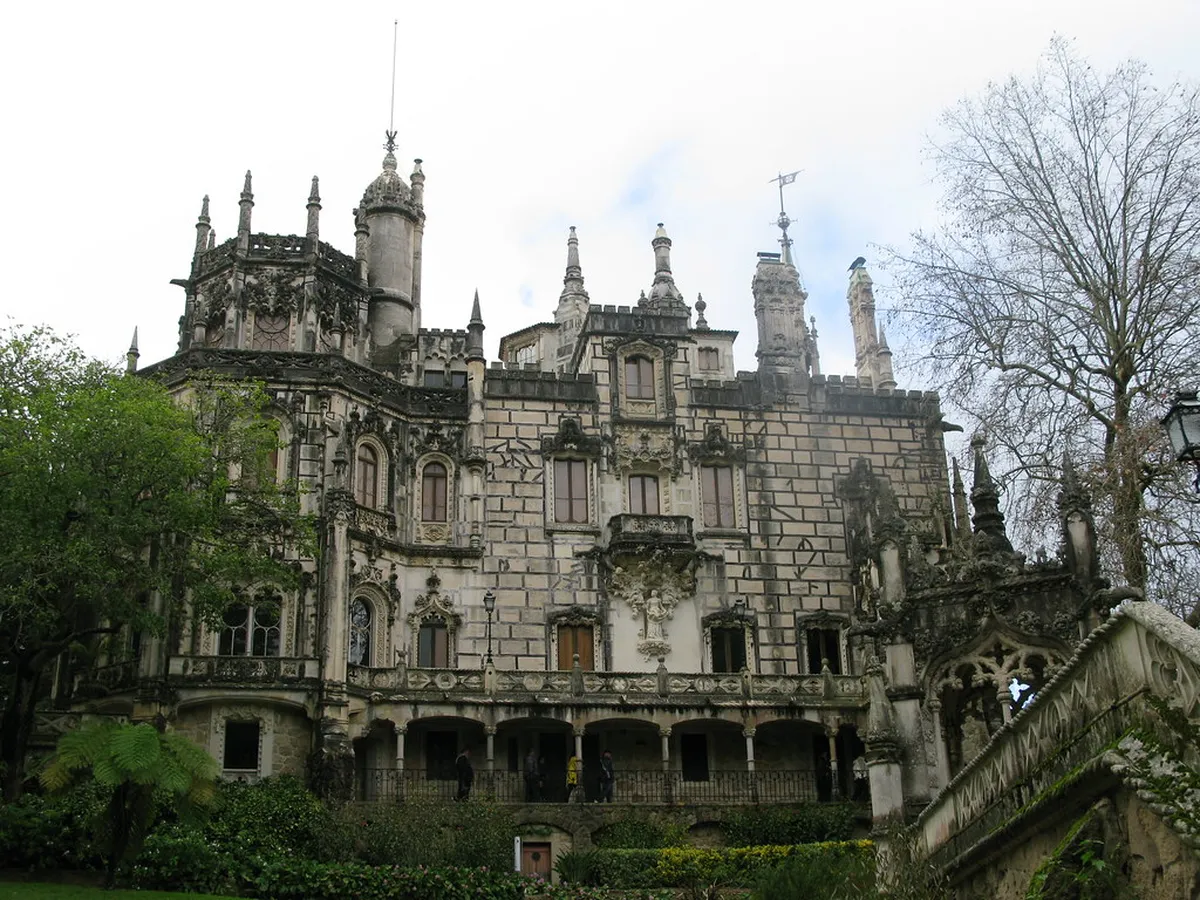
Quinta da Regaleira: The Mystical Estate With the Initiation Well
Quinta da Regaleira is the strangest place in Sintra, and the one most travelers fall in love with. Italian architect Luigi Manini built it for the eccentric millionaire Antonio Carvalho Monteiro between 1904 and 1910, weaving together Manueline, Gothic, Renaissance, and Romantic elements with a deep undercurrent of Masonic, Templar, and Rosicrucian symbolism. The grounds hide grottoes, tunnels, fountains, chapels, and the famous Initiation Well: a 27-meter inverted tower with a spiral staircase descending nine landings into the earth.
The 2026 ticket is €15 for adults and gives you access to the entire four-hectare estate plus the palace interior. Most visitors spend two to three hours wandering the grounds, getting deliberately lost in the underground tunnel network that connects the two wells, the Leda Cave, and the Lake of the Waterfall.
Transport note: Regaleira is NOT on Bus 434's route — a common mistake. It sits 1 km west of Sintra train station, which is an easy 20-minute flat walk. Alternatively, Bus 435 (the Regaleira-Monserrate circuit) stops nearby. Do not take the 434 and expect to reach it. For the full route through the grounds and the symbolism decoded, see our Quinta da Regaleira complete guide.
Sintra National Palace: 600 Years of Royal History in the Village Center
The Sintra National Palace is the white building with two enormous conical chimneys you see the moment you step out of Sintra train station. Those 33-meter chimneys belong to the medieval kitchens, and they have been the town's visual signature since at least the 15th century. The palace itself is the only royal residence in Portugal continuously inhabited from the early 1400s to the late 1800s, making it the most historically layered monument in Sintra.
The 2026 ticket is €13 and the visit takes about 90 minutes. Inside you walk through rooms that each preserve a different era: the Swan Room with its 27 painted swans, the Magpie Room (Sala das Pegas), the Coats of Arms Room covered in gilded heraldry of 72 noble families, and the Arab Room with 16th-century azulejo tilework — among the oldest tile decoration in Portugal.
This is the easiest castle in Sintra to visit: no bus, no uphill walk, no timed entry stress. It's also ideal for travelers who arrive late in the day or want to anchor a village-based afternoon. See our deep-dive Sintra National Palace guide for opening hours, room highlights, and how to combine it with Regaleira.
Monserrate Palace: The Quietest Castle With Indo-Gothic Gardens
Monserrate sits four kilometers west of Sintra village, far enough off the main bus route that most day-trippers never make it. The current palace was built in 1858 for English textile baron Francis Cook in a hybrid Indo-Gothic-Moorish style, with carved stucco arches, slender minaret-like towers, and a domed central hall that feels lifted from Rajasthan. It is unlike anything else in Portugal.
The 2026 ticket is €12 and includes the 30-hectare botanical garden — the real reason to come. Cook hired botanists to plant species from every continent: Mexican agaves, Australian tree ferns, Japanese camellias, Himalayan rhododendrons, and a complete bamboo forest. The loop trail takes 90 minutes at a slow pace and leads you past a Mexican garden, a Japanese garden, a rose garden, and the romantic ruined chapel.
Bus 435 connects Sintra train station to Monserrate every 30 minutes; the ride takes 20 minutes. Get the first bus around 9:45am and you may have the gardens almost to yourself for the first hour. Our Monserrate Palace guide covers the botanical garden loop in detail and the best time of year to visit.
Capuchos Convent: The Bonus 6th Castle Almost No One Reaches
If Monserrate is the quietest of Sintra's main monuments, the Convent of the Capuchos is the place almost no one reaches at all. This 16th-century Capuchin monastery sits eight kilometers west of Sintra village, hidden deep inside the Serra de Sintra forest, and it remains the most atmospheric site in the entire Sintra Cultural Landscape. Founded in 1560 and abandoned in 1834, it was restored in the 2010s and reopened to visitors.
What makes it extraordinary is the cork. Eight monks lived here in extreme austerity, and every cell, doorway, and corridor was lined entirely in cork-bark for insulation. The cells are shockingly small — roughly 1.5 by 2 meters — with low cork-covered doorways that force adults to stoop. Lord Byron visited in 1809 and famously called it the "stones of darkness."
The 2026 ticket is €7, the cheapest of any Sintra monument. Plan about an hour. Reaching it requires a car (small parking area at the entrance) or the very limited Bus 435 service. There is no cafe, no gift shop, and often no other visitors. For a full description and logistics, see our Convento dos Capuchos visitor guide.
Which Sintra Castle to Skip (and Why)
If time is short, here is the honest prioritization for a single-day visitor:
- Skip Capuchos Convent unless you have a car or are returning for a second visit. Its 8 km distance and limited bus service make it impractical for a day-tripper.
- Skip Monserrate if this is your first time in Sintra. Save it for a return visit when you want to escape the crowds — its remoteness is a feature, not a bug, but it costs you 1–2 hours of transit time.
- Skip Sintra National Palace if you care primarily about outdoor views and photography. It's the best choice for history lovers but has limited Instagram drama compared to Pena and Mouros.
- Never skip Pena Palace on a first visit — it is the defining Sintra experience. The only reason to skip it is if queues are already 60+ minutes at 10am; in that case, reverse the order and do Mouros first from the top.
- Regaleira is worth the walk for almost everyone — particularly families with children over six, who love the tunnels and wells.
Optimal Visit Order: Bus 434 vs Bus 435
Understanding which bus goes where is the single most useful piece of logistics for Sintra. Many visitors waste time because they assume Bus 434 serves all castles — it does not.
Bus 434 (Circuito da Pena) — loops from Sintra station → village center → Moorish Castle → Pena Palace → back down. Runs every 15–20 minutes from 9:30am. Single ride €3.90; day pass €7.50. Use it for: Pena and Moorish Castle. Does NOT stop at Regaleira or Monserrate.
Bus 435 (Circuito da Regaleira / Monserrate) — loops from Sintra station → Regaleira → Monserrate → Capuchos (limited stops). Runs every 30 minutes from 9:45am. Same pricing as 434. Use it for: Regaleira, Monserrate, Capuchos. Does NOT go up the hill to Pena or Mouros.
For detailed route maps, timetables, and how to buy tickets, see our Bus 434 Sintra route guide.
Bus 434 (Circuito da Pena) does NOT stop at Quinta da Regaleira or Monserrate — this is one of the most common planning mistakes in Sintra. Use Bus 435 or walk the 1 km from the train station to reach Regaleira.
Best Visit Order: One Day vs Two Days
For the optimal routing strategy between Sintra's castles, see our dedicated Sintra one day vs two days itinerary. Here is the summary:
One Day in Sintra: Two Combinations That Actually Work
Trying to do three or more castles in a single day usually results in rushed visits and long queues. The two strongest one-day combinations are:
Combination A — Hill Day: Pena Palace + Moorish Castle. Take Bus 434's first departure (9:30am), arrive at Pena before the main crowds, spend two hours inside, walk down 350 meters to the Moorish Castle for 90 minutes on the walls, then descend to the village for lunch by 2pm. Total cost: €27. Best for first-timers who want maximum visual impact.
Combination B — Village Day: Sintra National Palace + Quinta da Regaleira. Both are reachable on foot from the train station — no bus queues, no uphill walks. Do the National Palace at opening (10am), walk 1 km to Regaleira for the afternoon, and finish with a coffee in Sintra village. Total cost: €28. Best for travelers arriving mid-morning or those who want to avoid the 434 bus chaos entirely.
Two Days in Sintra: The Deluxe Four-Castle Plan
Day one: Take the morning train from Lisbon, do Sintra National Palace at 10am, walk to Quinta da Regaleira for the afternoon, eat dinner in Sintra village, and stay overnight.
Day two: Catch the first Bus 434 up to Pena Palace at 9:30am, walk down to Moorish Castle for late morning, descend to the village for lunch, then take Bus 435 to Monserrate in the afternoon. Optional: on day two morning, check if the Capuchos Convent 435 service runs — if it does, add it after Monserrate for just €7 more.
Total cost for two days: approximately €67 per person in castle tickets plus transport. For full time-of-day logistics, see our Sintra day trip from Lisbon guide.
| Combination | Castles included | Bus needed | Walking required | Total ticket cost (adult) |
|---|---|---|---|---|
| One Day — Combination A (Hill Day) | Pena Palace + Moorish Castle | Bus 434 | 350 m (Pena to Mouros) | €27 |
| One Day — Combination B (Village Day) | National Palace + Quinta da Regaleira | Walk / Bus 435 | 1 km to Regaleira | €28 |
| Two Days — Day 1 | National Palace + Quinta da Regaleira | Walk / Bus 435 | 1 km to Regaleira | €28 |
| Two Days — Day 2 | Pena Palace + Moorish Castle + Monserrate | Bus 434 + Bus 435 | 350 m (Pena to Mouros) | €39 |
| Two Days — Total | All four main castles | Bus 434 + 435 | Moderate | ~€67 (incl. transport) |
2026 Ticket Bundle Options
For detailed pricing on every Sintra monument — individual tickets, Parques de Sintra combos, and the Lisboa Card — see our dedicated Sintra ticket prices 2026 guide. Quick summary:
- Pena + Moorish Castle combo (Parques de Sintra official): approximately €22 per adult — saves around €5 vs buying separately. Book at parquesdesintra.pt.
- Lisboa Card (1-day, ~€31): includes Sintra train, Bus 434/435, entry to Sintra National Palace, and discounts on Pena and Regaleira. Best value if you are also visiting Lisbon attractions the same day or adjacent days.
- Regaleira + Monserrate: no official combo — buy separately (€15 + €12 = €27).
- All Parques de Sintra monuments (Pena, Mouros, Monserrate, Capuchos) should be booked online in advance in summer — walk-up tickets regularly sell out by 11am.
Frequently Asked Questions
Which Sintra castle is best?
Pena Palace is the most photogenic and best for first-time visitors. Castelo dos Mouros has the best views. Quinta da Regaleira is the most atmospheric and unusual. There is no single best castle in Sintra — only the best one for the kind of traveler you are. For the full comparison, see our complete Sintra guide.
Can you visit all Sintra castles in one day?
Realistically no. Visiting all six monuments in a single day requires roughly 14 hours of visit time plus transit, and Sintra's bus routes and walking distances do not allow it. Two castles is comfortable, three is rushed, four or more requires staying overnight. Travelers who try to cram everything into one day usually leave Sintra exhausted and remember nothing clearly.
Does Bus 434 go to Quinta da Regaleira?
No. Bus 434 (Circuito da Pena) serves only Pena Palace and the Moorish Castle. Quinta da Regaleira is served by Bus 435 or a 20-minute walk from Sintra train station. This is one of the most common planning mistakes in Sintra. See our Bus 434 route guide for the full stop list and timetable.
Which Sintra castle is least crowded?
Monserrate Palace is consistently the quietest, often receiving fewer than 800 visitors per day compared to Pena's 6,000-plus. Its location four kilometers west of the village and the need to take Bus 435 keep most day-trippers away. Quinta da Regaleira is the second quietest of the major monuments, especially before 11am or after 4pm.
Are all Sintra castles UNESCO World Heritage?
Yes. The entire Cultural Landscape of Sintra was inscribed on the UNESCO World Heritage list in 1995, which covers Pena Palace, Castelo dos Mouros, Sintra National Palace, Quinta da Regaleira, Monserrate Palace, and the surrounding forested mountains as a single protected ensemble.
Which Sintra castle has the best views?
Castelo dos Mouros has the best 360-degree panorama. From the Royal Tower at the western end of the walls you can see Pena Palace to the east, the Atlantic Ocean and Cabo da Roca to the west, and Lisbon's April 25 Bridge on the southern horizon on clear days. Pena Palace terraces come a close second but face mostly southward.
Are ticket bundle deals available for Sintra castles?
Yes. The official Parques de Sintra website sells a Pena Palace + Moorish Castle combo for approximately €22, saving around €5 off individual prices. The Lisboa Card covers the Sintra train, local buses (434/435), and Sintra National Palace entry, and gives discounts on other monuments. See our Sintra ticket prices 2026 guide for current rates and the best deal for your itinerary.