Sintra National Palace: 10 Things to Know Before You Go
Plan your visit to the Sintra National Palace with our guide to the iconic chimneys, Sala dos Brasões, ticket tips, and how to skip the Pena Palace crowds.
On this page
Sintra National Palace: 10 Things to Know Before You Go
The Sintra National Palace stands in the heart of the historic town center as a testament to centuries of royal life. Visitors often recognize this landmark by its two massive conical chimneys that rise above the medieval skyline.
While many travelers rush to the colorful Pena Palace on the hill, this central monument offers a deeper look into Portuguese history. It served as a continuous royal residence from the early 14th century until the fall of the monarchy in 1910.
Exploring this site allows you to walk through rooms where kings and queens shaped the destiny of an empire. You will find the most impressive collection of Mudéjar tiles in the country within these thick stone walls.
This guide covers everything you need to know about the town palace, from its tragic royal legends to practical visiting tips for 2026. Discover why this architectural marvel is a mandatory stop on any Sintra day trip from Lisbon.
A Thousand Years of Portuguese History
The origins of the Sintra National Palace date back to the Moorish rule of the Iberian Peninsula, with the earliest structures likely built in the 10th or 11th century. After the Christian Reconquista, Portuguese monarchs began expanding the existing buildings into a grand royal retreat. King Dinis, King João I, and King Manuel I were the three monarchs most responsible for creating the layered complex that visitors walk through today.
Unlike other royal sites that served as seasonal retreats, this palace was a primary residence used across many centuries. Its architecture evolved organically through Gothic, Manueline, and Renaissance phases as each ruler left a distinct mark. That layered growth created a maze of rooms, courtyards, and hidden staircases that no single architectural hand could have designed.
The palace remains the best-preserved medieval royal residence in Portugal because it survived the catastrophic 1755 Lisbon earthquake with minimal damage. You can still see the original Islamic influence in the courtyard layout and tile work. The site was classified as a monument in 1910 and became part of Sintra's UNESCO World Heritage cultural landscape in 1995 — and in 2013 it joined the Network of European Royal Residences.
History enthusiasts will appreciate the layers of time visible in every stone and archway. This is a building where the decisions that shaped an empire were actually made, not a 19th-century romantic imitation of one.
Essential Visitor Information: Hours and Tickets
The palace opens daily at 09:30 and closes at 18:30, with last entry at 18:00. The ticket office closes between 12:00 and 13:00 for lunch, but automatic vending machines remain available during that gap. Plan your arrival for the morning opening or mid-afternoon to avoid the short but real midday queue.
Tickets in 2026 cost €13.00 for adults, €11.50 for seniors and youth. Buying through the official Parques de Sintra website saves 5% and lets you walk past the ticket queue entirely — a meaningful advantage in July and August when lines form quickly. Check the Official Opening Times and Prices before you go, as schedules can shift for public holidays. For a full breakdown of what each Sintra site costs this year, see our Sintra ticket prices 2026 guide.
Unlike Pena Palace, where the exterior terraces and gardens swallow crowds, the National Palace's interior rooms fill up faster than they look from outside. Arriving by 10:00 lets you photograph the Sala dos Brasões and the Magpie Room ceiling without other visitors in frame — natural light from the eastern windows is also at its best in the first two hours. Photography is permitted throughout the interior without flash; the tile work in the Central Patio photographs particularly well because the space is shaded and evenly lit.
Wear comfortable shoes. The floors are original stone and tile — uneven in the older sections, slippery when damp. The main ground-floor rooms including the Swan Room and Magpie Room are accessible to visitors with limited mobility. Narrower medieval corridors in the upper sections are not wheelchair-accessible, so those visitors should prioritize the ground floor route for the highest concentration of decorated rooms.
Tickets cost €13.00 for adults in 2026. Buying online through the Parques de Sintra website saves 5% and lets you skip the ticket office queue entirely — particularly worthwhile in July and August when lines form quickly.
How to Get to the Palace from Lisbon and Sintra
Reaching the palace is straightforward because it is the most central monument in the entire region. Most travelers arrive by taking the Lisbon to Sintra train from Rossio or Oriente station. The CP Sintra Line runs every 20 minutes, takes around 40 minutes, and costs approximately €2.40 each way — the cheapest connection to any major Sintra monument.
Once you exit Sintra train station, a scenic 10-minute walk (roughly 1 km on a flat, paved route) brings you directly to the palace gates at Largo Rainha Dona Amélia. You will pass through charming streets filled with local shops and small cafes. This easy walk is one of the concrete advantages over hilltop sites, which require either a steep 30-minute hike or a queue for the overloaded Bus 434 hop-on route.
If you prefer not to walk, Scotturb Bus 434 and 435 both connect the train station with Sintra Vila and stop within sight of the palace entrance. These routes also serve the Moorish Castle and Pena Palace further up the hill. The buses are useful if you plan to continue uphill after visiting the National Palace, but for the palace itself, walking is faster and more pleasant. See our Bus 434 Sintra route guide for timetables and fares.
Driving to the historic center is strongly discouraged. Private vehicle circulation is restricted to residents during peak hours, and the narrow streets offer almost no parking. Public transit is the default for the vast majority of visitors, and for this particular monument it is genuinely the faster option.
The Iconic Twin Chimneys and Royal Kitchen
The two massive conical chimneys are the most recognizable feature of the Sintra National Palace. Rising 33 meters above the royal kitchen, these cylindrical towers have become the visual symbol of the town itself. They were originally built in the 14th century to keep the kitchen free of smoke during the enormous banquets the court demanded.
Inside the kitchen, you can see the full scale of medieval royal cooking operations. The room features multiple large ovens and iron spit systems capable of roasting entire animals for hundreds of guests. It is one of the largest and best-preserved royal kitchens surviving in Europe, and the scale of the operation gives a clearer picture of court logistics than any painting or document could.
Standing at the center of the kitchen floor and looking directly up into the twin shafts is one of the best moments in the entire visit. The geometry of the venting system is striking — two separate conical chambers joined at the base, each wide enough to walk into. The exterior courtyard offers the best angle for a wide-angle photo of both chimneys against the sky; mid-morning light hits the stone cleanly from the east.
This area provides an effective contrast to the ornate decorated rooms found elsewhere in the building. It shows the physical infrastructure required to support a royal court — often hidden or demolished in other palaces — still completely intact here after 600 years.
The Sala dos Brasões (Room of the Coats of Arms)
The Sala dos Brasões is arguably the most beautiful and historically significant room in the entire palace. It features a magnificent gilded dome decorated with the coats of arms of 72 noble Portuguese families arranged around the royal arms of King Manuel I. Manuel commissioned this tower room in the early 16th century to display the hierarchy of power at the height of the Age of Discovery.
The walls are covered from floor to ceiling with stunning 18th-century blue and white azulejo panels depicting hunting scenes and courtly life. The combination of the gold dome above and the deep blue tile work below creates a visual contrast that no other room in Portugal quite matches. Historians consider this one of the most important heraldic rooms in all of Europe because the families represented here were the backbone of Portugal's colonial expansion.
Each coat of arms was carefully chosen to represent families that supported the crown during its overseas ventures. Examining the individual shields is a slow, rewarding exercise — heraldic details reveal alliances, conquests, and bloodlines that shaped the empire. If you have a Portuguese surname, there is a reasonable chance one of those 72 shields belongs to your family's lineage.
Take your time in this room. It is often the highlight for visitors exploring the Sintra castles guide in full, and because it sits in an upper tower section, crowds thin out faster here than in the ground-floor rooms.
The Magpie Room and Royal Gossip
The Magpie Room, or Sala das Pegas, is famous for its painted ceiling and the legend behind it. The ceiling displays 136 magpies, each holding a rose in its claws and a banner reading "Por Bem" — meaning "In Good Faith" or "For the Best." The number of birds was not chosen arbitrarily: it matched exactly the number of ladies-in-waiting serving in the royal household at the time.
Legend holds that King João I was caught giving a rose to one of the queen's ladies-in-waiting. To deflect the ensuing court gossip, he ordered the room painted with magpies — equating the chattering women to the notoriously loud birds. The phrase "Por Bem" was his personal motto and his public reply to the whispers.
The room served as a formal reception space where King João received officials and foreign dignitaries, which adds a dry irony to the story: the king managed his reputation at the highest diplomatic level using ceiling art. Beyond the legend, the room contains fine examples of Mudéjar tiles along the lower walls and elegant period furniture.
It is one of the most charming stories you will encounter on the tour, and the ceiling is genuinely worth studying slowly. The magpie detail is small; binoculars help, though most visitors do not think to bring them.
The Swan Room: A Manueline Masterpiece
The Swan Room is the largest and most formal reception space within the palace, and the first major hall King João I added to the building in the early 15th century. Its name comes from the 27 painted swans decorating the octagonal panels of the wooden ceiling, each depicted in a different pose and each wearing a golden collar. The room's original name was simply the Great Hall.
This grand space hosted the most important royal banquets, balls, and official ceremonies across four centuries of continuous use. The architecture already shows the transition toward the Manueline style, with maritime references worked into the carved details. Large windows facing the town flood the hall with light and frame views of the surrounding hills.
The swan motif is believed to reference a gift of swans from the Duke of Burgundy, the birds functioning as a symbol of grace and dynastic prestige across European courts. The sheer scale of the room was deliberate — every foreign visitor was meant to feel the weight of Portuguese royal ambition the moment they entered.
The hall occasionally hosts cultural events and small concerts today, a use that the original builders would have recognized immediately. The acoustics are excellent for an unlined stone room of this age.
The Prison of King Afonso VI
A small, somber chamber on the upper floor holds one of the most disturbing stories in Portuguese royal history. King Afonso VI was confined here for nine years by his own brother, who seized the throne and married Afonso's former wife. The room is sparsely furnished, with a heavy wooden door and iron bars on the window.
The floor still shows the wear pattern from where the king paced during his years of isolation. He was denied contact with the outside world while his brother Pedro II ruled the country and consolidated power. Afonso eventually died in this room in 1683, ending his captivity with no trial and no formal charge.
Visiting this space provides an immediate tonal shift from the golden ceilings and grand banquet halls seen elsewhere in the tour. The atmosphere is noticeably quieter and heavier. The room is also one of the oldest surviving spaces in the palace, sitting in the section originally built by King Dinis in the late 13th century — the same chapel structure that contains some of the earliest examples of Moorish craftsmanship in Portugal.
The story of the imprisoned king is a particular draw for those who find the political mechanics of monarchy more interesting than its pageantry. It is a rare chance to see a royal prison that has remained essentially unchanged since the 17th century.
The Galley Room: Portugal's Seafaring Ceiling
The Galley Room (Sala das Galés) is one of the least-discussed rooms in the palace, and one of the most distinctive. Its domed ceiling is painted with a fleet of Portuguese ships from the 17th and 18th centuries — galleys, caravels, and merchant vessels rendered in fine detail against a dark background. No other room in the palace makes the connection between the court's daily life and Portugal's maritime empire this explicit.
The room itself served a transitional purpose in the palace layout, connecting more private royal quarters to the formal reception areas. Because it lacks a dramatic legend or a famous royal name attached to it, it draws fewer visitors and is often passed through quickly. That makes it one of the quietest spaces on the tour route, with good natural light and almost no crowd pressure.
For anyone with an interest in Portuguese naval history, the ceiling panels are worth a slow examination. The ships are painted with enough technical accuracy that you can distinguish vessel types by hull shape and rigging. It is the kind of specific, unrepeatable detail that separates a genuine lived-in palace from a purpose-built tourist monument.
This room is also a good reminder that the Sintra National Palace was decorated by people who thought about Portugal's place in the world, not just the royal family's comfort. The seafaring imagery would have been as natural to a 17th-century court as a family crest.
Central Patio and the Water Grotto
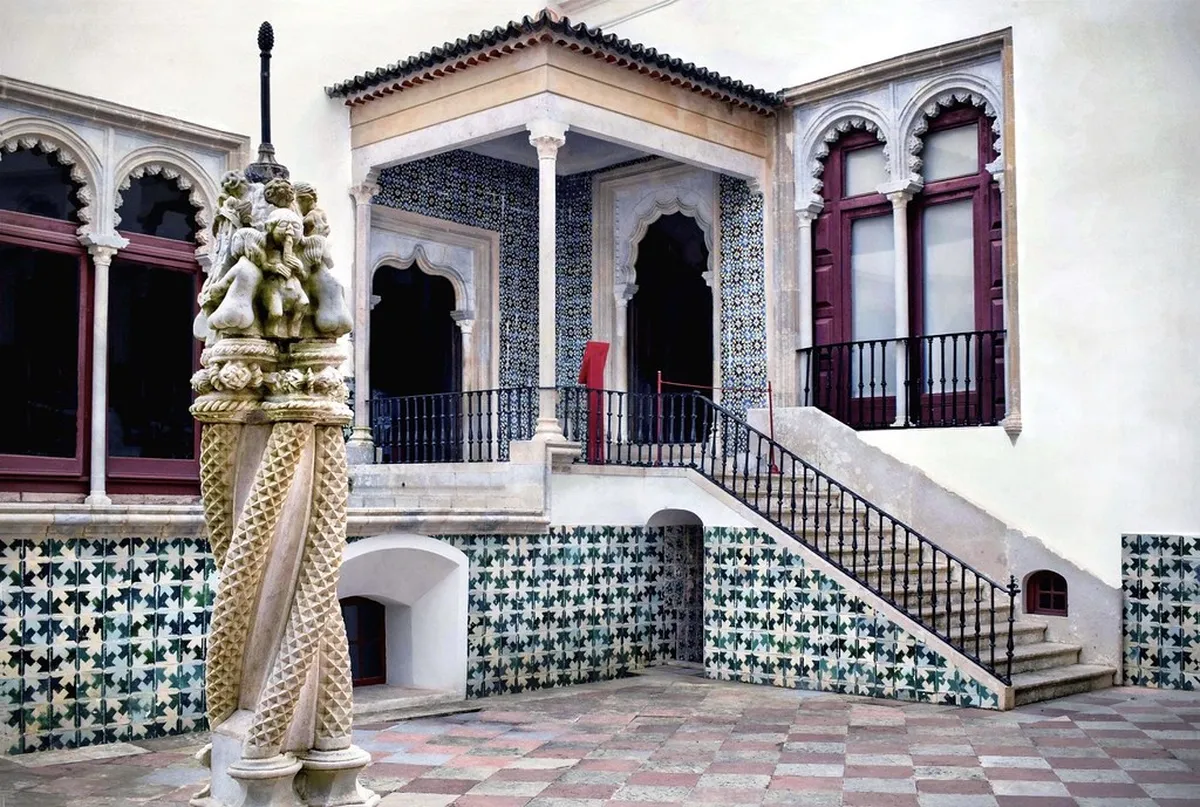
The Central Patio is an open-air courtyard that showcases the Islamic foundation beneath every layer of the palace's later additions. It contains the most concentrated collection of Mudéjar geometric tile patterns in Portugal, with designs dating from the 15th century arranged across floors and lower wall sections. The repeating geometry creates a calming, mathematically precise visual rhythm that contrasts with the narrative painted scenes found in the interior rooms.
One of the most interesting features here is the Water Grotto, a Renaissance addition used to cool the surrounding air during the hot Sintra summers. It includes concealed water jets that could be activated to surprise and refresh guests — an early form of palace entertainment. The grotto is decorated with frescoes and tile work representing natural elements, and the sound of running water in the enclosed courtyard creates an atmosphere unlike any other part of the building.
This patio functioned as a private garden for the royal family, screened from the public areas by stone arcades. The tile work here is particularly valuable to scholars because it shows the technical evolution of Portuguese azulejos across several generations of production: raised geometric patterns from the earliest Mudéjar period sit alongside later flat painted variations.
The tiles in this area photograph well in any light because the courtyard is shaded and evenly illuminated throughout the day. It is a good place to pause and examine the architectural details at close range without the time pressure of the smaller interior rooms.
National Palace vs. Pena Palace: Which Should You Choose?
The choice between the two depends on what you want from a day in Sintra. The National Palace is in the flat town center, a 10-minute walk from the train station, with no bus queue and no uphill climb. Pena Palace requires either a 45-minute uphill hike or a wait for the frequently overcrowded Bus 434. In peak summer season, the wait alone can consume an hour of your visit.

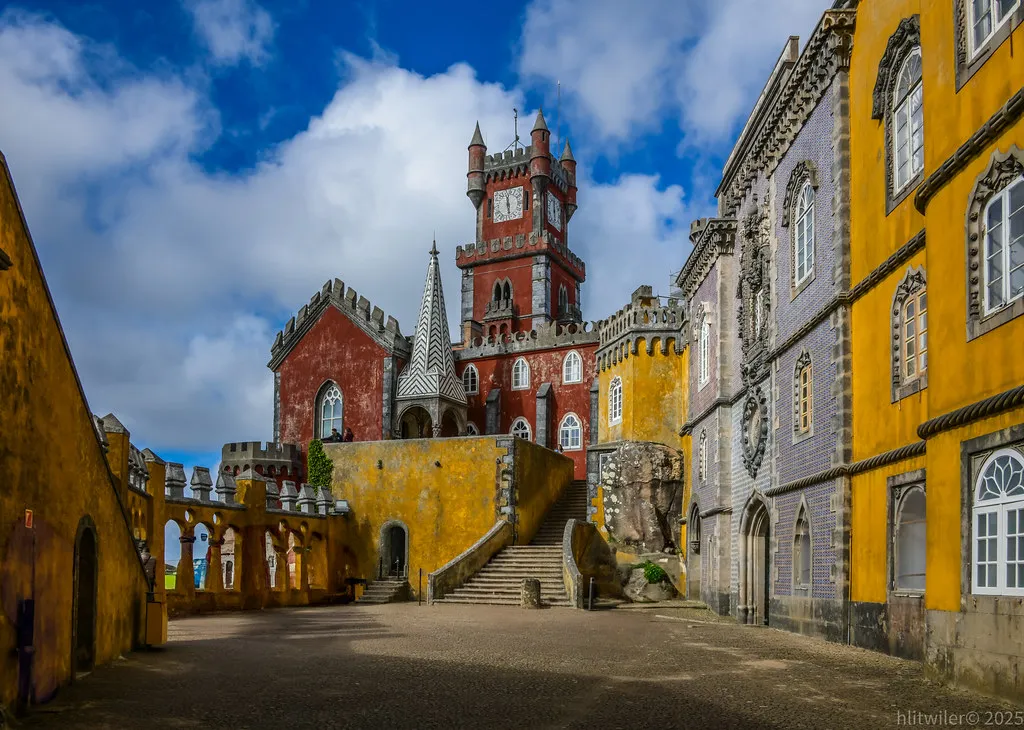
Architecturally, Pena is a 19th-century Romantic confection — vivid colors, battlements, and turrets designed to look like a fairy-tale. The National Palace is a genuine medieval and Manueline building that grew organically over 500 years of actual use. If you want visual spectacle and exterior photography, Pena wins. If you want to understand what Portuguese royal life actually looked like, the National Palace wins by a wide margin.
Travelers with limited mobility often find the National Palace significantly more accessible than Pena, where the terraces and outer walkways involve steep steps and rough cobblestone. The National Palace's main ground-floor rooms cover the most important spaces with manageable gradients. You can easily pair a visit here with lunch at one of the restaurants on Praça da República, immediately across from the palace entrance — no transport required. This makes for a very complete morning without leaving Sintra Vila.
If you have two full days, visit both in sequence — National Palace on day one for historical grounding, Pena on day two for the landscape. If you only have one day, the National Palace is the more efficient choice: shorter queues, richer historical content, easier logistics, and proximity to everything else in the town center. Use our Sintra in one day vs two days itinerary to build the full plan.
Driving to Sintra's historic center is strongly discouraged — private vehicle circulation is restricted to residents during peak hours and parking is almost nonexistent on the narrow streets. Take the train from Lisbon instead.
Frequently Asked Questions
Is the Sintra National Palace worth it?
Yes, the Sintra National Palace is absolutely worth it for history lovers and fans of architecture. It offers the most authentic look at royal life in Portugal without the massive crowds found at Pena Palace. You can see unique features like the world-famous tile collection and the iconic twin chimneys.
How long does it take to visit the National Palace of Sintra?
Most visitors spend between 90 minutes and two hours exploring the interior rooms and the royal kitchen. If you take the time to read the historical displays, you might want to allow for a full two hours. This leaves plenty of time to enjoy other things to do in Sintra.
What are the two big chimneys in Sintra?
The two big chimneys belong to the kitchen of the Sintra National Palace and stand 33 meters tall. They were built in the 14th century to vent smoke from the massive royal ovens. Today, they are the most famous landmark in the historic center of the town.
Can you buy tickets for Sintra National Palace at the door?
You can buy tickets at the door, but it is better to purchase them online in advance. Online tickets usually come with a 5% discount and allow you to skip the main ticket office line. This is especially helpful during the busy summer season when the town is crowded.
What is the difference between Pena Palace and Sintra National Palace?
The National Palace is a medieval and Manueline building located in the town center, focusing on deep history. Pena Palace is a 19th-century Romantic palace located on a high hill, known for its bright colors. The National Palace is generally easier to access and much less crowded.
The Sintra National Palace is a remarkable journey through the heart of Portuguese royal heritage. From the towering chimneys to the tragic prison of a king, every room tells a compelling story of the past. Its central location makes it the most accessible and stress-free monument to visit in the region.
Whether you are a history buff or just looking for beautiful architecture, this palace will not disappoint. You can enjoy the stunning tile work and grand halls without the overwhelming crowds of the hilltop sites. It remains a true jewel in the crown of Sintra's historic center.
Plan your visit early in the day to enjoy the quietest atmosphere and the best lighting for photos. Don't forget to explore the surrounding streets of Sintra Vila for a complete local experience. For more help planning your trip, check out our travel blog for expert tips and guides.
 How To Get To Guimaraes Travel GuideJune 8, 2026