Quinta da Regaleira Sintra: 2026 Guide to the Initiation Well & Palace
Quinta da Regaleira is Sintra's most mysterious palace — a 1904 Romantic estate with a 27m Initiation Well and Templar symbolism. This 2026 guide covers tickets, Carvalho Monteiro's story, photography tips, crowd tactics, and how to visit.
On this page
Quinta da Regaleira is Sintra's most mysterious palace — a Romantic estate built between 1904 and 1910 by Brazilian coffee millionaire António Augusto Carvalho Monteiro and Italian stage-designer-turned-architect Luigi Manini. Every carving, tunnel, and fountain on the 4-hectare grounds was designed to encode a theme: Templar knights, Rosicrucian alchemy, Masonic initiation, and Portuguese mythology. The estate's centerpiece is the famous Initiation Well — a 27-meter-deep inverted tower carved into the bedrock, with nine spiral landings mirroring Dante's circles. Quieter than Sintra's headline act at Pena Palace, Regaleira rewards visitors who love puzzles, symbolism, and walking through a landscape that feels half-garden, half-novel. Here's everything you need to plan your 2026 visit — including the man who built it, the best light for photos, and how to dodge the well queue.
The man behind the mystery: António Augusto Carvalho Monteiro
To understand Quinta da Regaleira, you need to understand its creator. António Augusto Carvalho Monteiro was born in Rio de Janeiro in 1848 to Portuguese parents. He left Brazil for Portugal as a young man, read Law at the University of Coimbra, and then spent decades building one of the largest private fortunes in the Portuguese-speaking world — primarily through Brazilian coffee, gemstones, and rubber. By the 1890s he was wealthy enough that Lisbon society had given him a nickname: Monteiro dos Milhões — "Monteiro of the Millions."
He was also, by all accounts, magnificently eccentric. He was a serious entomologist who spent years cataloguing Brazilian and European insects. He collected rare books and manuscripts obsessively. And he was deeply immersed in the esoteric traditions that captivated fin-de-siècle Europe: Freemasonry, Rosicrucian alchemy, the legends of the Knights Templar, Tarot mysticism, and the Hermetic tradition that runs through Dante's Divine Comedy. When he purchased the Regaleira estate in 1893 for 25 contos de réis, he was not buying a summer residence — he was commissioning a monument to his inner world.
To realize that vision, Carvalho Monteiro hired Luigi Manini in 1898. Manini was an Italian architect and scenographer who had designed sets for La Scala in Milan — a choice that explains everything about how Regaleira functions as a space. The estate is constructed like theatre: careful sightlines, sudden reveals, hidden passages, and symbolic props placed exactly where an audience — or an initiate — would encounter them. Construction ran from 1900 to 1910.
Carvalho Monteiro died in 1920. The estate passed through private hands — sold in 1942 — until Sintra's town council purchased it in 1997 and opened it to the public. In 1995, the wider Cultural Landscape of Sintra, which includes Regaleira, was recognized as a UNESCO World Heritage Site.
Decoding the symbolism: Templar, Masonic, Rosicrucian, Tarot
The motifs woven throughout Quinta da Regaleira are not decorative — they are a theological and philosophical argument, encoded in stone. Carvalho Monteiro drew from four overlapping traditions:
- Knights Templar: The Templar cross (a cross pattée) appears repeatedly — most prominently in the mosaic floor at the base of the Initiation Well and in the stained glass of the chapel. The Templars were the original guardians of the Holy Land and, in mystical tradition, keepers of sacred geometry. Their cross at the bottom of the well signals that the descent leads somewhere holy.
- Freemasonry: The compass above the Templar cross at the well's base is a Masonic emblem — specifically used by Freemasons who adhere to Christian doctrine. The nine landings of the well correspond to the degrees of initiation in certain Masonic rites. The overall architecture of the estate — proceeding from outer garden through hidden passages to an underground chamber and finally upward into the chapel — mirrors the spatial logic of Masonic lodge progression: candidate enters in darkness, moves through trials, emerges illuminated.
- Rosicrucian alchemy: Rosicrucian thought holds that the universe is built from four elements — earth, water, fire, and air — and that wisdom comes from understanding their interplay. The estate's garden zones are laid out to echo this four-element framework: deep grottoes and tunnels for earth, the lakes and cascades for water, the solar terrace and tower for fire/air. Alchemical transformation — death and rebirth — is the theme of the Initiation Well's descent and emergence.
- Tarot and Dante: The nine landings of the Initiation Well mirror both the nine circles of Hell in Dante's Inferno and the nine-card structure of certain Tarot spreads. The journey from top (light, the outer world) to bottom (darkness, the unconscious) and back is the initiatory arc: the candidate dies to their old self underground and is reborn in the chapel above.
Whether Carvalho Monteiro was himself formally initiated into Masonic or Rosicrucian orders is not documented — Portuguese historians remain cautious — but the density and precision of the symbolism is not accidental. The estate is a statement of belief.
The Initiation Well: a full descent guide
If you've seen one photo of Quinta da Regaleira, it was probably taken inside the Initiation Well. There are actually two wells on the estate: the large Initiation Well (Poço Iniciático) and the smaller Imperfect Well (Poço Imperfeito). The larger well is the one everyone comes for.
Physical structure
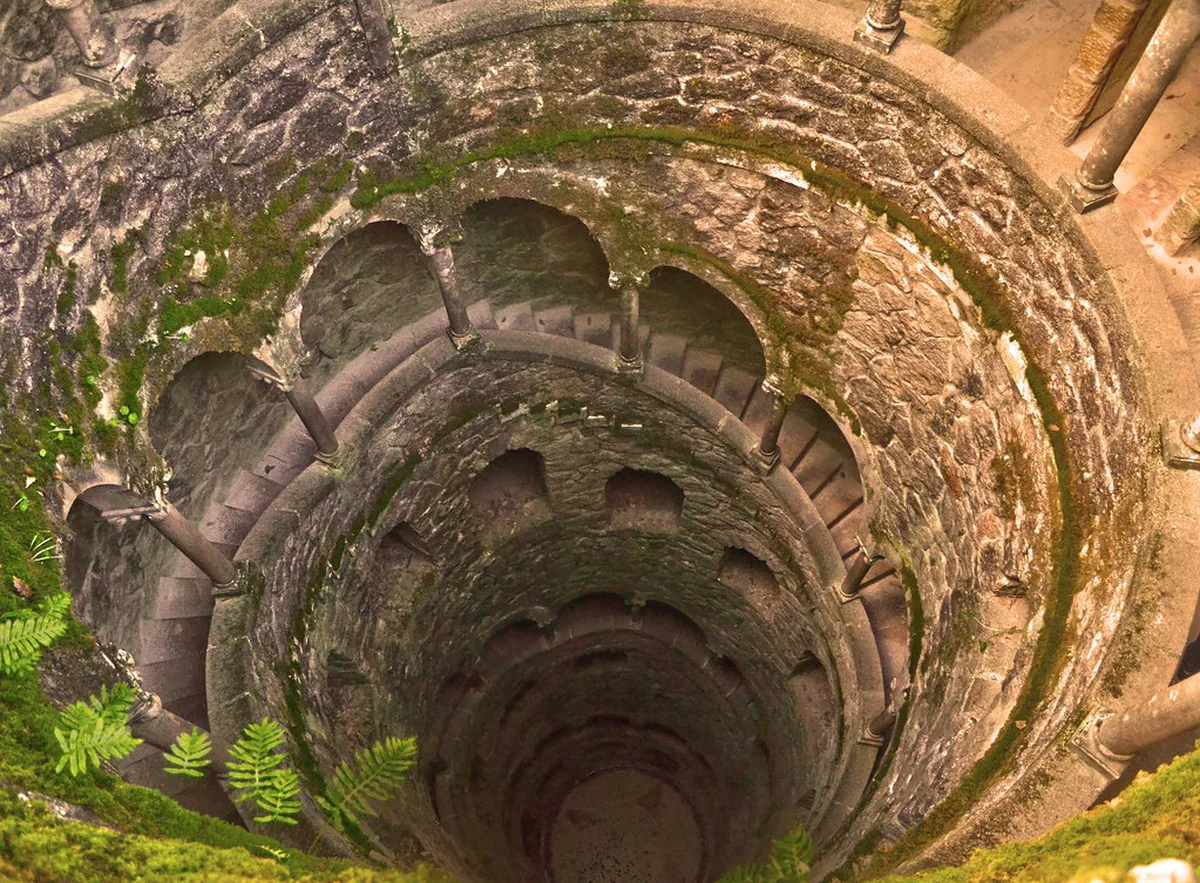
The well is a 27-meter-deep inverted tower cut into the granite hillside — not a water well, but a subterranean tower. A spiral staircase of 139 steps winds down nine landings, each bordered by carved stone columns and niches that hold moss and ferns. The staircase spirals around a hollow central shaft, so you can always see both the sky above and the mosaic floor below. At the base, the floor is inlaid with a compass rose and a Templar cross in contrasting stone. Twenty-three small niches are set into the outer wall of the shaft at regular intervals on the way down.
The nine levels and their symbolism
Each of the nine landings carries weight. In Dante's Divine Comedy, the nine circles descend through sin into the abyss, but the journey does not end there — Dante climbs back through Purgatory to emerge in Paradise. The well replicates this structure: you descend through nine levels of increasing darkness, reach the Templar-cross floor (the symbolic nadir), and then exit not the way you came but through a tunnel — a passage from death to rebirth. The Masonic reading is identical: the candidate enters as an uninitiated stranger (profane), passes through symbolic death below ground, and emerges into the brotherhood above.
The initiation rite theory
According to the most widely repeated theory — based on descriptions recorded by historians who interviewed people connected to the estate — initiation ceremonies at Regaleira involved blindfolded candidates entering the well at night. Each candidate held a sword close to their chest and descended the nine flights in complete darkness. At the bottom, they were left to find their own way through the tunnel labyrinth. The correct path led upward through the grotto network to the Chapel of the Holy Trinity, where they were formally welcomed into the brotherhood — a ritual re-enactment of emerging from the underworld into enlightenment. Whether these ceremonies ever actually took place is not verifiable; no contemporary written record has been published. But the estate was clearly built to support them.
Descent vs. ascent: which direction is better?
There are two ways to experience the well: enter at the top and spiral down, or enter from the tunnel network below and climb up. Both are valid and give completely different experiences.
- Descending is more theatrical. Walking down toward the faint light at the bottom, watching the circular sky above you shrink, is the intended dramatic arc. The sense of descending into something sacred builds with each landing. Recommended for first-time visitors.
- Ascending from the tunnel gives you the "emergence into light" shot that photographers prize. You walk out of a dimly lit stone passage and find yourself at the base of the well, looking straight up at a circle of blue sky framed by spiraling arches. This is the image that goes viral on Instagram. If photography is your priority, enter via the tunnels first.
In practice, staff often control the flow direction depending on queue levels. On busy days, descent is typically the enforced direction. If the flow is unrestricted, enter from the top.
Crowd management: when to enter the well
The well bottleneck is the most frustrating part of the Regaleira visit. The staircase is narrow — two people can pass, barely — and if you arrive mid-morning on a summer weekend, you could wait 30–45 minutes just to enter the top. Strategies that actually work:
- Go straight to the well on entry. The moment you're through the gate, ignore the palace, ignore the gardens, and walk directly to the Poço Iniciático. The path is signposted. This is the single most effective crowd strategy at Regaleira.
- Visit after 4 PM. Queue times thin significantly in the late afternoon. Staff are also less likely to rush you through at this hour.
- Avoid 11 AM–3 PM. This is peak crowd time across the entire estate. The well queue is at its worst during this window.
- Weekdays over weekends. Saturdays in July and August see the longest queues. Tuesday and Wednesday mornings are the quietest.
- Shoulder season: April–May and October–November combine decent weather with significantly thinner crowds than July–August.
Tickets and 2026 prices
Quinta da Regaleira is one of the better-value palace tickets in Sintra. Here's what to expect in 2026:
- Standard adult (18–64): €15–€20 (confirm on the official website before booking — pricing has been in flux)
- Youth (6–17): €10
- Seniors (65+): €10
- Children under 6: Free
- Family ticket (2 adults + 2 children): around €40
- Audio guide add-on: €5 extra — genuinely worth it; the symbolism is dense and on-site signage is minimal
- Wheelchair companion: Free entry for one travel companion accompanying a visitor with a disability ID
How to buy: Purchase in advance online through the official Regaleira website. On peak days (June–September, Easter week) the gate queue stretches 30–45 minutes. Online tickets are timed-entry and save up to 90 minutes on the busiest days. Skip-the-line tickets via third-party operators are also available but cost more.
Book online in advance to avoid gate queues of 30–45 minutes on peak summer days. The audio guide add-on (€5 extra) is genuinely worth it — on-site signage is minimal and the symbolism throughout the estate is dense.
Opening hours by season (2026)
- Summer (April–September): 9:30 AM – 6:30 PM; last entry 6:00 PM
- Winter (October–March): 9:30 AM – 5:30 PM; last entry 5:00 PM
- Closed: 25 December and 1 January
Note the last-entry cutoffs — the estate is large and you need at least 30 minutes after entry to see the essentials. Arriving within an hour of last entry is not recommended for first-time visitors.
The palace and chapel
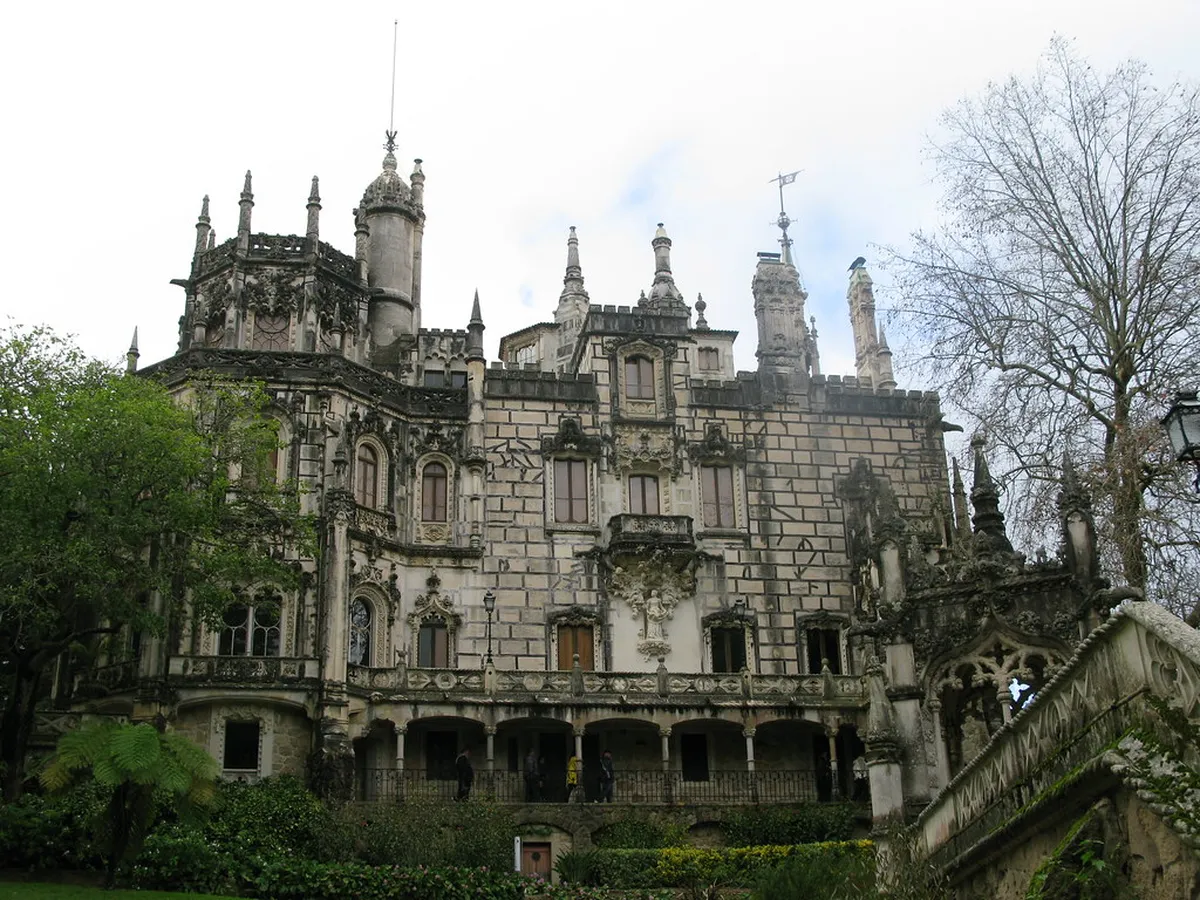
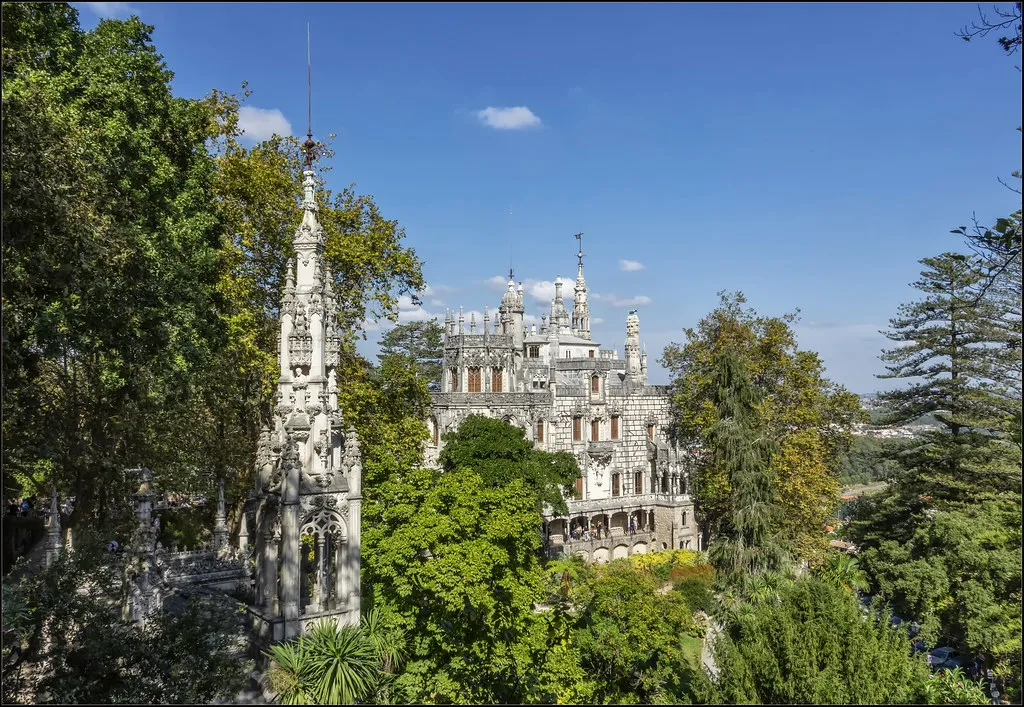
The main Regaleira Palace (Palácio da Regaleira) is a five-story Neo-Manueline fantasy that looks as if Gaudí had been given a copy of a medieval Portuguese atlas. Manini layered in gargoyles, carved dragons, mythological creatures, alchemical symbols, and stonework that borrows from the Jerónimos Monastery in Lisbon. The turrets and limestone pinnacles give the facade its distinctive silhouette — the best photo angle is from the lawn just below the main entrance.
Interior access is included in your ticket and is self-guided. Allow 30–45 minutes to walk through the ground-floor rooms (dining room, library, billiards room, hunting room with its carved stone fireplace) and climb to the upper floors. The rooms are sparsely furnished — most of the original furniture was sold in 1942 — but the ceilings, stonework, and stained glass are the real attractions. Don't skip the basement, where a short tunnel connects the palace directly into the wider grotto network.
Just beside the palace stands the Chapel of the Holy Trinity, a small but exceptionally decorated private chapel. It blends Catholic iconography with Templar symbolism — a Templar cross appears in the stained glass above the altar, and pentagrams are worked into the floor mosaics. Below the chapel is a crypt that connects, once again, to the tunnel system. In the initiation rite theory, the chapel is the destination — the place where the candidate emerges from darkness into membership of the brotherhood. Whether or not that ever happened here, the architecture makes it feel like a culmination.
The gardens: grottoes, follies, and hidden passages
The 4-hectare gardens are where most of your time will actually go, and they are Regaleira's real masterpiece. Manini laid them out as a sequence of themed zones — Romantic garden rooms, open lawns, hidden grottoes, classical statuary, and clusters of exotic trees Carvalho Monteiro collected from across Europe and the Americas. The overall structure loosely follows the Rosicrucian four-element framework: deep underground zones for earth, lake and waterfall areas for water, the hilltop tower and open terraces for air and fire.
The tunnel and grotto network
The underground passages at Regaleira are more extensive than most visitors realize. The tunnels were cut from the granite bedrock, but their walls are lined with coastal rocks brought from near Peniche — a deliberate sensory choice that makes the tunnels smell and feel like a sea cave rather than a mine. Four primary grottoes anchor the network:
- Labyrinthic Grotto: The main branching junction below the Initiation Well. Multiple passages diverge here; finding the right one is part of the experience.
- Leda's Grotto: Hidden behind the waterfall on the lower lake. Named after the Greek myth of Leda and the Swan (Zeus in disguise). Accessible by stepping stones across the water. Duck inside and you rejoin the tunnel network from a different angle.
- Eastern Grotto: Connects the eastern slope of the gardens to the palace basement. Less visited than the others, which means shorter queues.
- Grotto of the Virgin: A small, contemplative chamber decorated with Marian imagery. Quieter and more intimate than the main well — worth finding if you have time.
Allow 30–45 minutes for the well and tunnels combined on a normal day. On a crowded day with well bottlenecks, build in an extra 20 minutes.
Garden highlights beyond the tunnels
The Tower of Regaleira sits at the highest point on the estate. Climb the narrow spiral staircase to the top platform and you get 360° views across Sintra — the National Palace's twin chimneys, the Atlantic coast on clear days, and the Moorish Castle ridge in the distance. It is the best free viewpoint in Sintra.
The Promenade of the Gods is a tree-lined path dotted with life-size statues of Greek deities — Hermes, Venus, Pan, Vulcan, Orpheus, and more. Each figure is placed to "watch over" a specific section of the estate, a nod to the Hermetic tradition's belief that classical gods embody universal principles.
Leda's Cave is one of Regaleira's most atmospheric spots — a low grotto hidden behind a waterfall on the lower lake. The Portal of the Guardians (two stone gatekeepers flanking a hidden passage), the Fountain of Abundance, and the sweeping terrace of the Loggia of the Nymphs are among the other highlights scattered across the grounds. Wear proper walking shoes — paths are steep, often damp, and always uneven.
Photography guide: how to shoot Regaleira well
Quinta da Regaleira is one of the most photographed estates in Portugal, and the Initiation Well is one of the most-shared travel images on the internet. Getting beyond the cliché requires some planning.
The Initiation Well
- The downward spiral shot: Stand at the very top of the well and shoot straight down. Get your framing clean — the repeating arches pull the eye through the frame. A wide-angle lens (16–24mm equivalent) maximizes the depth impression. The challenge is other visitors: on busy days you will not have the top to yourself. Early morning entry or a late-afternoon visit makes this shot achievable.
- The upward spiral shot (the viral one): Enter via the tunnel network and stand at the very base of the well. Shoot straight up. This is the image most people recognize — a circle of sky framed by nine rings of spiraling arches. If a friend is with you, have them stand midway on the staircase for scale.
- No flash: The tunnels are dimly lit and flash destroys the atmosphere. Use a high ISO (3200+) or bring a lightweight tripod if you want sharp tunnel shots. The well shaft itself gets natural light and does not require artificial lighting.
- Best light: The well is partly sheltered, so it is photogenic at most times of day. The palace facade and garden follies benefit from golden-hour light — aim to be in the open garden areas in the first or last 90 minutes of the day. Morning light hits the palace facade from the east; afternoon light catches the tower and western terraces.
Other key shots
- Palace facade: From the lower lawn, slightly off-center. Mid-morning when the facade is in sun but the sky still has colour.
- Promenade of the Gods: Shoot along the path with a god-statue in the foreground. A medium telephoto (85mm equivalent) compresses the tree tunnel nicely.
- Tower viewpoint: For the panoramic Sintra view, visit on a clear morning before heat haze builds. Bring a wide-angle.
- Tunnel interiors: Slow shutter or high ISO. The Peniche-rock walls have natural pink and brown tones that reproduce beautifully without a flash.
How long do you need? Speed route vs. deep route
Regaleira is larger than it looks from the entrance — first-time visitors consistently underestimate the walking involved. Here are two honest routes:
Speed route: ~1 hour
Initiation Well (descent + tunnels) → Leda's Grotto → palace facade (exterior only) → chapel exterior. This gives you the headline experience and the photographs, but skips the palace interior, the Tower, and most of the upper gardens. Not recommended — you'll leave wishing you'd stayed longer.
Standard route: 2–2.5 hours
Initiation Well → tunnels to Leda's Grotto and Eastern Grotto → palace interior (30 min) → chapel → Tower of Regaleira → Promenade of the Gods → lower lake and waterfall → Fountain of Abundance. Comfortable pace, covers all the major highlights.
Deep route: 3.5–4+ hours
All of the above, plus: Grotto of the Virgin → upper terrace gardens → Loggia of the Nymphs → Portal of the Guardians → reading the symbolism at each site carefully → time for photography at the well and tower. If you are interested in the esoteric history, or want serious photos of the well, plan for this. Four hours is not excessive for this estate.
Accessibility at Quinta da Regaleira
Be realistic about accessibility before you visit. The estate is very difficult for visitors with mobility limitations:
- Initiation Well: Stairs only. 139 steps with no ramp, lift, or alternative route. If you cannot manage steep spiral stairs in both directions, the well interior is not accessible.
- Tunnels: Low ceilings, uneven footing, dim lighting, no ramps. Not suitable for wheelchairs or mobility aids.
- Palace: Ground-floor rooms are partially accessible; upper floors involve stairs.
- Gardens: The grounds are steep, with uneven stone paths throughout. Standard wheelchairs are not practical for most of the estate.
- Strollers: Not practical. Leave pushchairs at the entrance if possible.
- Companion policy: One travel companion accompanying a visitor with a recognized disability ID receives free entry.
The most accessible experience focuses on the palace ground-floor rooms, the chapel exterior, and the flatter sections of the lower garden near the entrance.
The Initiation Well has 139 steep spiral stairs with no ramp or lift alternative, and the tunnel network has uneven footing and low ceilings throughout. Standard wheelchairs and pushchairs are not practical for most of the estate — leave strollers at the entrance if possible.
How to visit: getting there and combining with other sites
Quinta da Regaleira sits just 1 km west of Sintra's historic center. From the Sintra National Palace — the one with the twin conical chimneys in the main square — walk west along Avenida Visconde de Monserrate. The walk takes about 15 minutes, is mostly downhill on the way there, and passes small cafés and the hedged entrance walls of several private quintas. This is the easiest and most pleasant way to arrive.
If you prefer transit, Bus 435 ("Villa Express 4 Palaces") loops between Sintra train station, Regaleira, Seteais, and Monserrate Palace, with a day pass around €6–7. It runs every 15–20 minutes in peak season. Even from the station, 1.8 km away, walking is often faster than waiting for the bus on busy days.
Sintra National Palace: the 10-minute combination
The Sintra National Palace is a 10-minute walk from Regaleira and makes a natural pairing. The National Palace is the medieval royal palace in the town center — entirely different in character from Regaleira's Romantic mysticism — with Gothic and Manueline halls, Moorish azulejo tiles, and the famous twin conical kitchen chimneys that define Sintra's skyline. Tickets are separate (around €10 adult). If you visit Regaleira in the morning and the National Palace in the early afternoon, both are comfortable in a single day.
How Regaleira compares to other Sintra palaces
Sintra has five major palace sites, and choosing correctly makes a significant difference to your day. Here is how Regaleira fits:
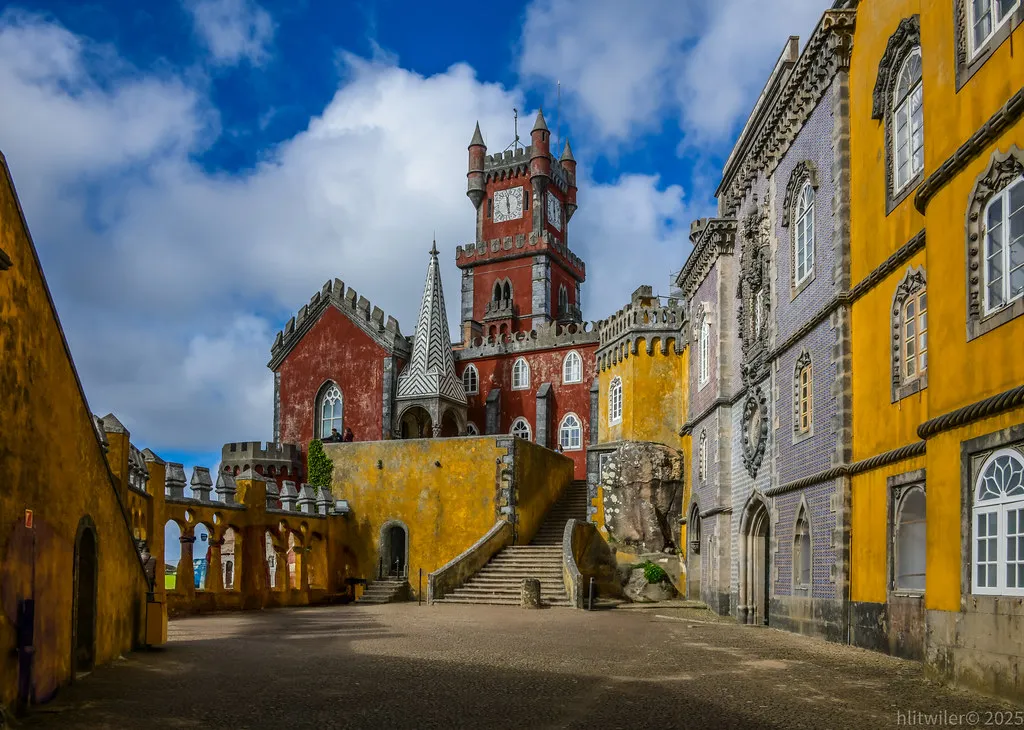
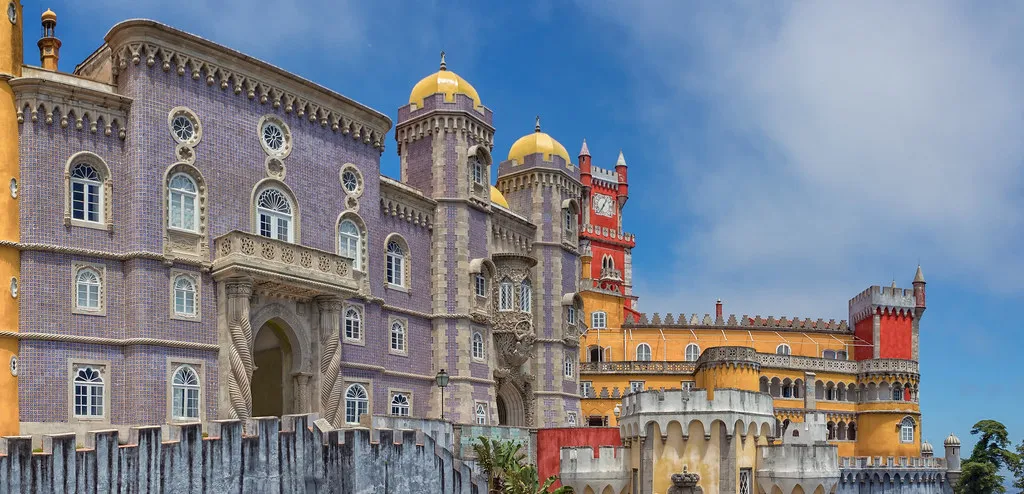
- Regaleira vs. Pena Palace: These are Sintra's two most visited sites and very different experiences. Pena is the colorful Romantic hilltop castle with panoramic views and lavishly decorated royal rooms — the "iconic Sintra" photo. Regaleira is the atmospheric mystical estate, focused on underground symbolism and gardens rather than hilltop views. They are on opposite ridges, requiring a separate bus or long uphill walk between them. Do not combine them in a single day unless you are moving quickly and accept that you will rush both. If you only have one day in Sintra and must pick one, choose Pena for the view and Regaleira for the experience. If you have two days, visit each properly.
- Regaleira vs. Moorish Castle: The Moorish Castle is on the same ridge as Pena, 30–45 minutes uphill from the town center. It pairs naturally with Pena (a single bus ride gets you to both). Regaleira pairs naturally with the National Palace (both in the valley). Don't mix ridge and valley sites unless you have transport.
- Regaleira + day trip from Lisbon: Sintra is 40 minutes from Lisbon's Rossio station by regional train (around €2.50 each way). For a day trip, the classic sequence is: arrive early, Regaleira first (well queue is shortest at opening), National Palace in the afternoon, train back before peak evening crush. See our Sintra day trip from Lisbon guide for the full logistics.
For a comprehensive overview of all Sintra's palaces and how to sequence them, see our complete Sintra castles and palaces guide.
Frequently asked questions
Is Quinta da Regaleira worth visiting?
Yes — it is one of the three must-see sites in Sintra, alongside Pena Palace and the Moorish Castle. Regaleira offers the unique experience of the Initiation Well and the underground tunnel system, which you will not find anywhere else in Portugal. It is less crowded than Pena, better value at €15–€20, and easier to reach on foot from central Sintra. If you only have time for two Sintra palaces, Regaleira should be one of them.
How many steps is the Initiation Well?
The Initiation Well has 139 steps in its spiral staircase, descending 27 meters across nine landings. The steps are stone, narrow, and uneven in places. Most reasonably fit adults manage them without difficulty, but they are steep and there is no ramp or lift alternative. Allow 20–30 minutes for the descent and tunnel exit on a quiet day, longer if there is a queue bottleneck on the staircase.
What is the best time to visit Quinta da Regaleira?
Arrive at opening (9:30 AM) and go straight to the Initiation Well — this is the single most effective strategy for avoiding the well queue. Alternatively, arrive after 4 PM when crowd levels thin noticeably. For the overall estate, shoulder season (April–May or October–November) offers decent weather without the July–August peak crowds. Weekdays are significantly quieter than weekends year-round.
How long do you need at Quinta da Regaleira?
Plan for a minimum of 2–2.5 hours at a comfortable pace covering all main highlights: the well, tunnels, palace interior, chapel, and Tower. If you are interested in the symbolism and history, or want good photographs of the well and gardens, allow 3.5–4 hours. The estate is bigger than it looks from the entrance and most first-time visitors underestimate the walking involved.
Can you do Quinta da Regaleira and Pena Palace in one day?
Technically yes, but not recommended. Both sites deserve 2.5–3+ hours each, they are on opposite ridges, and the bus transfer between them adds another 30–45 minutes. Visitors who combine both in a day typically rush one or both. If you only have one full day in Sintra, pick one. If you have two days, visit each properly — Pena in the morning (views are best before noon), Regaleira on the second day at opening.
Who built Quinta da Regaleira?
The estate was commissioned by António Augusto Carvalho Monteiro, a Portuguese-Brazilian millionaire known as "Monteiro of the Millions," who purchased it in 1893. He hired Italian architect and La Scala scenographer Luigi Manini to design the palace, chapel, and gardens, which were built between 1900 and 1910. Carvalho Monteiro's deep interest in Freemasonry, Rosicrucianism, the Knights Templar, and Tarot symbolism drove every design decision on the estate.
Is Quinta da Regaleira accessible for wheelchairs?
The estate is largely not accessible for wheelchair users. The Initiation Well has 139 stairs with no ramp alternative; the tunnels have uneven footing and low ceilings; the gardens have steep stone paths throughout. Ground-floor rooms in the palace and the flatter sections near the entrance offer the most accessible experience. One companion accompanying a disabled visitor with a recognized disability ID receives free entry.
Should I visit Pena Palace or Quinta da Regaleira?
Visit both if you can — they are very different experiences. Pena Palace is the colorful Romantic hilltop castle most people recognize from Sintra postcards, with panoramic views and lavishly decorated royal rooms. Regaleira is the mystical estate, focused on symbolism, grottoes, and gardens rather than royal interiors. If you can only pick one, choose Pena for the "iconic Sintra" experience and Regaleira for the more immersive, atmospheric walk-through. See our Pena Palace visitor guide for full details.
Is Quinta da Regaleira good for kids?
Yes, especially for kids who like adventure, tunnels, and spooky castles. The underground tunnel network feels like a real-life treasure hunt, and the towers and grottoes keep most children engaged. Practical cautions: strollers are not practical (steep stone paths, narrow tunnels, spiral staircases); the well descent involves 139 stairs and no alternative; the tunnels are dimly lit, which can unsettle younger children. For tips on timing family visits and the best things to do in Sintra with kids, see our full Sintra guide.