18 Essential Algarve Hidden Gems and Travel Tips (2026)
Discover the best Algarve hidden gems with our guide to secret beaches, Moorish villages, and local salt pans. Includes practical trade-offs and timing tips.
On this page
18 Essential Algarve Hidden Gems and Travel Tips (2026)
After five summers exploring the southern coast of Portugal, I have realised that the most rewarding moments happen far from the resort strips. The region offers much more than crowded sand, provided you know which dirt tracks to follow. Our editors have spent months mapping these quieter corners for the 2026 season so your next visit feels entirely authentic.
This guide was refreshed in May 2026 to reflect current pricing, parking rules, and access conditions. We have prioritised spots where the local rhythm still dictates the pace of life. Whether you want a silent Moorish castle, a river-sea confluence, or a salt-pan float, the locations below represent the true soul of the south.
Cacela Velha: The Sleepy Gateway to Ria Formosa
Cacela Velha is a whitewashed hamlet perched on a cliff at the eastern edge of the Ria Formosa lagoon. The village itself is barely 300 metres across: a fort, a church, two cafes, and one of the best viewpoints in the Algarve. Come for sunrise and you will likely share the church plaza with one fisherman and a stray cat.
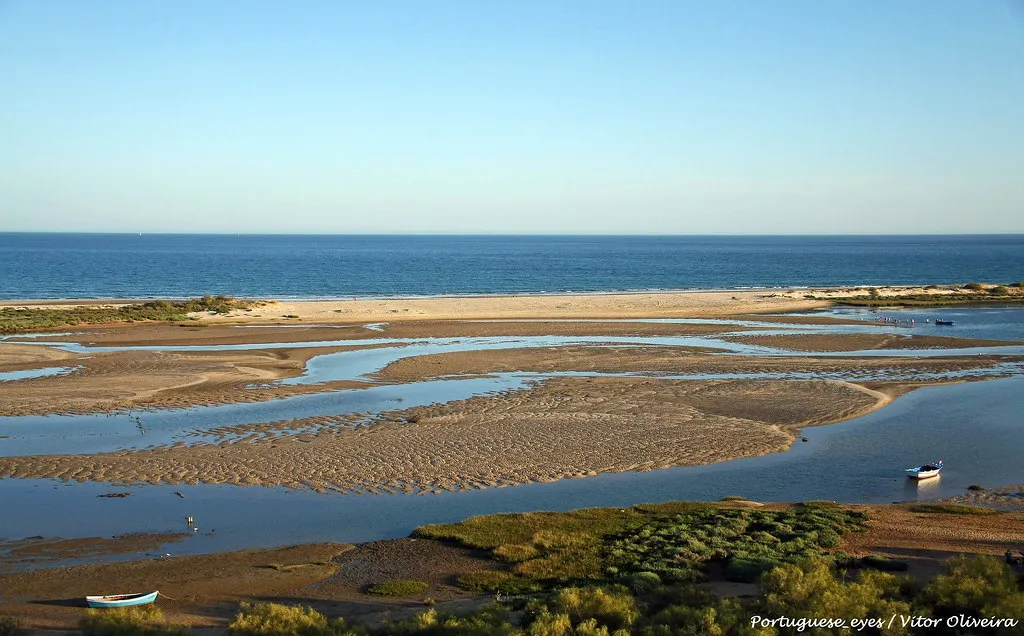
The trick is the lagoon crossing to Praia da Fábrica. At low tide you can wade across in waist-deep water for free; at high tide a small fishermen's boat shuttles people for €2 to €3 per person, cash only. Check the Faro tide tables the night before, and time your visit for the two hours either side of low tide to walk both ways without surprises.
Parking sits at the village entrance and fills by 11:00 AM in July and August. The closest train station is at Vila Nova de Cacela, a 30-minute walk inland, so a rental car (or a taxi from Tavira) is the realistic option. For a complete eastern Algarve plan, our Algarve 3-day itinerary slots Cacela between Tavira and Castro Marim.
Check the Faro tide tables the night before your visit to Cacela Velha. Timing your arrival within two hours of low tide lets you wade across to Praia da Fábrica for free; at high tide the fishermen's boat shuttle costs €2–€3 per person, cash only.
Praia da Marinha: Postcard Views with Real-World Vibes
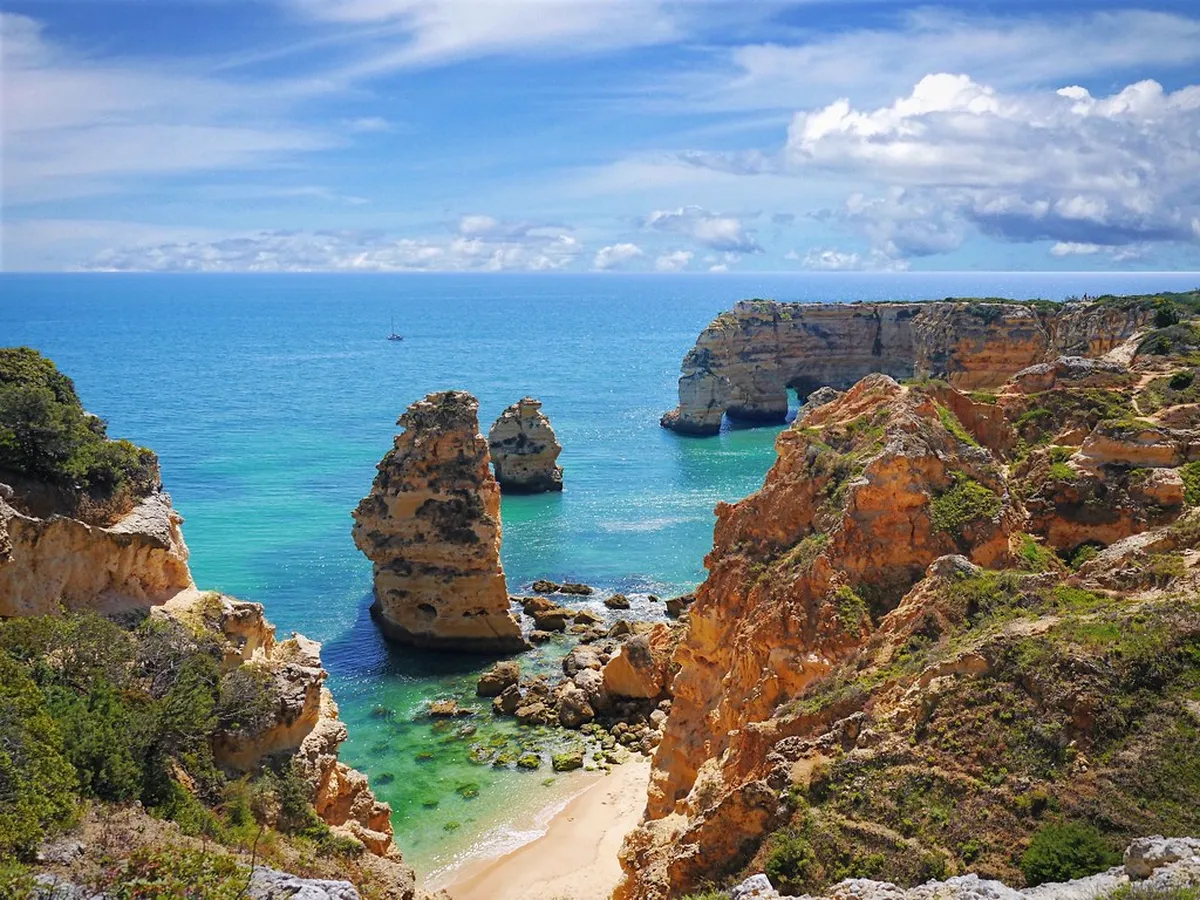
Praia da Marinha keeps showing up on world-best-beach lists for a reason: two natural arches, layered limestone cliffs, and water clear enough to count the fish from the clifftop. The catch is timing. Tour buses begin disgorging at 10:45 AM. To have the cove almost to yourself, arrive by 8:30 AM with coffee in a thermos and walk down the eastern staircase first.
To find the famous heart-shaped rock formation, take the Seven Hanging Valleys trail east of the beach for about 400 metres until you reach the second viewpoint. Look down and slightly inland: two adjacent arches form a clear heart shape when the sun is low. The view does not exist from beach level, only from the clifftop path, which is why most visitors miss it.
The car park is free but holds only around 80 vehicles. Bring reef shoes, since the swimming entry is rocky, and skip the cliff-edge selfies — at least one fatal fall happens here most years. Combine Marinha with Praia da Falésia and the Algar de Benagil viewpoint for a full central-coast day; our guide to Algarve viewpoints maps the best sequence.
Ferragudo: Where Locals Still Outnumber Tourists
Across the river from Portimão, Ferragudo has somehow resisted the resort sprawl of its neighbour. Fishing boats still unload sardines at the quay before lunch, retirees play cards outside Pastelaria O Forninho, and the alleys behind Rua Vasco da Gama smell of geraniums rather than sunscreen. It is the easiest "real Algarve" stop on the central coast.
Lunch at O Barril or A Casa do Avô for grilled sardines (€8 to €12), or splurge on the cataplana de marisco at Rei das Praias right on Praia dos Caneiros (€55 for two). Wander uphill to Igreja Matriz for panoramic harbour views, then drop back down for an espresso at Vila Adentro on the main square.
Parking is the single biggest mistake first-timers make. The historic centre was built for handcarts, not Renault Clios. Use the free gravel lot at the town entrance (signposted "Largo do Pescador") and walk in — five minutes flat. Driving past that point in summer means a 40-minute wedge in a one-way alley.
Aljezur: Surfing, Sweet Potatoes, and Slow Living
Aljezur sits on the wild west coast inside the Costa Vicentina natural park, and it feels half-Algarvian, half-Atlantic-surf-town. The Moorish castle ruins are free to enter from sunrise to sunset and give a clean view over the river valley and the white houses below. Allow 30 minutes for the climb and another 20 for the small archaeology museum at the base.
Sweet-potato culture is the unexpected hook here. The local IGP-protected batata-doce de Aljezur shows up in everything from bread to ice cream. Stop at Padaria Aljezurense on Rua 25 de Abril for sweet-potato pastéis (€1.20), or sit down at Pão de Aljezur for sweet-potato cake with cinnamon. For a surf-vibe lunch rather than a tourist menu, locals point to Restaurante Ruth on the main road or Mercearia Gato Preto for sandwiches before the beach.
The Atlantic water here is genuinely cold (15 °C to 18 °C even in August), and rip currents are real. If you are not surfing, head to Praia da Amoreira for the calmer river-mouth side. The town pairs neatly with Sagres for a two-day western loop — see our 17 Best Things to Do in Sagres: 2026 Travel Guide for the southern half.
Odeceixe Beach: The Dramatic River-Sea Confluence
Praia de Odeceixe sits where the Seixe river loops back on itself before meeting the Atlantic, creating a horseshoe of warm, shallow river water on one side and cold, surf-pounded ocean on the other. The river side is shin-deep for 50 metres out and stays around 22 °C in summer — easily the best family swim spot on the west coast. The sea side is for confident swimmers only.
From the village of Odeceixe, the beach is a 4 km drive or a steep 25-minute walk down. The clifftop car park (free, around 60 spaces) fills by 11:00 AM in July and August; an overflow lot 500 metres back is the fallback. The descent staircase is fine for most, but the upper-village footpath has loose gravel and is not stroller-friendly.
Two practical notes: there is no shade on the sand after midday, and the single beach restaurant (Dorita) takes a 90-minute wait at peak season, so buy bread, cheese, and water in the village first. The nudist zone is signposted at the northern end of the sea side — wander there by accident and you will get a polite look, not a fine.
Tavira's Outskirts: Salt Pans, Flamingos, and Anchor Fields
Most visitors stop at Tavira's old town and miss the better stuff outside the centre. Five kilometres west, Praia do Barril holds a "cemetery of anchors" — around 100 rusting tuna-fleet anchors planted upright in the dunes as a memorial to the industry that collapsed here in the 1960s. Walk from the mainland (15 minutes across the wooden boardwalk) or take the narrow-gauge tourist train for €1.50 one way.
The Ria Formosa salt pans east of town turn into a flamingo viewing post from October through February. Two hundred or more pink birds usually feed in the shallow pans behind Quatro Águas; bring binoculars and arrive an hour before sunset for the best light. Spoonbills, avocets, and black-winged stilts share the same flats year-round.
For a longer base in the area, our things to do in Tavira guide covers the old town, the seven-arch Roman bridge, and the camera obscura. Pair Barril's anchor field with an early-morning visit before the train starts running at 9:00 AM and you may have it entirely alone.
Castro Marim: Medieval History and Artisanal Salt
Castro Marim guards the Guadiana river border with Spain and has done so since the 13th century. The combined ticket for the Castelo and the Forte de São Sebastião costs €2.50 and gives you the full Templar-era story plus a small but genuinely interesting medieval torture museum in the keep. Allow 90 minutes for both.
The real surprise is the salt pans below town. Salmarim runs a 60-minute "salt experience" (€15 per adult, booking required at salmarim.com) where you walk into a working flor-de-sal harvest, taste five grades of salt, and — in July and August — float in a hyper-saline pool that mimics the Dead Sea. Pack a swimsuit and flip-flops; the salt crust under bare feet is sharp.
Time your visit for the last weekend in August and you walk into the Dias Medievais festival: jousting, falconry, period markets, and street food across the entire old town. Tickets are €4 at the gate, free for children under 10. The town is otherwise sleepy on weekdays, so the festival is genuinely the high-energy moment of its year.
Loulé: Islamic Baths and the Neo-Arab Market
Loulé's Banhos Islâmicos were excavated under the town hall in 2006 and are the best-preserved Islamic thermal baths on the Iberian peninsula. The four chambers — cold room, warm room, hot room, and furnace — date to the 12th century and were used until the Christian reconquest in 1249. Entry is €1.50, the site opens Tuesday to Saturday from 10:00 AM, and the visit takes 20 minutes. Most Loulé day-trippers walk straight past the unmarked entrance.
The municipal market 200 metres away is the second draw. Built in 1908 with a neo-Arab red-brick facade and four corner minarets, it still functions as the working market for inland Algarve. Saturday morning is the local farmers' market on the surrounding streets — fig leaf cheese, carob flour, and seasonal almonds at half the price of coastal supermarkets.
For visitors with an afternoon to spare, Loulé hosts the Algarve's biggest carnival in February (the only one to rival Rio in Portugal) and the Festival MED world-music weekend in late June. Both are free to wander, paid only for headline acts.
Praia dos Piratas: Finding the Secret Pirate Beach
Praia dos Piratas sits between Senhora da Rocha and Albandeira on the central coast and has no signpost from the road. To find it, park at the free Senhora da Rocha lot, walk east on the clifftop path for about 700 metres until you reach a wooden bench at the second cove viewpoint, then look for the unmarked footpath cutting diagonally down to the right.
The descent is a steep limestone scramble — five minutes down, ten minutes back up — with a fixed rope on the trickiest section. Sturdy trainers are essential; flip-flops here genuinely end in twisted ankles. There is no lifeguard, no shade, and no facilities, but in exchange you usually get the entire cove to yourself, even in August.
The water is clear and calm because the cove is protected from west swells, making it ideal for snorkelling around the rock stacks at the western edge. Bring everything you need (and bring it back out). Skip the visit if seas are forecast above 1.5 metres — the cove fills with surge and the scramble back up becomes unsafe.
Carvoeiro and the Algar de Benagil Skylight
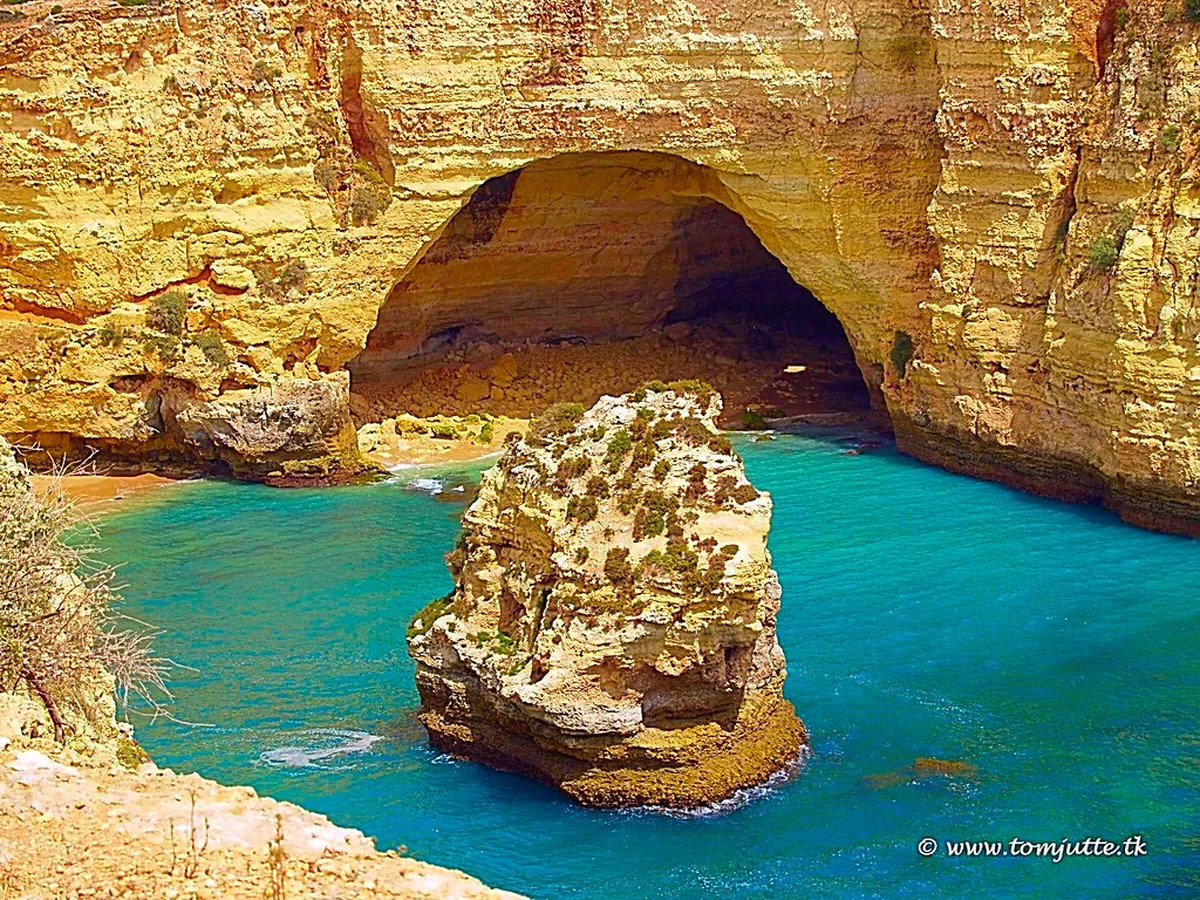
Carvoeiro itself has grown into a small resort, but the cliffs immediately east hold the most famous "Algar" formation in Portugal: the Benagil Cave skylight. Instead of paying €25 for a packed boat tour, walk the clifftop trail from Praia do Carvalho to the marked Algar de Benagil viewing platform (1.2 km, 25 minutes flat). You look straight down through the circular skylight into the cave, no boat fee, no queue.
If you do want to enter the cave, rent a single kayak or SUP from Benagil Beach (€20 to €30 per hour) and paddle in yourself when conditions are calm. The paddle takes 15 to 20 minutes and lets you see three smaller caves the tour boats skip. Avoid mid-July to mid-August between 11:00 AM and 3:00 PM, when boat traffic inside the cave is genuinely dangerous.
For a fishing-village nightcap, finish in Ferragudo or in the small harbour of Carvoeiro itself, where grilled fish at A Rampa or O Pescador still costs €10 to €14 — proof that the village heart has not been entirely renovated away.
Castle of Paderne: A Laid-Back Inland Walking Trail
Paderne is one of the seven castles drawn on the Portuguese flag, yet it sees fewer visitors in a year than Silves does in a week. The red-sandstone ruins sit on a quiet ridge above the Quarteira river, eight kilometres inland from Albufeira. Entry is free, the site has no gate, and you can wander the walls and the small chapel inside at any hour.
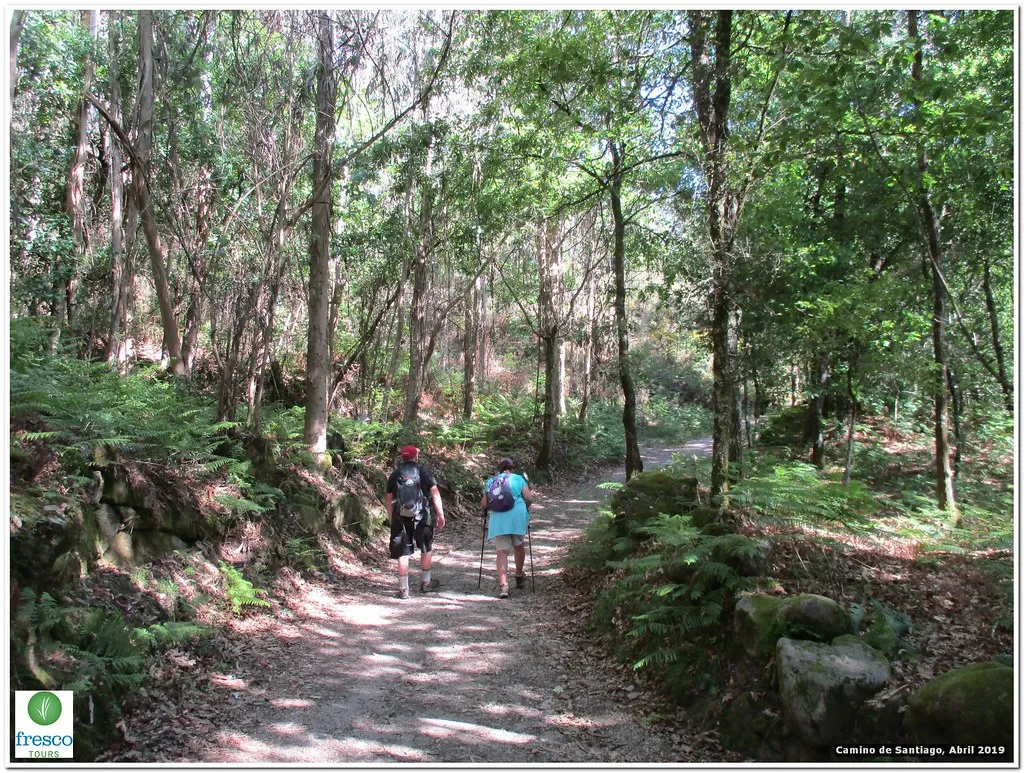
The real draw is the 4 km circular walking loop that starts at the castle car park. The path drops through orange groves to a Roman bridge over the river, climbs back up the opposite ridge, and circles back via almond and carob orchards. Allow 90 minutes, bring two litres of water in summer, and go before 10:00 AM or after 4:00 PM — there is no shade on the upper sections.
February is the magical month here, when 200,000 almond trees bloom white and pink across the surrounding valley. Pair Paderne with a stop in nearby Alte (waterfall pool and tiled village fountain) for a half-day inland escape from the coast.
Costa Vicentina: Nearly Footprint-Free Atlantic Bays
The Costa Vicentina natural park covers the western Algarve coast from Burgau north into the Alentejo, and it remains the wildest stretch of Portuguese shoreline. Praia da Amoreira, Praia da Bordeira, and Praia do Amado all sit inside the park and routinely have more surfers than sunbathers, even at peak season. Cliff-top access roads are gravel, parking is free, and there is no resort within 20 km.
The Rota Vicentina hiking network passes here — the Fisherman's Trail (Trilho dos Pescadores) clings to the clifftop for 230 km from Porto Covo to Lagos. You can walk single sections of 8 to 12 km between guesthouses and never lose sight of the Atlantic. The Aljezur to Arrifana section (8.5 km, 3 hours) is the most photogenic single-day option in the south.
Wind is the catch. The Atlantic gusts here regularly hit 40 km/h on summer afternoons, so plan walking and beach time before 1:00 PM and switch to inland villages after. Layers are non-negotiable, even in August.
Estoi: Roman Ruins and the Pink Rococo Palace
Estoi is a tiny inland village 10 km north of Faro that sits on top of one of the largest Roman villas in southern Portugal. The Milreu ruins (€2, open Tuesday to Sunday) preserve a 3rd-century bath complex, fish mosaics, and an unusual nymphaeum temple. Allow 45 minutes for the site and the small museum.
Two hundred metres uphill, the pink Palácio de Estoi is a tiered Rococo confection now operating as a pousada hotel. The formal gardens — terraced with tiled benches, fountains, and a grotto — are free to walk through during the day, even if you are not a guest. The combination of a working Roman site and a livable 19th-century palace in the same village is genuinely rare in the Algarve.
Time the visit around the 1:00 PM to 2:00 PM lunch closure at Milreu — staff lock the gate and you will wait outside. Pair Estoi with the Sunday morning Loulé farmers' market for a slow inland day far from the beaches.
Praia da Falésia: The Colourful Cliffs at Sunset
Praia da Falésia runs six kilometres between Olhos de Água and Vilamoura, backed by the most photogenic stretch of cliff in the central Algarve. The iron oxide in the clay turns the rock face orange, ochre, and white in alternating bands, and the colour intensifies dramatically in the last hour of daylight.
Five staircases connect the clifftop pine forest with the sand. The one most worth using is at Aldeia das Açoteias — free parking, a low-key beach bar at the base, and the longest stretch of empty sand to the east. Avoid the central Olhos de Água entry, which feeds straight onto the busiest 800 metres of the beach.
The clifftop walking path on top of the cliffs is shaded, mostly flat, and ideal for a 90-minute one-way stroll between two beach bars. Go at golden hour, bring a wind layer, and stay 50 cm back from the edge — the soft clay collapses without warning.
Silves: A Slice of Moorish History
Silves was the Moorish capital of the Algarve from the 8th to the 13th century, and the red sandstone castle that crowns the town is still the best-preserved Islamic fortress in southern Portugal. Entry is €3 (or €5 with the municipal museum), the cisterns below the keep are open to walk through, and the wall-walk gives the best inland river view in the region.
The streets below the castle are full of independent ceramic workshops and small art galleries — a leftover of the town's Moorish craft traditions. Ask at the tourist office about azulejo painting workshops at ColaborArte, where a two-hour session (€35) lets you design and fire your own tile. For a deeper dive on this town, see our Silves from Lagos day-trip guide.
Visit during the second week of August for the Silves Medieval Festival, when the streets fill with jousts, falconers, and period markets for 10 nights. It is the largest medieval festival in Portugal and tickets are €4 at the gate.
Ceramics Stores in the Algarve: Shopping Local
Algarve ceramic tradition runs back to the Moorish period and is genuinely worth supporting over the airport-souvenir alternative. The two trusted addresses are Porches Pottery on the EN125 near Lagoa (founded 1968, every piece thrown and hand-painted on site) and Olaria Pequena in Silves (smaller scale, bolder folk patterns).
How to spot the real thing: turn the piece over. Authentic Algarve ceramics carry a painted studio mark (Porches uses a small "P" inside a circle) and the base is rough-textured terracotta, not the smooth white of mass-produced imports. Prices for small tiles start at €5, six-piece dinner plates around €120, and large hand-painted platters €40 to €150. Roadside stands on the N125 between Albufeira and Loulé selling "traditional" plates at €4 are almost universally imports from Asia.
Most reputable workshops ship internationally for €25 to €40 — far safer than wrapping clay in a checked bag. Ask for the workshop's certificate of origin if you plan to claim VAT back at Faro airport.
Best Time to Visit the Algarve's Hidden Gems
May, June, late September, and October are the sweet spot. Daytime temperatures sit between 22 °C and 28 °C, the sea is warm enough for swimming from late June onwards, and the coastal trails are not yet baked. Accommodation runs 30% to 50% cheaper than peak August, and the tour buses at Marinha and Benagil drop to about a third of their July volume.
July and August are functional but punishing on the western coast — afternoon wind, 32 °C inland, and every car park full by 11:00 AM. If you must visit in summer, start every day at 7:30 AM and reserve afternoons for inland villages like Silves, Paderne, or Estoi where the heat is bearable in stone-walled streets.
Winter (December to February) is the underrated season. Daytime temperatures hover around 16 °C, hiking is genuinely pleasant, flamingos are in the Tavira salt pans, and almond trees bloom in February. Most coastal restaurants stay open in Lagos, Faro, and Tavira; smaller beach towns shutter from November to March. For full winter planning see our Algarve in winter guide.
May, June, late September, and October are the sweet spot for visiting: accommodation runs 30–50% cheaper than peak August, and car parks at Marinha and Benagil hold fewer than a third of their July crowd. If you must go in summer, start every day at 7:30 AM to beat the queues.
How to Plan Your Algarve Hidden Gems Trip
Renting a car is non-negotiable for any of the gems in this guide. Public buses link Faro to the major coastal towns (Lagos, Albufeira, Tavira) but do not serve Cacela Velha, Paderne, Praia dos Piratas, Estoi, or any of the Costa Vicentina trailheads. Book the car directly at Faro airport — pickup is on-site at every major company and rates start around €25 per day in shoulder season.
For a sense of how to combine these stops, our guide to the Algarve's best towns and our Algarve historic towns guide sequence the inland and coastal villages into realistic day loops. The east coast (Tavira, Cacela, Castro Marim) needs two days; the west coast (Aljezur, Odeceixe, Sagres) needs another two; the central cliffs (Marinha, Benagil, Falésia) work as a single base from Carvoeiro or Albufeira.
Cash matters in the small villages. Cafes in Cacela, Paderne, and Aljezur often have a €10 minimum for card payments or no card machine at all. Keep €40 to €60 in cash for two days of inland exploration, and remember that Sunday afternoons in inland Portugal are genuinely closed — plan eating around 1:00 PM Sunday lunch (open) and 8:00 PM Sunday dinner (most spots shut).
What to Skip: Overrated Algarve Spots
Not every famous attraction is worth the bus queue. The midday Benagil boat tour, the central Albufeira strip ("The Strip" on Avenida Sá Carneiro), and the resort beach clubs of Vilamoura all over-promise and under-deliver in 2026. The cave is best from the clifftop or by self-paddled kayak; nightlife is more interesting in Lagos old town; and beach atmosphere is better at any free public stretch east of Vilamoura.
Generic souvenir markets in Praia da Rocha and central Albufeira sell the same mass-produced tat found across the Mediterranean. Spend the same money at the Loulé Saturday market, the Porches Pottery showroom, or the small workshops behind Silves cathedral and you walk home with something a Portuguese family also owns. For an alternative cave experience see secret Algarve caves near Alvor.
Large all-inclusive complexes can insulate you from the region — convenient, but the food and atmosphere flatten quickly. A €90-per-night guesthouse in Silves, Tavira, or Ferragudo usually gives a better trip than a €180-per-night beach resort. The resort hotels in Albufeira are fine as a base if you have small children, but the experience improves the moment you drive 15 km in any direction.
Is the Algarve Worth Visiting in Winter?
Yes — and arguably more than in summer for hidden-gem hunters. The southern coast averages 300 days of sunshine a year, and December and January routinely deliver 16 °C to 18 °C afternoons that are perfect for the Seven Hanging Valleys trail and the Paderne walking loop. Beaches at Falésia, Marinha, and Odeceixe sit completely empty between November and March.
Birdwatching peaks in the same months. Several thousand flamingos winter in the Castro Marim and Tavira salt pans, joined by spoonbills, glossy ibises, and white storks. Bring binoculars and head out an hour before sunset for the best light — and the calmest wind.
The trade-offs are real: the Atlantic is too cold for swimming (15 °C to 16 °C), some smaller beach restaurants close from late November to early March, and the inland surf towns thin out. The trade-up is empty trails, halved accommodation prices, and a slow pace that the summer crowd never sees.
An Honest Note on Accessibility and Mobility
Most Algarve "hidden gems" guides skip this section, which is unfair to anyone travelling with a stroller, a wheelchair, or a knee that no longer enjoys rope-assisted scrambles. Of the 18 spots above, the genuinely accessible ones are Praia da Falésia (Aldeia das Açoteias entry has a ramp), the Castro Marim castle courtyard, the Loulé Islamic baths (street-level entry), the Estoi palace gardens, and Ferragudo's main square and harbour.

The hard-no for limited mobility: Praia dos Piratas (rope-assisted scramble), Odeceixe river side (steep descent, loose gravel), the cliff path to the Algar de Benagil viewpoint (no railings on long sections), and the Paderne castle ruins (uneven sandstone steps). Cacela Velha is village-level accessible but the beach crossing is not.
For families with strollers, the Tavira anchor cemetery (boardwalk plus tourist train) and the Silves castle wall-walk (paved) are the easiest wins. None of the major Algarve attractions are fully wheelchair-certified beyond the Faro old town — a gap worth knowing before booking.
Frequently Asked Questions
Which Algarve Hidden Gems options fit first-time visitors?
First-time visitors should focus on Cacela Velha and Silves Castle for a mix of coastal beauty and history. These spots are easily accessible and offer a clear contrast to the busy resort towns.
How much time should you plan for Algarve Hidden Gems?
You should plan at least five to seven days to explore these offbeat locations properly. This allows you to visit one or two gems per day without feeling rushed by the driving distances.
What should travelers avoid when planning Algarve Hidden Gems?
Avoid relying solely on public transport, as many secret beaches and inland villages are unreachable by bus. You should also skip visiting the most popular caves during the midday peak to avoid heavy crowds.
The Algarve's true magic is found in the details, from the rustling salt pans of Castro Marim to the red cliffs of Falésia. By stepping away from the main tourist hubs you discover a region that is deeply connected to its maritime and Moorish roots. We hope this guide encourages you to take the dirt road and find your own favourite corner of southern Portugal in 2026.
Respect the fragile environment and the quietude of the villages you visit. The beauty of these hidden gems depends on visitors who value preservation as much as exploration. Safe travels — and may the best moment of your trip be one you cannot find on a map.
 10 Best Hidden Gems in Braga (2026)June 4, 2026