7-Step Silves Day Trip From Lagos: The Ultimate Itinerary
Plan your Silves day trip from Lagos with our 7-step itinerary. Includes train vs. bus logistics, castle highlights, and the best local lunch spots.
On this page
7-Step Silves Day Trip From Lagos
Silves is the inland counterweight to coastal Lagos: a red-sandstone hill town that served as the Moorish capital of the Algarve for nearly 500 years before the Christian reconquest in 1242. This guide is built for first-time visitors based in Lagos who want a realistic single-day plan, including the train logistics that catch most travelers off guard. The whole trip works on a 7-step rhythm covering transport, the castle, the cathedral, lunch, the riverside, and a return decision before sunset.
If you are still mapping out your week, see Things To Do In Lagos Portugal: The Ultimate Travel Guide for the coastal half of the trip and Lagos Portugal 3 Day Itinerary: 8 Essential Planning Tips for slotting Silves into a longer stay. Refreshed for travel in 2026 with current ticket prices, train timetables, and on-the-ground notes from a spring visit.
Lagos to Silves: Transport Options (Train, Bus, and Car)
Silves sits 35 km east of Lagos. The Comboios de Portugal (CP) regional line is the cheapest option at roughly €2.55 each way, with about eight departures per day from Lagos station. The journey runs 32 to 38 minutes depending on the service. The catch is that Silves train station is in Estação de Silves, a separate village 2 km south of the historic center across the Arade.

The Vamus Algarve bus (route 113 and seasonal route 17) is slower at 50 to 70 minutes but drops you closer to the old town, near the Praça do Município. Frequency drops to two or three departures per weekday and almost nothing on Sundays, so always check the Vamus website the night before. A one-way fare is around €4.30.
Driving is the most flexible choice for a day trip to Silves from Lagos: 25 minutes via the A22 toll motorway (about €2.40 each way) or 35 minutes via the toll-free N125. Several free public car parks ring the old town, with the riverside lot below the castle being the most convenient. See Lagos Portugal Car Rental: 8 Essential Tips for Your Trip for pickup logistics, and the wider Algarve by train or bus guide if you are stitching multiple stops together.
The Silves Train Station Walk: A Survival Guide
This is the part every other guide warns about and almost none of them solve. The walk from Estação de Silves to the castle is 2.0 km, climbs roughly 60 meters in elevation over the second half, and has almost no shade once you cross the bridge over the Arade. In July and August, the asphalt regularly hits 40 C by 11:00, which is why so many first-timers end the day exhausted before they have even seen the cathedral.
Three practical workarounds make a real difference. First, the small green Silves Urbano shuttle bus meets most trains at the station and runs into town for €1.50; it is unmarked on Google Maps but parks directly outside the station building. Second, taxis rarely wait at the station, but Bolt and Uber both cover Silves and a ride into the center is €4 to €6. Open the app before you leave Lagos because mobile signal at the station can be patchy. Third, if you are walking, follow the riverside path on the east bank rather than the main road, which adds shade from plane trees and a flat approach to the Roman Bridge.
For the return, time your descent for the cooler late afternoon and aim to be back at the station 15 minutes early; the platform has no shelter and trains to Lagos do not always wait if you sprint up at the last second.
Morning: Exploring Silves Castle (Castelo de Silves)
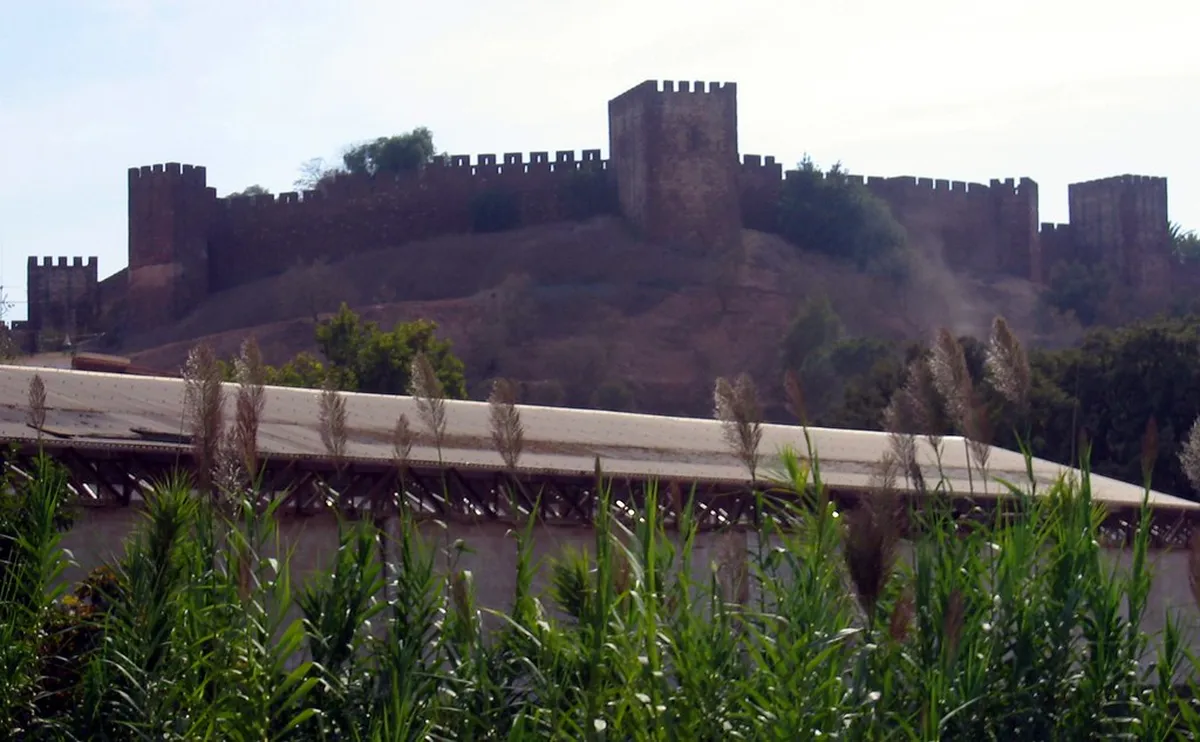
Castelo de Silves is the largest and best-preserved Moorish castle in Portugal. Built in red local sandstone between the 8th and 13th centuries, its battlements run 388 meters around the highest point of town and look out over orange groves and the Monchique mountains. Entry is €2.80 for adults in 2026, €1.40 reduced, and free for under-12s. It opens at 09:00 in winter and 09:30 in summer; aim to arrive within 30 minutes of opening to walk the walls before the heat builds.
Inside, the most rewarding sections are the Almohad cistern (a vast subterranean water chamber built around 1150) and the archaeological dig in the central courtyard, which exposed Moorish-era housing foundations. The wall walk is uneven sandstone with no railings on some inner edges, so closed-toe shoes matter more here than at most Algarve sights. Allow 75 to 90 minutes to do the full circuit without rushing.
Entry to Silves Castle is €2.80 for adults (€1.40 reduced, free for under-12s) in 2026. Arrive within 30 minutes of the 09:00–09:30 opening to walk the walls before the heat builds.
Midday: Sé de Silves and the Archaeological Museum
A 90-second walk downhill from the castle gate brings you to the Sé de Silves, the Gothic cathedral built between the 13th and 14th centuries on the foundations of the former Friday mosque. The 1755 Lisbon earthquake collapsed much of the original facade, and what you see today is a careful 18th-century reconstruction that retained the Gothic nave and side chapels. Entry is €1.50 and the interior usually takes 15 to 20 minutes; look for the tomb slabs of the Crusader knights who took the city in 1242.
One block south, the Museu Municipal de Arqueologia is built around an extraordinary Almohad-era well-cistern that descends 18 meters into the bedrock. Entry is €2.10, or €3.90 combined with the castle, which is the deal almost everyone should take. Galleries cover everything from Neolithic tools found along the Arade to Roman pottery and Islamic ceramics, and English signage was upgraded across the museum in 2024.
Lunch: Where to Eat Authentic Portuguese Food in Silves
Silves runs on a traditional Portuguese lunch rhythm: kitchens open 12:00 to 15:00 and most close fully between lunch and dinner. The "Prato do Dia" lunch menu typically runs €10 to €14 including bread, a main, a drink, and coffee. Cash is still preferred at smaller tascas, though card readers have become standard since 2023.
The Mercado Municipal on Rua Gregorio Mascarenhas is the easiest single stop for a quick, cheap meal. Inside the market, a handful of counters serve fresh grilled fish, soup, and seasonal Silves oranges that locals consider the best in the country. For a sit-down meal with river views, look at restaurants along Rua da Cruz de Portugal heading toward the bridge. Specialties to look for include cataplana de marisco (seafood stew sealed in a copper pan), porco preto (Iberian black-pig pork), and medronho, the local strawberry-tree fruit brandy distilled in the Monchique hills above town.
Afternoon: Riverside Strolls, the Roman Bridge, and Stork Spotting
The Arade riverside is the quiet payoff of the day. The so-called Roman Bridge (Ponte Romana) is actually a medieval reconstruction of an earlier Roman crossing, rebuilt repeatedly between the 13th and 15th centuries. It is pedestrian-only and frames the best photograph in town: the red castle walls rising directly behind the cathedral spire. Late afternoon, between 16:30 and 18:00, gives the warmest light on the sandstone.
Silves is also one of the best places in southern Portugal for stork spotting. White storks (Ciconia ciconia) build enormous twig nests on the disused factory chimneys along the river and on the bell towers of the cathedral and Igreja da Misericordia. Nesting season runs roughly February through July, with the loudest bill-clattering displays in March and April. Bring binoculars or a phone with at least 5x zoom; the chimney-top nests are 30 meters up and easy to miss without optics. The riverside promenade between the Roman Bridge and the modern road bridge is the single best vantage point.
Essential Practical Tips for a Smooth Day Trip
- Wear closed-toe shoes with grip; the cobbles are smooth and slick even when dry, and the castle walls have no railings.
- Carry at least 1.5 liters of water per person in summer. There is one public fountain inside the castle and shops thin out above the cathedral.
- Bring cash for the Mercado, small tascas, and the Vamus bus. Card works at the castle, museum, and most sit-down restaurants.
- Avoid Mondays for the museum (closed) and check the Sé schedule, which sometimes shuts during midday Mass.
- If the August Medieval Festival overlaps with your dates, book accommodation in Lagos rather than Silves and take an early train; entry to the festival itself is around €2 in costume and €4 without.
- Download offline Google Maps for Silves before leaving Lagos; signal in the old town backstreets is unreliable.
The Museu Municipal de Arqueologia is closed on Mondays, and the Sé de Silves sometimes shuts during midday Mass. In July and August the station-to-center walk regularly hits 40 °C by 11:00 — plan the uphill stretch for early morning or late afternoon.
Is Silves Worth the Trip? Silves vs. Sagres Decision Matrix
The most common day-trip dilemma from Lagos is Silves or Sagres From Lagos Day Trip Travel Guide. Both are excellent, but they answer completely different questions. Use the comparison below to choose based on what you actually want from the day.
- Distance from Lagos: Silves 35 km east (25-min drive). Sagres 33 km west (35-min drive on slower roads).
- Public transport: Silves has train + bus. Sagres is bus-only (route 14/15, around 60 minutes).
- Vibe: Silves is inland, sheltered, history-saturated, often 5 C warmer. Sagres is exposed Atlantic clifftop, windy, raw, surfer-tinged.
- Main draw: Silves Castle and Moorish old town. Sagres Fortress and Cabo de Sao Vicente lighthouse, the southwestern tip of continental Europe.
- Best for: Silves suits history travelers, families, and anyone wanting a walkable old town. Sagres suits surfers, big-landscape photographers, and travelers chasing the "End of the World" feeling.
- Worst for: Skip Silves on the hottest July afternoons (the walk is brutal). Skip Sagres on windy or low-cloud days (the cape view disappears).
Many visitors with a rental car combine both across two days from Lagos. If you only have one, pick by weather: hot and clear favors Silves with its shaded riverside, while a windy or partly cloudy day actually flatters Sagres.
| Factor | Silves | Sagres |
|---|---|---|
| Distance from Lagos | 35 km east (25-min drive) | 33 km west (35-min drive) |
| Public transport | Train + bus (from €2.55) | Bus only (~60 min, route 14/15) |
| Vibe | Inland, sheltered, history-saturated | Atlantic clifftop, windy, raw |
| Main draw | Moorish castle & old town | Sagres Fortress & Cabo de São Vicente |
| Best for | History, families, walkable old town | Surfers, big-landscape photographers |
| Avoid when | Hottest July afternoons | Windy or low-cloud days |
Add an Extra Day: Algarve Day-Trip Extensions
If Silves leaves you wanting more inland Algarve, Monchique day trip is 25 minutes further north by car, climbing into cork-oak forest and the Caldas thermal springs. The drive itself, on the N266, is one of the prettiest in the region. Without a car, the Vamus 4602 bus connects Silves and Monchique twice daily on weekdays.
On the way back to Lagos, the fishing village of Ferragudo sits at the mouth of the Arade across from Portimão. Whitewashed cottages, a small castle ruin, and the Praia Grande beach make it a 90-minute stop. Boat operators on the Silves riverside also run small-group eco-tours down the Arade between April and October, blending birdwatching with the area's old cork and citrus trade history.
Best Base for Your Stay: Where to Stay in Lagos
Most travelers do Silves as a return day trip rather than an overnight, so where you sleep in Lagos matters. See Where to Stay in Lagos Portugal: 11 Best Areas for the full breakdown. For Silves logistics specifically, the Old Town and Marina districts win because both are within a 10-minute walk of Lagos train station, sparing you a taxi at 08:00.
The Old Town is the most atmospheric option but can be noisy in July and August. The Marina is quieter, has more apartment-style rentals, and sits directly across the footbridge from the station. Porto de Mós and Meia Praia work better if you have a rental car and prefer beach access; both add 10 to 15 minutes to your drive to Silves but trade that for direct cliff or sand access at sunset.
Frequently Asked Questions
Is there a direct bus from Lagos to Silves?
Yes, there are direct buses, but they are less frequent than the train. Route 113 connects the two towns several times per day. Check the Vamus Algarve website for the most current seasonal schedules.
How far is Silves train station from the town center?
The station is roughly 2 kilometers from the historic center. This walk is mostly uphill and takes about 25 minutes. Taxis are sometimes available, but ride-sharing apps are more reliable in this area.
How much time do you need in Silves?
You need about four to six hours to see the main sites comfortably. This allows time for the castle, the cathedral, and a relaxed Portuguese lunch. Most visitors arrive mid-morning and leave by late afternoon.
Is Silves Castle worth visiting?
The castle is absolutely worth visiting for its well-preserved Moorish architecture and red sandstone walls. It offers the best views in the region. The entry fee is very affordable at under three Euros.
A Silves day trip from Lagos is the best way to experience the Moorish soul of the Algarve. From the red walls of the castle to the quiet riverside, it offers a peaceful break from the beach. Wear comfortable shoes, carry water, and time the train station walk for cooler hours.
Whether you take the train or drive, the history of this former capital will leave a lasting impression. Look up at the storks on the chimneys, eat a Silves orange, and you will have seen the inland Algarve at its best.
Use our Lagos Portugal hub to plan the rest of your trip.
 Porto To Guimaraes Day Trip Travel GuideJune 8, 2026