Lagos vs Albufeira vs Faro: Where to Stay in the Algarve in 2026
Lagos, Albufeira, or Faro? This 2026 comparison covers the three main Algarve bases — vibe, beaches, transport, family-friendliness, and which town suits which traveler.
On this page
Three Algarve towns dominate the "where should I base myself?" debate, and choosing the wrong one can shape an entire trip. Lagos sits on the dramatic western coast, framed by golden cliffs and hidden coves. Albufeira holds the central position — the original package-tourism resort, equal parts family beaches and late-night strip. Faro, the regional capital out east, is the quietest of the three but unlocks the Ria Formosa lagoon and its barrier islands. They sit within 90 minutes of each other by train, yet the experience in each is genuinely different. This 2026 guide compares Lagos, Albufeira, and Faro across vibe, beaches, transport, price, and traveler type so you can pick the base that matches the trip you actually want. For strategy on where to stay in the Algarve, see our full Lagos Portugal complete guide.
The 10-second answer: Choose Lagos if it's your first Algarve trip and you want cliff-cove beaches plus a postcard old town. Choose Albufeira if you're travelling with young kids who need calm sandy beaches, or if nightlife is the point of the trip. Choose Faro if you've been to the Algarve before, want the cheapest base (15–25% lower than Lagos), or are building the trip around the Ria Formosa lagoon and its barrier islands.
Lagos — Historic Old Town and Dramatic Western Cliffs
Lagos is a small city of about 22,000 people on the western Algarve, roughly an hour by train from Faro airport. It's the most photogenic of the three — and arguably the most rewarding for first-time visitors who want both a real Portuguese town and headline-grade scenery in walking distance.
The historic centre is wrapped in 16th-century walls and laid out around mosaic-paved squares, family-run tascas, and a pedestrianised main street that fills with live fado in the evenings. Unlike Albufeira, Lagos has not been bulldozed by package resorts; the old town is still where most visitors actually sleep, eat, and wander. For more on the western Algarve hub, our Lagos Portugal complete guide goes deeper on neighbourhoods, food, and logistics.
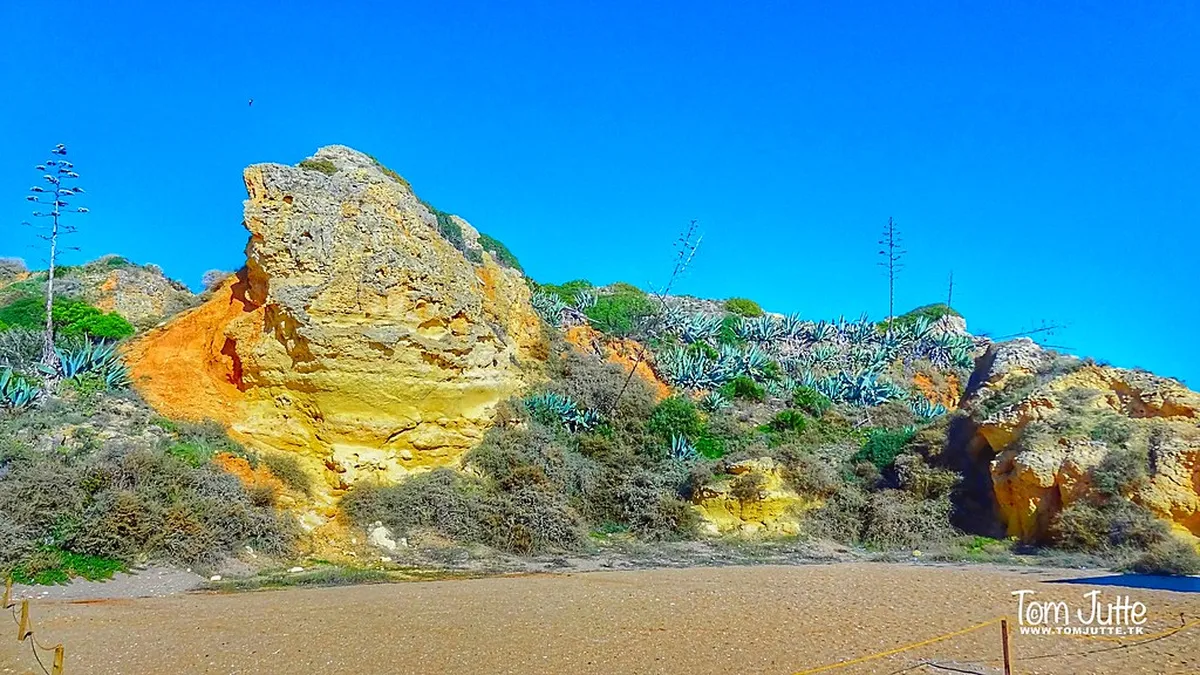
Then there are the cliffs. Praia Dona Ana, Praia do Camilo, and the sea stacks at Ponta da Piedade are some of the most photographed coastal landscapes in Europe — gold-orange sandstone, caves you can kayak into, and water that turns turquoise in midday light. A clifftop walk links most of them in under two hours. If beaches are the main reason you're coming to the Algarve, our best beaches in Lagos breakdown ranks the coves by crowd level, family-friendliness, and access difficulty.
Lagos has nightlife — student bars, live music, a few late venues near the marina — but it's a fraction of Albufeira's scene. That makes it the natural pick for couples, photographers, slow travellers, and families who want sand and atmosphere without thumping clubs at 2 a.m. Best for: cliffs, history, photography, couples, first-time Algarve visitors.
Lagos is roughly one hour from Faro airport by regional train, with several departures daily and a fare of around €8 each way — making it an easy car-free arrival from the airport.
Albufeira — Central Resort Town for Families and Party-Seekers
Albufeira is the Algarve cliché — and it earns the reputation honestly. Population around 25,000, it was the first fishing village on this coast to go full resort in the 1970s, and it has been the regional centre of mass tourism ever since. Faro airport is just 30 minutes away, which is why most package holidays land here.
The town splits cleanly in two. The Old Town (Cidade Velha) is whitewashed, cobbled, and pleasant in the morning before the cruise crowds arrive, with a main square that opens straight onto Praia do Túnel — sand reached through a tunnel cut into the cliff. Then there's "The Strip" (Avenida Sá Carneiro) in the Areias de São João district, a 1.5-km run of bars, clubs, karaoke rooms, and late-night food that is loud, cheap, and unapologetic. If a stag weekend is happening in the Algarve, it is happening here.
West of town, in Olhos de Água, Salgados, and the sprawling Galé area, you find a different Albufeira: family resorts with kids' clubs, calm sandy beaches that slope gently into the water, and big buffet hotels that suit travellers with young children. This is where parents who want pool slides and a five-minute walk to the sand should be looking — not the old town.
Beaches around Albufeira are long and sandy rather than dramatic. They're easier for swimming, easier for toddlers, and considerably less of a scramble than the cove beaches further west. Best for: families with young kids, party-seekers, package holidaymakers, travellers who want everything in one place.
Faro — The Capital, the Lagoon, and the Barrier Islands
Faro is the largest of the three at around 65,000 people, and yet it sees the smallest share of tourists. That sounds like a contradiction until you realise most arrivals get off the plane at Faro airport and immediately get on a transfer west to Albufeira or Lagos. The capital itself stays relatively quiet — and that is its biggest asset. For a detailed head-to-head, see our Faro vs Albufeira comparison.
The historic centre, the Cidade Velha, sits inside a ring of medieval walls reached through the Arco da Vila gate. It's compact, walkable, and noticeably more "everyday Portuguese" than its neighbours: locals doing their shopping, university students filling the cafés, fewer souvenir shops, and food prices that haven't been inflated by package tourism. Faro is also the best of the three for dinner — the seafood restaurants on the back streets near the cathedral are routinely the highest-rated in the region.
Faro itself doesn't have great beaches inside the city. What it has instead is the Ria Formosa, a vast lagoon of salt marshes, oyster beds, and barrier islands that shelter the coast. From Faro's harbour and from nearby Olhão you can take ferries (around 20–40 minutes) to Ilha Deserta, Ilha da Culatra, Ilha do Farol, and Ilha de Tavira — long, near-empty white-sand islands with almost no development. Ilha Deserta in particular is one of the wildest beaches in southern Europe.
Because Faro is the airport and the rail/bus hub, it's also the easiest base for day trips east to Tavira and Olhão, west to Albufeira, and inland to the hill towns. Best for: repeat visitors, foodies, travellers who want authentic Portugal, anyone whose trip is built around the barrier islands.
A week-long stay in Faro typically costs €150–250 less than the equivalent week in Lagos once hotel, food, and airport transfer savings are combined — making it the best-value base in the Algarve for 2026.
Lagos vs Albufeira vs Faro: Side-by-Side Comparison
Quick scan format — every category rated for a 2026 trip.

| Category | Lagos | Albufeira | Faro |
|---|---|---|---|
| Population | ~22,000 | ~25,000 | ~65,000 |
| Vibe | Historic, scenic, relaxed | Resort, lively, commercial | Local, quiet, authentic |
| Best beach style | Dramatic cliff coves | Long sandy resort beaches | Wild barrier islands (boat) |
| Nightlife | Moderate (bars + live music) | Heavy (clubs, "The Strip") | Light (student bars) |
| Family-friendly score | 8 / 10 | 9 / 10 (west of town) | 6 / 10 |
| Walkability | Excellent | Good (Old Town only) | Excellent |
| Faro airport transfer | ~1 hour by train | ~30 min by train | 10 min taxi |
| Avg 3★ hotel (2026) | €95–130 / night | €85–120 / night | €70–100 / night |
| Avg dinner for two (2026) | €55–75 | €50–70 | €40–55 |
| Closest airport | Faro (90 km, ~1 hr) | Faro (40 km, ~30 min) | Faro (8 km, 10 min) |
| Food scene | Good | Tourist-heavy | Best of the three |
| English spoken | Very widely | Universally | Widely |
For a wider look at the entire coastline rather than just these three towns, our best beaches in the Algarve guide ranks the top stretches of sand from Sagres to Tavira. For pairwise town comparisons, check out our dedicated Lagos vs Albufeira and Faro vs Lagos guides.
Which Algarve Town for Which Traveler
Solo travellers and couples: Lagos. The old town is the most romantic, the cliff walks are the most photogenic, and there's enough nightlife to fill an evening without it being a scene. Couples on a first Algarve trip almost always come back happy from Lagos.
Families with young kids (under 10): Albufeira, specifically the resort strip west of the old town in Olhos de Água or Galé. Calm sandy beaches, kids' clubs, big pools, and short transfers from the airport. Lagos is doable with kids but the cove beaches involve stairs and steep paths.
Travellers wanting authentic Portugal: Faro. You'll eat better, pay less, hear more Portuguese spoken in cafés, and be 25 minutes from one of the most beautiful lagoon systems in Europe. The trade-off is that Faro itself is not "pretty Algarve postcard" — it's a working city.
First-time Algarve visitors: Lagos. It delivers the version of the Algarve people picture before they book — gold cliffs, painted boats, narrow lanes, sunset cocktails — and it's still small enough to grasp in two days.
Returning visitors: Faro, for the islands. After you've done the cliffs and the cove beaches, the Ria Formosa lagoon is the obvious next chapter — and almost no first-time visitors get to it.
Party travellers, hen/stag groups: Albufeira. There is no second choice here. The Strip is the only place on the Algarve set up for a serious night out at scale.
Digital nomads and slow travellers: Lagos in winter, Faro in summer. Lagos is dead in January (in a good way) and full of co-working space. Faro stays moderately priced through July and August, when Lagos is overrun.
Which is Best for First-Time Algarve Visitors?
Lagos is the right base for a first Algarve trip in roughly 8 out of 10 cases. The reason is a specific combination almost no other town on this coast pulls off: a walkable, lived-in old town, headline cliff scenery within a 20-minute walk of the centre, and a regional train station that makes the rest of the Algarve a day-trip away.
The two exceptions are well-defined. Families travelling with kids under 10 should choose Albufeira's Galé or Olhos de Água resort strip — the cove beaches around Lagos involve stairs and steep clifftop paths that don't work with strollers or tired toddlers. And travellers on a tight budget who want to base in one place for a week should look at Faro: a 7-night stay in Faro typically lands €150–250 cheaper than the equivalent week in Lagos once airport transfer, hotel, and food costs are added up.
For everyone else — couples, solo travellers, photographers, food-curious visitors, and anyone whose mental image of the Algarve involves orange cliffs and turquoise water — Lagos delivers that picture without requiring a car. Our Is Lagos Portugal Worth Visiting? 7 Key Things to Know breakdown goes deeper on whether the town lives up to the Instagram version.
Day Trips Between Lagos, Albufeira, and Faro
One of the best things about the Algarve is how easy it is to base in one town and visit the others. The regional train (CP Linha do Algarve) runs the full coast and is cheap. As a rule of thumb, any one of the three towns is reachable from either of the other two as a half-day or full-day trip without renting a car.

- Lagos to Albufeira: ~45 minutes by train, around €5 each way. Several departures per day. Albufeira's train station is 6 km from the old town — take a local bus or a €10 taxi.
- Albufeira to Faro: ~30 minutes by train, around €4 each way. Hourly service. Faro's station is in the centre, 5 minutes from the old town.
- Lagos to Faro: ~1.5 hours by train, around €8 each way. Direct, no changes. Easy as a long day trip if you're staying in Lagos and want a Faro + Ilha Deserta day.
- Driving: The A22 motorway connects all three. Lagos–Faro is about 1 hour by car (faster than the train); Albufeira sits in the middle at 35 minutes either way. Tolls apply.
Day-trip feasibility verdicts:
- Lagos base → Faro + Ilha Deserta day: Doable but tight. Catch the 8:00 a.m. train, ferry to Ilha Deserta by 11, late lunch in Faro old town, return train by 5 p.m. Better as an overnight if you want to see Faro properly.
- Lagos base → Albufeira beach day: Easy half-day. Train + bus, four hours on Praia da Oura or Praia dos Pescadores, back for sunset in Lagos.
- Faro base → Lagos cliffs day: Recommended. The 1.5-hour train each way is a fair price for seeing Ponta da Piedade and the cove walk in a single day.
- Albufeira base → Faro islands day: Best of the day-trip combos. 30 minutes to Faro by train, immediate ferry to the lagoon, a noticeably different landscape from anything you've seen in Albufeira.
Practical takeaway: pick one base and use trains for the others. Trying to split a one-week trip across two towns wastes a half-day per move — the unpacking, the transfer, the re-orientation. One base, two day trips, beats two bases.
Where to Go for What — Quick Verdicts
- Best beaches overall: Tied — but for different things. Lagos wins for drama, Albufeira for swim-friendly sand, Faro (via the islands) for emptiness.
- Best old town: Lagos. It's the most intact, the most walkable, and the most photogenic.
- Best nightlife: Albufeira, by a wide margin. Nothing else in the region is even close.
- Best for islands and lagoons: Faro. Ria Formosa is the entire reason to base east.
- Best food scene: Faro. Less tourist-trap pricing, more locals eating in the same restaurants you are, and the seafood comes off boats moored 200 metres away.
- Best weather: Effectively identical. The Algarve coast averages around 300 days of sun a year, and Lagos to Faro is only 90 km — temperature differences across the three towns are usually under 2°C on any given day.
- Cheapest base: Faro, both for hotels and food. Albufeira can be cheap if you book a package; Lagos is the most expensive for walk-up bookings in summer.
- Easiest with no car: Lagos and Faro tie. Both have walkable old towns and rail stations in the centre. Albufeira's old town is 6 km from its train station, which is a real friction point for car-free travellers.
Frequently Asked Questions
Is Lagos better than Albufeira?
For most travellers, yes — Lagos has the better old town, the more dramatic beaches, and a more relaxed atmosphere. Albufeira is better only if you specifically want package-resort convenience, late-night clubs, or a family resort with a kids' club. For a first Algarve trip with no specific party or kid-club needs, Lagos is the stronger pick. See our Lagos Portugal complete guide for the full case.
Should I stay in Lagos or Faro?
Stay in Lagos if it's your first Algarve trip and you want cliff beaches and a postcard old town. Stay in Faro if you've been to the Algarve before, if your trip is built around the Ria Formosa barrier islands, or if you want a quieter, more authentic Portuguese city with the best food scene of the three. Faro is also the right pick if you're flying in late and want to skip the airport transfer.
Where is the best base for the Algarve?
Lagos is the best all-round base for a 5–7 day Algarve trip. It combines a real old town, the most photogenic beaches in the region, easy train access to the rest of the coast, and a moderate (not overwhelming) tourist density. The only travellers who should base elsewhere are families wanting a beach resort (Albufeira) and repeat visitors prioritising the lagoon (Faro).
Is Faro a boring base?
No — but it's quieter. Faro is "boring" only by the standards of someone expecting Albufeira's strip or Lagos's marina bars. What it offers instead is excellent food, an intact walled old town, daily ferries to wild barrier-island beaches, and prices that are 15–25% lower than the resort towns. For travellers who want substance over scene, Faro is actively the best of the three.
Which is cheapest — Lagos, Albufeira, or Faro?
Faro is the cheapest in 2026 for independent travellers booking direct: hotels run roughly €70–100 a night for a 3-star, restaurant meals about 15% lower than Lagos, and you don't need to pay for an airport transfer. Albufeira can be cheaper if you book a package holiday with flights, but walk-up prices are similar to Lagos. Lagos is the most expensive of the three in peak summer (July–August), when 3-star hotels cross €130 a night.
Can I visit Lagos, Albufeira, and Faro in one trip?
Yes — comfortably, in 5–7 days, basing yourself in one town and using the regional train for day trips to the other two. The recommended pattern is to base in Lagos (best old town + cliff beaches), spend two full days exploring Lagos and Ponta da Piedade, take a day trip to Faro and Ilha Deserta, and a half-day to Albufeira if nightlife or a long sandy beach is on the wishlist. Splitting accommodation across two towns is rarely worth the half-day you lose to each transfer.
How many days do I need in the Algarve?
Five to seven days is the sweet spot for a first Algarve trip. Three days only covers one town and one day trip; two weeks lets you add the eastern lagoon, the western surf coast at Sagres, and inland hill towns like Monchique. For a Lagos-based week, see our Lagos 3-day itinerary and our broader day trips from Lagos guide for ideas to extend a stay.