8 Best Cascais Museums to Visit (2026)
Explore the best Cascais museums in the Bairro dos Museus. From Castro Guimarães to Paula Rego, discover art, maritime history, and lighthouses in Portugal.
On this page
8 Best Cascais Museums to Visit (2026)
Cascais punches well above its weight for culture. Within a compact Museum Quarter called the Bairro dos Museus, you can move between a Gothic Revival palace, a Pritzker-winning contemporary gallery, an interactive town history museum, and an active lighthouse — all on foot, most of them free. This guide covers every major site in the quarter with current hours, pricing, and the specific artifacts worth seeking out.
The town's cultural depth traces back to its transformation from fishing village to royal summer retreat in the late 19th century. Portuguese aristocracy and wealthy foreigners built grand residences here, and many of those collections later became public museums. The result is an unusual concentration of high-quality cultural spaces in a town of roughly 35,000 people — a ratio that puts it ahead of many regional Portuguese cities.
The Bairro dos Museus: How the Museum Quarter Works
The Bairro dos Museus is not just a marketing label. It is an integrated management structure that groups twelve cultural spaces under the Cascais Municipality umbrella. The practical benefit for visitors is a single combined ticket that covers multiple sites at a discounted rate, available at the entrance of any participating venue. Most of the sites cluster around the Jardim Marechal Carmona and the southern seafront — a walkable circuit that takes about three hours at a relaxed pace.
Entry pricing across the quarter is low. Several municipal museums charge nothing at all in 2026. The Cascais tourism overview outlines how these cultural venues fit into the broader visitor experience, but for museum-focused visits the quarter is a self-contained day. Check the official Bairro dos Museus site before you go, as individual venues update their hours around Portuguese public holidays including 1 January, Easter Sunday, 1 May, 13 June, and 25 December.
One practical note: nearly all municipal museums in Cascais are closed on Mondays. Plan your cultural day for Tuesday through Sunday. The gardens surrounding most sites remain open daily, so even on a Monday you can walk the grounds of Jardim Marechal Carmona and admire the exteriors.
Castro Guimarães Museum: Art and Architecture
The Castro Guimarães Museum is the centerpiece of the Bairro dos Museus and the most architecturally striking building in Cascais. The exterior blends mock Gothic towers, classical Portuguese stonework, and Arabian arched details into a style that looks centuries older than its 1900 construction date. It was commissioned by Jorge O'Neil, an Irish tobacco millionaire and close friend of King Carlos I of Portugal, who called the original structure Torre de São Sebastião.
O'Neil's business empire collapsed in 1912. He sold the estate to Count Castro de Guimarães, a successful banker who redecorated the interior and added the hand-painted tile panels visible throughout. The Count and Countess had no children; in their will they left the entire estate to the people of Cascais. The museum opened in 1930, three years after their deaths, and has operated as a public institution ever since.
Inside, the building functions less like a conventional gallery and more like a restored aristocratic home. Every room retains its original Indo-Portuguese furniture, ornate ceilings, and decorative objects from the Counts' personal collection. The standout piece is in the library: a 16th-century illuminated manuscript titled "Chronicles of King Alfonso Henriques," which contains what scholars consider the first known colour representation of Lisbon, including an early image of the Castelo de São Jorge. The music room, lined with classic azulejo tiles and an elaborately painted ceiling, is the most photographed interior. For detailed information and current visiting hours, see the Cascais Municipality museums guide. Entry to Castro Guimarães is free in 2026. The museum opens Tuesday to Sunday, 10:00 to 17:00.
Entry to the Castro Guimarães Museum is free in 2026, and the museum opens Tuesday to Sunday from 10:00 to 17:00. The peacocks roaming the surrounding gardens are a regular surprise for first-time visitors.
Casa das Histórias Paula Rego: Contemporary Masterpieces
Opened in September 2009, the Casa das Histórias Paula Rego was built specifically to house the work of one of Portugal's most internationally recognized artists. Paula Rego (1935–2022) was a painter and printmaker widely celebrated for her expressive figurative work and feminist themes. The building was designed by Eduardo Souto de Moura, who won the Pritzker Architecture Prize in 2011 — two years after this museum opened, confirming what visitors could already see. The structure's twin rust-red pyramid towers are instantly recognizable and work particularly well photographed in late afternoon when the warm light intensifies the terracotta pigment.
The 750 m² of exhibition space holds Paula Rego's complete engraving donation to the Cascais municipality, a large body of drawings previously unseen before the museum's opening, and a rotating selection of paintings from her five-decade career. The collection also includes work by her late husband Victor Willing, an artist and art critic who appears as a subject in some of Rego's most powerful paintings from the 1980s and 1990s. Temporary exhibitions and a parallel programme of talks, film screenings, and educational workshops run throughout the year.
The museum also contains a cafe, garden terrace, and a well-stocked shop selling original merchandise and art books. Admission is €5 for adults. The cafe terrace is a good midday stop even if you visit the museum in the morning — it stays open to non-ticket holders. Opening hours are Tuesday to Sunday, 10:00 to 18:00, with closures on the same Portuguese public holidays as the rest of the quarter.
Cascais Town Museum (Museu da Vila): Local History from Neolithic to the 20th Century
The Museu da Vila is the clearest way to understand the full arc of Cascais history before exploring the other sites. Divided into five display areas, the museum covers the region from Neolithic settlement through to the early 20th century using state-of-the-art interactive technology rather than static display cases. The multimedia format makes this one of the most accessible museums in the quarter for visitors who are new to Portuguese history.
The collection includes some of the most significant archaeological relics from the municipality, among them Votive Sandals — ceremonial footwear recovered from Neolithic-era burial sites along the Estoril coast. These objects appear in almost no other public collection and provide a tangible link to the pre-Roman communities who first settled this stretch of the Atlantic shore. The exhibits are logically sequenced, so you move through time as you move through the rooms, arriving at the fishing-village-to-royal-retreat transformation by the final section.
A digital seagull guide accompanies visitors through the museum, designed specifically to engage younger visitors while conveying the same historical content. Admission is free. The museum is located in the Town Hall square, a few minutes' walk inland from the marina. Visit this one first if you are new to Cascais — the context makes every other site more meaningful.
Farol de Santa Marta: Lighthouse and Sea Views
The Farol de Santa Marta is an active lighthouse that has guided ships through the approaches to the Tagus since the mid-19th century. The lighthouse complex includes a small dedicated museum explaining the history of coastal signaling, Portuguese maritime technology, and the daily life of lighthouse keepers across different eras. The building sits on the southern tip of the Cascais waterfront near the Santa Marta Lighthouse promontory, making it a natural endpoint for a seafront walk from the marina.
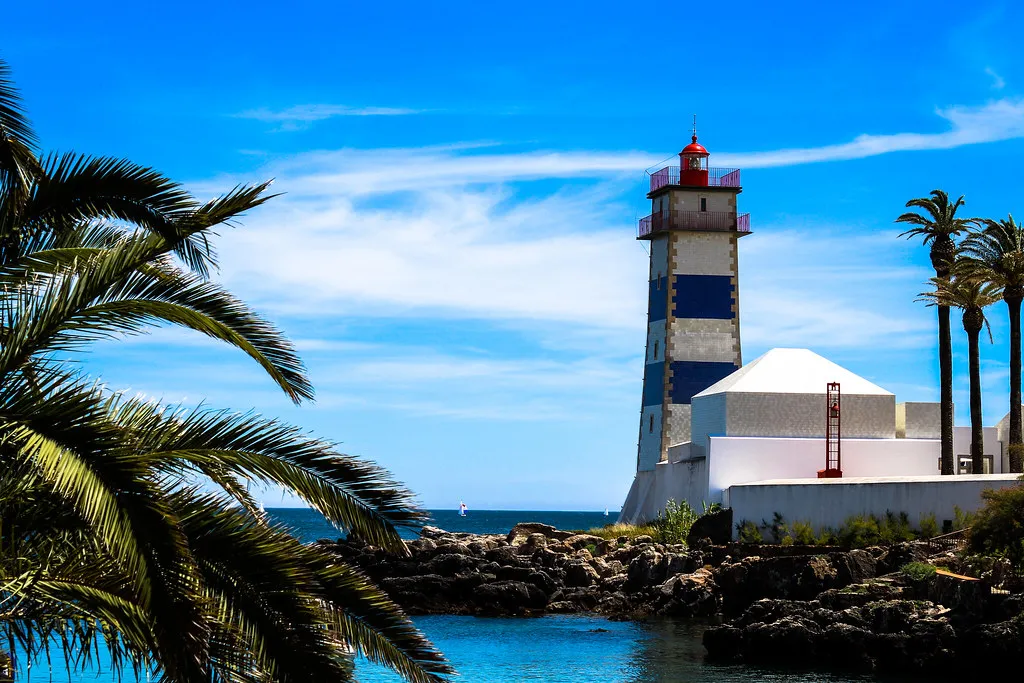
The adjacent Casa de Santa Maria shares the same compound. This former private residence is famous for its Portuguese tile murals and painted wooden ceilings, with a balcony that once served as an observation point for royalty during their summer stays. The two buildings can be visited back-to-back in under an hour. Combined entry covers both for €3 per adult. The panoramic view from the lighthouse platform takes in the full Atlantic horizon and the marina below — one of the better viewpoints in town without climbing a hill.
Museu do Mar Rei D. Carlos: Maritime Heritage
The Museu do Mar Rei D. Carlos occupies the former Sporting Club of Cascais and focuses on the town's identity as a working fishing port — a side of Cascais that is easy to overlook against the backdrop of aristocratic palaces. The museum takes its name from King Carlos I, who was an accomplished oceanographer and used Cascais as a base for marine research expeditions in the late 19th century. His scientific work is one of the more surprising threads in the museum's narrative.
The collection includes traditional fishing equipment, model ships scaled to historical accuracy, and costumes worn by Cascais fishermen across different periods. There is also material on the sardine canning industry that once made the town economically significant beyond its role as a royal retreat. Entry is €3, and the museum opens Tuesday to Sunday, 10:00 to 17:00. This is a smaller and more traditional display than the Town Museum, but it provides genuine working-class context that the more aristocratic sites in the quarter do not cover.
Cidadela Art District: Contemporary Art Inside a 16th-Century Fort
The Cidadela de Cascais is a working fortress with a history stretching back to the 1500s. In recent years, a portion of the fortified complex has been converted into an open-studio art district where contemporary artists work and exhibit within the historic stone walls. Wandering the fortress grounds is free, and several gallery spaces inside are also free to enter. Specific exhibitions within the palace section may require a paid ticket — check current listings before visiting.
The Cidadela sits on the promontory at the western edge of the town centre, about a ten-minute walk from the Jardim Marechal Carmona. For a deeper look at the fortress history, the Citadel of Cascais: The Ultimate Visitor Guide covers the military architecture and the palace wing in detail. As a museum-day stop, the Cidadela works well as a late-afternoon add-on after the main Bairro dos Museus circuit — the late light on the stone walls is worth timing correctly.
Suggested Walking Route Through the Museum Quarter
None of the standard Cascais guides publish an efficient walking sequence for the Museum Quarter, so here is one that avoids backtracking. Start at the Cascais train station (the Lisbon line from Cais do Sodré, roughly 40 minutes, runs every 20 minutes). Walk five minutes south to the Museu da Vila in the Town Hall square — start here for historical context. From there, walk seven minutes east through the Jardim Marechal Carmona to Castro Guimarães, which sits on the park's southern edge near the marina.
After Castro Guimarães, follow the seafront west for about twelve minutes to reach the Farol de Santa Marta and Casa de Santa Maria cluster on the promontory. Then walk back east along Rua Rei Humberto II de Itália, passing the marina, to reach the Museu do Mar Rei D. Carlos. The Casa das Histórias Paula Rego sits slightly inland from the town centre on Rua Barbosa do Bocage — allow ten minutes on foot from the marina or a short taxi from the train station if you prefer. End the day at the Cidadela Art District, which faces the bay at the western edge of the old town.
The full circuit runs roughly 3.5 km on flat terrain. Done at a museum-going pace with a lunch stop, it fills a comfortable six to seven hours. The Cascais Old Town Travel Guide covers the streets between these sites in more detail if you want to combine the museum circuit with the historic centre.
Planning Your Visit: Tickets, Free Entry, and Practical Details
The key pricing fact that many online sources get wrong in 2026: Castro Guimarães and the Museu da Vila are free to enter as municipal institutions. The Bairro dos Museus combined pass makes most sense if you are paying for Casa das Histórias (€5), the Santa Marta lighthouse complex (€3), and the Museu do Mar (€3) — that combination already totals €11, and the pass typically undercuts this. Buy the pass at any participating venue entrance rather than online, since no booking fee applies at the door.
All municipal museums close on Mondays. The Casa das Histórias also closes on the major Portuguese public holidays listed on its official website. The Cidadela grounds are accessible daily. If you are arriving from Lisbon, the train is the simplest option — the Cascais line from Cais do Sodré runs every 20 minutes and costs around €2.40 each way. From the station, every museum in the Bairro dos Museus is reachable on foot without needing a taxi or bus.
Visiting on a weekday morning avoids the weekend crowds that gather in the Jardim Marechal Carmona. The museums themselves rarely feel crowded — Cascais draws far fewer museum visitors than central Lisbon, which means you often have rooms to yourself. The peacocks that roam the Castro Guimarães gardens are a regular surprise for first-time visitors and a reliable hit with children.
Almost all municipal museums in Cascais close on Mondays, as well as on major Portuguese public holidays including 1 January, Easter Sunday, 1 May, 13 June, and 25 December. Plan your visit for Tuesday through Sunday and check each museum's official site before going.
Frequently Asked Questions
Is there a combined ticket for Cascais museums?
Yes, the Bairro dos Museus pass allows entry to multiple sites for a discounted flat rate. You can purchase this pass at the entrance of any major museum in the quarter. It offers excellent value if you plan to visit at least three locations.
Are Cascais museums open on Mondays?
Most municipal museums in Cascais are closed on Mondays for maintenance. You should plan your cultural visits for Tuesday through Sunday to ensure all sites are accessible. Always check official websites for holiday-specific closures or special events.
Which Cascais museum is best for families?
The Museu da Vila is the top choice for families due to its interactive multimedia displays. Children enjoy the digital seagull guide that explains the town's history in an engaging way. The nearby Jardim Marechal Carmona also provides space for kids to run around.
Cascais museums offer a surprisingly deep dive into the history and art of the Portuguese coast. The Bairro dos Museus initiative makes exploring these treasures simple, affordable, and highly rewarding for any visitor. From the Gothic towers of Castro Guimarães to the modern pyramids of Paula Rego, the variety is truly impressive. Make sure to include at least two or three of these stops in your next trip to the Estoril coast. For related Cascais deep-dives, see our Cascais Old Town walking route and Santa Marta Lighthouse guides.