Algar Do Carvao Terceira: The Ultimate Visitor's Guide
Plan your visit to Algar do Carvão on Terceira Island. Includes ticket prices, opening hours, what to wear, and the latest 2024/2025 construction updates.
On this page
Algar Do Carvao Terceira: Complete Visitor's Guide
The Algar do Carvão on Terceira Island is one of the rarest geological sites in Europe — a vertical volcanic chimney you can walk inside, descending 90 metres to a clear rainwater lagoon at its base. Formed over 2,000 years ago, it is one of the few unobstructed volcanic vents anywhere in the world open to visitors.
Important for 2026 visitors: The cave has been closed since October 2024 due to the construction of the new CAVE — Azorean Center for Volcano-Speleology visitor complex. Construction runs for approximately 18 months from that date. The Montanheiros Association has indicated it hopes to offer some form of restricted visitation during the works, but this remains uncertain. Before any trip, check the official Montanheiros site for the current access status. Nearby Gruta do Natal, managed by the same association, remains open as an alternative.
This guide covers everything you need for a successful visit once the cave reopens: tickets, opening hours, what to wear, how to get there, nearby attractions, and the guided-tour landscape. It also explains what makes this chimney geologically distinct from the lava tubes nearby.
Algar do Carvão has been closed since October 2024 due to construction of the new CAVE — Azorean Center for Volcano-Speleology visitor complex. Construction is expected to run approximately 18 months. Check the official Montanheiros site for current access status before travelling.
Algar do Carvão: History and Geology
The chimney's age is pinned to approximately 2,148 years (±115 years) by a fossil found in the carbonised vegetation layer from its final eruption phase. The formation began with the large Pico Alto eruption to the north of the Guilherme Moniz volcanic apparatus. Those lavas poured across a wide area and left a trachytic layer that acted as a natural barrier. A later, basaltic eruption then broke through that barrier from below, forming the zone of the lagoon and the two vaults above it before the magma drained back, leaving the open chimney we see today.
The first recorded descent into Algar do Carvão took place in 1893. Organised descents only began in 1963, led by a group of enthusiasts who later formed the Montanheiros Association. To make the site accessible at scale — the original rope-descent method took a full day to move six to eight people — the Montanheiros excavated a 44-metre access tunnel into the side of the chimney. That tunnel is what visitors walk through today before reaching the main chamber.
The site sits within the Azores Geopark network and was a finalist in the Seven Natural Wonders of Portugal competition. It has even hosted live concerts, Eucharistic celebrations, and at least one wedding inside the main vault. Its scientific value comes from both its age and the rare combination of silica stalactites, basalt walls, and a living freshwater lagoon in a single accessible space.
Volcanic Chimney vs Lava Tube: What Is the Difference?
Most visitors arrive on Terceira planning to see both Algar do Carvão and the nearby Gruta do Natal. The two caves look and feel completely different, and understanding why helps you appreciate each on its own terms.
Algar do Carvão is a volcanic chimney — the central vent of a former volcano. It formed vertically when magma drained back into the earth, collapsing the conduit and leaving a deep, open pit. The structure is dominated by height: the main vault rises to roughly 45 metres and the chimney descends 90 metres to the lagoon. You spend most of the visit looking up or down, not forward.
Gruta do Natal is a lava tube — a horizontal tunnel formed when the outer crust of a lava flow solidified while molten rock continued to flow through the interior and eventually drained out. The Natal tube is nearly 700 metres long, mostly walkable with high ceilings and a relatively flat floor. Its signage about lava types is one of its advantages over Algar, which has almost no interpretive material inside.
The combo ticket (€15) covers both sites and is almost always worth buying. Seeing both in the same afternoon takes about two hours total and gives you the clearest possible picture of how different volcanic processes create entirely different underground landscapes.
What to Expect Inside the Volcanic Chimney
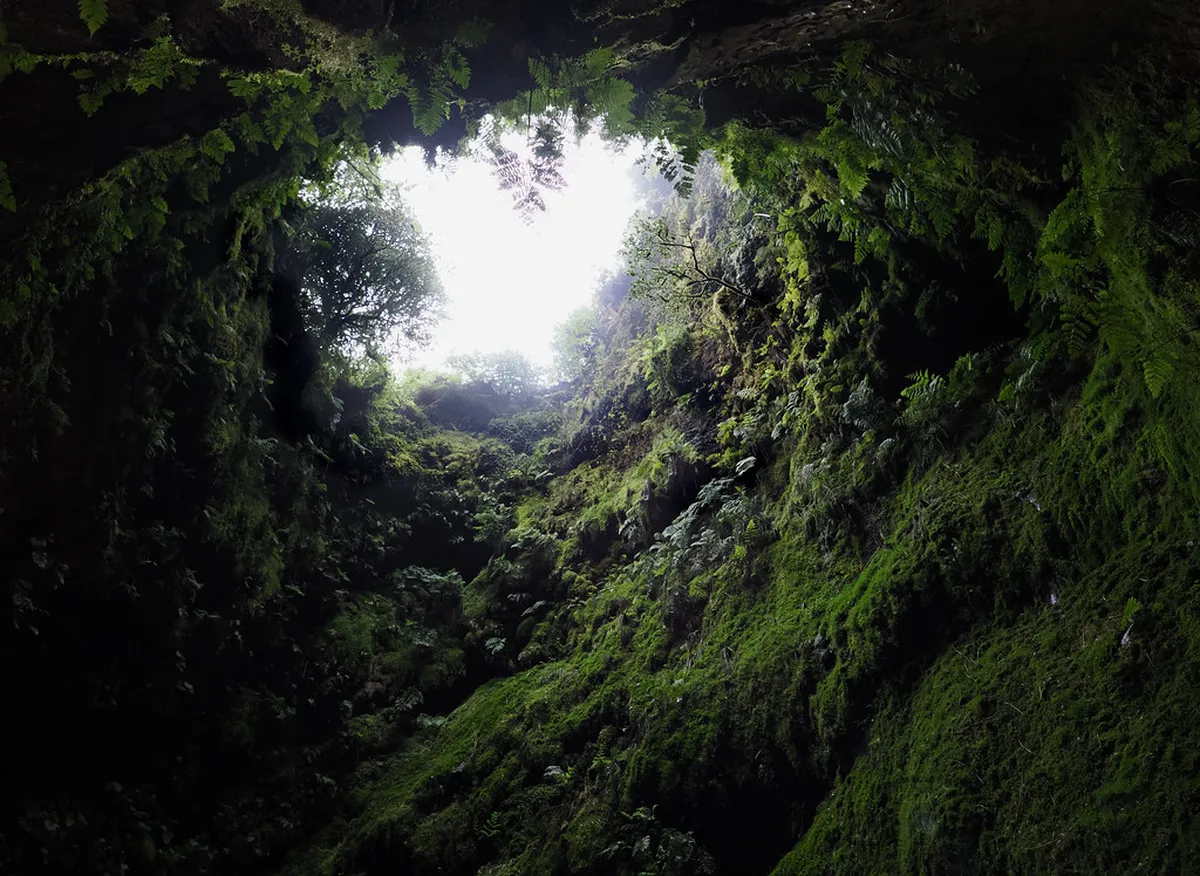
Entry is through the 44-metre access tunnel, a narrow, low passage with geology posters on the walls — these are the only interpretive panels you will encounter during a self-guided visit. Once you emerge into the main chamber, the scale of the interior vault stops most visitors in their tracks. Light falls from the moss-edged opening high above; spotlights illuminate the walls, making torches unnecessary.
The descent involves more than 300 steps arranged across multiple balconies that spiral down the chimney. The floor is concrete and well maintained, but it is always wet. Water drips constantly from the ceiling — what the Portuguese call the cave perpetually "raining." The handrails are solid throughout. Most fit adults find the descent straightforward; the upward return is where legs begin to tire.
At the bottom, 90 metres below the entrance, sits the lagoon. It is filled exclusively by rainwater filtering through the rock above. Its depth and diameter vary dramatically by season: after a wet winter it can reach 15 metres deep and 400 square metres in area; after a dry summer it may be almost gone. The water is crystal clear. The silica stalactites above the lagoon — white, almost translucent formations — are the site's most photographed feature and are extremely fragile. Do not touch them.
One logistical note that surprises many visitors: there are no audio guides and no interpretation panels inside the main chamber itself. If understanding the geology matters to you, this is a compelling reason to book a guided tour rather than visiting independently.
Is it Worth Visiting Algar do Carvão?
For geology enthusiasts or anyone chasing genuinely rare experiences, yes — without reservation. Standing inside an unobstructed volcanic chimney is not something you can do almost anywhere else in the world. The lagoon at the base, the silica formations, and the sheer geometry of the space are unlike anything else on Terceira or in the wider 12 Best Things to Do in Terceira Azores list.
The caveat is context. If you visit independently for €10 and spend 30 minutes taking photos with no geological background, you may leave underwhelmed. The site has no cafe, no exhibition, and almost no on-site interpretation. That gap is exactly why the new CAVE visitor complex is being built. Until it opens, the honest advice is this: book a guided tour, especially the private geologist-led option, if you want to understand what you are actually looking at.
Families with children aged four and over generally find the experience exciting, provided the children are comfortable in enclosed or dimly lit spaces. The cave is not appropriate for wheelchair users or visitors with significant mobility difficulties — there is no lift, and the only way in and out involves the full staircase.
Practical Information: Tickets, Hours, and What to Wear
Tickets are sold only at the entrance kiosk — there is no online booking system. Capacity is limited, so arriving during peak hours in summer can mean a wait. The single ticket costs €10 for Algar do Carvão alone. The combined ticket costs €15 and adds entry to Gruta do Natal, which is a short drive away and is recommended as a pairing.
Normal opening hours, when the cave is operating, follow a seasonal schedule. From 1 January to 31 March: Tuesdays, Wednesdays, Fridays, and Saturdays, 14:30–17:00. From 1 April to 31 May: every day, 14:30–17:00. From 1 June to 30 September: every day, 14:00–18:00. From 1 October to 31 December: Tuesdays, Wednesdays, Fridays, and Saturdays, 14:30–17:00. The cave is also closed on New Year's Day, Carnival Tuesday, Easter Sunday, 1 December, Christmas Eve, Christmas Day, and New Year's Eve. Always verify the current schedule on the official Montanheiros page before travelling, especially given the ongoing 2024–2026 construction period.
The interior stays at a constant 14°C with very high humidity. Bring a waterproof jacket — water drips from the ceiling throughout the visit. Wear shoes with solid grip; the steps are always wet and smooth-soled footwear is dangerous. Forget flip-flops or heeled shoes entirely. Layers are useful because you will warm up on the climb back out. Bathrooms are available at the entrance facility.
Arrive at opening time (14:00 or 14:30 depending on season) to avoid both the parking crunch and tour-bus crowds inside. The combo ticket at €15 covers both Algar do Carvão and Gruta do Natal — almost always worth buying if you plan to visit both sites in the same afternoon.
Guided Tours: Why They Change the Experience
The absence of on-site interpretation inside Algar do Carvão is one of the most consistent complaints from independent visitors. A guided tour addresses this completely — a knowledgeable guide explains the volcanic processes that created each feature, points out formations you would otherwise walk past, and provides the context that makes the geology legible.
Three main tour formats operate on Terceira. The Terceira Island Caves and Craters Tour (approximately €69 per person, 4 hours) is the only option whose price already includes the cave tickets plus transport with hotel pick-up from Angra do Heroísmo or Praia da Vitória. It also covers Gruta do Natal and Furnas do Enxofre. The Private Caves Tour with a Geologist (approximately €55 per person, 5 hours) pairs you with a specialist who explains the geology in accessible terms — the most educational option available on the island for this subject. The Algar do Carvão Lava Caves Tour (approximately €45 per person, 3 hours) is the most popular and most affordable, but note that cave entry tickets are not included in that price, so the real cost is higher than it first appears.
If the cave is operating under restricted-access conditions during the construction period, guided tours may be the only pathway to secure entry. Check with operators directly for current availability, as group sizes and access protocols may be adjusted.
How to Get to Algar do Carvão
The cave is located approximately 12 km north of Angra do Heroísmo, in the island's interior highlands. The drive from Angra takes around 15 to 20 minutes. Follow signs for the 'Interior' or specifically for 'Algar do Carvão' from the main EN3-1A road. The roads are paved but become narrow and winding as you gain altitude — drive carefully, especially after rain.
There is no public transport to the site. The practical options are: rent a car (the most flexible approach), take a taxi from Angra or Praia da Vitória (round trips can be expensive, so agree a price in advance), or book one of the guided tours listed above (the all-inclusive tours include transport). Parking is available at the entrance, but it fills quickly during peak summer afternoons. Arriving at opening time — 14:00 or 14:30 depending on the season — is the best way to avoid both the parking crunch and the tour-bus crowds inside.
If you are still planning your broader trip to the islands, the How To Get To Azores Travel Guide guide covers inter-island ferry and flight logistics in detail.
Hiking Trails That Start Near the Cave
The area around Algar do Carvão is one of the best walking zones on Terceira. The PRC10 TER trail — Algar do Carvão to Furnas do Enxofre — begins right at the cave car park. It is a moderate 2h30 loop through the island's central caldeira zone, passing the sulfur vents at Furnas do Enxofre along the way. This is arguably one of the strongest two-for-one options on the island: combine the trail in the morning with a self-guided cave visit in the afternoon (cave hours start at 14:00 or 14:30).
Near Gruta do Natal, which is a short drive from Algar, the Trilho dos Mistérios Negros begins. This is the most iconic trail on Terceira — 5 km across a technically demanding lava field — but it carries a genuine difficulty rating and should not be attempted alone or without proper footwear. A third option, the PRC06 TER Rocha do Chambre, starts nearby and covers 9 km at a more accessible gradient.
Any of these trails takes roughly 2h30 to 3h and fits comfortably into a day that also includes the cave and the nearby geothermal field. This area of central Terceira repays an unhurried full-day approach rather than a rushed half-day stop.
Best Things to Do Near Algar do Carvão
Gruta do Natal is the obvious first pairing. The 700-metre lava tube is a short drive from the chimney, has its own interpretive signage, and is easy to walk for most visitors. Unlike Algar, it gives you a horizontal experience through flowing-lava geology. The combo ticket covers both sites. Even when Algar do Carvão is closed for construction, Gruta do Natal remains open and worth visiting on its own. For detailed information on all geotourism attractions across the Azores, visit the Visit Azores official website.
Furnas do Enxofre, just a few minutes from the cave by car, is a fumarole field where volcanic gases vent through wooden-boardwalk paths set among otherworldly vegetation. The sulfur smell and steam columns are unmissable. If you have been to the Furnas valley on São Miguel the spectacle here will feel smaller in scale, but the surrounding forest walk makes it worthwhile regardless.
Lagoa das Patas is a calm lagoon about 15 minutes from the cave by car, surrounded by forest and equipped with picnic tables and toilets — a natural stop for lunch between cave visits. After a morning of stairs and sulfur, it is a genuinely restorative place to sit. Consider the Santa Bárbara Viewpoint, a further 25 minutes west, which offers one of the widest panoramas across the whole island and is conveniently on the route back toward the coast.
If you have extra time in the afternoon, Biscoitos Terceira Azores on the north coast has natural lava rock swimming pools and old Verdelho wine vineyards. It offers a complete change of scene after a morning of volcanic geology and makes for a satisfying end to a full island day.
Photography Inside the Cave
Low light and constant moisture make this one of the more technically demanding cave environments to photograph. The spotlights are warm-toned and positioned to illuminate the walls rather than the floor, which means auto-exposure will often underexpose the lagoon. Manual or semi-manual modes give far more consistent results.

Avoid flash entirely — it flattens the texture of the silica formations and kills the sense of depth. Long exposures braced against a railing or on a small gorilla-pod tripod work well for the lagoon reflections. A wide-angle lens (16–24mm equivalent) captures the vault's scale in a single frame; longer focal lengths are better for close-up details of the stalactites. The chimney opening above the lagoon, when the weather is bright, creates a natural light source that can be used as a dramatic backlight for shots looking upward.
The interior is consistently wet, so protect your gear with a rain sleeve or a plastic bag with a lens hole. A microfibre cloth for wiping the front element is useful. The condensation on the lens when you first enter from warmer outside air can take a few minutes to clear.
Frequently Asked Questions
Is Algar do Carvão currently open during construction?
Yes, the cave remains open to visitors while the new visitor center is being built. Construction started in late 2024 and is expected to finish in 2026. Access might involve temporary paths, so check the official site for daily updates before you go.
How much time should I plan for the visit?
Most visitors spend between 45 and 60 minutes inside the cave itself. If you plan to visit the nearby sulfur vents and lava tubes, allow for a full morning or afternoon. This gives you enough time to enjoy the scenery without rushing.
Is it appropriate for people with mobility issues?
The cave involves descending and ascending over 300 stairs to reach the bottom lagoon. This can be challenging for those with significant mobility issues or breathing difficulties. There is no elevator available inside this natural volcanic structure.
What is the best clothing to wear inside the cave?
Wear a waterproof jacket and sturdy shoes with good traction for your visit. The interior stays at a constant 14°C and is very humid with frequent water drips. Layers are helpful as you will warm up while climbing back to the entrance. Budget travelers should bring their own gear to avoid buying expensive replacements.
Algar do Carvão is a geological rarity — a walkable volcanic chimney with a living lagoon at its base, formed over two millennia ago and preserved through the sustained effort of the Montanheiros Association. The new CAVE visitor complex, when complete, will add the interpretive infrastructure this site has always deserved.
Until it reopens fully, the best preparation is staying current with the official Montanheiros page and booking a guided tour rather than arriving on spec. A geologist-led private tour gives you a fundamentally different experience from a solo visit — the geology becomes a story rather than a backdrop. Pair the cave with Gruta do Natal, the PRC10 hiking trail, and Furnas do Enxofre to make the most of one of the most volcanically active landscapes in Europe.
Check the 10 Essential Tips for the Best Time to Visit the Azores to align your trip with the cave's seasonal opening hours. Bring the right clothing, leave at opening time, and give yourself a full day in the interior. Terceira's volcanic heart rewards exactly that kind of unhurried approach.