Best Beaches in the Algarve: 17 Top Beaches for 2026 (Western, Central & Eastern)
The Algarve has 200 km of coastline and 100+ named beaches. This 2026 guide covers 17 top beaches grouped by Western, Central, and Eastern Algarve — with how to get there, parking, facilities, vibe, and best season for each.
On this page
The Algarve is Portugal's southern coast, a 200 km stretch of golden cliffs, hidden coves, lagoon-fed barrier islands, and Atlantic surf points that consistently ranks among Europe's top beach destinations. With more than 100 named beaches and 88 active Blue Flags awarded for the 2026 season (Portugal ranked third worldwide for Blue Flags in 2025), the harder question isn't whether the Algarve has a great beach — it's which one suits your trip.
The wild Atlantic surf beaches of Sagres look nothing like the calm lagoon beaches of Tavira, and the dramatic sandstone coves of Lagoa are a different planet from the long resort sands near Albufeira. This 2026 guide covers 17 top beaches across the Western, Central, and Eastern Algarve — with how to get there, parking, facilities, vibe, and the best season for each.
For a deeper look at the most popular base town, see our Lagos Portugal complete guide; if you are still choosing between bases, our Lagos vs Albufeira vs Faro: Where to Stay in the Algarve in 2026 comparison breaks down each option in detail.
How the Algarve Coast Is Divided (and How to Use This Guide)
The Algarve splits naturally into three distinct coastal regions, each with its own character:
- Western Algarve (Sagres → Lagos → Burgau): Cliff-and-cove zone with dramatic sandstone formations, sea stacks, smaller beaches, cooler water (17–20°C in summer), and bigger Atlantic swell. Best for photographers, surfers, and "wow" scenery.
- Central Algarve (Carvoeiro → Albufeira → Vilamoura): Mixes iconic cove beaches like Marinha with longer sandy stretches like Falésia. Most resort-heavy zone, easiest for families, water 19–22°C in summer.
- Eastern Algarve (Tavira → Olhão → Faro): Barrier-island country — long flat beaches, warm shallow water (22–24°C), salt marshes, almost no cliffs. Best for solitude and warm swimming.
Quick comparison of the three regions at a glance:
| Region | Beach style | Aug water temp | Vibe | Best for |
|---|---|---|---|---|
| Western | Cliff coves, surf beaches | 17–20°C | Wild, dramatic | Photos, surfing |
| Central | Coves + long sands | 19–22°C | Resort + scenic | Families, first-timers |
| Eastern | Barrier islands, lagoons | 22–24°C | Quiet, low-key | Warm swimming, solitude |
Western Algarve Beaches (Sagres, Lagos & Aljezur)
The Western Algarve is the photogenic end — sea stacks, sandstone arches, and Europe's south-westernmost cliffs. Water is cooler, surf is stronger, and the scenery rarely disappoints. The Lagos area alone clusters half a dozen world-class beaches within a 10 km stretch; the Sagres peninsula and the Costa Vicentina extend the drama another 50 km north.
1. Praia Dona Ana — Lagos Icon
Praia Dona Ana is the postcard beach of Lagos and arguably the most iconic of the Western Algarve. Tucked into a cove just south of the old town, it features a wide arc of soft sand backed by terracotta and ochre cliffs, with sea stacks rising out of shallow turquoise water. After a 2014 sand replenishment project, the beach is now twice as wide as it used to be, making it more family-friendly than its dramatic photos suggest. Getting there: 25 min walk or 5 min drive from central Lagos. Parking: paid clifftop lot, €2/day in summer; arrive before 10:00. Facilities: sun loungers, beach bar, showers, lifeguard. Vibe: family-friendly. Best season: May–June and September.
2. Praia do Camilo — Lagos Cliff Cove
If Dona Ana is the showstopper, Praia do Camilo is its quieter, more dramatic sibling — and the favourite of many locals. Just a 10-minute walk further along the cliff path from Dona Ana, Camilo is reached by a famous wooden staircase of around 200 steps zigzagging down to a double cove connected by a tunnel through the rock. Getting there: 30 min walk from central Lagos. Parking: small free clifftop lot (~50 spaces, full by 09:30 in July/August). Facilities: seasonal restaurant (O Camilo) at the top, no shop on the sand — bring water. Vibe: scenic, photogenic, fills fast. Best season: June or September; check tide tables (the connecting tunnel floods at high tide).
3. Meia Praia — Lagos's Long Sandy Stretch
Meia Praia is the antidote to Lagos's cliff coves: a 4 km stretch of soft golden sand starting at Lagos marina and running east toward Alvor. Because it is so long, it never feels crowded — you can walk 10 minutes from any access point and have space around you. The water is calmer here than at the cliff coves (sheltered by the bay) and the slope is gentle, which makes it the best Lagos-area beach for swimming with kids. Getting there: 10 min walk from Lagos marina, or train (Meia Praia station). Parking: multiple free lots along the back road. Facilities: beach bars (chiringuitos) every few hundred metres, sun loungers, watersports rentals. Vibe: family + active. Best season: May–October.
4. Praia da Luz — Family Village Beach
Praia da Luz is the main beach of the small village of the same name, 8 km west of Lagos. A 1 km arc of sand ending at the dramatic Rocha Negra (Black Rock) headland, it is sheltered, shallow, and backed by a lively but low-rise promenade of cafés and seafood restaurants. This is the closest the Algarve gets to a classic "village beach" feel — a manageable scale that families and older travellers tend to prefer over big resort towns. Getting there: 15 min drive or bus from Lagos. Parking: free street parking (limited in summer). Facilities: full promenade, lifeguard, watersports school. Vibe: family + village. Best season: April–October.
5. Praia do Beliche & the Sagres Beaches
At the south-westernmost tip of mainland Europe, the beaches around Sagres are wild, windswept, and Atlantic-facing — closer in spirit to Cornwall or Brittany than to the Mediterranean. The ocean here behaves accordingly: bigger waves, stronger currents, cooler water (around 17–19°C even in August), and a steady offshore breeze that has made Sagres one of Europe's top surf destinations. Praia do Beliche is the most famous, a dramatic crescent reached by steep cliff steps, sheltered enough to attract sunbathers as well as surfers. Nearby Praia do Tonel (point-break surf), Praia do Martinhal (family + kitesurf), and Praia da Mareta (most sheltered, walkable from Sagres town) complete the quartet. Parking: free clifftop lots at all four. Vibe: wild, surfer. Best season: May–October for swimming, October–April for surfing.
6. Praia da Bordeira & Praia do Amado — Costa Vicentina Surf Coast
Crossing into the Costa Vicentina Natural Park north of Sagres, the coast turns even wilder. Praia da Bordeira is a vast crescent of sand at the mouth of a freshwater stream, backed by enormous dunes — almost a kilometre wide at low tide. Praia do Amado, just south, is one of Portugal's top beginner surf beaches, with clean rolling waves and three respected surf schools operating year-round. Neither has any resort development; both feel completely undeveloped. Getting there: 30 min drive north of Sagres on the N268. Parking: free dirt lots. Facilities: seasonal cafés only — bring water. Vibe: wild, surfer. Best season: June–September for swimming; year-round for surf.
The Lagos coastline also hides dozens of smaller coves accessible on foot from the cliff path. Our complete Lagos beaches guide ranks every western Algarve beach by access difficulty, crowds, and water quality, and our hidden beaches in the Algarve guide covers the ones that never make the mainstream lists.
Central Algarve Beaches (Carvoeiro, Albufeira & Vilamoura)
The Central Algarve packs the highest concentration of "world's best beach" lists into 30 km of coastline between Lagoa and Albufeira. Cliffs are still ochre and dramatic but the coves get smaller and the water is noticeably warmer than further west.
7. Praia da Marinha — the Algarve's Most Famous Beach
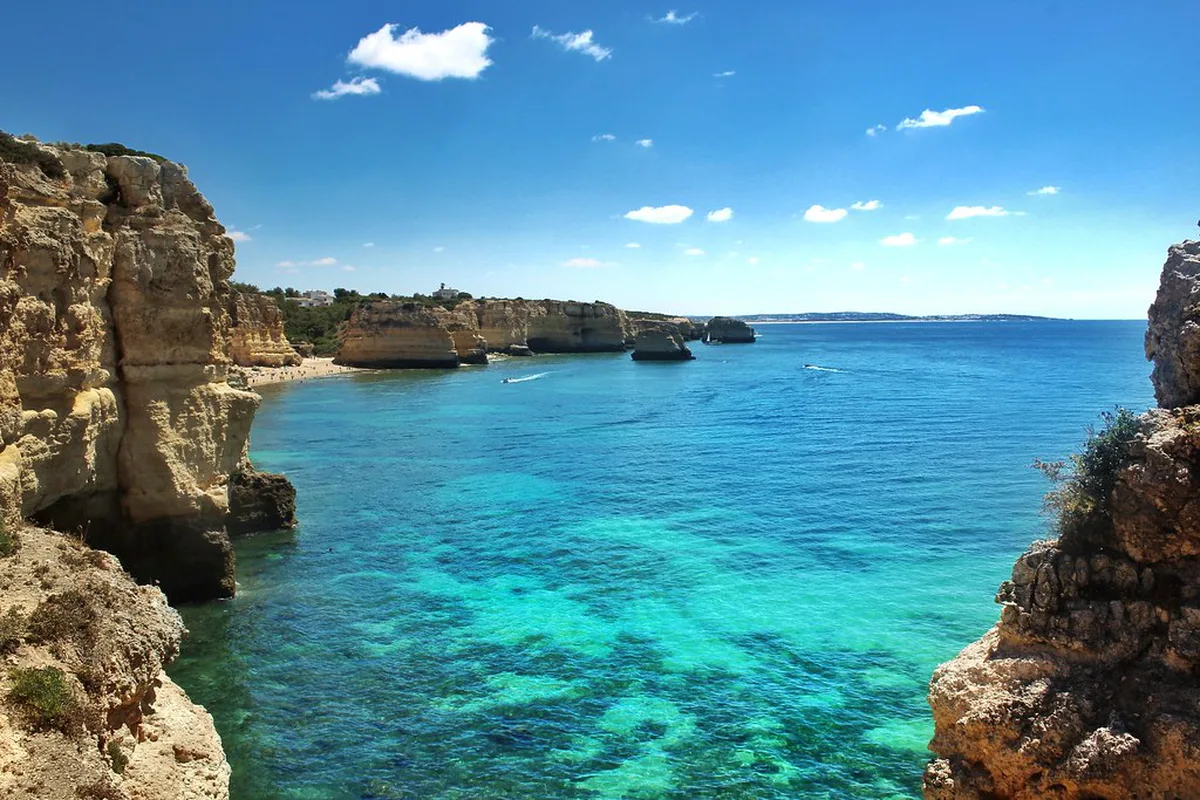
If you have seen one photo of the Algarve, it was probably Praia da Marinha. This central-Algarve cove sits between Lagoa and Carvoeiro and is regularly ranked among the world's best beaches. Golden sandstone cliffs curve around a 400-metre arc of fine sand, with two iconic sea-stack arches framing turquoise water that turns almost neon in summer afternoon light. Getting there: 15 min drive east of Carvoeiro. Parking: free clifftop lot, fills by 10:00 in July/August — arrive before 09:30 or after 17:00. Facilities: small seasonal café at the top, no resort sprawl. Vibe: scenic, low-development. Best season: May–June or September; visit at low tide for rock pools and the famous Seven Hanging Valleys trail. Our Praia da Marinha complete guide covers parking, tide timing, and the trail in full detail.
Praia da Marinha's free clifftop parking lot fills by 10:00 in July and August. Arrive before 09:30 or after 17:00 to guarantee a space — the late afternoon light on the sandstone arches is worth the wait.
8. Praia da Albandeira — the Cliff-Arch Beach
Praia da Albandeira sits just a few kilometres east of Marinha and is famous for twin sandstone arches just offshore — among the most photographed coastal features in Portugal. The beach itself is a small sandy cove backed by ochre cliffs, intimate and unhurried, with none of the resort sprawl you find further west. Getting there: 5 min drive from Marinha. Parking: free clifftop lot (~30 spaces), full by 10:30 in summer. Facilities: seasonal café at the top, gentle path down (no long staircase, more accessible than Marinha). Vibe: intimate, photogenic. Best season: low tide for rock pools, golden hour for photos.
9. Praia do Carvalho — the Hidden Tunnel Beach
Praia do Carvalho is one of the Algarve's most atmospheric small coves, tucked into the cliffs just west of Carvoeiro. What makes it unique is the access: you reach the sand by walking through a tunnel cut directly into the cliff face, originally carved (according to local lore) by smugglers in the 19th century. The cove itself has calm, shallow water and dramatic vertical rock walls on three sides. Parking: free clifftop lot, ~25 spaces. Facilities: small café at the top of the steps. Vibe: small, sheltered, snorkel-friendly. Best season: mornings or late afternoon; capacity is naturally limited (~80–100 people).
10. Praia de Benagil — Cave Beach
Praia de Benagil is a small cove that would be unremarkable were it not for the world-famous Benagil Cave next door, with its sand floor and natural skylight. The beach itself is a 150-metre arc of soft sand below a steep clifftop fishing village, and the cave is a 200-metre swim or kayak west. Boat tours leave from the beach itself in summer. Getting there: 10 min drive from Carvoeiro. Parking: small clifftop lot (€2/day in summer), full by 09:00. Facilities: two restaurants, kayak/SUP rental, boat tours. Vibe: busy, touristy in summer; magical at sunrise. Best season: May or September. See our Benagil Cave from Lagos: 2026 Guide to Tours, Kayak & Prices for tour options from the Lagos side.
11. Praia da Falésia — Long Sandy Stretch
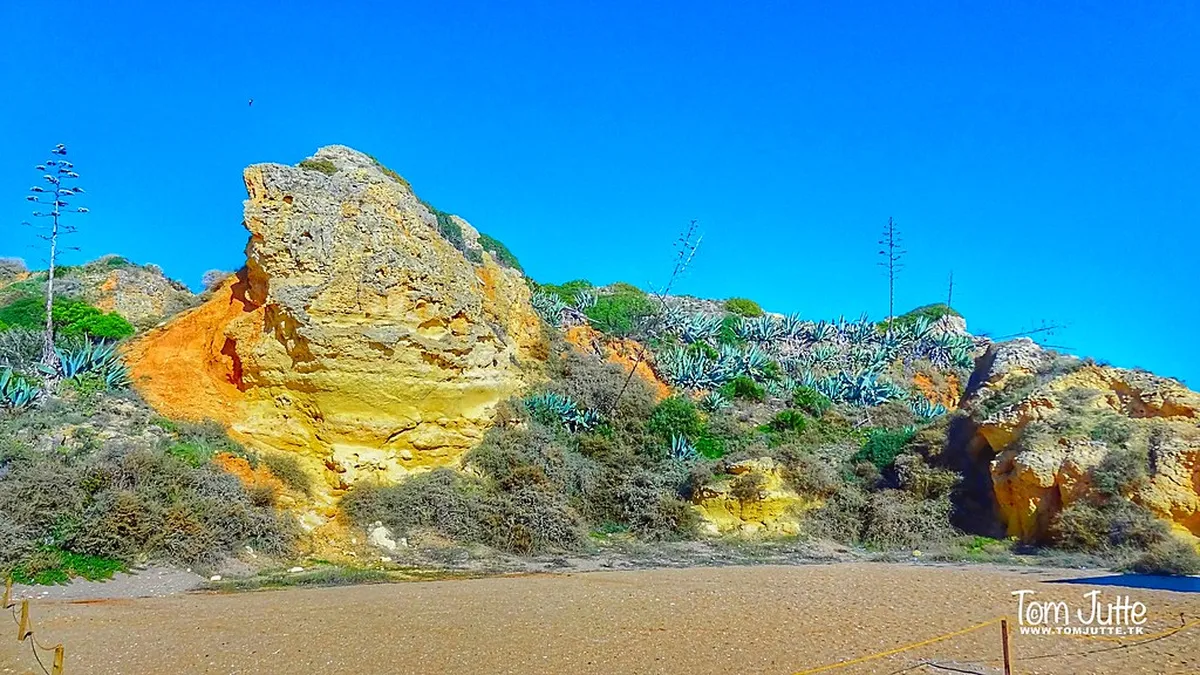
Praia da Falésia is the antidote to the Algarve's cove beaches. Stretching 3 km along the central coast near Olhos de Água (between Albufeira and Vilamoura), it is one of the longest continuous beaches in the region, with a defining wall of red, ochre, and white cliffs layered like a desert canyon and topped with umbrella pines. Getting there: 10 min drive east of Albufeira. Parking: multiple free clifftop lots. Facilities: beach bars at every access point, sun loungers, lifeguards. Vibe: family-friendly, never crowded despite popularity. Best season: May–October; for sunset, walk to the western end where the cliffs glow deep red. Read the full Praia da Falésia guide for the best access points and parking tips.
12. Praia da Rocha — Portimão's Grand Beach
Praia da Rocha is one of the Algarve's most iconic resort beaches, a broad 1.5 km sweep of golden sand directly below the clifftop promenade of Portimão. The defining feature is the scale: wide enough that even in peak July and August the sand rarely feels shoulder to shoulder. Dramatic sandstone pillars and rock formations rise from the shallows at the western end, giving the beach a photogenic backdrop that justifies its reputation as one of Portugal's grande praias. Getting there: 10 min walk from Portimão town centre or 30 min drive east of Lagos. Parking: large free clifftop lot plus paid on-street in town (€1/hour). Facilities: extensive promenade with restaurants and bars, sun loungers and umbrellas (€15–20/day for two), lifeguards, watersports rental, showers. Vibe: lively resort — expect crowds in summer but also buzz, good dining, and nightlife. Best season: May–October; September is the sweet spot (warm, less crowded). Our full Praia da Rocha Portimão guide covers the best sections of the beach and the clifftop walk.
13. Praia dos Pescadores & Praia da Oura — Albufeira
Albufeira's two main town beaches sit either side of its old town. Praia dos Pescadores ("fishermen's beach") is the picturesque one — a 600-metre arc of sand directly below the whitewashed old town, backed by traditional buildings and reached on foot from the main square. Praia da Oura, 2 km east, is the resort-strip beach: bigger, busier, lined with high-rise hotels, and the main beach for the famous "Strip" nightlife area. Parking: paid lots in town (€1.50/hour). Facilities: full promenade, watersports, lifeguard. Vibe: Pescadores = scenic; Oura = party. Best season: May–October. The Albufeira beaches guide ranks all eight town and surrounding beaches with crowd and parking scores.
14. Praia das Furnas — the Wild Central Algarve Cove
Praia das Furnas is one of the central Algarve's lesser-known coves, a remote stretch of sand below tall ochre cliffs on a coast with very little development. The water is exceptionally clear — no nearby resorts or rivers — and the dramatic rock formations on either side create natural shelter from wind and swell. Getting there: narrow road to a small cliff-top lot, then a track down to sand (no public transport, no signposting from the main coastal road, which is exactly why it stays quiet). Facilities: none — bring water, snacks, shade. Vibe: wild, undiscovered. Best season: June–September.
Eastern Algarve Beaches (Tavira, Cabanas & Faro)
East of Faro, the dramatic cliffs give way to the vast Ria Formosa lagoon and a string of low barrier islands. The water is the warmest in the Algarve, the beaches are the longest, and the crowds — even in August — are the thinnest. The trade-off is that many beaches are reachable only by ferry. The Faro beaches guide covers the full eastern Algarve in detail, including island ferry timetables and 2026 prices.
15. Praia da Ilha de Tavira — Barrier Island
Praia da Ilha de Tavira is a sandbar island stretching 11 km off the eastern Algarve coast. To reach it, take a small ferry from Tavira itself (€2 return in 2026, 5 minutes across the lagoon, every 30 minutes from April through October). The beach runs for about 5 km of soft pale sand, backed by dunes and salt marsh — no cliffs, no resorts, no roads. Walk 10 minutes from the ferry landing and you will have a half-kilometre of empty Atlantic to yourself. Facilities: seasonal restaurant near the ferry landing, lifeguards on the central section. Vibe: Caribbean-quiet. Best season: June–September; water is 22–24°C in August. Bring a hat — there is almost no shade.
16. Praia de Cabanas — Lagoon Sandbar
Praia de Cabanas is the next barrier-island beach east of Tavira, reached by a 2-minute ferry from the Cabanas de Tavira fishing village. It is shorter than Tavira's beach but feels even more local — most visitors are Portuguese day-trippers from Faro and Olhão rather than international tourists. The lagoon-facing side has flat, very warm water (excellent for kids); the ocean-facing side has small surf. Ferry: €2 return, every 15 minutes in summer. Facilities: two beach restaurants on the sand. Vibe: low-key, local. Best season: May–October.
17. Praia de Faro & Ilha Deserta — Ria Formosa
Two very different beaches, both close to Faro airport. Praia de Faro is on a barrier sandspit reached by road bridge — a 6 km strip with summer-houses, beach bars, and the easiest "no ferry" eastern beach. Ilha Deserta ("Deserted Island"), the southernmost point of mainland Portugal, is a true uninhabited barrier island reached by a 30-minute ferry from Faro old town (€10 return). It has one solar-powered restaurant and 11 km of empty sand. Facilities: Faro = full promenade; Deserta = one restaurant, no shade. Vibe: Faro = accessible; Deserta = total solitude. Best season: May–October.
Eastern Algarve Bonus: Praia de Monte Gordo
Praia de Monte Gordo is the easternmost major beach in the Algarve, almost on the Spanish border. A wide, gently shelving 3 km arc of soft sand, it has the warmest water on Portugal's south coast (regularly 24°C in August) and a relaxed, lower-cost resort scene heavily favoured by Portuguese and Spanish families. Getting there: 30 min drive east of Tavira; reachable by direct train from Faro. Parking: free along the back road. Facilities: full promenade, casino, family-priced restaurants. Vibe: low-cost family resort. Best season: May–October.
Quick-Pick Comparison: 17 Beaches at a Glance
| Beach | Region | Type | Best for | Parking |
|---|---|---|---|---|
| Dona Ana | Western (Lagos) | Cliff cove | Iconic, family | Paid €2/day |
| Camilo | Western (Lagos) | Double cove | Photos, snorkel | Free, fills early |
| Meia Praia | Western (Lagos) | Long sand | Family, swim | Free |
| Praia da Luz | Western | Village beach | Family, slower pace | Free street |
| Beliche / Sagres | Western | Surf coves | Surf, drama | Free clifftop |
| Bordeira / Amado | Western (Aljezur) | Wild surf | Surf, solitude | Free dirt lot |
| Marinha | Central | Cliff cove | Iconic, photos | Free, fills 10am |
| Albandeira | Central | Cliff cove | Photos, accessible | Free, fills 10:30 |
| Carvalho | Central | Tunnel cove | Snorkel, quiet | Free, ~25 spaces |
| Benagil | Central | Cave beach | Cave tour | Paid €2/day |
| Falésia | Central | Long sand | Family, swim | Free |
| Praia da Rocha | Central (Portimão) | Grand resort | Buzz, dining, families | Free clifftop |
| Pescadores / Oura | Central (Albufeira) | Resort beach | Nightlife, town | Paid €1.50/hr |
| Furnas | Central | Wild cove | Solitude | Free dirt lot |
| Ilha de Tavira | Eastern | Barrier island | Warm swim, quiet | Ferry €2 |
| Cabanas | Eastern | Sandbar | Local, kids | Ferry €2 |
| Faro / Deserta | Eastern | Barrier island | Accessible / remote | Free / Ferry €10 |
| Monte Gordo | Eastern | Long resort sand | Family, warmest water | Free |
Best Algarve Beaches by Traveler Type
The Algarve's best beach depends almost entirely on what you are looking for. Here is the direct answer for the most common traveler profiles:
Best for Families with Young Children
Family-friendly beaches in the Algarve share three traits: a gentle slope into the water, lifeguard coverage in season (June 15 – September 15), and enough flat sand to set up camp without feeling squeezed. The top picks are Praia da Falésia (3 km of sand, gentle water, never crowded), Meia Praia (4 km long, shallow bay, calm water), and Praia da Luz (sheltered village beach, low-rise, manageable scale). For the eastern Algarve, Praia da Ilha de Tavira has warm 22–24°C water and a short, fun ferry ride that children love.
Best for Surfers
Head to the western coast. Praia do Amado near Aljezur is Portugal's most consistent beginner surf beach, with rolling Atlantic swells and three well-regarded surf schools running year-round. Praia do Tonel in Sagres has a quality point-break suited to intermediate and advanced surfers. Praia da Bordeira adds empty dune-backed scenery. Water temperatures in the western Algarve run 17–20°C in summer — a 3 mm wetsuit top is comfortable from October through May.
Best for Hidden Gems and Solitude
The Algarve's most photogenic beaches are also its most crowded. For quiet, head to the hidden beaches of the Algarve — small coves like Praia das Furnas, Praia da Mesquita, and the western face of Praia do Carvalho that rarely appear in mainstream guides. The eastern barrier islands — Tavira, Cabanas, Ilha Deserta — offer the most consistent solitude in summer, especially if you walk 20 minutes from any ferry landing.
Best for Scenic Photography
Praia da Marinha is the answer almost every time — the twin sea-stack arches, ochre cliffs, and neon turquoise water combine to produce the Algarve's most recognisable image. For a different type of drama, visit Praia do Camilo at sunset, when the clifftops turn deep amber and the double cove fills with golden light. Ponta da Piedade — technically a cliff formation rather than a beach, but flanked by Dona Ana and Camilo — is the western Algarve's most spectacular coastal landmark for photography from above or by kayak.
Best for Snorkelling and Rock Pool Exploration
Low-tide rock pools are the Algarve's secret attraction. Praia da Marinha at low tide reveals dozens of pools teeming with sea anemones, blennies, and octopus. Praia do Camilo and the tunnel at Praia do Carvalho both have clear, shallow water around the cliff bases that reward a mask and snorkel. The central Algarve coves between Carvoeiro and Albufeira generally have the clearest water for snorkelling (no river run-off, no heavy boat traffic).
How to Choose Your Algarve Beach in 2026
By region: The Western Algarve is the cliff-and-cove zone — dramatic sandstone, sea stacks, smaller beaches, cooler water, bigger Atlantic swell. The Central Algarve blends iconic cove beaches with longer sandy stretches; this is the most resort-heavy zone and the easiest for families. The Eastern Algarve is barrier-island country — long flat beaches, warm shallow water, and almost no cliffs.
By beach type: Cliff coves (Marinha, Camilo, Dona Ana, Benagil, Carvalho, Albandeira) are smaller, photogenic, and best at low tide. Long sandy stretches (Falésia, Meia Praia, Ilha de Tavira, Monte Gordo) are better for families, walking, and avoiding crowds. Surf beaches (Bordeira, Amado, Tonel, Beliche) are best from October through April for swell, year-round for lessons.
By crowd tolerance: July and August fill every popular cove by mid-morning. If you cannot stand crowds, either visit cove beaches before 10:00 or pick a long beach where the crowd disperses naturally. May, June, and September are the sweet spots — warm enough to swim, half the crowds. Many Algarve beaches hold Blue Flag status (88 across the region for 2026), guaranteeing water-quality monitoring, lifeguards in season, and accessible facilities.
Parking reality check: Almost every clifftop cove fills its small free lot by 10:00 in July and August. Either go very early, very late, or walk in from a paid lot in the nearest village. Inland coastal roads (the M125 and EN125) are slow in summer — add 50% to any drive time you would expect off-season.
When to Visit Algarve Beaches in 2026
The Algarve's beach season runs from April through October, but the experience changes significantly month by month. The full breakdown — including water temperatures, crowd levels, and monthly weather — is in our best time to visit the Algarve guide. Here is the one-paragraph summary:
May and June are the sweet spot for beach holidays: sea temperatures reach a swimmable 18–20°C, the clifftops are green and wildflower-covered, crowds are manageable, and accommodation prices are 30–40% below peak. July and August are the hottest months (air temperatures 28–34°C, water 21–23°C), the most expensive, and the most congested — iconic coves like Marinha and Camilo fill before 10:00. September is many locals' favourite month: water is at its warmest (22–24°C), crowds thin dramatically after the first week, and prices drop. October is still viable for beach days (water 20°C, air 22–25°C) and excellent for surfing, hiking, and photography on the western coast. November through March the ocean is too cool for most swimmers, but the cliffs and light are spectacular for walkers and photographers.
In July and August, iconic coves like Praia da Marinha and Praia do Camilo fill their clifftop parking lots before 10:00. If you can't arrive by 09:30, plan for a long-sand beach like Falésia or Meia Praia instead — both stay manageable throughout the day even in peak season.
Getting Around Algarve Beaches Without a Car
The complete guide to getting around the Algarve by train and bus covers every route in detail. The short version:
The Algarve coastal train (Lagos → Faro → Vila Real de Santo António) is the backbone. It stops at or within walking distance of: Meia Praia (Lagos), Ferragudo (for Praia da Rocha), Carvoeiro (change for Marinha), Albufeira (for Falésia and town beaches), Vilamoura, Quarteira, Loulé (for Faro beaches), Tavira, Cabanas, and Monte Gordo. The train runs every 30–60 minutes and single fares cost €2–8 across the region.
The EVA/Rede Expressos bus network connects the train stops to beach towns not on the rail line, including Sagres, Lagos to Sagres (1h 15m), Carvoeiro, and Olhos de Água. For the iconic central-Algarve cove beaches (Marinha, Carvalho, Benagil), a rental car or taxi is the practical option — the nearest bus stop is typically 2–4 km from the clifftop.
The eastern barrier islands (Tavira, Cabanas, Ilha Deserta, Praia de Faro) require short ferry crossings (€2–10 return) from the nearest village. Ferries run frequently from April through October and take 2–30 minutes depending on the island.
Frequently Asked Questions
What is the best beach in the Algarve?
Praia da Marinha is the most consistently top-ranked beach in the Algarve and is regularly listed among the world's best beaches. It sits on the central coast between Lagoa and Carvoeiro and is famous for its golden sandstone cliffs, twin sea-stack arches, and turquoise water. Visit at low tide and arrive before 10:00 a.m. in summer to secure parking. For an alternative with similar drama and smaller crowds, try nearby Praia da Albandeira or Praia do Carvalho.
Are Algarve beaches free?
Yes — every beach in the Algarve is free to access by Portuguese law. There are no entry fees and no private beaches. You will, however, pay for sun loungers and umbrellas at most popular beaches in summer (typically €15–25 per day for two loungers and an umbrella in 2026), and parking near the most famous coves can cost €2–5 per day in peak season. Ferries to barrier islands like Ilha de Tavira or Ilha Deserta cost €2–10 return. The sand and water themselves are always free.
Which Algarve beach is best for families?
Praia da Falésia near Olhos de Água is the top family pick: huge sand area, gentle slope into the water, calmer sea than the western coast, and plenty of room to spread out. Meia Praia in Lagos and Praia da Luz are also excellent for families with younger kids — both have lifeguards and shallow shelving water. For older kids, Praia da Ilha de Tavira's short ferry ride and warm 22–24°C water make it a natural playground. Our family beaches guide ranks every kid-friendly option with water depth, facilities, and parking scores.
When is the warmest water in the Algarve?
August is the warmest month, with sea temperatures averaging 21–24°C across the south coast. The Eastern Algarve around Tavira and Monte Gordo is consistently 2–4°C warmer than the Western Algarve around Sagres because of the shallow lagoons and shelter from the Atlantic swell. If you want the warmest possible swim, head east; if you prefer cooler water and bigger waves, head west.
Are western Algarve beaches good for swimming?
They are beautiful but more challenging than the central or eastern beaches. The Western Algarve faces directly into the Atlantic, so waves are bigger, currents are stronger, and water temperatures are 2–4°C colder than at Tavira or Falésia. Sheltered coves like Dona Ana, Camilo, and Meia Praia are fine for casual swimming, but the open beaches around Sagres are better suited to surfers and confident swimmers. Always check the flag system before entering — green is safe, yellow means caution, red means no swimming.
Which Algarve beaches have Blue Flag status in 2026?
The Algarve was awarded 88 Blue Flags for the 2026 season, including all the major beaches in this guide — Marinha, Falésia, Dona Ana, Camilo, Meia Praia, Praia da Luz, Pescadores (Albufeira), Tavira, Monte Gordo, and most Sagres beaches. Blue Flag certification means the beach meets strict standards for water quality, lifeguard coverage in season (typically June 15 – September 15), accessibility, and environmental management.
Do I need a car to visit Algarve beaches?
For the iconic cove beaches between Lagos and Albufeira (Marinha, Albandeira, Carvalho, Benagil, Furnas), yes — public transport reaches the nearest village but rarely the clifftop. For town beaches (Dona Ana, Camilo, Meia Praia, Pescadores, Faro, Tavira, Monte Gordo) you can walk or use the regional train. The Algarve coastal train runs from Lagos through Faro to Vila Real de Santo António, stopping near most major beach towns. See the full breakdown in our Algarve getting around guide.
What is the difference between western, central, and eastern Algarve beaches?
The western Algarve (Sagres to Lagos) has the most dramatic cliff scenery — sandstone arches, sea stacks, and surf beaches — but cooler water (17–20°C in August) and stronger currents. The central Algarve (Carvoeiro to Albufeira) is the most popular zone, mixing world-famous cove beaches like Marinha with long family-friendly stretches like Falésia; water reaches 21–22°C. The eastern Algarve (Faro to the Spanish border) is barrier-island country — long flat beaches, warm shallow water (22–24°C), and the smallest crowds. Most first-time visitors base in the central zone and day-trip west to Lagos or east to Tavira.
Explore More Algarve Beach Guides
Deep-dive guides for every beach, region, and activity across the Algarve coast — from hero coves like Praia da Marinha and Praia da Falesia to sub-regional hubs in Lagos, Albufeira, and Faro.
Hero beaches & coves
- 11 Essential Tips for Your Praia da Marinha Guide
- Praia da Falésia Guide
- 10 Essential Tips for Your Praia da Rocha Portimão Guide
- 10 Essential Tips for Visiting Praia do Camilo, Lagos
- 10 Things to Know Before Visiting Praia Dona Ana Lagos
- Praia Do Carvalho Benagil Travel Guide
- Praia Do Alvor Portimao
- Meia Praia Lagos Beach Guide
- Praia Da Luz From Lagos
- Ponta da Piedade Lagos
Regional sub-pillars
Themed beach lists
Algarve trip planning
- Best Time to Visit Algarve
- Algarve Weather By Month
- Getting Around the Algarve by Train and Bus
- 10 Essential Chapters for Your Algarve Beach Itinerary Road Trip