
Island Hopping Azores Guide: Routes, Ferries & Flights
Master Azores island hopping with our guide to SATA flights, Atlânticoline ferries, and multi-island itineraries. Plan your perfect Atlantic adventure today.
On this page
Island Hopping Azores Guide
The Azores archipelago sits in the middle of the Atlantic Ocean, roughly 1,500 km west of Lisbon. Nine volcanic islands spread across three distinct groups, and no bridge or tunnel connects any of them. That means every hop between islands involves either a SATA flight or an Atlânticoline ferry — and planning which one, when, and in what order is the core challenge of any multi-island trip.
This guide takes a logistics-first approach. Before you decide which island to base yourself on, you need to understand what transport actually exists, what it costs in 2026, and where the bottlenecks are. Most first-timers underestimate the distances and the seasonal limitations of the ferry network. We cover the honest version so you can plan accordingly.
Whether you have 7 days or two weeks, the structure of this guide follows the decisions you will actually face: which islands to include, how to sequence them, how to get between each pair, and what to do when the Atlantic weather has other ideas.
Best Azores Islands to Visit
The nine islands divide into three geographic groups, and that geography shapes everything about how you travel. The Eastern Group contains São Miguel and Santa Maria. São Miguel is the largest island and the main international hub, home to Ponta Delgada airport (PDL). It offers the widest range of accommodation, the most developed tourism infrastructure, and enough to fill five days without touching the same trail twice. Santa Maria is smaller and drier, with sandy beaches rare elsewhere in the Azores — access is by SATA flight from São Miguel, a 30-minute hop. For detailed Visit Azores official resources, you can explore comprehensive island guides and planning tools before departure.

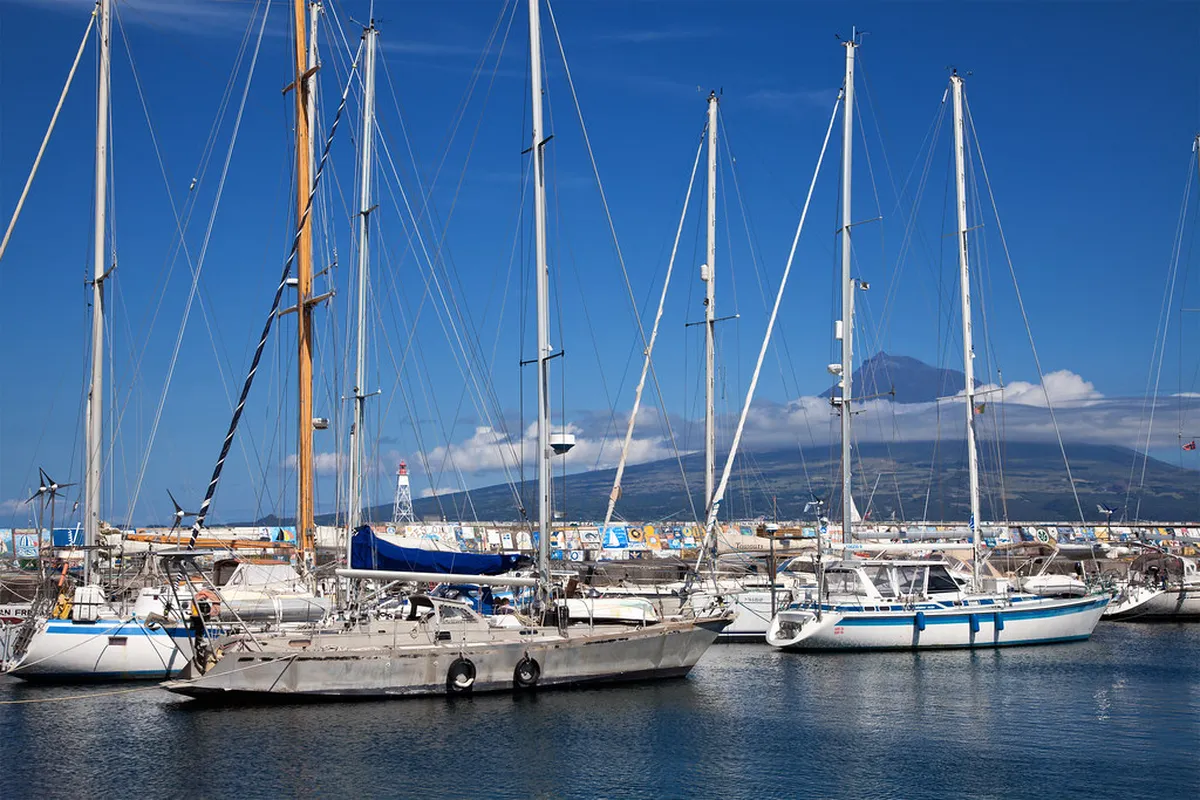
The Central Group holds five islands: Terceira, Graciosa, São Jorge, Faial, and Pico. This cluster sits roughly 150 km west-northwest of São Miguel. Terceira has the UNESCO-listed city of Angra do Heroísmo and a second international airport at Lajes (TER). Pico is dominated by Portugal's highest mountain and a UNESCO-listed wine landscape of black basalt vineyards. Faial's Horta marina is a legendary Atlantic waypoint, and the Capelinhos volcano on its western tip looks genuinely lunar. São Jorge is elongated and ridge-like, best known for dramatic fajã coastal platforms accessible by trail. Graciosa is the smallest of the five, calm and low-key, with a sulfur lake inside a caldera cave.
The Western Group consists of Flores and tiny Corvo, another 200+ km further west. Flores is one of the most beautiful islands in the archipelago, covered in waterfalls, hydrangeas, and crater lakes. Corvo has around 430 inhabitants and can be walked end to end in a day. Both are reached only by SATA flight from Faial or São Miguel — no seasonal ferry connects the Western Group to the Central Group in 2026. Plan at least two nights on Flores to justify the journey.
Azores Island Hopping Itinerary Ideas
A 7-day trip works best when focused on one group. The most popular structure is São Miguel (5 nights) with a day trip to Santa Maria, or a Central Group focus of Faial + Pico + São Jorge via the Triangle ferry route. Trying to combine the Eastern and Central groups in 7 days usually means two transit days out of seven — you lose too much time. Pick one group and go deep.
A 10-day trip opens the door to two groups. A practical route: fly into Ponta Delgada, spend 4 nights on São Miguel, then fly to Faial (40 minutes, around €80–100 in 2026), do the Triangle route covering Pico (2 nights) and São Jorge (2 nights) on ferry before flying back to Faial for your return. This gives you five islands across two groups without retracing any steps. Build one buffer day, ideally on Faial, before your international connection.
A 14-day trip allows you to add the Western Group. After the Triangle, fly from Faial to Flores (45 minutes, around €80). Spend 3 nights on Flores — enough to hike the waterfalls, swim at Poço do Bacalhau, and day trip to Corvo by small boat if weather permits. Fly back to São Miguel for your international departure. Fourteen days is also the minimum to visit all three island groups without feeling rushed. If you want all nine islands individually, plan 21 days or more.
The Triangle route (Faial–Pico–São Jorge) deserves its own mention because it is uniquely easy by ferry standards. You can move between these three islands the same way you would use a bus — same-day connections are possible in summer, the crossings run 30 to 60 minutes, and the combined car rental and ferry costs are lower than three separate SATA flights. See the ferry section below for the seasonal caveats.
How to Get to the Azores
Most international travelers land at Ponta Delgada (PDL) on São Miguel. Direct flights operate from Lisbon, Porto, London, Paris, Frankfurt, Boston, Toronto, and New York, with several seasonal European routes added in summer. Terceira's Lajes airport (TER) also handles international connections from mainland Portugal and some European cities — useful if you want to start your trip in the Central Group. In summer 2026, SATA added a small number of seasonal direct flights to Pico (PIX) from Lisbon, which can simplify itineraries for those prioritizing the Triangle route.
Ryanair, easyJet, and SATA's own Azores Airlines brand serve the routes from mainland Europe. SATA operates the Azores Airlines brand for long-haul flights and the SATA Air Açores sub-brand for all inter-island hops. Booking the international leg well in advance (3–4 months for summer travel) secures better prices. Check Skyscanner for a combined view of all carriers on a single route — SATA's own website does not always show competitor fares.
You can find more details in our guide on how to get to the Azores including visa requirements and airport transfer options. Once you land, car rental desks are inside the arrivals hall. On smaller islands you may need to shuttle to a separate lot — always confirm pickup details when you reserve. Clear customs at your first port of entry if arriving from outside the Schengen Area; subsequent inter-island hops are domestic and require no further immigration processing.
Inter-Island Flights (SATA / Azores Airlines)
SATA Air Açores is the only carrier for inter-island routes. It operates a monopoly with small turboprop aircraft — mostly Dash 8s — on runways that are often short and weather-exposed. Flight times range from 25 minutes (São Miguel to Santa Maria) to about 90 minutes (São Miguel to Flores). In 2026, expect to pay €60–80 per leg in shoulder season and €80–120 in July–August for routes within the Central Group. Western Group routes from Faial to Flores or Flores to Corvo typically run €60–90.
The SATA Air Pass is worth calculating carefully before you buy. It covers a set number of flights at a fixed per-leg price (around €55–65 per flight depending on the tier), valid only when booked alongside an international SATA/Azores Airlines ticket. If you are visiting three or more islands and your international flight is on SATA, the pass usually saves money compared to booking individual legs at peak prices. If your international flight is with another carrier or you only plan two inter-island hops, individual booking is often cheaper — compare both before committing. The pass must be purchased before or at the same time as your international ticket, not after arrival.
Flexibility matters more than price on SATA inter-island tickets. The flexible fare allows date and time changes at no charge, which is critical on a multi-island trip where weather can close an airport for a day. The cheapest non-refundable fares are fine for São Miguel to Terceira or other high-frequency routes, but always buy flexible for flights to Flores, Corvo, or any island where delays are frequent. You will likely need to rebook at least once on a 9-day or longer itinerary.
The SATA Air Pass (around €55–65 per leg) is only worth buying if your international flight is also with SATA/Azores Airlines and you are visiting three or more islands. If your international leg is on another carrier, individual bookings are usually cheaper — compare both options before committing.
When SATA Grounds Your Flight: What to Do
Weather cancellations are not a rare edge case in the Azores — they are a routine part of inter-island travel, especially to Flores, Corvo, and Pico. Strong winds at exposed island runways and fog banks that form quickly can ground aircraft for 12 to 36 hours. SATA will rebook you on the next available flight at no charge if the cancellation is weather-related, but "next available" on a low-frequency route can mean the following day or later.

The practical protocol when a flight is cancelled or significantly delayed: go to the SATA desk immediately rather than waiting at the gate. Staff there can rebook you before the queue forms. If you booked direct through SATA, the rebooking is straightforward. If you booked via a third-party aggregator, call the aggregator's line — SATA cannot always access third-party reservations at smaller island desks. Save SATA's Azores contact number (+351 296 209 720) to your phone before departure, and know your booking reference code.
Build at minimum one buffer day before any international departure — two if you are flying out of a smaller island like Flores or Faial to São Miguel. Never plan a same-day connection from an island airport to your homeward international flight. If you do get stranded on an island for an extra night, SATA will provide a hotel voucher for delays caused by weather or technical fault when you ask at the desk. The Azores does not have bad weather; it has interesting weather. The islands that are most likely to strand you (Flores, Pico) are often the most rewarding to spend an extra day on.
Taking the Ferry (Atlânticoline)
Atlânticoline is the government-owned ferry operator and the only option for sea travel between islands. The single most important rule to know: there are no ferries between island groups, regardless of season. Ferries only operate within the Central Group. You cannot take a ferry from São Miguel to Faial, from Terceira to São Miguel, or from any central island to Flores. For any inter-group journey, you must fly.
Within the Central Group, Atlânticoline operates on a seasonal model. The Blue and Green Lines run year-round and cover the Triangle: Faial–Pico (Madalena port, 30 minutes) and Pico–São Jorge (São Roque to Velas, 60–90 minutes). These run multiple times daily in summer and at least once daily in winter, though winter schedules are reduced. Tickets cost €7–12 for the Faial–Pico crossing and €14–18 for Pico–São Jorge. Book at least 24 hours ahead in July and August. The Yellow Line is a seasonal express service that runs June through September only, connecting Faial, São Jorge, Graciosa, and Terceira in a longer inter-island circuit taking up to several hours. It does not run in winter at all. Many travelers see the Yellow Line listed on maps or planning tools and assume it operates year-round — it does not.
Atlânticoline's website is notoriously difficult to use. For easier booking, try Omio or DirectFerries as third-party interfaces. Ferries accept luggage with no weight limits — you carry bags on yourself, no checked-baggage system. Rental cars can sometimes be transported on ferries, but many rental companies prohibit it in their terms. Read the contract before you assume you can drive a car onto the Faial–Pico ferry. You can enjoy Azores boat tours that also offer memorable perspectives of the volcanic coastlines if you want a more curated sea experience alongside the utilitarian ferry crossings.
The Yellow Line ferry — connecting Faial, São Jorge, Graciosa, and Terceira — runs June through September only and does not operate in winter at all. Travelers planning shoulder-season or winter trips who rely on this route will need to fly instead.
Ferry vs. Flight: Which Route, Which Mode
The decision between ferry and flight comes down to route, season, and how much your time is worth. For the three most common inter-island decisions, the trade-offs look like this in 2026:
- Faial to Pico: Always take the ferry. 30 minutes, €7–10, runs constantly. A SATA flight costs €60–80 and requires airport time on both ends. The ferry wins on every dimension.
- Pico to São Jorge: Ferry in summer (€14–18, 60–90 min, scenic). SATA flight off-season or if you are carrying bulky gear and prefer the airport-to-airport transfer.
- São Miguel to Faial or Terceira: Always fly. No ferry exists. SATA flight is 40–50 minutes; the only alternative is chartering a private boat, which no normal traveler does.
- São Miguel to Terceira: Fly (€60–90). No ferry, no alternative.
- Terceira to Graciosa or São Jorge (Yellow Line): Ferry only in June–September for a slow scenic crossing. Otherwise fly — SATA has direct service.
Cost-wise, the ferry network saves meaningful money only within the Triangle. Across a 10-day trip covering two island groups, ferry savings typically amount to €40–80 versus flying all legs. That is real money but should be weighed against convenience. Bad weather affects both modes, but a grounded ferry is usually more predictable to rebook than a grounded aircraft — the next Faial–Pico ferry is rarely more than a few hours away.
Do You Need a Car on Each Island?
Public transport on every island is minimal outside the main towns. Bus services exist but run infrequently and rarely reach trailheads, crater viewpoints, or remote beaches. A car is not a luxury on the Azores — it is the practical prerequisite for exploring most of what each island offers. The exception is Corvo, which is small enough to walk across in a few hours. On Terceira and São Miguel you can make do with organized tours plus taxis if you are based in the main town, but you will miss a large portion of the island.
The critical logistics issue is availability. Car rental fleets on the smaller islands are tiny. Flores, São Jorge, and Graciosa each have perhaps a dozen rental vehicles total across all companies combined. In high season, these sell out four to six months in advance. Book your rental car for each island at the same time you book your flights, not later. Waiting until three weeks before travel to search for a car on Flores in July will leave you carless at the airport. Search Discover Cars for a multi-supplier comparison across all the Azores islands, and book with free cancellation when possible so you can adjust if itinerary changes.
Pickup locations add another layer of complexity. On islands where you arrive by ferry rather than flight, the car rental office is at the port, not the airport. On Pico, for example, arriving at Madalena port (by ferry from Faial) and at Pico airport are different towns — confirm your pickup location in advance and note that some companies charge a premium for port delivery. When you search at Discovercars.com for São Miguel or review best deals for Pico Island, filter by pickup location early to avoid surprises.
Best Time for Island Hopping
June through September is the practical window for island hopping by ferry and by flight. All Atlânticoline lines are running, flight frequencies are highest, and accommodation is easiest to find across all nine islands. July and August are the warmest months (20–25°C) but also the most crowded, with the highest prices for both flights and cars. Late June and September offer the best trade-off: summer transport frequencies with slightly lower prices and thinner crowds.
May and October sit in a useful middle ground. Most ferry routes on the Triangle still operate in May, and SATA frequencies hold up. The landscape is intensely green in May with hydrangeas in full bloom. October brings dramatic Atlantic skies and quieter trails. Some Yellow Line routes may wind down in October. Check the updated Atlânticoline schedule for 2026 before booking shoulder-season trips that depend on specific ferry legs.
Winter travel (November to March) is possible but requires full commitment to flying only. Ferry services reduce sharply or stop entirely. SATA still operates inter-island flights, but cancellation rates rise in winter storms. The Azores never get cold in a European sense — temperatures stay around 14–18°C — but the wet, windy Atlantic weather is persistent. Winter is genuinely beautiful for those who want dramatic cliffs and empty trails, but plan for weather disruption and do not book non-refundable internal flights. Find the best time to visit the Azores for your specific priorities in our dedicated guide.
Practical Logistics & Booking Tips
Book inter-island flights and car rentals before you book accommodation. The transport is the constraint — rooms on most islands are easier to find than a rental car in high season. SATA flights should be booked 6–10 weeks ahead for summer travel on popular routes (São Miguel to Faial, São Miguel to Terceira). Flores-bound flights should be booked as early as possible; seats are limited by the small aircraft size and the route is genuinely popular in summer 2026.
SATA's baggage rules on inter-island flights are tighter than on international routes. Small Dash 8 aircraft have strict hold limits. One carry-on bag plus one personal item is standard on most inter-island fares. If you are touring for 10+ days, pack in a soft-sided bag that fits overhead — hard-shell large cases can be a problem on smaller island routes. Check the current baggage policy directly on SATA's website when you book, as rules have changed several times in recent years.
Stay close to your transport hub on days you are moving between islands. Arriving in a new island port or airport and then driving across the island adds time and stress. Build in one transition day whenever you cross between island groups. Use 15 Best Azores Tourist Attractions: 2026 Travel Guide resources to plan activities near arrival points on transit days rather than committing to full-day hikes. Book accommodation and flights at least four to five months ahead for July–August travel — the Azores have limited capacity and popular properties sell out well before peak season.
Frequently Asked Questions
How many days do you need for island hopping in the Azores?
You should plan for at least 10 to 14 days to see three or four islands. This allows you to spend 3 days per island without rushing. Shorter trips of 7 days are best spent on just two islands to minimize transit time.
Is it better to fly or take the ferry between Azores islands?
It depends on the distance between the islands you are visiting. Use the ferry for the short Triangle route between Faial, Pico, and São Jorge. For longer distances between island groups, flying with SATA is much faster and more comfortable.
Do you need a car on every island in the Azores?
Yes, a car is highly recommended for every island except perhaps Corvo. Public buses are infrequent and do not reach the best natural sights. Booking your rental car months in advance is essential to ensure availability on smaller islands.
What is the best month for island hopping in the Azores?
June through September is the best window for island hopping. During these months, the weather is most stable and all ferry lines are active. You will also enjoy the best conditions for whale watching and hiking during this period.
Island hopping in the Azores rewards travelers who plan the logistics before they fall in love with the scenery. Book your SATA flights and car rentals early, understand which ferry lines actually operate in your travel window, and build buffer days before international connections. The Atlantic will surprise you at least once — that buffer is what turns a potential missed flight into a bonus afternoon on a volcanic island.
The Azores in 2026 remain one of Europe's most logistically interesting travel challenges and one of its most rewarding. Start with the transport skeleton and let the islands fill in the rest.