
12 Best Lisbon Coffee Shops: A Specialty Coffee Guide (2026)
Discover the 12 best Lisbon coffee shops for specialty beans and remote work. Includes laptop policies, neighborhood maps, and the best third-wave roasters.
On this page
12 Best Lisbon Coffee Shops for Specialty Beans
After living in Lisbon for several years, I have watched a quiet revolution take over the cobblestoned streets. The €1 bica still rules every corner tasca, but a focused third-wave scene has matured into something Portuguese baristas now compete in international championships for. This 2026 guide covers the 12 specialty shops worth crossing town for, with current laptop policies, roast styles, and neighborhood groupings.
I refreshed every entry in early 2026 to reflect new openings in Marvila, the Buna expansion onto Rua do Poço dos Negros, and Hello, Kristof's second location near the Panteão Nacional in Graça. Lisbon's coffee map shifts fast: shops change suppliers, owners open second outposts, and laptop rules tighten as digital nomad numbers rise. Whether you need a quiet corner before a self-guided walking tour or a precision V60 to start the day, these picks deliver.
Specialty drinks in Lisbon run €3 to €6 — roughly four times the cost of a bica but still cheaper than the same flat white in Paris, London, or Copenhagen. Almost every shop on this list pours Oatly oat milk; about half also stock locally produced almond or coconut alternatives. Plan to spend €4 for a flat white plus €1.50 to €2.50 for a pastry if you want the full experience.
Quick Summary: Lisbon Specialty Coffee at a Glance
This snapshot lets you pick a shop in seconds based on neighborhood, work-friendliness, and best use case. Use it as a planning shortcut before reading the full entries below.
- Buna Coffee & People — Santos. Not laptop-friendly. Best for multi-roaster espresso and conversation.
- Fábrica Coffee Roasters — Baixa (and others). No Wi-Fi. Best for pioneering in-house roasts.
- Comete Coffee Roasters — Penha de França. Limited tables, minimal laptop tolerance. Best for tasting-room precision.
- Curva — Graça. Laptop tables on weekdays, banned weekends. Best for long work sessions.
- Copenhagen Coffee Lab — Príncipe Real (and others). Laptop-friendly. Best for reliable Wi-Fi and pastries.
- Malabarista Café — Arroios. Laptop-friendly off-peak. Best for brunch with specialty.
- Give it a Shot — Baixa. Standing only. Best for a quick precision shot mid-tour.
- Simpli Coffee & Bakery — Marquês de Pombal. Laptop-friendly. Best for full meals plus on-site roasting.
- 94° Specialty Coffee Shop — Chiado. Limited laptop space. Best for refined espresso between sights.
- Neighbourhood Coffee — Santos and Graça. Laptop-friendly off-peak. Best for Australian-style brunch.
- Dramático — Príncipe Real. Strict no-laptop. Best for a slow, intentional cup.
- Olisipo Coffee Roasters — Ajuda. Limited public hours. Best for buying retail bags and learning.
Bica vs. Specialty: What You Are Actually Drinking
The traditional Portuguese coffee experience centers on the bica, a short, dark-roasted espresso served in a thick porcelain cup for around €1. It is brewed almost exclusively from commodity-grade Robusta and Arabica blends roasted by industrial Portuguese giants like Delta and Sical, and most locals add two sugar packets to counter the burnt, bitter finish. The bica is a social ritual more than a flavor experience.
Specialty coffee in Lisbon takes the opposite approach. Shops like Fábrica, Olisipo, and Comete source single-origin green beans from named farms in Ethiopia, Honduras, Burundi, Colombia, and Brazil, then roast light-to-medium to preserve fruit, floral, and chocolate notes. A flat white with these beans runs €3 to €5; a V60 pour-over of a high-end micro-lot can hit €6 to €7. The cost is roughly four times higher, but you are paying for traceability, freshness, and beans roasted within the past two weeks.
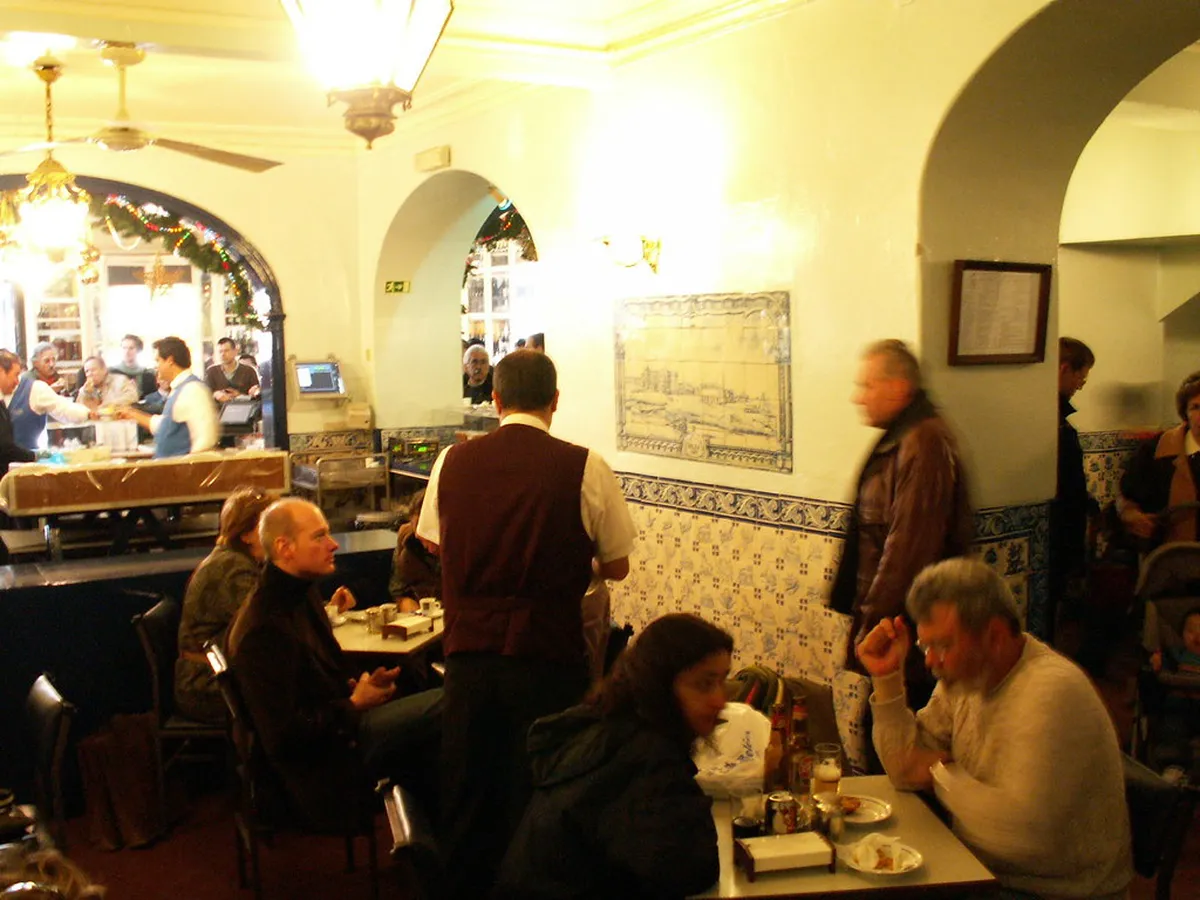
If you are staying near the Baixa district, you will see both worlds within a single block: a tiled corner tasca pulling €0.80 bicas next door to a minimalist specialty shop pricing pour-overs at €5.50. Trying both back-to-back is the fastest way to taste the difference between commodity and craft. Drink the bica fast and standing; sit down for the V60.
Specialty drinks in Lisbon run €3 to €6 — roughly four times the cost of a traditional bica but still cheaper than equivalent drinks in Paris, London, or Copenhagen. Most third-wave shops carry Oatly oat milk; ask for "leite de aveia" to order it in Portuguese.
How to Order Coffee in Portuguese (Without Defaulting to a Bica)
This is the single most useful piece of context most English-language Lisbon coffee guides skip. If you walk into any cafe and say "um café, por favor," you will get a bica by default — a small, dark espresso. To order specialty drinks you need the right vocabulary, and the menu language differs subtly from Italian or Spanish norms.
The essential terms: cimbalino is another name for the bica, mostly used in northern Portugal but understood everywhere. Abatanado is a long espresso closer to an Americano, served in a larger cup. Garoto means "little boy" and refers to an espresso with a splash of milk, similar to a macchiato. Meia de leite is half coffee and half steamed milk, served in a glass cup — this is the Portuguese equivalent of a café au lait. Galão is the milkier cousin, roughly three-quarters milk, served in a tall glass and consumed at breakfast.
In specialty shops, the international menu takes over: ask for a flat white, cortado, V60, or batch brew and the staff will speak English fluently. But if you wander into a neighborhood cafe expecting a flat white and get a galão instead, that is the language gap at work. To request oat milk, say "leite de aveia"; for almond milk, "leite de amêndoa." Most third-wave shops carry Oatly Barista; smaller ones may stock locally produced Provamel or rice milk.
The Roasters: Shops That Roast Their Own Beans
If your priority is freshness and traceability, head straight to the shops roasting on-site or in nearby warehouses. These are the people pushing Lisbon's third-wave movement forward and the names you will hear at industry events like the annual Lisbon Coffee Fest, held each March in Marvila since 2019.
Fábrica Coffee Roasters in Baixa is the godfather of the scene. Founder Stanislav Bendersky launched the company in 2015, inspired by the Nürnberg specialty wave, and now operates multiple Lisbon shops plus locations in Porto and Cascais. Fabrica Coffee Roasters roasts every bean it serves in-house and rotates single-origin offerings monthly. Drinks run €2.50 to €5; the Baixa flagship opens at 9:00 and closes at 18:00. Critically: there is no Wi-Fi, by design.
Comete Coffee Roasters in Penha de França is run by Adrien and Alexandra Scheffer, two former Paris pharmacists who pivoted to coffee with surgical precision. They roast on a Coffee-Tech FZ94 Evo and recently opened a small tasting counter inside the roastery. Beans rotate through Burundi Red Bourbon, Ethiopian Landrace, Honduran IH90, and the prized Colombian Castillo from the Bermúdez family. Pour-overs cost €4 to €7; hours are 10:00 to 18:00, closed Mondays.
Olisipo Coffee Roasters in Ajuda operates differently — Anthony Watson and Sofia Gonçalves opened it as a working roastery in 2018, with a public-facing cafe only on select days. Check their Instagram before walking up the hill from Alcântara. When open, single-origin pours and retail bags run €3 to €10. This is the best place in the city to take home freshly roasted beans, and they occasionally host public cupping sessions.
The Multi-Roaster Cafes: Curated From Across Europe
The other half of the scene runs on guest-roaster rotations. These shops do not roast in-house but instead curate beans from top European roasteries — Drop Coffee in Stockholm, Bonanza in Berlin, La Cabra in Copenhagen, Manhattan Coffee in Rotterdam — and rotate them every few weeks. The result is a constantly evolving menu that rewards repeat visits.
Buna Coffee & People in Santos is the marquee multi-roaster. Buna recently moved to a corner spot on Rua do Poço dos Negros 168, where the 28 tram passes the door. Their house blend comes from Drop Coffee in Stockholm; rotating guests have included Sumo Coffee Roasters from Dublin and Manhattan Coffee Roasters. The Japanese iced V60 is the move on a hot afternoon. Drinks €3 to €6, hours 9:00 to 18:00, but no laptops on the small footprint inside.
TACT in Alcântara, a corner cafe with curved windows opened by Kirill Ivanov and Vika Parfinskaia, has become the quiet locals' favorite. They feature beans from Bonanza Berlin, Man vs. Machine Munich, Dak Coffee Amsterdam, and A Matter Of Concrete in Rotterdam. The food is plated on vintage ceramics; ask the team for a cold brew if you visit in summer. Drinks €3 to €5.
Curva in Graça doubles as a gallery, concept store, and remote-work haven during the week. They pour Lisbon's best filter setups and reasonably priced small plates. Drinks and snacks €3 to €10, open 10:00 to 19:00. The defining feature: designated tables for laptop users on weekdays and a strict no-laptop policy on Saturdays and Sundays to recover the social atmosphere.
Three Neighborhood Coffee Crawls You Can Walk in a Morning
Most travelers never group these shops geographically, which means they spend Lisbon's notorious hills on the metro instead of on foot. Here are three walkable routes that hit two to three top shops per neighborhood, each timed for a 60- to 90-minute morning loop.
Santos crawl (45 minutes walking, 1 km): Start at Buna Coffee & People on Rua do Poço dos Negros for an espresso, then walk five minutes downhill to Neighbourhood Coffee at Largo do Conde Barão for a flat white and breakfast burrito. Finish with a riverside stroll along the Tagus before heading back. This crawl works best between 9:30 and 11:30, before the brunch crowd at Neighbourhood gets thick.
Chiado–Príncipe Real crawl (60 minutes, 1.5 km): Begin at 94° Specialty Coffee Shop in Chiado for a precision espresso, then walk uphill 10 minutes to Dramático on Rua da Alegria for a slow second cup. End at Copenhagen Coffee Lab in Príncipe Real for a cinnamon roll. The total elevation gain is about 60 meters — wear flats.
Graça crawl (50 minutes, 1.2 km): Start at the Hello, Kristof outpost near the Panteão Nacional for a magazine-and-coffee moment with viewpoint access, then walk 12 minutes south to Curva for a longer sit-down session. Both sit on the same hilltop ridge, so once you are up, the walking is flat. This crawl pairs naturally with a tram 28 ride back down.
More Specialty Shops Worth a Detour
Copenhagen Coffee Lab in Príncipe Real is the Danish-owned chain with at least a dozen Lisbon outlets. The Príncipe Real basement is the coziest; the Cais do Sodré branch the most reliably laptop-friendly. Drinks €3 to €6, opens at 8:00. The bakery section — sourdough, cinnamon rolls, kanelbullar — rivals the coffee.
Malabarista Café in Arroios serves brunch alongside specialty coffee in a residential corner of one of Lisbon's most diverse neighborhoods. Full breakfast plus coffee runs €12 to €15, single drinks €3 to €8; open 9:00 to 17:00 with rotating closed days. The back patio is a quiet hidden gem.
Give it a Shot is a hole-in-the-wall in Baixa where the focus is purely on extraction. Standing only, drinks €3 to €6, hours 10:00 to 18:00. Despite the central tourist location, the quality stays high and the staff happily geek out about beans.
Simpli Coffee & Bakery near Marquês de Pombal roasts single-origin beans on-site (minimum 84-point cupping score) and runs longer hours than most — 8:00 to 20:00. The industrial-chic interior fits larger groups. Drinks from €2.50, full breakfast €10 to €15.
94° Specialty Coffee Shop sits on a quiet side street in Chiado, offering refined precision brewing in a sleek minimalist space. Drinks €3 to €6, open 9:00 to 18:00. Best for a calm reset between sightseeing.
Neighbourhood Coffee brings Australian-style brunch and ristretto culture to Santos and a second outpost in Graça. Coffee €3 to €6, full meals €10 to €18. The breakfast burrito has cult status; pair it with a flat white made from rotating Olisipo or Field Coffee beans.
Dramático in Príncipe Real is the smallest entry on this list — a tiny pink building on a steep hill with floor-to-ceiling windows. Owner Ricardo Galésio pours La Cabra beans from Copenhagen with a deliberately unhurried pace. Drinks €3 to €5, open 10:00 to 18:00 most days. A strict no-laptop policy keeps the room calm even when there is a queue.
Remote Work, Wi-Fi, and Laptop Policies (2026 Update)
Lisbon's digital nomad influx has forced almost every specialty shop to make a public stance on laptops. Some — Curva, Copenhagen Coffee Lab, Simpli, Malabarista — actively welcome remote workers on weekdays but post no-laptop signs for Friday evenings or weekends. Others — Buna, Fábrica, Dramático, Comete — quietly discourage laptops year-round through a mix of small footprints, no-Wi-Fi policies, and counter-only seating.
If you plan to work for several hours, the unwritten etiquette matters as much as the rules. Order a fresh drink every 60 to 90 minutes, never plug into a wall outlet without asking, free your table during the 12:00 to 14:00 lunch peak, and never take a four-person table for a solo session. Wi-Fi speeds vary widely; Copenhagen Coffee Lab and Simpli reliably hit 50 Mbps, while smaller shops cap at 10 to 20 Mbps and slow further during morning rushes.
For all-day deep work, head further from the tourist core. Use the Lisbon transport guide to reach Arroios, Marvila, or Penha de França where Comete, Malabarista, and the newer Marvila warehouses give you space, plugs, and lower prices. Many shops now post their Wi-Fi password on a chalkboard; if it is not visible, just ask.
The unwritten remote-work etiquette: order a fresh drink every 60 to 90 minutes and free your table during the 12:00 to 14:00 lunch peak. Copenhagen Coffee Lab and Simpli reliably hit 50 Mbps Wi-Fi; smaller shops typically cap at 10 to 20 Mbps.
Pairing Pastel de Nata With Specialty Coffee
Here is the awkward truth most specialty shops will not advertise: very few of them serve genuinely good pastéis de nata. The classic recipe — laminated puff pastry, custard with cinnamon and lemon zest, baked at 300°C until the top blisters — requires a dedicated pastry kitchen, and most third-wave cafes outsource desserts to focus on coffee. So you will need a hybrid plan to get both right.
The best pairing routes combine a specialty shop with a nearby traditional bakery. Near Fábrica's Baixa flagship, walk five minutes to Manteigaria on Rua do Loreto for a hot-from-the-oven nata, then return to Fábrica for a V60 to cut through the custard. In Belém, hit Pastéis de Belém first (the original 1837 recipe) and then take the train back to Cais do Sodré for a flat white at Copenhagen Coffee Lab.
For a single-stop alternative, Malabarista in Arroios and Simpli near Marquês de Pombal both bake decent natas in-house, and Copenhagen Coffee Lab keeps a respectable supply at most of its outlets. For more options on where to source the genuinely best nata in town, see our Lisbon food tour guide — the rule of thumb is that any shop crowded with locals before 11:00 is doing it right.
What to Skip: Tourist-Trap Coffee Spots
A Brasileira in Chiado is the cafe everyone tells you to visit and almost no specialty drinker recommends. The historic 1905 venue, with its bronze Fernando Pessoa statue out front, charges €4 to €5 for what is essentially a commodity bica with mediocre milk drinks. Take the photo, then walk three minutes to 94° or seven minutes to Copenhagen Coffee Lab for actual coffee.
Avoid the kiosks directly outside Belém Tower, the Jerónimos Monastery, and Praça do Comércio. These spots quietly mark up commodity coffee 200 to 300 percent because they have a captive tourist audience. The €3.50 you pay for a watery cappuccino there buys a proper flat white at any specialty shop on this list.
Be skeptical of any cafe that does not list bean origin or roast date on its retail bags. Genuine specialty shops are transparent: a chalkboard with farm name, country, processing method, and roast week is the baseline. If the menu just says "coffee" or "espresso" with no further detail, you are drinking mass-market beans at boutique prices.
Frequently Asked Questions
Which Lisbon coffee shops are best for remote work?
Copenhagen Coffee Lab and Simpli Coffee are the most reliable options for remote work. They offer more space and generally have more relaxed laptop policies compared to smaller artisanal roasters. Always check for 'no-laptop' signs on weekends.
What is the average price of specialty coffee in Lisbon?
You should expect to pay between €3 and €5 for a standard flat white or latte. Filter coffee and V60 pours can cost slightly more, often ranging from €4 to €7. This is significantly higher than a traditional €1 bica.
What is a Bica and how does it differ from specialty coffee?
A Bica is a traditional Portuguese espresso that uses dark-roasted, commodity-grade beans. It is usually bitter and served quickly at a counter. Specialty coffee uses high-quality beans with lighter roasts to highlight complex, natural flavors.
Lisbon's coffee scene now sits comfortably alongside Copenhagen, Berlin, and Melbourne in the global third-wave conversation, but it has done so without losing the bica tradition that defines daily life. Use the neighborhood crawls above to taste both worlds in a single morning, and tip your barista the small change — the local norm is rounding up the bill rather than a percentage. After coffee, explore the best seafood restaurants for dinner to complete your Lisbon food journey.
For more planning context, pair this guide with our 3-day Lisbon itinerary to fit coffee stops into a fuller trip. Whether you settle into Curva for a working morning or queue at Dramático for a slow La Cabra pour, the city rewards the traveler who slows down enough to actually taste what is in the cup.
 12 Best Cocktail Bars in Lisbon (2026)May 29, 2026