
15 Best Free Things to Do in Lisbon (2026)
Discover the 15 best free things to do in Lisbon, including hidden viewpoints, free museum days, street art tours, and historic neighborhood walks.
On this page
15 Best Free Things to Do in Lisbon (2026)
Across four trips to the Portuguese capital, the city's greatest charms have repeatedly proven to cost nothing. Lisbon blends historic grandeur and modern creativity in a way that remains accessible to any budget. If you have limited time, pair this guide with our Lisbon 3-day itinerary to see the highlights without overspending.
This guide has been last refreshed in May 2026 to keep pricing and access rules current. Many attractions are permanently free; others have specific windows for no-cost entry that require timing. The 15 spots below are grouped so you can plan by neighborhood and avoid backtracking across the city's seven hills.
Join a Free Guided Walking Tour
Free walking tours are the fastest way to orient yourself in Lisbon's tangled historic core. Sandemans New Europe runs the most reliable two-hour route through the Baixa district, meeting daily at Praça do Comércio at 10:00 and 14:00. Smaller operators run themed walks of Alfama, Mouraria, and the Jewish Quarter on the same tip-based model.

The word "free" is misleading. Guides are freelancers paid entirely by tips, and the unspoken Lisbon standard is €5 to €10 per person for a two-hour tour, €15 if the guide was exceptional. Carry small euro notes; ATMs near Praça do Comércio frequently run dry on Saturday mornings. Avoid any guide who pivots into a hard sell for a paid evening pub crawl partway through.
Wander the Historic Streets of Alfama and Bairro Alto
The two neighborhoods that anchor any free Lisbon itinerary sit on opposite hills. Alfama, the only district that survived the 1755 earthquake intact, is a maze of staircases, tile-covered façades, and laundry strung between balconies. Bairro Alto, on the western hill above Chiado, is a quiet warren of bookshops and galleries by day and Lisbon's loudest nightlife block after 21:00.
Visit Alfama before 10:00 to dodge tour-bus drop-offs and summer heat. Tram 28 runs through both neighborhoods, but in peak season the trams are so packed with tourists and pickpockets that walking the route is faster and safer. Pairing morning Alfama with dusk Bairro Alto gives the full historic-to-modern arc for zero euros.
Take in the Views from Lisbon's Miradouros
The miradouros, public viewing terraces, are Lisbon's signature free attraction and open 24 hours a day at no charge. Each offers a different angle on the river and orange-tile rooftops, so visiting three or four during a stay is reasonable.
Not all miradouros are equal at all times of day. Miradouro da Senhora do Monte is the highest point in central Lisbon and the strongest sunset spot. Miradouro das Portas do Sol faces east and is best at sunrise when the light hits Alfama's tiles. Miradouro de São Pedro de Alcântara works at golden hour with the castle opposite. Miradouro da Graça is easiest with kids and has a kiosk for a €2 beer at sunset. Arrive 60 to 75 minutes before sunset in summer; locals start gathering at 19:00. The full guide to Lisbon viewpoints includes which to skip and how to plan a route by geography.
For the best sunset views, arrive at Miradouro da Senhora do Monte 60–75 minutes before sunset — in summer, locals start gathering at 19:00. All miradouros are open 24 hours and are completely free to visit.
Explore the Vibrant Street Art in Graça and Beyond
Lisbon's street art scene is among Europe's strongest, and the city actively commissions large-format murals as part of public regeneration. Graça, on the eastern hill above Alfama, has the densest concentration of work by Portuguese artist Vhils, whose chiseled-portrait technique is now shown worldwide. Walk the side streets near Miradouro da Graça for one hour and you will pass at least a dozen large pieces.
Calçada da Glória, descending from Bairro Alto, is an outdoor mural gallery repainted regularly by new artists. The Elevador da Lavra hosts the "40 anos 40 murais" project marking Portugal's revolution anniversary, and walls around LX Factory carry pieces by Pedro Zamith and Gonçalo Mar. The free Underdogs map (downloadable PDF) charts the best work and saves the cost of a paid graffiti tour.
Livraria Bertrand and Rainy-Day Indoor Stops
Lisbon's winter and shoulder-season rainfall is brief but intense, and the cobblestones become treacherous within minutes. Livraria Bertrand in Chiado, the world's oldest operating bookstore (1732, Guinness-certified), is open 09:00 to 22:00 daily and free to enter; staff will stamp any purchase with the commemorative seal. Ler Devagar at LX Factory pairs a multi-floor bookshop with the famous flying-bicycle sculpture and a small café.
The CCB (Centro Cultural de Belém) lobby and rotating exhibition halls are free and offer dry covered space if a storm catches you in Belém. Most central churches, including Igreja de São Domingos and Igreja de São Roque, are also free and provide quiet shelter from a downpour.
Relax in Eduardo VII Park and Lisbon's Gardens
Eduardo VII Park, at the top of Avenida da Liberdade, is the largest central green space in Lisbon. Manicured hedges form a geometric pattern that descends toward the river, and the highest point flies an oversized Portuguese flag with views down to Praça do Marquês de Pombal. The park is permanently free and hosts the Feira do Livro every May and June plus regular free open-air concerts in summer.
Inside the same park, the Estufa Fria greenhouse charges €3.10 most days but is free every Sunday until 13:00. The Lisbon Botanical Garden in Príncipe Real is also free Sundays until 12:00 (gardens only). Jardim do Príncipe Real next door is free anytime with a Saturday organic market, and Jardim da Estrela opposite Estrela Basilica has a duck pond and free playground.
Browse the Feira da Ladra Flea Market
The Feira da Ladra ("Thieves Market") runs every Tuesday and Saturday 09:00 to 18:00 in Campo de Santa Clara behind Igreja de São Vicente de Fora. Entry is free and the goods range from genuine vintage azulejo tiles and revolution-era posters to outright junk. Bargaining is expected and most vendors take cash only.
It is a 10-minute walk from Santa Apolónia metro station, or take Tram 28 to Voz do Operário. Tile collectors should arrive at 09:00 sharp; antique tiles vanish within 90 minutes. Pickpockets work the central aisles, so carry a front-pocket wallet. For a calmer alternative, LX Factory's Sunday craft market features local designers at similar price points.
Discover the LX Factory Creative Hub
LX Factory is a former industrial complex in Alcântara, repurposed into a sprawling cluster of art studios, independent bookstores, design shops, and casual restaurants. Entry is free and the site stays open from 09:00 until late evening; most shops close by 21:00 and bars run past midnight on weekends.
Beyond Ler Devagar, look for the rotating gallery at A Tapada, the rooftop installations on the original chimney building, and the printmaker workshops on the ground floor — none charge admission. Take the 15E tram from Praça da Figueira or any westbound bus along Avenida 24 de Julho; the 25 de Abril Bridge passes directly overhead and the riverside path is a five-minute walk for unobstructed views toward Cristo Rei.
Visit the Núcleo Arqueológico (Free Roman Ruins)
One of Lisbon's most surprising free attractions sits beneath a working Millennium BCP bank branch on Rua dos Correeiros. The Núcleo Arqueológico preserves Roman fish-salting tanks, mosaics, and medieval foundations from a 1990s renovation. Free guided tours run Monday through Saturday between 10:00 and 18:00, with English sessions at 10:00, 12:00, and 16:00.
You must reserve in advance through the bank's online portal; groups are capped at 12 people and walk-ins are turned away, especially during cruise-ship arrivals when daily slots fill within hours. Bring photo ID for the security check at the entrance.
See the Belém Tower and Jerónimos Monastery (Exterior)
The two icons of Belém charge admission (Belém Tower €8, Jerónimos Monastery €18 in 2026), but the surrounding gardens, plazas, and three-kilometer waterfront path from Padrão dos Descobrimentos to the Tower are free. The exteriors are arguably more photogenic than the cramped interior staircases. The Jerónimos Monastery's church (separate from the cloisters) is free to enter and contains the tomb of Vasco da Gama.
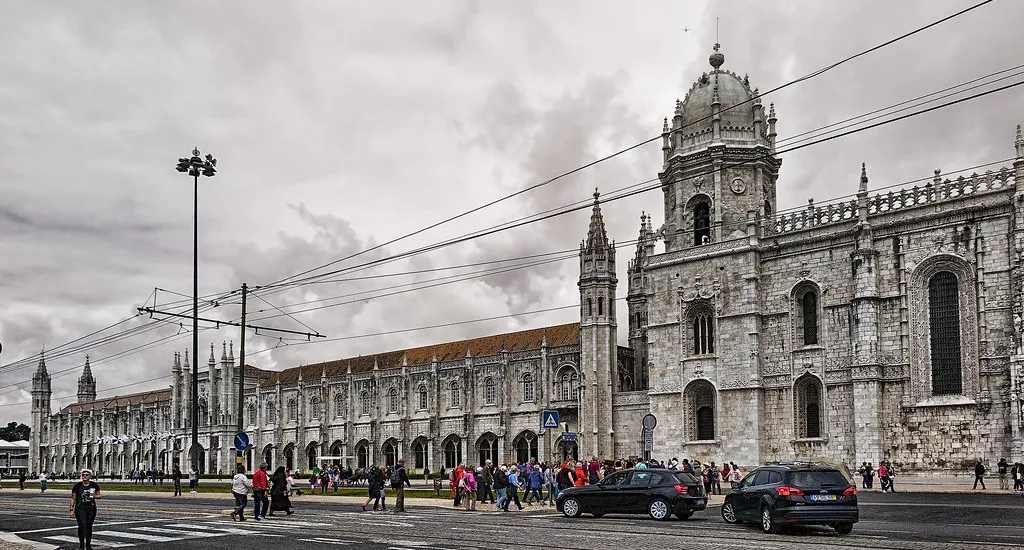
EU students under 25 receive 50% off both monuments and Portuguese seniors over 65 enter free with ID — discounts that are inconsistently advertised at the ticket counter. Take the 15E tram from Cais do Sodré (about 25 minutes) or the suburban train from the same station. Visit before 10:00 or after 16:00 to dodge cruise-ship and tour-bus crowds.
The Jerónimos Monastery church (separate from the cloisters) is free to enter and contains the tomb of Vasco da Gama. The surrounding gardens and three-kilometer waterfront path are also free — no ticket needed to enjoy Belém's iconic exteriors.
Walk the Waterfront at Ribeira das Naus
Ribeira das Naus is the modern riverside promenade between Praça do Comércio and Cais do Sodré, redeveloped in 2014 from a former dockyard. The walk is permanently open and free, with stone steps descending directly into the Tagus where locals sun themselves on warm afternoons. Wooden lounge chairs are first-come, first-served and street performers play here most evenings. A €2 Pingo Doce sandwich on the steps makes an instant free riverside picnic.
For a near-free water experience, take the Cacilhas ferry from Cais do Sodré (€1.30, the cheapest "boat trip" in any European capital) and walk back along the south bank for the postcard view of central Lisbon.
Visit the Money Museum (Museu do Dinheiro)
The Museu do Dinheiro is one of Lisbon's most underrated free attractions, in a beautifully restored former church on Largo de São Julião. It opens Wednesday to Sunday 10:00 to 18:00 and admission is permanently free — no membership tricks or first-Sunday rules.
The exhibits are unusually well-designed for a central-bank museum. Visitors can hold a real gold bar, print a souvenir banknote with their own face on it, and study counterfeiting examples through forensic-grade microscopes. The basement preserves a rare exposed section of the 13th-century King Dinis wall. Allow 60 to 90 minutes; it pairs well with the walking tour, the Núcleo Arqueológico, and a riverside lunch on the same loop.
Explore the Cemitério dos Prazeres
Cemitério dos Prazeres in Campo de Ourique is an open-air museum of 19th-century funerary architecture, open daily 09:00 to 17:00 (16:30 in winter). The cemetery sits at the final stop of Tram 28, and from the entrance it is a 15-minute walk through the avenues to the western perimeter, where an unobstructed view of the 25 de Abril Bridge and Cristo Rei rivals any paid viewpoint.
This is an active cemetery — Portuguese families regularly visit graves on Sundays, so behave as a guest and skip the flash photography. The Campo de Ourique neighborhood is worth lingering in afterward; the Mercado de Campo de Ourique offers lunch options under €10.
Attend a Free Portuguese Language Exchange
For travelers who want to meet locals rather than tourists, SPEAK runs free language-exchange events across Lisbon throughout the week. The model pairs newcomers with Portuguese residents (and sometimes Spanish, French, or German speakers) in cafés and community centers in Arroios, Baixa, and Anjos. Most events are free with a quick online registration.
The Wednesday and Saturday evening meetups in Anjos are the most active and attract working professionals rather than only digital nomads. For shorter visits, the Wednesday "Conversation Club" at the Lisboa Welcome Center near Praça do Comércio is a single-evening drop-in — and the best free way to collect insider restaurant tips no guidebook will list.
Listen to Free Live Music and Fado
Fado, the melancholic Portuguese folk style recognized by UNESCO, is Lisbon's most celebrated musical tradition. Famous Fado restaurants charge €40 to €70 per person for a tasting menu plus performance, but older neighborhoods host nightly "Fado Vadio" (amateur Fado) sessions where the only cost is a drink. Reliable free venues include Tasca do Chico (Bairro Alto and Alfama, sessions from 20:00), Mesa de Frades in Alfama, and Povo on Rua Nova do Carvalho. Order a beer and petiscos under €10 and you have a complete cultural evening. The full Fado scene guide distinguishes performance houses from amateur tascas.
Beyond Fado, the Lisboa na Rua festival (June through September) runs free open-air shows in Praça do Município and Largo do Carmo. Buskers in Bairro Alto and Cais do Sodré between Wednesday and Saturday evenings provide a constant free soundtrack as bars open at 22:00.
First Sunday Museum Access: The 2026 Free List
Many of Lisbon's national museums offer free admission on the first Sunday of every month, but the rules are inconsistently posted. Below is the verified 2026 list of state-run museums confirmed free on the first Sunday, all open from approximately 10:00 to 18:00.
- National Tile Museum (Museu Nacional do Azulejo) — most popular target; queue by 09:30.
- National Museum of Ancient Art (MNAA) — the country's largest art collection, including the Panels of São Vicente de Fora.
- Aqueduto das Águas Livres — the rare chance to walk along the 18th-century aqueduct above the city.
- National Coach Museum (Museu dos Coches) in Belém — royal carriages, free first Sunday until 14:00.
- MAAT (Museum of Art, Architecture and Technology) in Belém — free first Sunday until 14:00.
- Calouste Gulbenkian Museum — free every Sunday from 14:00 onward (not first-Sunday-only).
Two caveats. First, the Lisboa Card already covers most of these, so cardholders do not need to plan around the windows. Second, several smaller municipal museums (Lisbon City Museum, Fado Museum) reserve free admission for Lisbon residents only — tourists are charged the standard €5 to €8 fee. Check the official website 24 hours before visiting; spring and autumn exhibition openings sometimes override the free-day rule.
Strategic Tips for Free Travel in Lisbon
The historic "Chafariz" public water fountains in Alfama, Mouraria, and Chiado deliver clean potable water at zero cost. Refilling a one-liter bottle twice a day saves roughly €4 per traveler in convenience-store water. Look for Chafariz d'El Rei in Alfama and Chafariz das Janelas Verdes near the MNAA as the most reliable taps. Skip the Santa Justa Lift's €5.50 fee and 60-to-90-minute queue: walk into Largo do Carmo, pass the convent façade, and follow signs marked "Miradouro" onto the upper bridge platform — the view is identical.
The 24-hour Carris/Metro ticket is €6.80 and covers all metro, bus, and historic-tram lines including the funiculars. For two or more days, the Lisboa Card adds free entry to Belém monuments and the Tile Museum, often paying for itself in a single day. Walking beats waiting for Tram 28 in summer; getting around Lisbon on metro and feet is the cheapest realistic strategy.
What to Skip: Overrated Budget Traps in Lisbon
Three traps drain budget travelers' time and money for negligible return. Santa Justa Lift's queue is the most famous, covered above. Tram 28 itself has become so packed in 2026 that visitors regularly cannot see out the windows; pickpocket teams board at busy stops near Sé Cathedral. Walking the route in early morning delivers the same scenery without the stress.
The Pink Street (Rua Nova do Carvalho) is a single block painted pink, surrounded by mid-tier nightclubs and overpriced bars — it photographs well at midday before crowds and spilled-drink residue, but it is not worth detouring for. Be cautious of any "free" walking tour that pivots into a sales pitch for an evening pub crawl. Reputable operators never mix tip-based daytime tours with paid evening products.
How Far Does a Free-Day Budget Stretch in Lisbon?
Lisbon remains one of Western Europe's most affordable capitals in 2026. A traveler stitching free attractions together can run a complete day for €25 to €35 including food, transport, and a coffee stop — far below the equivalent in Paris, London, or Amsterdam. The catch is accommodation: budget hostels in Bairro Alto now run €30 to €45 per dorm bed in summer.
The "Prato do Dia" (daily special) at neighborhood tascas is the budget eater's strongest tool. A main, a glass of wine or beer, and an espresso costs €10 to €13 in Campo de Ourique, Anjos, and Arroios; the same plate in a Praça do Comércio tourist trap runs €18 to €22. Stack a walking tour, a miradouro sunset, the Money Museum, and a tasca lunch into one day and the total stays under €20. Add the €1.30 Cacilhas ferry for a postcard skyline view and you have a full day of cultural Lisbon for less than a single Belém Tower ticket.
Frequently Asked Questions
Are museums in Lisbon free on Sundays?
Most major state-run museums offer free entry on the first Sunday of every month for residents and some visitors. You should check the official website of the specific museum before visiting to confirm current rules. Arriving early is essential as queues are very long.
Is the tap water in Lisbon safe to drink?
Yes, the tap water in Lisbon is perfectly safe and meets all international health standards. You can refill your bottle at any of the historic public fountains to save money. This practice is common among locals and helps reduce plastic waste.
How much should I tip on a free walking tour?
A standard tip for a free walking tour in Lisbon is usually between €5 and €10 per person. If the guide was exceptional and the tour lasted over two hours, €15 is considered very generous. Most guides rely on these tips as their primary income.
Lisbon proves that you do not need a massive budget to enjoy a world-class European city break. By focusing on the many free viewpoints, historic walks, and cultural centers, you can experience the best of Portugal for less. The city's natural beauty and welcoming atmosphere are its greatest assets, and they are available to everyone for free.
Remember to pack comfortable walking shoes and a reusable water bottle to make the most of your explorations. The hilly terrain and cobblestone streets are best tackled at a slow pace with plenty of stops for photos. Enjoy your journey through this historic capital and discover why it remains a favorite for budget-conscious travelers in 2026. Pair this guide with our Cascais From Lisbon and 8 Things to Know Before Visiting Bairro Alto Lisbon for a fuller Lisbon picture.

 12 Best Cocktail Bars in Lisbon (2026)May 29, 2026