7 Things to Know Before Visiting the Azulejo Museum Lisbon
Plan your visit to Lisbon's National Tile Museum. Explore the 1755 Lisbon Panorama, the Madre de Deus Convent history, and practical tips for tickets and transport.
On this page
7 Things to Know Before Visiting the Azulejo Museum Lisbon
The Museu Nacional do Azulejo sits inside a former 16th-century convent in Beato, about 4 km east of Praca do Comercio. The building survived the 1755 earthquake almost intact, which makes the cloisters and church one of the rare pre-disaster interiors you can still walk through in Lisbon.
Inside, five centuries of tilework run from a 15th-century Hispano-Moorish floor pattern to a 75-foot blue-and-white panorama of pre-earthquake Lisbon, then forward to Maria Keil's metro-station designs from the 1950s. This guide covers the seven things that actually shape a good visit in 2026: what to look for in the panorama, how to pace the floors, when to skip the bus, and why the surrounding Beato neighborhood is worth an extra hour.
Explore the History of Madre de Deus Convent
Queen Dona Leonor founded the Madre de Deus Convent in 1509 for the Poor Clares, an enclosed branch of the Franciscan order. She was the widow of King Joao II and used royal income to commission a Manueline Gothic complex with maritime stone carvings — ropes, knots, armillary spheres — that signal Portugal's 16th-century ocean wealth. Most of the foundational structure you see today dates from her patronage.
The 1755 earthquake leveled downtown Lisbon and damaged Belem, but Beato's elevation and bedrock spared most of Madre de Deus. Repairs in the late 18th and 19th centuries added Baroque overlays, and after the religious orders were dissolved in 1834 the convent passed through several uses before reopening as the National Tile Museum in 1965 and earning National Museum status in 1980.
Keep the distinction clear as you walk: the convent is the building (cloisters, church, refectory, dormitories), and the museum is the collection installed inside it. The two interlock — many tile panels are mounted on the original convent walls — but a few rooms preserve the convent's spatial logic without museum captions, so look up at the vaulting and read the architecture itself.
View the 75-Foot Lisbon Panorama Tile Panel
The Great Panorama of Lisbon occupies an entire room on the top floor and is the single piece most visitors come for. It runs about 23 meters (75 feet) along one wall, painted in cobalt-on-tin-glaze around 1700 and attributed to Spanish-born baroque master Gabriel del Barco. The panel shows roughly 14 km of the Tagus waterfront before the 1755 earthquake — effectively a panoramic photograph of a city that no longer exists.
The room is not large, so visitors cluster near the center. Walk to the far left and read the panel from west to east, the same direction the Tagus flows past the city. The panorama is often referenced in any serious Lisbon 1-day itinerary because it visually anchors every other place you'll visit downtown.
What to look for, left to right:
- Belem Tower and the Jeronimos Monastery on the western edge — both survived 1755 and you can still visit them today.
- The Ribeira Royal Palace, the long riverfront facade with two flanking towers, sitting where Praca do Comercio is now. The palace and its 70,000-volume royal library were destroyed in the earthquake and tsunami.
- The Casa da India warehouse complex beside the palace, the customs hub that processed Portugal's spice and Brazilian gold cargo.
- The Fernandine walls climbing the Alfama hill, with watchtowers at the corners — fragments of these walls still exist near the Se cathedral.
- Sao Jorge Castle on the highest hill, drawn smaller than the palace because it was already a residential ruin by 1700.
- Galleys and merchant ships moored along the riverbank, including a few East Indiamen returning from Goa.
Spend at least 15 minutes in this room. It rewards slow looking, and the bench against the back wall is usually empty after the first tour group cycles through.
Walk to the far left of the panorama room and read the panel west to east — the same direction the Tagus flows. Most visitors cluster in the center, so the left and right ends are the least crowded spots for quiet study.
Discover the Evolution of Portuguese Azulejos
The galleries are arranged chronologically, and walking them in order is the easiest way to see how the form developed. The earliest tiles on display, from the second half of the 15th century, are Hispano-Moorish — small geometric patterns, often green and yellow, made by the cuerda seca and arista techniques. Portugal imported these from Seville before mastering domestic production.
By the late 16th century Portuguese kilns were producing tin-glazed tiles in large narrative panels, and Dutch Delftware contact in the late 17th century pushed the palette toward the cobalt blue and white that became Portugal's signature. The 18th-century rooms are the largest in the museum: full Baroque scenes, single-figure azulejos called "figuras de convite" that greeted visitors at noble palaces, and theatrical Rococo borders. Many of these tiles came from buildings flattened in the 1755 earthquake — when the museum acquired them, it was effectively rescuing rubble.
Don't skip the 19th and 20th-century rooms. Industrial production cheapened the form for a few decades, then artists like Jorge Colaco brought it back with massive narrative facades — Colaco painted the panels at Sao Bento railway station in Porto. The final room covers Maria Keil, Querubim Lapa, and contemporary studios; Keil's geometric blue-grey designs cover Lisbon's metro stations and tie the museum directly to the city outside.
If you arrived from the Alfama district, you've already seen 18th and 19th-century azulejos on apartment facades — this museum gives you the vocabulary to date them by eye.
Admire the Baroque Splendor of the Church
The Madre de Deus Church is reached through an unmarked door near the second-floor galleries — many visitors miss it. The interior is among Lisbon's most concentrated examples of "talha dourada," carved and gilded woodwork, and it survived 1755 with most of its 17th and 18th-century overlay intact. Almost every surface is covered: walls, side chapels, the high altar, the choir loft.
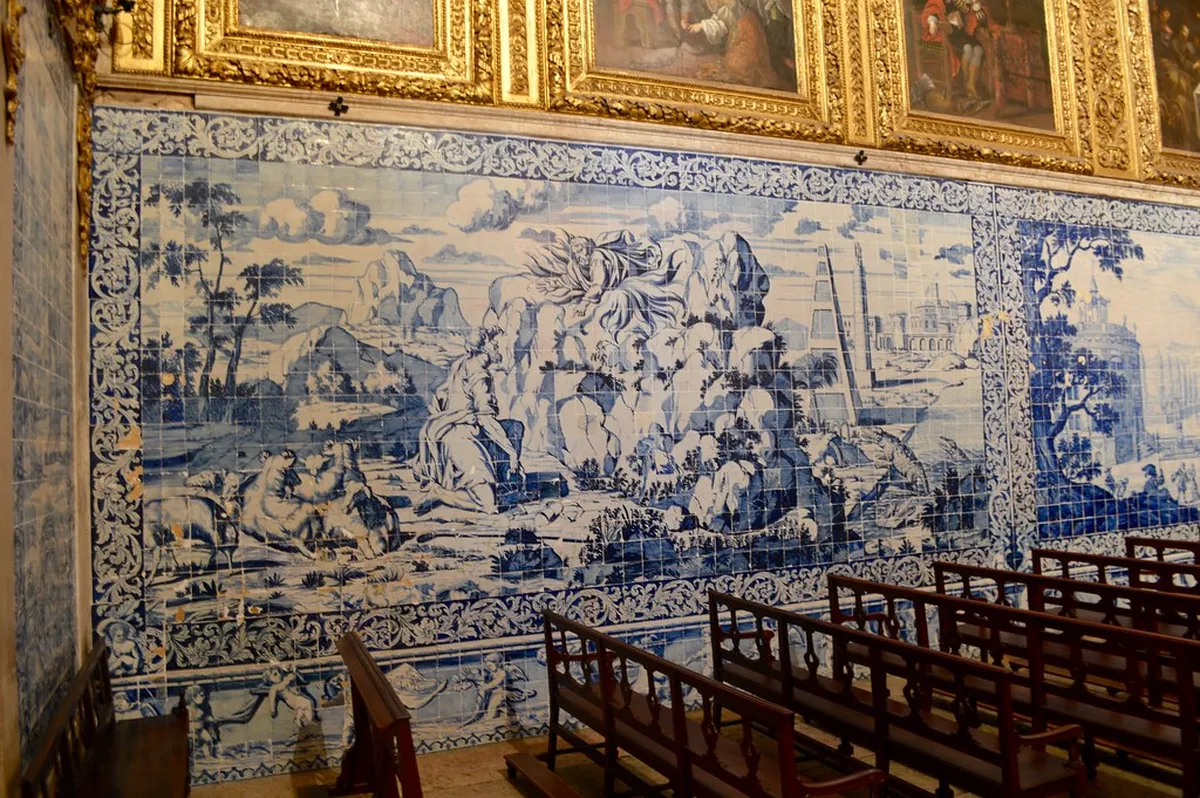
The lower walls carry blue-and-white tile panels depicting the Life of St. Francis, painted in the early 18th century by Manuel dos Santos. Above them, oil paintings by Cristovao Lopes (16th century) and Andre Goncalves (18th century) sit in heavy gilt frames. The ceiling is coffered and painted; the natural light through the small windows is dim, so visit on a sunny morning if you can.
The upper choir, accessed by a narrow staircase, holds Portuguese Renaissance choir stalls and a different angle on the church. It is one of the quietest spots in the museum complex and worth a five-minute pause before you continue.
Plan Your Visit: Tickets, Hours, and Schedule
Opening hours in 2026 are Tuesday through Sunday, 10:00 to 18:00, with last entry at 17:15. The standard adult ticket runs around 8 EUR; reductions apply for ages 13-25 and 65+, and entry is free on the first Sunday of each month and on International Museum Day (May 18). The library is open weekdays 14:00 to 17:30 by appointment only, useful if you're researching specific azulejos.

The museum is closed every Monday plus several fixed holidays — write these down before you build your itinerary, because the sign on the door is in Portuguese only and many travelers turn up to a locked gate:
- Every Monday — the most common closure tourists miss.
- January 1 — New Year's Day.
- Easter Sunday — date shifts annually; in 2026 it falls on April 5.
- May 1 — Labor Day.
- June 13 — Lisbon's Saint Anthony holiday, when the city throws sardine festivals and the museum closes despite peak tourist demand.
- December 25 — Christmas Day.
Plan two to three hours for a thorough visit; rushing leaves you skimming the panorama room. Mid-morning Tuesday through Thursday is the quietest window. Avoid Sunday afternoons and any cruise-ship arrival day if you can — the cafeteria and panorama room get cramped after 14:00. Check current pricing on the National Tile Museum Official Info page or pair the visit with other things to do in Lisbon.
The museum is closed every Monday and on June 13 (Lisbon's Saint Anthony holiday) — a day many travelers overlook because it falls during peak tourist season. Entry is free on the first Sunday of each month and on International Museum Day (May 18).
Get There: Transport to the Beato Neighborhood
The museum sits at Rua da Madre de Deus 4, in Beato, between the historic center and Parque das Nacoes. Beato is post-industrial — old warehouses, the LX Factory's smaller cousin "Hub Criativo do Beato," some shipping infrastructure along the Tagus — and it has none of Alfama's tourist polish. That's part of its appeal, but it does mean you should pick your route deliberately.
From Praca do Comercio or anywhere around Baixa, the practical options are roughly:
- Bus 728 from Praca do Comercio runs east along the river to Madre de Deus in about 15-20 minutes for 2 EUR; the most common tourist route. Buses run every 12-15 minutes.
- Bus 759 from Restauradores or Rossio takes 20-25 minutes and is useful if you're staying around the Avenida da Liberdade end of downtown.
- Walking from the Lisbon Cathedral via Santa Apolonia along the riverfront takes 30-35 minutes on flat ground; pleasant in cool weather, brutal in July afternoons.
- Uber or Bolt from Baixa runs roughly 6-9 EUR depending on traffic and is the fastest option for families with kids in tow.
- Train from Santa Apolonia station one stop to Marvila station, then a 12-minute walk; only worth it if you're already at Santa Apolonia.
Tactical guidance: take the bus or rideshare out, then walk back. The walk along the Tagus passing the Santa Apolonia cruise terminal and the warehouse district is one-directional in interest — most travelers find the museum-bound walk dull and the riverfront return walk scenic, especially at golden hour. Consult our Lisbon transport guide for current 2026 fares and Viva Viagem card top-up details.
Pair the Museum with Living Azulejo Culture in Beato
The museum tells you what azulejos were. Walking 30-90 extra minutes through Beato shows you what they still are. Most guides treat the National Tile Museum as a single stop and send you back downtown — that wastes the trip out east, because Beato is currently Lisbon's most interesting district for contemporary tile and street-art crossover.
Three additions worth weaving into your visit. About 10 minutes north of the museum on foot, the Bordalo II "Half Animals" street-art series uses recycled industrial scrap to mount large-scale beasts onto warehouse walls — Bordalo trained as a graffiti artist and his pieces dialogue with Lisbon's tile-as-public-art tradition. Another 5 minutes brings you to the Hub Criativo do Beato, a former military bakery converted into co-working studios; its courtyard cafes are quieter than anything around the museum and use modern tile cladding worth a look. And on weekend afternoons, contemporary ceramicists at studios like Surrealejos and Cortico open their doors for short demonstrations — call ahead, but the live-tile-painting experience is something the museum cannot offer.
For the ambitious: ride metro line yellow to Rato station after the museum and look at the platform tiles. Maria Keil designed them in 1959 as part of the original metro program, and they extend the museum's final gallery directly onto the city's transit infrastructure. Pairing the 1700 panorama in the morning with Keil's 1959 platform in the afternoon gives you 250 years of azulejo evolution in one day.
Shop and Dine: The Museum Cafe and Store
The museum cafe occupies a glassed-in section of the original convent courtyard, with potted citrus trees, climbing jasmine, and tile-clad walls on three sides. It serves light Portuguese plates — bacalhau croquettes, salads, soups — plus pasteis de nata, fresh juices, and proper espresso. Mains run roughly 9-14 EUR; coffee and a pastel sit around 3-4 EUR. The food is honest rather than exceptional, but the room itself is one of the more memorable cafe interiors in Lisbon.
Time the cafe carefully: arrive before noon or after 14:30 to avoid the tour-group lunch rush, which can stretch service to 30 minutes. Outdoor courtyard tables fill first and are worth waiting for in spring and autumn. The cafe accepts cards including contactless and stays open through museum hours.
The museum store at the exit carries higher-quality tile reproductions than the souvenir shops on Rua Augusta — small framed panels run 25-60 EUR, full-size reproduction tiles 8-15 EUR each, and there's a serious art-book section in Portuguese and English. If you want a tiled stay nearby, the Aurea Museum Hotel in Baixa pairs themed rooms with central access to the rest of the city.
Frequently Asked Questions
Is the National Tile Museum in Lisbon worth it?
Yes, it is widely considered one of the city's best cultural gems for art lovers. The combination of the historic convent and the 1755 panorama makes it unique. It offers a quiet escape from the busier tourist zones found in our Lisbon 3-day itinerary.
How much time should you spend at the National Tile Museum?
Most visitors find that two hours is enough for a thorough visit of the main floors. This allows time for the galleries, the church, and a quick cafe stop in the courtyard. If you love art history, you might stay for three hours.
How do I get to the Azulejo Museum from Alfama?
You can take bus 728 or 759 for a short 10-minute ride from the riverfront. Alternatively, a taxi or Uber is very affordable for this distance from downtown. Walking takes about 35 minutes along the flat Tagus riverfront path.
What is the most famous tile in the Lisbon Tile Museum?
The Great Panorama of Lisbon is the museum's most iconic piece on display. It shows the city before the 1755 earthquake destroyed much of the historic center. The panel is 23 meters long and features incredible architectural detail.
The Azulejo Museum rewards travelers who treat it as more than a quick stop. Block two to three hours for the floors and the church, then add 30-60 minutes for the cafe and a short walk through Beato. Avoid Mondays, time your bus or rideshare to dodge cruise-ship lunch crowds, and read the Lisbon Panorama from west to east to make sense of the pre-1755 city you'll be exploring downstream the rest of your trip. By the time you leave, the tiled facades you see across Lisbon will read as a 500-year continuous tradition rather than decoration. For a wider look at every Lisbon neighborhood, day trip, and itinerary, see our full Things to Do in Lisbon guide. Pair this guide with our Chiado Lisbon and Ginjinha Lisbon for a fuller Lisbon picture.
 Óbidos Castle: Complete Visitor's Guide (2026)June 11, 2026