11 Essential Tips for Your Praia da Marinha Guide
Plan your visit with our Praia da Marinha guide. Includes parking tips, how to find the "heart" rock, snorkeling spots, and hiking the Seven Hanging Valleys.
On this page
11 Essential Tips for Your Praia da Marinha Guide
Praia da Marinha stands as the crown jewel of the southern Portuguese coastline. The Michelin Guide ranks it among the 10 most beautiful beaches in Europe and among the 100 most beautiful in the world — a distinction it has held for decades. Our comprehensive praia da marinha guide helps you navigate the rugged cliffs and golden sands of this natural wonder. You will find everything from parking logistics to the best photography spots for your 2026 trip.
The beach is famous for its towering orange limestone stacks and remarkably clear turquoise water. It offers a perfect blend of relaxation on the sand and adventure along the clifftop trails. Planning your arrival is essential because this popular spot fills up completely by mid-morning during summer. Follow these expert tips to ensure a smooth and memorable visit to this coastal paradise.
Why Praia da Marinha is the Algarve's Most Iconic Beach
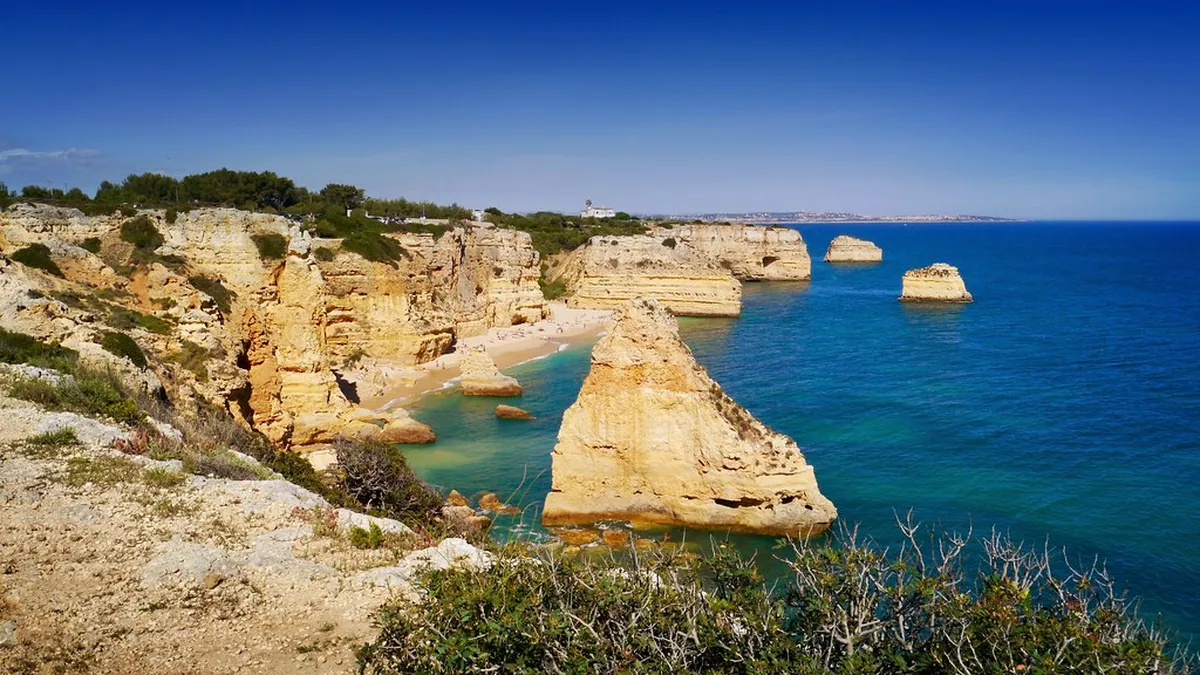
The visual impact of Marinha Beach is immediate and breathtaking for every first-time visitor. Massive orange-hued limestone cliffs protect the cove from strong Atlantic winds and create a secluded, sheltered atmosphere. These formations have been carved by the ocean over thousands of years into arches, pillars, and sea caves that define the horizon. CNN included this beach in its global list of the 20 most beautiful cliff beaches in 2018, and re-listed it as "best spot to visit in September" in 2019.

The water here is remarkably calm and transparent during the summer season — one of the clearest on the entire Algarve coast. Such clarity makes it easy to spot fish from the clifftop before you even step onto the sand. The sheltered position means waves rarely build to any size, making swimming conditions ideal even for those who are not strong ocean swimmers. Check the weather by month to find the clearest days for your visit.
Nature has also created the Arcos Naturais, a double sea arch at the western edge of the beach. When viewed from the right clifftop angle, the two arches align to form a heart shape known locally as "O Coração do Algarve" — the Heart of the Algarve. This feature is one of the most photographed natural landmarks in Portugal, and it remains a must-see destination for anyone exploring the southern coast.
Location: Where is Praia da Marinha?
Praia da Marinha sits in the municipality of Lagoa in the central Algarve, at coordinates 37°05′N 8°24′W near the hamlet of Caramujeira. It lies roughly midway between Albufeira to the east and Portimão to the west, making it an ideal stop on any Algarve beach road trip. The seaside village of Carvoeiro is the most popular base — it is only a 15-minute drive from the beach parking lot.
Drive times from nearby hubs give you a realistic planning frame: Carvoeiro and Armação de Pêra are each about 15 minutes away, Portimão and Alvor about 25 minutes, and Albufeira about 30 minutes via the A22 highway. Faro International Airport, the main regional hub, sits roughly 60 kilometres to the east — allow 50 minutes by car. The nearby Benagil Beach is only 10 minutes by car or approximately 35 minutes on foot along the clifftop trail.
The surrounding landscape falls within a protected coastal zone that limits large-scale development. This preservation ensures that views remain dominated by nature rather than high-rise hotels. You will notice a distinct absence of urban noise once you step out of your vehicle at the clifftop parking area. It feels like a hidden world despite its global fame and growing visitor numbers.
Transportation: How to Reach the Beach
Most visitors drive — and for good reason. The parking lot sits directly above the beach, and having your own car lets you arrive at first light before the crowds form. Rental cars cost approximately 30–60 EUR per day from Faro Airport. Ride-sharing apps including Uber and Bolt serve the Lagoa and Carvoeiro areas and offer a practical alternative if you want to skip the parking battle entirely.
The "return trip trap" is a real logistical problem worth preparing for. Getting an Uber to the beach in the morning is straightforward from any nearby town. Getting one back in the late afternoon — when demand peaks and drivers are occupied in town — can take 30 to 45 minutes of waiting. Options to avoid it: arrange a taxi in advance, walk 35 minutes east to Benagil and catch a ride from there, or simply time your departure before 14:00 when the crowds start to thin.
A public bus (line 77) runs from Lagoa town to Marinha Beach and takes roughly 15 minutes. The service operates twice daily on weekdays only, with no weekend service — it is useful for one-way trips but not reliable enough for a full beach day. Always verify timetables directly with Algarve Bus before relying on the schedule, as off-season services change with little notice.
Parking Logistics and Arrival Strategy
Parking is the single biggest practical challenge at Praia da Marinha. The clifftop lot is modest in capacity and fills within one to two hours of sunrise during peak season — by 10:00 on a July or August morning it is typically full. When the lot is full, local police close the access road approximately one kilometre from the beach and turn cars away. Arriving by Uber or taxi is permitted even during road closures, which is why pre-booking a ride is a viable strategy for late risers.
Overflow parking along dirt tracks further back from the cliff edge can absorb a few extra vehicles on the busiest days. Do not block traffic or ignore posted restrictions — police patrol the area actively during summer and issue fines. Parking on the grass verges can damage the protected clifftop vegetation and is increasingly enforced.
The simplest solution is timing. Arrive before 09:00 in shoulder months (May, June, September) and before 08:30 in July and August. Visiting mid-week versus weekends makes a noticeable difference even during peak season. A May or early June visit offers a near-empty beach at its best — water is clear, air temperatures are comfortable, and the parking lot rarely fills at all. Our best time to visit Algarve guide covers all six coast zones with month-by-month crowd data.
The clifftop parking lot fills completely by 10:00 on summer mornings. Arrive before 08:30 in July and August, or before 09:00 in shoulder months like May, June, and September, to guarantee a space.
The Descent: Navigating the 115-Step Staircase
Accessing the sand requires descending a long wooden and stone staircase built into the cliff face. There are approximately 115 steps to reach the bottom, with no shade along the entire route. Sturdy footwear is essential — flip-flops become hazardous on the uneven stone sections, particularly when the steps are damp with sea spray in the morning. Take your time and use the small landings to rest if needed.
This staircase makes the beach inaccessible for strollers, wheelchairs, and anyone with significant mobility limitations. There is no step-free alternative. Every item you bring down must be carried back up: keep your gear light and leave heavy coolers in the car. The water temperature rarely exceeds 22°C even in August, so a wetsuit is comfortable for extended snorkelling sessions — but it is one more thing to haul back up in the midday heat.
The views from the staircase are some of the finest at the entire site. Many visitors stop halfway to photograph the beach from a higher perspective before the crowds arrive. Be considerate on the narrow walkway and stand to one side when taking pictures. Once you reach the bottom, the soft golden sand is an immediate reward for the effort.
Tides and Low-Tide Hidden Coves
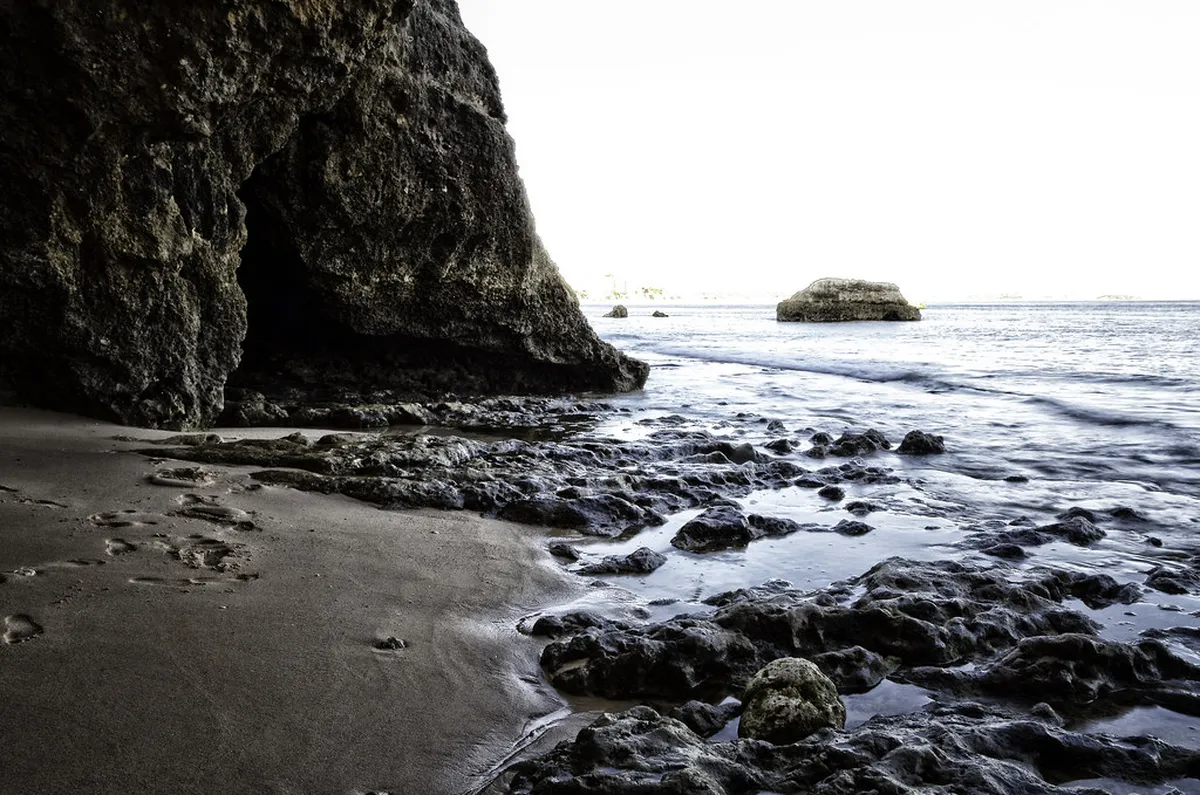
Tides shape the entire experience at Praia da Marinha more than at almost any other Algarve beach. At high tide the available sand shrinks considerably, the natural arches are surrounded by water, and the western section of the beach becomes fully inaccessible. At low tide, the beach opens up dramatically — rock platforms and tidal pools emerge, and you can walk through gaps in the limestone formations into neighbouring coves that most visitors never reach.
The eastern side of the beach holds the best low-tide reward. Walk slowly along the rock shelf that appears when the tide drops, and you will find enclosed natural pools sheltered from the swell, with clear water warm enough for comfortable swimming. Seahorses, starfish, and sea urchins all live in these pools — step carefully and avoid touching anything. Few tourists make it this far because the access only exists for a two-hour window around low tide.
Check tide times before you go. The Portuguese Institute for Sea and Atmosphere (IPMA) tide tables publish exact low-tide windows for the Algarve coast and are updated daily. Aim to arrive one to two hours before low tide so you have the full window to explore. If the forecast shows high tide in the morning, consider shifting to an afternoon visit — the light is also better for photography on the western cliff faces in the late afternoon.
At high tide the sand area shrinks significantly and the western section of the beach becomes inaccessible. Check the IPMA tide tables before your visit and aim to arrive one to two hours before low tide for access to hidden coves and tidal pools.
Beach Conditions, Sand, and Facilities
The beach is divided into several sections by natural rock walls that extend into the water. The sand is soft and golden, though rocky patches exist near the cliff base where the limestone meets the shore. A lifeguard is on duty from June to mid-September — outside those months the beach is unmonitored. The water depth increases quite quickly beyond the shallows, so keep a close eye on young children even when the sea looks calm.

Facilities are deliberately limited to preserve the natural setting. There is a small snack bar at the base of the staircase serving cold drinks, ice cream, and basic meals; prices are higher than in town due to location and demand. Portable toilets are available at the clifftop parking area; on-beach facilities vary by season. There are no sun-bed or umbrella rentals — bring your own shade. The Lagoa municipality administers the beach under the Câmara Municipal de Lagoa, which publishes seasonal beach safety notices and any access restrictions.
Note that Praia da Marinha does not hold a Blue Flag certification — the designation requires specific facility standards (showers, waste separation, accessibility) that the beach's natural, infrastructure-light setting does not meet. This is not a flaw; it reflects a deliberate choice to keep the environment intact. The water quality remains excellent regardless of certification status.
Snorkeling and Marine Life Highlights
Praia da Marinha is widely considered one of the finest snorkelling spots on the Algarve coast because of its rocky seabed and calm water. The many submerged boulders provide ideal habitat for sea bream, colourful wrasse, octopus, and the occasional seahorse. The best visibility is found on calm days with little Atlantic swell — typically May through early October. Water temperature peaks around 21–22°C in August and September.
The areas around the large rock stacks are particularly rich in biodiversity. Swim slowly along the base of the cliffs to find small caves and crevices where fish congregate. Be cautious of sea urchins that cling to rocks just below the surface and are easy to miss. Bring your own mask and snorkel — equipment rentals are not reliably available at this beach. A pair of water shoes is highly recommended for getting in and out over the rocky sections.
Advanced snorkellers can explore deeper sections further from shore where the seabed drops beyond three to four metres and larger species appear. Always snorkel with a companion and stay aware of any passing boat traffic, particularly during the summer months when kayak and boat tour traffic around the arch increases. The marine environment is protected within this coastal zone — avoid touching rocks, coral, or any animals.
Photography: The M Rock and the Heart Shape
The most famous landmark is the M-shaped rock formation just offshore, sometimes called "The Cathedral" by local boat captains for its grand proportions. You can photograph it from the beach at sand level or from the various viewpoints along the clifftop trail above — each angle gives a completely different image. The double arch (Arcos Naturais) photographs best from the clifftop path rather than the beach floor.
To find the legendary "Heart" shot — O Coração do Algarve — walk east from the staircase along the clifftop path for about five minutes. At one specific vantage point the two natural arches align to form a near-perfect heart outline. Arrive in the early morning when the light falls directly on the formation and before other photographers crowd the spot. Golden hour in the evening also works when the setting sun warms the orange limestone to a deep amber.
Early morning shoots reward you with empty sands below and long shadows that emphasise the cliff geometry. Late afternoon light deepens the blue of the ocean against the golden rock. Bring a wide-angle lens for the arch and a short telephoto (85–135mm equivalent) for compressing the M-rock against the horizon. For an alternative coastal photography comparison, our Praia do Camilo guide covers a beach with equally dramatic sea stacks just 30 kilometres west.
Hiking the Percurso dos Sete Vales Suspensos
Praia da Marinha serves as the eastern trailhead for the Seven Hanging Valleys trail (Percurso dos Sete Vales Suspensos), widely rated as the finest coastal walk in Portugal. The route runs 7 kilometres along the clifftops westward, past Benagil Cave and on to the Alfanzina Lighthouse at Carvoeiro. Starting from Marinha is recommended because the parking lot here is significantly larger than at the western end, and hiking east-to-west in the morning keeps the sun behind you.
The trail is moderately challenging — rocky in sections, with steep descents into the hanging valleys that give the route its name. Allow three to four hours for the one-way walk at a relaxed pace, or six hours if you plan to explore every viewpoint. Bring a minimum of two litres of water per person; there is almost no shade and temperatures regularly exceed 30°C in July and August. Wear high-SPF sunscreen and closed shoes with grip. Follow the marked yellow and red waymarkers — unofficial shortcuts near cliff edges are genuinely dangerous.
You do not have to complete the full route to enjoy it. Even a 20-minute walk from the parking lot delivers clifftop views that are among the best on the entire southern coast. The trail leads past the clifftop above Benagil Cave; note that since August 2024 access to the cave interior has been restricted to small guided groups only — you cannot enter independently. If you plan a one-way hike and need a return, Uber pickup from the Benagil end is straightforward during business hours.
Marinha vs Benagil: Which to Prioritise
Both beaches sit 10 minutes apart by car and are often treated as a pair — but they offer fundamentally different experiences. Praia da Marinha is where you swim, snorkel, and linger on the sand surrounded by cliff architecture. Praia de Benagil is primarily a staging point for cave tours; the beach itself is tiny and overwhelmed with visitors in summer, and parking is near-impossible. Most travellers find that Marinha delivers the better full-day experience.
If you have one morning in the area, start at Marinha for the beach and tide pools, then walk the clifftop trail to the viewpoint above Benagil Cave before returning. This gives you both highlights without dealing with Benagil's parking crisis. If the cave interior is your priority, book a guided boat or kayak tour in advance — the official restriction introduced in 2024 means unguided entry is no longer permitted and spots fill weeks ahead in summer.
Marinha also benefits from calmer water in the morning before the sea breeze picks up. Benagil's tiny beach faces more direct ocean exposure, which makes it unsuitable for swimming on any day with moderate Atlantic swell. For families or anyone prioritising swimming and snorkelling over cave photography, Marinha is the clear choice.
Where to Eat and Stay Nearby
No hotels sit directly at the beach, but Carvoeiro — 15 minutes by car — offers a full range of accommodation from boutique guest houses to larger resort hotels. Staying in Carvoeiro puts you within easy reach of both Marinha and the Seven Hanging Valleys trailhead. For a broader selection of options, our best time to visit guide covers accommodation booking strategy by month across the central Algarve.
Rural villas in the Lagoa countryside offer more privacy and space than the coastal strip hotels. The Lagoa municipality website maintains a registry of licensed local accommodation. If you want to explore multiple beaches from one base, the central Algarve is ideal — you can reach Marinha, Benagil, and the dramatic Praia do Carvalho all within 20 minutes by car.
Carvoeiro town has a good spread of restaurants ranging from casual beach-facing terrace spots to traditional Portuguese tasca-style taverns. Try fresh grilled sea bass (robalo) or the local cataplana seafood stew. Prices in Carvoeiro are lower than in Albufeira or Vilamoura for equivalent quality. The beach snack bar at Marinha serves adequately but the prices reflect the captive audience — eating in town before or after is the better value move.
Frequently Asked Questions
Where is Praia da Marinha?
Praia da Marinha is located in the municipality of Lagoa in the central Algarve region of Portugal. It sits between the towns of Carvoeiro and Armação de Pêra. You can find more details on our travel blog about reaching this coastal gem.
Is Praia da Marinha Family Friendly?
Yes, the beach is family-friendly due to its calm waters and soft sand. However, the 115-step staircase makes it difficult for families with very young children or strollers. Older children will enjoy the snorkeling opportunities and exploring the many rock pools at low tide.
What is the closest town to Praia da Marinha?
The closest major town is Lagoa, but the seaside village of Carvoeiro is the most popular base for visitors. Carvoeiro is only about a 10-minute drive from the beach parking lot. It offers a wide range of restaurants, shops, and accommodation options for travelers.
How to get to Marinha Beach from Albufeira?
The easiest way to reach the beach from Albufeira is by car or ride-sharing app. The drive takes approximately 30 minutes via the N125 or the A22 highway. There is no direct public bus, so a taxi or rental car is highly recommended for this trip.
Can you walk from Praia da Marinha to Benagil Cave?
You can walk along the clifftops via the Seven Hanging Valleys trail to reach the area above Benagil Cave. The walk takes about 30 to 45 minutes and offers spectacular views. Note that you cannot access the inside of the cave on foot; you must take a boat or kayak.
See our best beaches in the Algarve guide for the broader coast overview. Praia da Marinha remains an essential stop for any traveller visiting the Algarve in 2026. Its combination of dramatic geology, crystal-clear water, and low-tide hidden coves creates a coastal experience that rewards planning. Arrive early, check the tide tables, and allow at least half a day — this beach consistently delivers more than a single morning can hold.
For related Algarve beach deep-dives, see our Praia Do Carvalho Benagil Travel Guide.