Is Lagos Portugal Worth Visiting? 7 Key Things to Know
Is Lagos worth the trip? Discover 7 reasons to visit, from the dramatic cliffs of Ponta da Piedade to the historic Old Town, plus a full 3-day itinerary.
On this page
Is Lagos Portugal Worth Visiting? 7 Key Things to Know
Yes, Lagos is absolutely worth visiting in 2026 for its rare blend of historic Old Town streets and the most photographed cliffs on the Algarve coast. If you came for high-rise resorts and casino nightlife, Vilamoura or Albufeira will fit better. After a recent spring week along this stretch of the western Algarve, the verdict is clear: Lagos delivers more scenic variety per square kilometre than any other base in southern Portugal. Updated May 2026 with current train schedules and tide guidance.
The town strikes a balance between social energy and natural quiet that competing Algarve hubs rarely match. Ponta da Piedade lives up to the postcards, and the historic centre is genuinely walkable rather than a souvenir corridor. Mid-range dinners run roughly €20 to €35 per person with wine, and a 75-minute grotto boat tour from the marina sits around €25. Bring walking shoes — the calçada cobbles and the cliff staircases are the trade-off for those views.
The Verdict: Is Lagos Portugal Worth Visiting?
Lagos remains one of the most rewarding bases in Portugal for travelers who want both coastline and culture in the same day. The historic centre is compact enough to cross in fifteen minutes on foot, yet packs in more than fifty quality restaurants, two museums, and a working fishing marina. The local feel is preserved better than in Albufeira's Strip, even at the height of summer.

The short answer: yes, it is a must-visit for coastal hikers, history readers, photographers, and couples. Skip Lagos if you have severe mobility limits — the Old Town is hilly, and several headline beaches are reached only by long staircases. If your priority is shopping malls, golf resorts, or a flat boardwalk, Vilamoura is a better fit. For a flatter, less touristed city feel, Faro works as an alternative.
- Pros travelers consistently mention
- Dramatic limestone cliffs at Ponta da Piedade
- Walkable, low-rise historic centre
- Affordable, varied food scene
- Strong base for western-Algarve day trips
- Lively but not chaotic nightlife
- Cons to weigh honestly
- Steep hills, cobbles, and 200-step beach descents
- Atlantic water hovers around 18–20°C even in August
- Parking near the Old Town is impossible in July and August
- Peak-season crowds at Camilo and Dona Ana from 11:00 onward
- Limited high-end retail compared with Vilamoura
Why Choose Lagos Over Other Algarve Towns
Choosing the right Algarve base shapes the whole trip. Lagos lands between sleepy Carvoeiro and party-heavy Albufeira, with cliff scenery that neither can match. The town's bohemian character — backpacker hostels next to family guesthouses, surf shops next to tiled fish taverns — explains why a quick comparison of Lagos vs. Albufeira vs. Faro usually swings toward Lagos for first-time Algarve visitors.
The honest comparison below is what most blog write-ups skip. Use it to match your travel style to the right town before booking accommodation:
- Lagos — Vibe: historic and bohemian. Crowds: international, mixed ages. Beaches: dramatic cliff coves. Best for: scenic variety, first-timers, walkers without a car.
- Albufeira — Vibe: resort and nightlife strip. Crowds: stag/hen and family resort. Beaches: long, flat, golden. Best for: bar-hopping, package holidays, swimming-focused families.
- Faro — Vibe: working Portuguese city. Crowds: locals and day-trippers. Beaches: barrier islands by ferry. Best for: budget travelers, history readers, late-arrival flights.
Public transport is the deciding factor for many travelers. Lagos sits at the end of the regional CP rail line and the Rede Expressos bus network, so you can arrive directly from Lisbon without changing operators. Bolt and Uber respond within five to ten minutes inside town and roughly fifteen minutes for Meia Praia or Porto de Mós, which is not the case in smaller villages like Salema or Burgau.
Must-See Beaches and Natural Wonders
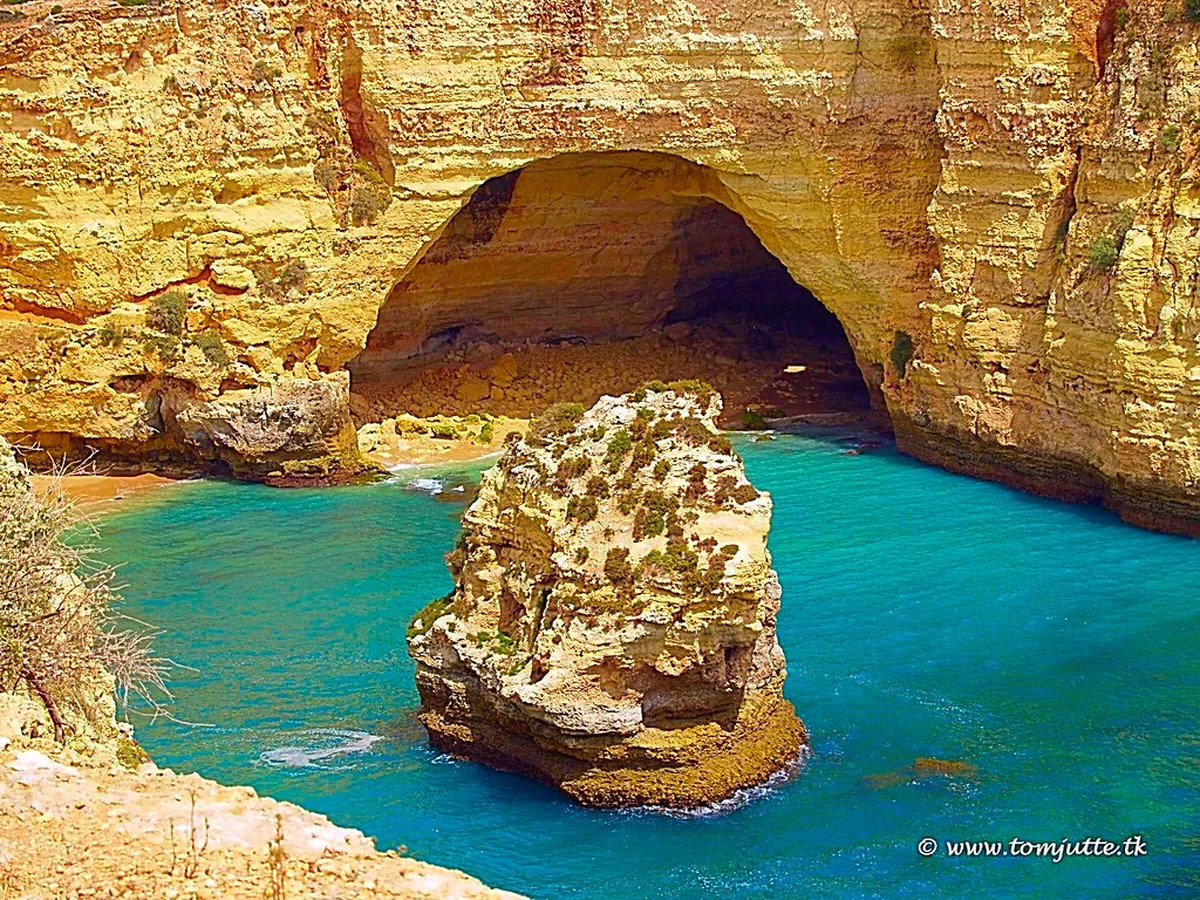
The coastline is famous for its orange limestone cliffs, sea arches, and small turquoise coves. Ponta da Piedade is the centrepiece — a labyrinth of sea stacks roughly two kilometres south of the marina. The cliff-top walk takes about thirty minutes from Praia da Batata, while a 45 to 75-minute grotto boat tour from the marina runs €20 to €30. For a deeper itinerary across the headland, the Ponta da Piedade boat tour guide breaks down operators by group size.
Grotto boat tours from the marina run €20 to €30 and take 45 to 75 minutes. Morning departures avoid the afternoon Atlantic wind and the busiest motorboat traffic around the sea stacks.
Praia do Camilo is the most photographed cove and also the most misunderstood. The descent is 200 wooden steps, returning is a real workout, and the sand strip below is far smaller than Instagram suggests. Always check the Tide Forecast Lagos the night before. At spring high tides, the small middle beach effectively disappears and the tunnel between the two coves floods. The honest tide rule of thumb for 2026: arrive within two hours either side of low tide, and aim to be on the steps before 09:00 in summer. By 11:00 the staircase becomes a queue.
At spring high tides, Camilo's small middle beach disappears and the tunnel between the two coves floods. Always check the tide forecast the night before and arrive within two hours either side of low tide.
Meia Praia is the antidote when the cove beaches feel cramped. Four kilometres of flat golden sand stretch east from the marina, with seafood shacks serving grilled sardines and clams (cataplana around €18 for two). For a full breakdown of every cove in walking distance, our guide to the Best Beaches in Lagos Portugal: Top 10 for 2026 covers access, parking, and shade.
Where to Stay in Lagos: Best Areas and Hotels
The right neighbourhood depends on whether you prioritise atmosphere or convenience. The full neighbourhood breakdown lives in Where to Stay in Lagos Portugal: 11 Best Areas, but four areas cover most travelers.
The Old Town inside the city walls is the right call for first-timers and anyone without a car. You wake up to bells from Igreja de Santo António and you can roll out of bed into a coffee at 08:00. Calçada cobbles are slippery in the rain and most guesthouses do not have lifts. Rooms in restored townhouses run €100 to €180 in shoulder season.
The Marina and Avenida is flatter and easier for travelers with luggage or limited mobility. The Lagos Avenida Hotel is the reference mid-range option here, with a rooftop view of the harbour at €150 to €250 per night. Meia Praia suits beach-first travelers who want sand at the doorstep and a fifteen-minute walk into town. Porto de Mós, twenty-five minutes south on foot or a €5 Bolt, is best for families wanting space, kitchens, and a quieter beach.
For the contrast to Lagos's party-town reputation, boutique adults-only properties such as Villas D. Dinis and Vivenda Miranda show how the area handles the calmer end of the market — pool decks set into the clifftops, no organised entertainment, two-night minimums in July and August. Book these by April for a summer stay; they sell out earlier than the chain hotels.
The Perfect 3-Day Lagos Itinerary
Three days is the sweet spot — enough to see the cliffs from land and sea, eat well twice, and take one day trip. The full hour-by-hour plan lives in our Lagos Portugal 3-day itinerary; the summary below is what most visitors actually do.
Day 1 — Old Town and sunset cliffs. Start at the Mercado Municipal for fruit and pastries (08:00–13:00, closed Sundays), then walk the city walls and the Slave Market Museum on Praça do Infante (€3 admission). After a long lunch, take the cliff path south from Praia da Batata, reaching the Ponta da Piedade lighthouse for sunset around 20:30 in May or 21:15 in July.
Day 2 — On the water. Book the 09:00 kayak or stand-up paddle tour from Praia da Batata (€35, two hours). Morning tours beat the motorboat wakes and the wind that builds after midday. Lunch at a beachfront grill on Meia Praia, then a slow afternoon at Praia Dona Ana once the late-morning crowd has cleared.
Day 3 — Day trip or beach day. Pick one. The classic is a Sagres From Lagos Day Trip Travel Guide to Cape St. Vincent — bring a windproof jacket even in August because the Atlantic gusts are no joke. The alternative is the Benagil cave kayak, which is genuinely better launched from Marinha or Benagil itself rather than the longer Lagos boat tour version.
Logistics: How to Get to Lagos Without a Car
The "do I need a car?" question has a clear answer in 2026: no, not if you base in the Old Town or Marina. Most visitors who rent a car spend the first day wishing they hadn't paid for parking. Full route options are in how to get to Lagos; the practical summary follows.
From Lisbon, the Rede Expressos bus is usually the best choice — direct, 3h45 to 4h15, €20 to €23 booked a week ahead, modern coaches with Wi-Fi, arriving five minutes' walk from the marina. The CP train via Tunes is more scenic but requires a transfer and runs €22 to €30 in Conforto class. Book through the Comboios de Portugal Official Site rather than third-party resellers — discounts of up to 65% are available eight days in advance under the "Promo" fare. From Faro Airport, the regional train runs hourly via Tunes (€8.50, 1h45), or a Bolt costs €70 to €85 direct in 75 minutes.
Inside Lagos, the town is small enough that you will rarely use anything but your feet. The local "A Onda" municipal bus circles between the Old Town, the marina, Meia Praia, and Porto de Mós for €1.50 per ride. Bolt and Uber both work, with Bolt typically €1 to €2 cheaper on short hops. Late-night returns from the bars on Rua 25 de Abril rarely cost more than €6 inside town. Avoid driving into the Old Town under any circumstances — the streets are barely car-width and several have remote-controlled bollards.
Who Lagos Is Not For — and What a Day Actually Costs
Most "is it worth it" guides oversell the destination. Lagos is a poor fit for three groups. Travelers with significant mobility limits will struggle: the Old Town is hilly, the iconic beaches require staircases, and many guesthouses occupy three-storey townhouses without lifts. Luxury shoppers will be disappointed — there is no premium retail strip; the closest thing is a small Hugo Boss outlet near the marina. Pure party travelers chasing cheap-shot bars and superclubs will have a better time in Albufeira's Strip; Lagos nightlife runs out at 02:00 and skews toward craft cocktails and live music.

The honest cost of a day in Lagos in 2026, broken down by tier:
- Budget — about €60 per day. Hostel dorm €20–25, supermarket breakfast €4, lunch at a tasca €10, A Onda bus €3, dinner with a beer at a side-street grill €18, ice cream €4.
- Mid-range — about €130 per day. Guesthouse double room €90 (split: €45 each), brunch €9, kayak tour €35, lunch on Meia Praia €18, dinner with wine €28, two cocktails €14.
- Comfort — about €240 per day. Boutique hotel €180 (split: €90 each), café breakfast €10, private boat tour €50, sit-down lunch €25, tasting menu dinner €55, museum or wine bar €10.
Three first-timer mistakes worth avoiding: arriving at Camilo Beach at 12:00 in July (the staircase is a queue and the sand is gone at high tide); booking a "Benagil cave tour from Lagos" when the boat spends two of the three hours in transit; and renting a car for a town you can cross in fifteen minutes on foot. The locals do not drive into the Old Town either.
Lagos Travel FAQ: Costs, Safety, and Timing
Timing matters more in Lagos than in larger cities. July and August are saturated — Old Town restaurants need reservations by 18:00, Camilo is a parking nightmare from 10:00 onward, and accommodation runs 60% above shoulder rates. The sweet spots in 2026 are mid-May to mid-June and mid-September to mid-October: water at 19–22°C, daytime highs of 22–27°C, and roughly half the crowd density of August. For a fuller seasonal picture, the complete Lagos Portugal guide includes a month-by-month crowd calendar.
Safety is a non-issue by European standards. Solo female travelers report Lagos as one of the easier Algarve bases, and the Old Town is well-lit until at least 02:00 on weekend nights. Standard pickpocket precautions apply at the Mercado, the marina, and on packed boat tours. The bigger risks are sun and surf — UV index reaches 9 to 10 from June through August, and the Atlantic shore-break at Meia Praia is stronger than it looks.
For ongoing planning across the cluster — beaches, day trips, food, evenings — the index is in Things To Do In Lagos Portugal: The Ultimate Travel Guide. If Lagos is one stop in a longer trip, slot it as days 5 to 8 of a typical Lisbon-Algarve loop and continue west to Sagres or back inland to the Alentejo.
Frequently Asked Questions
Is Lagos Portugal expensive to visit?
Lagos is moderately priced compared to other European beach destinations. You can find lunch specials for €12, while dinner with wine costs around €25. Accommodation prices vary greatly by season, with summer being significantly more expensive.
Do you need a car in Lagos Portugal?
You do not need a car if you stay in the town center or near the marina. Most beaches and attractions are reachable on foot or via affordable ride-share apps. A car is only necessary for exploring remote western beaches.
What is the best month to visit Lagos?
September is the best month to visit for warm water and fewer crowds. June is also excellent for long daylight hours and pleasant temperatures. Avoid August if you dislike heavy crowds and high accommodation prices.
Lagos is a rare destination that lives up to its glowing reputation without feeling like a tourist trap, provided you time the cliff beaches around the tides and skip the car. The combination of Atlantic limestone scenery, a walkable historic core, and direct transport from Lisbon makes it the strongest single-base choice on the Algarve for first-time visitors in 2026. Pack walking shoes, book Camilo for sunrise, and give it at least three nights.